For more than seventy years, Prince Philip stood beside Queen Elizabeth II as the model of royal duty. He was a decorated naval officer, a blunt-speaking consort, and a constant presence in British public life. Yet behind that carefully maintained image, questions about his private life never fully disappeared.
At the center of those questions was a French-born entertainer named Helene Cordet. She was a singer, a broadcaster, and a close friend of Prince Philip. But her two children, born out of wedlock, had fathers whose identities were never revealed. Philip served as godfather to both children and quietly supported the family, which fueled speculation that would last for decades.
Helene Cordet was born in France to Greek parents. She grew up in a Europe that was shifting and uncertain, much like Philip himself. Both carried the weight of displacement. Philip was a prince without a kingdom, exiled from Greece as an infant. Cordet was navigating a continent in turmoil while building a career in the performing arts.
Their paths crossed in the social circles of pre-war and wartime Europe, where exiled royals, artists, and aristocrats mixed easily. It was in that space between privilege and exile that their friendship took root. Some accounts suggest they first met as children in the 1930s, possibly in the French coastal town of Le Touquet, where their families, linked through aristocratic and expatriate networks, sometimes spent time together.

Philip’s early life was marked by instability. He was born in 1921 into the House of Glücksburg, a branch of the Danish royal family. His grandfather, King George I of Greece, had reigned for fifty years before being assassinated in 1913. His uncle, King Constantine I, was forced to abdicate during World War I due to his ties to Germany, then briefly returned to the throne.
In 1922, Greece’s military campaign in Asia Minor ended in disaster. Turkish forces drove the Greek army back, and the city of Smyrna was lost in fire and massacre. The monarchy took the blame. Prince Andrew, Philip’s father, was arrested and sentenced to exile. In December 1922, the family fled Greece aboard a British warship. Philip was just eighteen months old.
They settled in a suburb of Paris, in a home loaned by Princess Marie Bonaparte. But the family remained fragile. Prince Andrew had no work and drifted toward gambling. Princess Alice, Philip’s mother, began showing signs of severe mental illness and was later diagnosed with schizophrenia. She was committed to a sanatorium in Switzerland in 1930.
Philip was effectively left without a stable home. His four older sisters married into German aristocratic families, and he moved between relatives in Britain and Germany. He attended school in England, then spent time at a progressive school in Germany run by Kurt Hahn. When Hahn fled Nazi Germany, Philip followed him back to Britain and later enrolled at Gordonstoun, the school Hahn founded in Scotland.
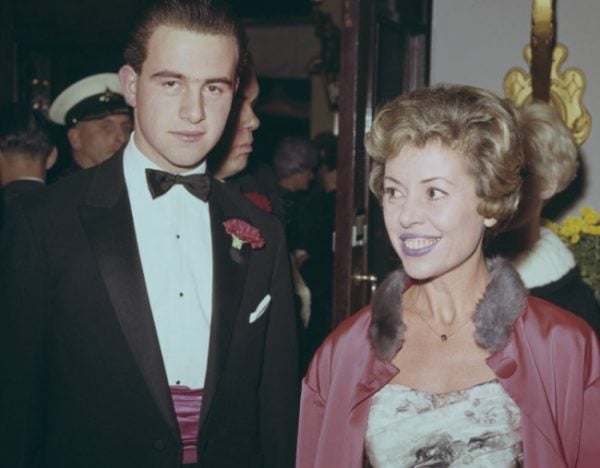
In 1939, Philip entered the Royal Naval College at Dartmouth. He excelled academically and physically, graduating at the top of his class in naval theory. When World War II broke out, he saw active service in the Mediterranean and the Pacific. He served aboard HMS Valiant and HMS Wallace, earning a reputation for leadership under fire and rising to first lieutenant by 1942.
Helene Cordet also moved to Britain as war spread across Europe. She fled the German occupation of France and settled in London. Fluent in both French and English, she became a broadcaster for the BBC’s French Service. Her voice became a symbol of resistance for occupied France, and she gained public admiration as a figure of Allied resilience.
As her career grew, Cordet reconnected with Philip, now a decorated naval officer. Their friendship deepened. They were often seen together at social events, and some reports suggest she occasionally acted as a hostess by his side. This was especially noted in the period before his courtship of Princess Elizabeth.
Philip first met Princess Elizabeth in 1939 during a royal visit to Dartmouth. She was thirteen years old and reportedly smitten with the confident cadet. Their correspondence began soon after, and by 1946, Philip had asked King George VI for her hand in marriage.

But during the same period, his friendship with Cordet continued. Then came the most controversial development. In the late 1940s and early 1950s, Cordet gave birth to two children out of wedlock. At the time, this was highly unconventional and socially risky. Philip did not distance himself. Instead, he supported her quietly and became godfather to both children.
The whispers began almost immediately. Tabloids speculated about a possible royal scandal. Neither Cordet nor Philip ever publicly addressed the rumors. Cordet later married a man who gave her children his surname, but she never revealed the identity of their biological father.
No definitive evidence has ever emerged to prove that Prince Philip fathered Helene Cordet’s children. But the questions never fully faded. Their friendship endured for decades, even as Philip became Prince Consort and Cordet moved to a quieter life. They remained in contact, publicly quiet but privately close.
The truth may have gone with them. But the bond between Prince Philip and Helene Cordet remains one of the most intriguing personal stories behind the royal curtain.