On the morning of November 10, 1944, a crowd gathered outside the Ehrenfeld train station in Cologne. A massive wooden gallows had been erected in the public square, and notices had been posted across the city announcing the executions to come. Thirteen German men and boys were led to the platform, their hands bound, their faces turned toward the crowd that had come to watch them die. Among them were six teenagers.
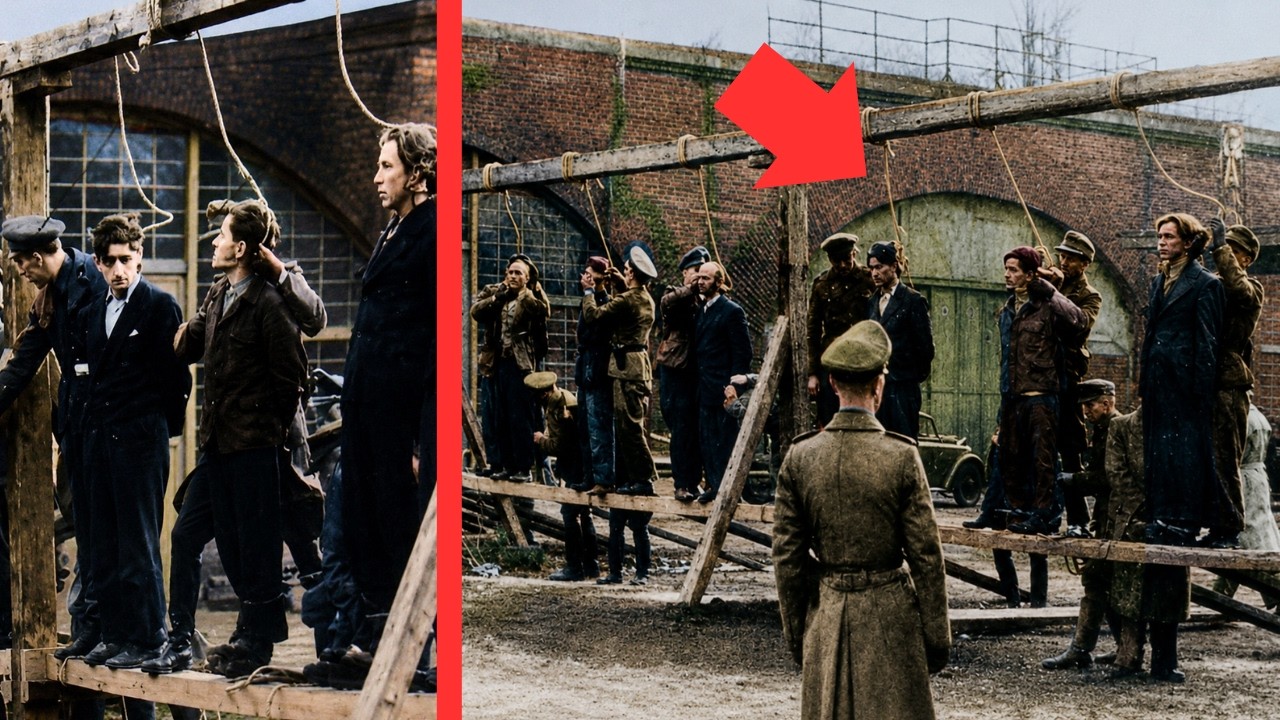
Günther Schwarz, Johann Müller, and Barthel Schink were all just sixteen years old. The executioners, dressed in German uniforms, placed the nooses around their necks. When the ropes were secured around all thirteen prisoners at once, the platform beneath their feet was dropped. They did not die quickly.
The hangings were performed by slow strangulation, and the condemned kicked and struggled for several minutes before their bodies finally went still. The audience watched in silence as the last breaths left the members of the Edelweiss Pirates, a youth resistance group that had dared to defy the Third Reich. The Edelweiss Pirates had emerged years earlier as a quiet rebellion against the Nazis’ control over German youth. The regime had built its future army through the Hitler Youth, forcing boys into military training from an early age.
They drilled with weapons, practiced throwing grenades, and learned the discipline that Hitler hoped would produce a generation of skilled soldiers. Girls were funneled into the League of German Girls. The Edelweiss Pirates rejected all of it. Named after the alpine flower that grew wild in the mountains, the group attracted boys and girls mostly between the ages of fourteen and eighteen.
They wanted the freedom to spend their time as they pleased, to listen to the music they liked, and to voice their own opinions. They refused the indoctrination imposed on them in Nazi schools, and some simply left school altogether. When the older boys received military conscription notices, they evaded the draft rather than report for service. The group’s resistance was not always peaceful.
Edelweiss Pirates gathered on street corners to provoke and harass Hitler Youth members in their uniforms. Large groups of Pirates sometimes attacked Hitler Youth patrols, and street battles broke out in German cities. One account described the situation bluntly: every child knew who the Edelweiss Pirates were. They were everywhere, more numerous than the Hitler Youth, and they never accepted no for an answer.
They organized camping trips into the hills and mountains, and away from Nazi supervision they listened to American jazz and sang anti-Nazi songs. One of their songs declared that Hitler’s power was making them small, that they were still in chains, but that they would one day break free. The Nazis dismissed the Pirates as a nuisance for years, an annoyance rather than a serious threat to the regime. That assessment changed as the war turned against Germany.
The assassination attempt on Hitler’s life on July 20, 1944, carried out by resistance members within the military, shook the Nazi leadership to its core. Suspicion fell on anyone who had ever spoken against the regime. Heinrich Himmler, the head of the SS, decided that the Edelweiss Pirates had become a problem that needed to be crushed. His first instinct was to send them to concentration camps, where they could be rehabilitated through harsh treatment.
He ordered that the young prisoners be beaten first, then subjected to the most strenuous training and forced labor. They would never be allowed to return to their studies, he declared, and he ordered an investigation into the support they had received from their parents. If their parents had encouraged them, they too would be sent to a concentration camp and their property confiscated. According to Himmler’s statement, the SS officers were to intervene with brutality to stop the spread of further opposition.
One branch of the Edelweiss Pirates in Cologne had gone far beyond singing songs and skipping school. The Ehrenfeld group, also known as the Steinbrück Pirates after their leader, counted about one hundred members. Their leader was Hans Steinbrück, a man who had escaped from a concentration camp after being imprisoned for resistance activity. Under his direction, the group became far more militant.
He began stockpiling weapons, ammunition, and other goods in a cellar. The Pirates sheltered persecuted people who were being collected for deportation and eventual execution within the city. They dealt in stolen goods and sold black-market merchandise. At one point they robbed a shop and seized a supply of butter, which they sold on the black market for twelve thousand Reichsmarks, an enormous sum at a time when the average worker earned about fifty Reichsmarks a week.
They continued stealing and reselling until they had grown wealthy. But their activities eventually attracted dangerous attention. Someone betrayed the group, and the Gestapo moved in. Steinbrück refused to surrender quietly.
Using the weapons they had stored, the Pirates attacked Nazi guards and SS men. They shot a guard and killed a member of the Nazi group, along with another civilian. The Cologne Pirates also ambushed a Hitler Youth member near a railway line and attempted to steal explosives for a major attack. The Gestapo rounded up the conspirators, arresting sixty-three people, nineteen of whom were teenagers.
Under interrogation, many were beaten and tortured as the Gestapo tried to extract names and intelligence. What they learned confirmed the seriousness of the threat: the group had been planning to bomb the Gestapo headquarters in Cologne, the very same building where they were being tortured. In the end, thirteen of the arrested men and boys were sentenced to death. On November 10, 1944, they were brought to the gallows that had been erected outside the Ehrenfeld train station.
The structure had been built to hold all thirteen at once, a display of Nazi power intended to terrify the city into compliance. The executioners lifted the condemned onto the wooden platform and wrapped the ropes around their necks. When the platform was dropped, the thirteen Pirates were left hanging, strangling slowly in front of the assembled crowd. The public nature of the execution was deliberate.
The Nazis wanted the ordinary citizens of Cologne to watch the fate of those who defied the regime and to understand that any challenge to Hitler would be met with the same terrible end. The Edelweiss Pirates had never enjoyed life under the Third Reich. They had resented the way the Nazis restricted their lives and forced them into state-controlled youth organizations. Their rebellion was born out of a simple desire for freedom, the freedom to think, to listen, to sing, and to live as they chose.
But their defiance collided with the full brutality of the Nazi state, and thirteen young men paid for it with their lives on a massive gallows outside a busy train station in Cologne. Their execution was meant to break the spirit of resistance, yet the memory of what happened that day endured long after the regime that ordered it had crumbled into history.