At 4:00 in the afternoon on March 26, 1945, Captain Abraham J. Baum stood beside his half-track in Aschaffenburg, Germany, and counted his vehicles again, though he already knew the numbers by heart. Fifty-seven Sherman tanks, six light tanks, twenty-seven armored half-tracks, three self-propelled guns, assault guns, a medical jeep, and 294 men, most of them exhausted. No one had told them the full truth about where they were going.
Baum was twenty-three years old. Before the war, he had cut fabric in the garment district of the Bronx. Now he was a captain in the 10th Armored Infantry Battalion of the 4th Armored Division, holder of the Silver Star and two Purple Hearts. He had been wounded four times during eleven months of fighting across France and Germany.
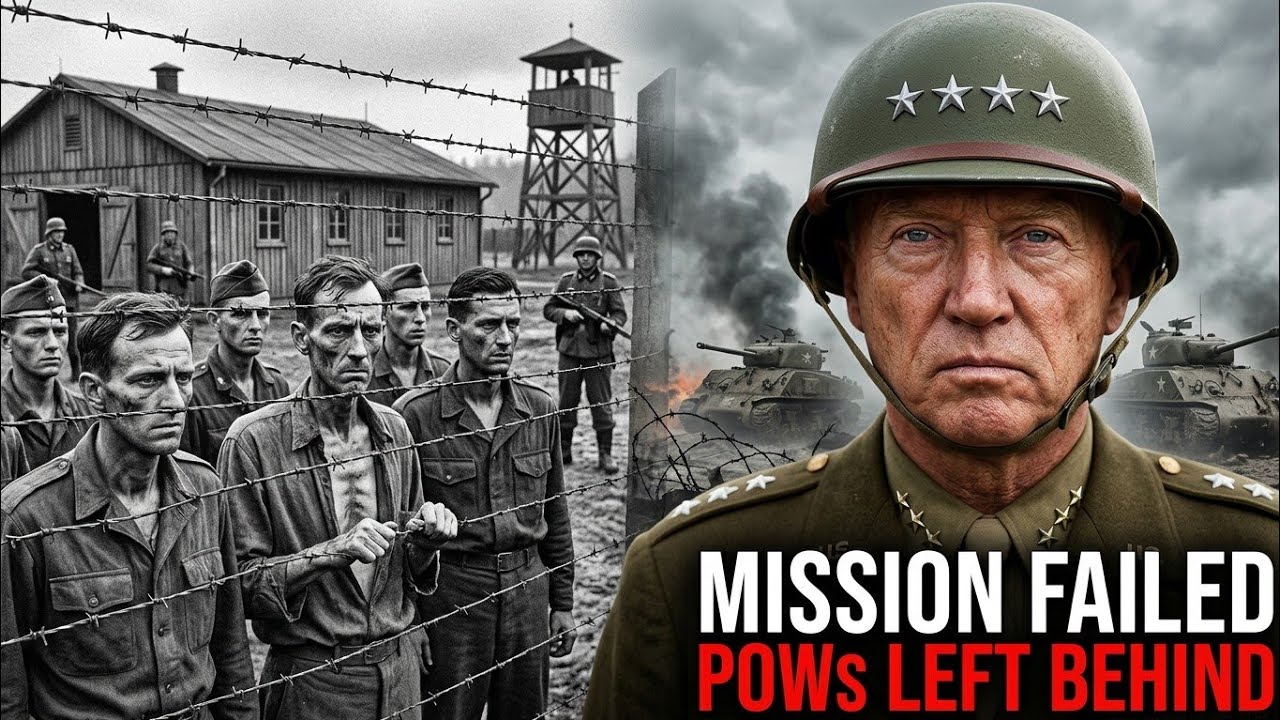
By his own later account, he was not the officer anyone would have chosen to lead the most controversial raid of the European campaign. He was simply the officer who happened to be there when the order came. The order had a name that meant nothing on paper: Task Force Baum. What it meant in practice was this: drive sixty miles behind German lines, alone, without support, deep into territory the Third Army had not yet secured, to reach a prisoner-of-war camp called Oflag 13-B outside the town of Hammelburg.
Inside that camp were more than 1,500 American officers, along with British, Serbian, and other Allied prisoners. Baum was told the mission was to free them. What Baum was not told, not fully, not that evening, was why this particular camp had been chosen out of all the POW camps in the collapsing Reich. He would learn later, along with the rest of the army, that Lieutenant Colonel John K.
Waters was among the prisoners at Hammelburg. Waters had been captured in Tunisia in February 1943 during the disaster at Kasserine Pass. He was also the son-in-law of General George S. Patton, who commanded the Third Army.
Days earlier, Patton had personally sent a smaller reconnaissance patrol toward Hammelburg to confirm what intelligence suggested: that Waters was there. Now, with the front lines shifting and German resistance in that sector reported as light, Patton ordered a larger striking force formed and sent in. He selected the 4th Armored Division for the task despite objections from his staff, who considered the distance reckless and the force far too small for the objective. Patton ignored their objections.
He wanted the camp secured before the Germans could move the prisoners east, deeper into the collapsing Reich, where liberation might never come. Baum received his orders directly from Brigadier General William Hoge, commander of Combat Command B. Hoge did not like the mission. He said so.
He argued against it up the chain of command and lost. Now he stood before Baum with a map and gave him a route that passed through towns no American unit had yet entered, across countryside still fortified by remnants of German units, anti-aircraft batteries, training depots, and whatever else the Wehrmacht had been able to gather in the final weeks of the war. Baum asked how many prisoners he was expected to bring back. He was told roughly 300, with senior American officers in the camp expected to be able to walk or ride on their own.
He looked at his own numbers again. 294 men to fight sixty miles in, secure a position, extract 300 prisoners, and fight sixty miles back through hostile territory without flank support and with no guarantee the road would remain open on the return. He did not ask again. At 7:00 p.
m. , in the last grey light of March, Task Force Baum crossed the line of departure and headed east into the darkness. The column moved through Lohr and Gemünden by midnight, meeting scattered small-arms fire and destroying a few German vehicles along the way. It was not resistance in any organized sense.
Not yet. The real German army in this sector had been drained by five years of war, reduced to training battalions, convalescent companies, and Volkssturm conscripts armed with whatever remained in the depots. But scattered resistance accumulated over sixty miles of hostile road cost time, and time was the one resource Task Force Baum did not have enough of. By 4:00 a.
m. on March 27, the column had reached the town of Gemünden, where German engineers had already blown the bridge over the Sinn River. Baum’s lead tanks probed the town under enemy fire and found the crossing destroyed. He was forced to detour north, adding miles and hours to a route that had none to spare.
Fuel was already a concern. Ammunition consumption was higher than planned, and dawn, with its end of darkness’s cover, was less than three hours away. At Burgsinner, the column collided with a German column moving the same road in the opposite direction. A supply convoy heading the other way.
In the engagement that followed, several vehicles were destroyed on both sides, and Task Force Baum lost precious minutes it could not recover. Baum pushed the survivors forward. There was no other direction to go. German units that had received warning were now reporting the location of the American column to their commands, and word reached leaders who understood exactly what an isolated armored force sixty miles behind their lines represented.
It was not a threat to be repelled so much as a target to be encircled. By mid-morning on March 27, Baum’s force had covered most of the distance to Hammelburg, but it had burned nearly a full day off a timetable that allowed no delays. His vehicle count had already dropped. Men were wounded.
The column had been spotted from the air by a German reconnaissance plane, which meant the element of surprise the mission depended on had vanished entirely. Baum kept going. There was no version of the plan that involved turning back. Around 7:00 p.
m. on March 27, twenty-four hours after crossing the line of departure, the lead elements of the force came within sight of the Hammelburg camp complex. The column had shrunk. Vehicles had been lost to mines, anti-tank fire, and mechanical breakdowns on roads never designed for that weight at that speed.
But the remaining tanks pushed on, and shortly after dark, they broke through the barbed wire. Inside Oflag 13-B, the senior American officer, Colonel Paul Goode, and the camp’s most prominent tank officer, Lieutenant Colonel John Waters, had been alerted that something was happening outside the wire. While attempting to make contact with the advancing force under a white flag to prevent a firefight that might endanger the prisoners, Waters was shot by a German guard and seriously wounded before he could complete the task. The wound to his hip left him in critical condition during the chaotic hours that followed.
He was, in the most literal sense, the man for whom the mission had been built, and he had been hit in the moments before his rescue. When Baum’s tanks entered the compound, they did not find the roughly 300 officers he had been told to expect. They found the camp’s full population. More than 1,500 American prisoners along with British and other Allied officers, most held for months or years, and most unfit for a rapid overland movement through hostile territory.
There were not enough vehicles in the force, not even a fifth of what was needed, to carry them all. There was not enough fuel. There was not enough time before dawn, and dawn was only hours away. Baum made the decision that history would judge from every side at once.
He told the assembled prisoners the truth. His force could not evacuate everyone. Only some could ride on the remaining tanks and armored vehicles. The others, those judged fit enough, could try to leave on foot on their own, using the confusion of the night, toward American lines many miles away, and at their own risk.
Many chose to stay rather than risk a long overland journey through territory still full of German units. Waters, gravely wounded, could not be moved without even greater risk to his life. He would remain in the camp in German hands, to be found and treated there in the days that followed. In the early hours of March 28, Task Force Baum turned west toward American lines, loaded with as many freed prisoners as could be carried, critically low on fuel, running out of ammunition, its vehicle strength reduced by more than half, heading into an area where German forces had spent the past twenty-four hours gathering every available unit to close the road behind them.
They could not come back out the same way they had gone in. The convoy that moved west before dawn on March 28 was not the same force that had left Aschaffenburg thirty-six hours earlier. Of the original fifty-seven vehicles, fewer than half remained operational. Fuel gauges on the surviving tanks and half-tracks pointed toward empty, with resupply impossible and no friendly lines close enough to help.
The force now carried freed prisoners on every available inch of armored plate, men who had spent months or years behind barbed wire, now exposed on vehicles in enemy territory, moving through darkness toward a front line that was in fact farther than the remaining fuel could reach. German forces in the region had spent most of the day organizing their response. This was no longer scattered rear-area units reacting to the passage of an unexpected convoy. Word of the raid on Hammelburg had reached German command quickly, and by the time Task Force Baum began its withdrawal, elements of the 1st SS Panzer Division, training and replacement units, local security forces, anti-aircraft batteries re-tasked for ground fire, and whatever armor could be assembled in the region had been alerted and positioned along the likely roads back to American lines.
The Germans knew the terrain better than Baum did. They knew the roads, the choke points, the standing bridges, and those already destroyed. They had the one advantage the raid had consumed from its first hour: time to prepare. As dawn broke on March 28 near the village of Hesdorf, the convoy ran into German armor and entrenched anti-tank positions on the high ground.
Baum’s remaining Shermans, reduced in number and with their main ammunition running low, engaged at close range. Several tanks were destroyed in the exchange. The column broke apart under the fire, vehicles scattering off the road in different directions as drivers made individual survival decisions without time to consult a plan that no longer existed in any coherent form. Some of the freed prisoners thrown from vehicles or ordered to disperse on foot vanished into the surrounding woods and fields, left to make their way toward American lines as best they could, alone or in small groups, unarmed, without maps, with only what they carried.
Baum himself was wounded again, his third wound of the war by some accounts, his second in this operation alone, when shell fragments tore into his leg as his half-track came under fire. He continued to direct what remained of the task force from where he lay, refusing evacuation until it became clear there was no place left to evacuate to. By mid-morning, surrounded on a hill near Hesdorf with his ammunition exhausted and his vehicles destroyed or disabled, Baum gave the order that ended Task Force Baum as an organized fighting force: every man for himself, and all who could move should try to reach American lines on foot in small groups using whatever cover the terrain offered. A German patrol found Baum, badly wounded, hiding in a haystack outside Hesdorf on March 29, and he was taken prisoner.
He spent the remaining weeks of the war as a POW, to be liberated in turn by advancing American forces before hostilities ended in May 1945. Of the 294 men who had crossed the line of departure on the evening of March 26, only about 35 made it back to American lines under their own power in the days immediately following. Nine men were killed in action. The rest were captured or scattered, and in a few cases simply absorbed into the general chaos of a front moving so fast in those final weeks that isolated groups of Americans wandering west simply walked into friendly lines days later, with no official record of how they had arrived.
Every vehicle in the task force, every tank, half-track, and gun that had crossed into German territory two days before, was lost, destroyed, or abandoned. At Hammelburg itself, German forces retook the camp that the task force had briefly stormed, hours after the raid failed. The prisoners who had chosen to stay rather than risk the overland movement, including the wounded Lieutenant Colonel John Waters, were still there when German control resumed. Waters, critical from his gunshot wound, was eventually moved with other prisoners when the camp was evacuated eastward in the final weeks of the campaign, part of the broader forced marches that swept POWs across collapsing Germany in the spring of 1945.
He survived. He was liberated for the second and final time in late April 1945 by advancing American forces, recovered from his wounds, and continued his military career, eventually reaching the rank of lieutenant general. News of the raid’s outcome reached Patton within days, and the reaction inside Third Army headquarters, according to accounts from every officer present, was immediate and grim. It was not a celebration but anxiety bordering on alarm.
Patton had ordered a mission using a task force roughly ten times smaller than what his staff officers believed the objective required, sent sixty miles into hostile territory without flank protection, and the result was the near-total destruction of a veteran armored unit in exchange for the return of only a small fraction of the prisoners it had been sent to free. Patton’s own diaries and his later comments to colleagues acknowledged the scale of the loss, though he continued to defend the decision in terms of the strategic and personal stakes he believed justified it: the risk that the prisoners, including his son-in-law, would be moved somewhere beyond rescue as German-held territory continued to shrink. Publicly, Patton downplayed his connection to Waters for a time, describing the raid in press briefings as a reconnaissance in force intended to disrupt German rear-area operations and free prisoners generally, rather than acknowledging that a specific personal relationship had shaped the choice of target and the urgency behind it. That account did not hold.
Journalists and eventually official army investigations established that Patton most likely knew Waters was at Hammelburg before he ordered the raid, and that the selection of that camp over other targets in the sector had not been accidental. Patton was never formally disciplined for the operation. General Omar Bradley, his immediate superior, was reportedly displeased with the decision and with the way Patton had described it afterward. But by the spring of 1945, with the war in Europe entering its final weeks and Patton’s operational record held in high regard at the highest levels of Allied command, the matter produced no formal consequences.
Instead, it became one of the most scrutinized and controversial command decisions of Patton’s career, raised by historians and biographers in the decades since as an example of how a commander’s personal stakes can shape a military decision in ways that cost the lives and freedom of men who had no part in that personal relationship. Captain Abraham Baum was awarded the Distinguished Service Cross for his leadership of the raid. The citation praised the execution of the operation rather than assessing its strategic wisdom, which was not a decision Baum had been given to make. After the war, Baum returned to civilian life in New York, worked for decades in the garment industry he had left in 1942, and rarely discussed the raid publicly until historians began seeking him out in the 1970s.
In later interviews, he was blunt about his view of the mission. He had carried out the orders he was given, he had not been told the full truth about why Hammelburg had been chosen over other targets, and he had been leading, by his later estimate, a force perhaps one-tenth the size the objective actually required. He did not describe the outcome as a victory. He described it as a mission that should never have been assigned to him in that manner.
Task Force Baum achieved no lasting American gain at Hammelburg. Within weeks, the camp and the surrounding region fell to the general Allied advance regardless of the raid. As the Third Army and other Allied forces swept through the area in the final offensive of the war across central Germany, the prisoners who could have been freed were liberated through that larger, slower, better-equipped advance in any case, within about a month of the raid, and without the losses in lives, equipment, and captured soldiers that Task Force Baum had suffered in its attempt to reach them earlier. What the raid left behind was not a battlefield result but a case study, taught, debated, and revisited in military and historical literature ever since, as an illustration of how command authority, personal loyalty, and strategic judgment can collide, even among experienced and highly capable officers.
It is remembered for what it cost more than for what it achieved, and for the question it left permanently open: whether a mission built on the fate of one individual can ever be fairly weighed against the lives of the men ordered to carry it out. John Waters recovered from his wound and went on to a long career that ended in senior command. Abraham Baum lived until 2013, dying at the age of 91, having spent seven decades as the man whose name history attached to a raid he did not plan and did not fully understand the purpose of at the time he was ordered to lead it.
The nine men who did not return from Task Force Baum are listed among American dead from the final weeks of the European war, names recorded in the army’s official casualty lists, but their deaths, unlike many others in that campaign, trace not to the broad currents of strategy but to a specific, individual decision, still debated, made in a command tent in late March 1945.