In May 1945, the German Empire lay in ruins. As Allied forces swept across the country, they encountered a strange phenomenon: senior German officers, dressed in immaculate uniforms, still expected to be treated like royalty.
One of these men was Field Marshal Erhard Milch. A titan of the Luftwaffe, he had helped build the German Air Force from the ground up. He carried himself with the supreme confidence of the Aryan elite, believing that even in defeat, his rank made him untouchable.
Milch walked into British lines carrying his ceremonial field marshal’s baton. The silver and gold symbol of his authority was meant to command respect. He expected a formal salute. He expected a seat at a mahogany table. He expected to negotiate as an equal.
Instead, he walked into a tent with Brigadier Derek Mills Roberts. Mills Roberts was not a career diplomat. He was a legendary British commando who had just spent the last 48 hours liberating the Bergen-Belsen concentration camp.
He had seen the pits. He had smelled the smoke. When the elegant field marshal offered his hand, Mills Roberts delivered a reality check that shattered the pride of the Third Reich.
Mills Roberts was the archetype of the British tough guy. He was a veteran of the Dieppe raid and the scorched-earth battles of Normandy. By May 1945, he was exhausted, grieving for his fallen men, and sickened by the atrocities his unit had just uncovered at the nearby camps.
To Mills Roberts, there were no honorable German officers left. There were only those who pulled the trigger and those who signed the orders.
Then Erhard Milch walked into his headquarters. Milch was a man who obsessed over status. Even as a prisoner, he demanded the respect due to his rank. He approached Mills Roberts with an air of sophisticated boredom, seeing not a conqueror but a mongrel soldier.
Milch extended his hand for a formal handshake. It was a gesture meant to signal that they were both gentlemen of war. Mills Roberts did not move. He looked at Milch’s hand as if it were covered in filth.
The silence stretched long enough for Milch’s face to turn from confidence to confusion. Offended by the lack of a salute, he began to lecture the British brigadier on military protocol. He spoke of his achievements, his rank, and his proximity to Hitler. He even complained about the rude treatment he had received from front-line troops.

Mills Roberts listened in cold, vibrating silence. He was thinking about the skeletal bodies he had just pulled from the barracks at Belsen. He was thinking about the industrial-scale murder that men like Milch had authorized while sipping champagne in Berlin.
Then the German field marshal made his final mistake. He gestured with his silver baton, the ultimate symbol of his status, and demanded that Mills Roberts show him the respect a field marshal deserved.
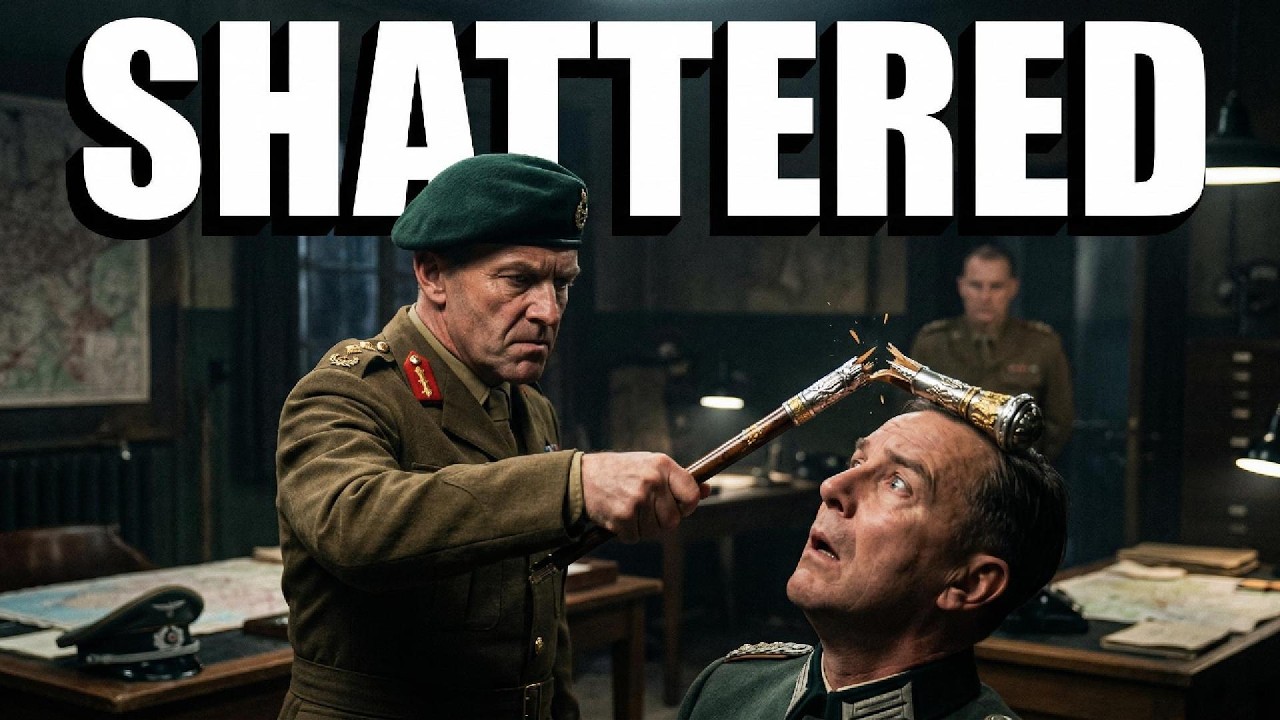
Mills Roberts did not salute. He did not argue. He stepped forward, snatched the priceless, jewel-encrusted baton out of Milch’s hand, and looked the representative of the master race in the eye.
In an explosion of pure, righteous fury, Mills Roberts swung the heavy silver rod and struck Milch across the head with his own symbol of authority. The impact was so hard that the baton, a masterpiece of German craftsmanship, literally snapped in half.
Milch collapsed to the floor. His monocle flew across the room. His pristine uniform was covered in dust.

Mills Roberts did not stop there. He berated the fallen officer, screaming about the horrors of the camps and the children who had died while Milch was playing great general.
The German officers in the room were paralyzed. They had been raised to believe that a field marshal’s person was sacred. To see one beaten with his own baton by a lower-status British officer was a psychological shock from which they would never recover.
It was the moment they realized the war was not a game of chess. It was a reckoning.
Milch was eventually dragged away, his face bruised and his precious baton in pieces. He would later be tried at Nuremberg and sentenced to life in prison for war crimes and crimes against humanity.
But the physical wound was nothing compared to the status crush. For the rest of his life, Milch would talk about the brutality of that encounter. He could not understand why the British did not respect his rank.
He never understood that his rank died the moment the first gas chamber was built.
Brigadier Mills Roberts was later asked about the incident. He did not apologize. He did not regret it. He simply said that after Belsen, he had no more room in his heart for military courtesy toward the men who built the Reich.
It remains one of the most satisfying reality checks in history: the moment a jewel-encrusted symbol of tyranny was used to break the jaw of the man who carried it.