Emma Coronel Aispuro walked into federal court in Brooklyn during her husband’s trial looking like a spectator watching someone else’s drama from a very expensive seat. Designers clothes, composed expressions, and cameras tracking her every appearance created a telenovela image. But the reality federal prosecutors later laid out in Washington, D. C.
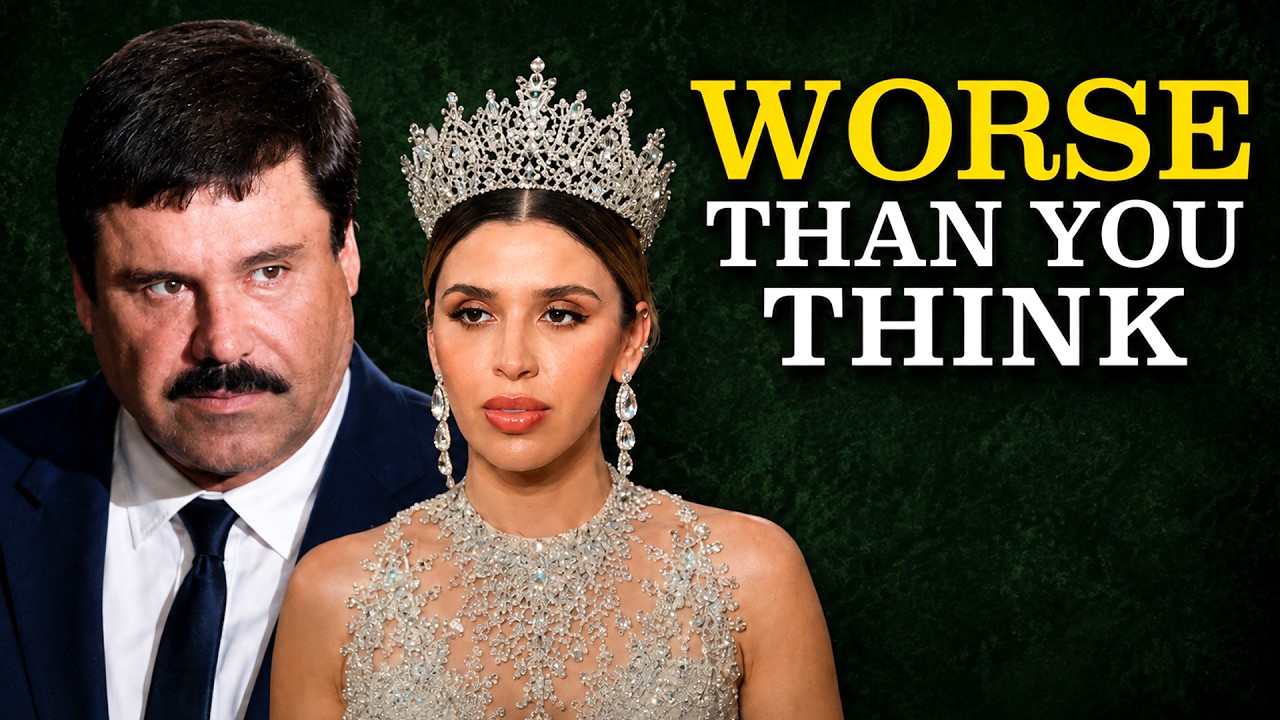
was far darker: her marriage to Joaquín “El Chapo” Guzmán was not simply a private relationship. It was an arrangement that placed her inside one of the world’s most powerful drug trafficking organizations and eventually made her a federal criminal defendant in her own right. The origin of the relationship reveals the power dynamic that shaped everything that followed. Emma Modesta Coronel Aispuro was born on July 2, 1989, near San Francisco, California, while her mother was visiting relatives in the United States.
That birth on American soil gave her U. S. citizenship, a fact that would become critically important decades later when federal prosecutors pursued her through the American court system. She did not grow up in California.
She grew up in La Angostura, a remote ranch community in Canelas, in the Mexican state of Durango, deep inside the region known as the Golden Triangle, where the states of Sinaloa, Durango, and Chihuahua converge. That geography is not incidental. The Golden Triangle is historically the most significant illicit crop production zone in Mexico and the birthplace of several of the most powerful trafficking networks in North American criminal history. Emma was not born into ordinary rural poverty.
Her father, Inés Coronel Barreras, was a cattle rancher with documented ties to the Sinaloa Cartel. Her uncle, Edgar Coronel Aispuro, also had alleged cartel connections. The family environment she grew up in was one where the boundaries between legitimate commerce and criminal organization were blurred. She participated in local beauty pageants as a teenager and briefly studied journalism at the University of Sinaloa before her life took a different direction.
The man Emma would eventually marry was, by 2006, one of the most wanted human beings on the planet. Guzmán had been building the Sinaloa Cartel into a global trafficking empire for decades. By the mid-2000s, Forbes magazine was listing him as one of the most powerful people in the world. He had escaped from a Mexican federal prison in 2001 inside a laundry cart, evaded recapture for years while continuing to run his organization, and was the subject of massive law enforcement attention from both Mexican and American authorities.
His network reportedly generated billions of dollars annually and had corrupted police forces, military units, politicians, and judges at every level of Mexican government. When El Chapo reportedly first encountered Emma Coronel at a ranch dance in Canelas, Durango, in 2006, she was approximately 17 years old. He was approximately 49. The gap of more than three decades represented an enormous asymmetry in life experience, power, and access to resources.
She was a teenager living in a remote rural community with family ties to his criminal world. He was a fugitive drug lord controlling a multinational trafficking organization with armed associates, corrupted officials, and vast wealth. According to accounts reported in the years that followed, El Chapo used his influence around the coffee and guava festival in Canelas to ensure Emma won the local beauty contest. Some accounts describe him deploying hundreds of armed cartel associates to the town during Three Kings’ Day in 2007 to ensure the event went the way he wanted.
The exact degree of that influence varies depending on the source, and this detail has been reported through journalism rather than established through direct court findings. On July 2, 2007, Emma’s 18th birthday, she and El Chapo were married. The symbolism of that date is almost impossible to miss. Whether deliberate or coincidental, her transition into the formal role of El Chapo’s wife coincided with the moment of her legal majority.
She had met a fugitive cartel boss as a teenager and became his wife the morning she turned 18. The marriage did not occur in a vacuum. It occurred inside a family network where criminal activity was a structural reality. El Chapo already had children and prior relationships, and his organization was a functioning criminal enterprise managing drug shipments, corruption payments, violence, and logistics.
For years, Emma’s public image was something quite different from the reality prosecutors later described. During El Chapo’s legal battles, she became internationally recognizable for her fashion sense, calm courtroom demeanor, and striking appearance. News organizations photographed her outside the courthouse. Fashion publications discussed her clothing.
Social media accounts tracked her outfits. But inside that federal courthouse in Brooklyn, witnesses described drug shipments moving cocaine by the ton, violence used to maintain discipline and territory, corruption payments to officials across multiple countries, and a criminal enterprise that had generated billions of dollars while flooding American cities with drugs. Federal prosecutors later presented Emma as someone who had participated in that enterprise in her own right. According to the government, she played a material role in maintaining communications and facilitating activities on behalf of the cartel.
Her status as El Chapo’s wife gave her access that ordinary intermediaries could not have had. When El Chapo was in Mexican custody, spousal visits created access, and access created communication opportunities that could be used to relay information about the organization. Prosecutors also presented Emma as having connections to Los Chapitos, the faction built around El Chapo’s sons, Joaquín Guzmán López and Ovidio Guzmán López, and to the broader criminal family network. She was alleged to have participated in narcotics distribution and money laundering activities.
Then came July 2015. El Chapo escaped from the Altiplano maximum security prison in Mexico through a tunnel that stretched more than a mile beneath the prison floor. Workers had spent months digging. The tunnel was equipped with lighting, ventilation, and a modified motorcycle on rails.
El Chapo apparently stepped into the shower area of his cell, dropped through a hole in the floor, and disappeared. Federal prosecutors later presented evidence that Emma was involved in elements of planning and financing the escape. Before July 2015, one might plausibly argue she was a wife living beside a criminal, not a partner in his crimes. That argument became much harder to sustain once prosecutors had evidence connecting her to the planning of an escape that required money, coordination, external logistics, and the involvement of people connected to the Sinaloa Cartel.
El Chapo was recaptured by Mexican authorities in January 2016, six months after the escape. His capture, complete with the famous meeting with actor Sean Penn and actress Kate del Castillo that had inadvertently helped lead authorities to his location, became its own global media event. El Chapo was extradited to the United States in January 2017. His trial in the Eastern District of New York began in November 2018 and ran for months, featuring testimony from former cartel associates and government operatives who described the workings of the Sinaloa Cartel in detail.
The government presented evidence of corruption reaching the highest levels of Mexican government, including, according to testimony, payments to former Mexican presidents. Witnesses described drug shipments measured in tons moving through submarines, aircraft, border tunnels, and commercial containers. Throughout the trial, Emma was a fixture in the courtroom galleries. The disconnect between the fashion coverage and the criminal evidence was striking.
In November 2018, one side of the story was beautiful clothes and composed expressions in the gallery. The other side was detailed testimony about cocaine shipments, murder orders, and systemic corruption that had damaged two countries for decades. Emma attended her husband’s trial as a symbol of personal loyalty, but federal investigators were building a separate case with her name on it. In July 2019, El Chapo was sentenced to life in federal prison plus 30 years, with no possibility of early release.
He was sent to the administrative maximum facility in Florence, Colorado, ADX Florence, which houses the most dangerous and high-profile federal prisoners in the United States under conditions of extraordinary restriction. His world became one of near total isolation. El Chapo’s conviction did not end the federal government’s interest in people around him. Investigations into cartel-connected figures continued, and Emma’s alleged role in communications, financial matters, and the 2015 escape had been part of the evidentiary record for years.
On February 22, 2021, Emma Coronel Aispuro was arrested at Dulles International Airport in Virginia. She was charged with conspiracy to distribute narcotics internationally, specifically heroin, cocaine, marijuana, and methamphetamine, money laundering, and conducting transactions with a foreign narcotics trafficker under the Foreign Narcotics Kingpin Designation Act. The woman who had attended her husband’s trial as a spouse was now a federal defendant with her own docket number. The charges carried the potential for a substantial prison term, and a conviction at trial on all charges could have resulted in a life sentence.
Emma chose to accept responsibility through a plea agreement. On June 10, 2021, she formally admitted in federal court to conspiring to distribute heroin, cocaine, marijuana, and methamphetamine internationally, to engaging in a money laundering conspiracy, and to conducting financial transactions with a designated foreign narcotics trafficker. On November 30, 2021, she was sentenced to three years in federal prison, 36 months. She was also ordered to forfeit approximately $1.
5 million in proceeds from her criminal conduct. Her husband received life plus 30 years. She received three years. She had pleaded guilty, admitted her role, and her cooperation was a factor in the government’s approach to her case.
Emma spent her time in federal custody at FMC Carswell, a federal medical center in Texas. In May 2023, she was transferred from the facility to community confinement in California, a halfway house arrangement that typically precedes full release. In September 2023, she was fully released from federal custody. She was placed on four years of supervised release, meaning she remained under the monitoring of the federal system but was living as a free person.
Emma did not disappear into quiet anonymity after her release. She did the opposite. Within the first year following her release, she launched a shapewear line called 347, a direct reference to her prison sentence. She participated in Milan Fashion Week in September 2024 as a model for LA-based designer April Black Diamond, walking the runway at Palazzo Serbelloni, the historic palazzo that had served as Napoleon’s Italian residence during his occupation of Milan.
A billboard ran in Times Square in New York City before the event. Designer April Black Diamond publicly explained her choice by saying that in a world where fashion often celebrates outer beauty, she was committed to showcasing a deeper, more powerful narrative. The result was an international news story. El Chapo’s wife was walking a runway in Napoleon’s palace.
She starred in her own documentary and announced involvement in the production of a narco series featuring Rafaela Amaya. She appeared at events and celebrations. Her 2024 birthday party at Hacienda El Patern in Carolina, Puerto Rico, where Tito El Bambino performed, was documented on social media. Her 2025 birthday was marked with images at sea, bikinis, and a jet ski.
Her 37th birthday on July 2, 2026, was more subdued. She shared congratulatory messages from family and friends, including a post from her sister Claudia, who shared a photo of Emma in a snowy landscape in a fur coat and sunglasses with the caption, “The distance separates their paths, but never their love. ”
Meanwhile, El Chapo remained in a cell at ADX Florence. The facility is the most restrictive federal prison in the United States, designed specifically to prevent any meaningful communication or connection with the outside.
According to reporting on El Chapo’s conditions, he has been largely cut off from meaningful communication with Emma and with the outside world generally. The organization he built has continued in fragmentary form under other leadership, particularly through Los Chapitos, his sons, but he has no realistic ability to direct any of it. Emma’s world, by contrast, is one of relative freedom, professional reinvention, and public attention. She can build a business, walk a runway in Milan, give interviews, and raise the twin daughters she shares with El Chapo, daughters whose identities and locations she has generally kept private.
The question that runs through this entire story is how much of her involvement in El Chapo’s criminal world was a deliberate choice, and how much was the product of circumstances she was embedded in before she was old enough to fully understand what they meant. She entered a relationship with El Chapo as a teenager. She became his wife on the morning of her 18th birthday. She spent her adult life inside a family network that was also a criminal organization.
But she also made choices. Federal prosecutors established that, and Emma herself confirmed it by pleading guilty. She admitted to drug trafficking conspiracy, money laundering, and conducting financial transactions with a designated narcotics trafficker. The loyalty that tied Emma to El Chapo’s world was not simple.
Loyalty inside a cartel family operates at multiple levels simultaneously. It is personal, institutional, and enforced in a world where demonstrating disloyalty can have severe consequences. The decision to cooperate with federal authorities represents not just a legal strategy, but a dramatic personal rupture with everything that had defined her identity for years. When Emma sat in a federal courtroom and pleaded guilty, she was not simply managing her legal exposure.
She was breaking with the world she had entered as a teenager. The Sinaloa Cartel’s operations did not collapse when El Chapo was imprisoned. Los Chapitos, his sons, built their own power within the organization and continued operations on a massive scale. Ovidio Guzmán López was eventually extradited to the United States in 2023.
Emma’s cooperation may have contributed to investigations that continued long after her sentencing, though the exact scope of what she provided remains largely outside the public record. What is clear is that the marriage between Emma Coronel Aispuro and Joaquín “El Chapo” Guzmán was never simply a private romantic arrangement. It was a relationship embedded in the center of a criminal empire that had shaped Mexican and American society in profound and damaging ways. The broader lesson in the story is one that applies beyond this specific case.
When a person’s marriage is also their membership in a criminal organization, the personal and the institutional become impossible to separate. A spouse can be a messenger. A family dinner can be an operational meeting. The same trust that makes a marriage work can make criminal communications possible.
And when law enforcement finally intervenes, the same family relationships that created access, trust, and operational utility become evidence. Emma’s cooperation with federal prosecutors was, in a sense, the final moment when the personal and the institutional were separated. She told the government what she knew. She received a dramatically shorter sentence than her husband, and she walked out of federal custody into a world that is rebuilding itself around an identity separate from his, even if it cannot yet fully escape the shadow of his name.
The question that defines the legacy of this marriage, how much of Emma Coronel’s life was built by her marriage to El Chapo, and how much of her life she has managed to build in the years since leaving that world, does not have a simple answer yet. She is still in her 30s. She is still under supervised release. Her story is still being written.
But the contrast with El Chapo’s story could not be more stark. His story ended in a cell in Colorado. Hers is still unfolding on runways and in documentary films and in the choices she makes every day about who she wants to become. The marriage did not end with a breakup.
It ended with two people living on completely different sides of freedom.