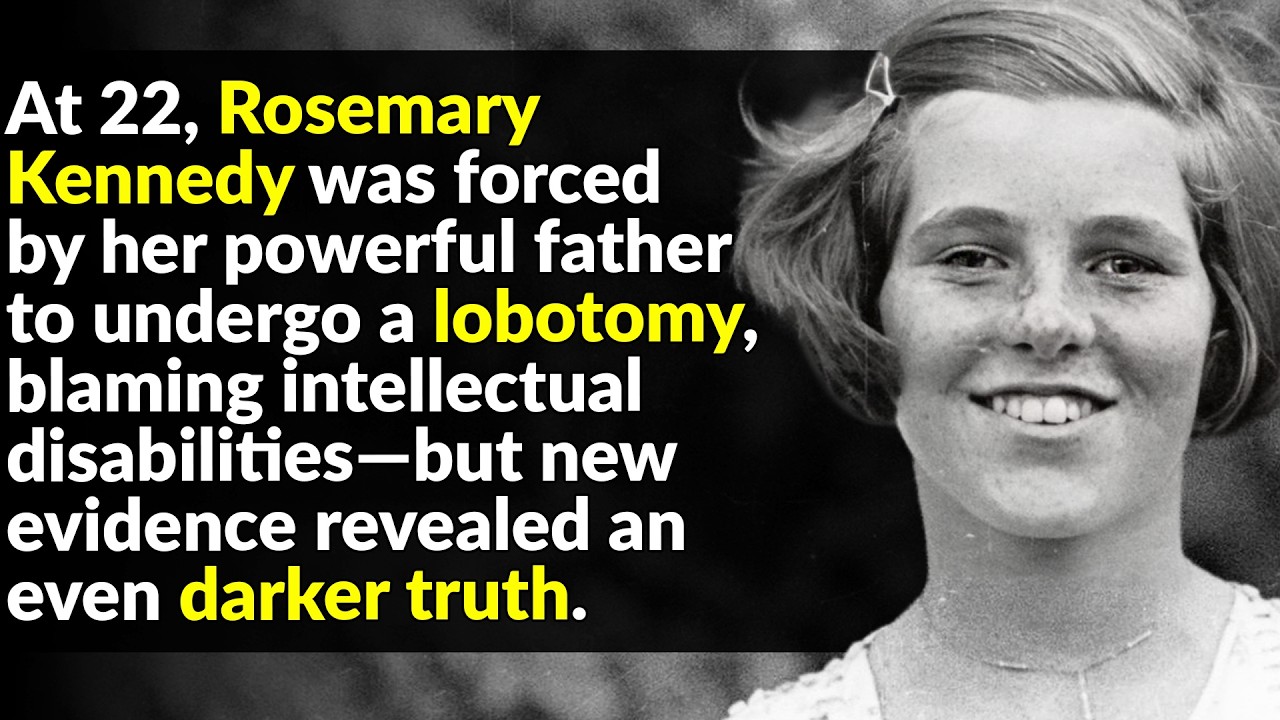
In November 1941, a 23-year-old woman was wheeled into an operating room where two doctors prepared to sever the neural connections in her frontal lobe. As they worked, they asked her to recite the Lord’s Prayer, sing “God Bless America,” and count backward. They cut until her words dissolved into nonsense. The woman was Rosemary Kennedy, eldest daughter of one of the most powerful families in America, and the surgery had been arranged by her own father.
Rosemary was born on September 13, 1918, into a nation gripped by the final months of World War I and the devastating Spanish flu pandemic. Her parents, Joseph and Rose Kennedy, were ambitious figures in the political and social worlds, and they eagerly awaited the birth of their first daughter. But on the evening Rose went into labor, no physician was available, as doctors were overwhelmed by the flu crisis. A frantic nurse ordered Rose to hold her legs closed until a doctor could arrive.
Rosemary’s head remained in the birth canal for more than two hours, deprived of oxygen. The newborn survived, but the Kennedys would never know the full cost of those lost minutes. The family that would later produce a president and two senators demanded near perfection from its children. Rosemary began missing developmental milestones early, struggling even to crawl by age two.
Rather than seek open help, her parents chose secrecy. Rose Kennedy confided in almost no one about her daughter’s difficulties and pretended all was normal. By the time Rosemary was a teenager, the differences were unmistakable. At family gatherings filled with sharp Kennedy banter, Rosemary remained quiet and confused, her personality far sweeter than her siblings’.
Her mother later described her as willing to try her best, appreciative of attention, and hopeful of deserving praise. But Rosemary also inherited the family’s striking good looks, and her older brothers, especially John, had to fend off young men drawn to the naive and beautiful girl. The Kennedys tried to mold Rosemary into a presentable debutante. Private tutors struggled to teach her to read and write.
At fifteen, she was sent to the Sacred Heart convent in Rhode Island, where the nuns educated her separately from other students, a measure that isolated her but also kept her difficulties hidden. When her parents arranged for John to escort Rosemary to a tea dance, they were overjoyed when guests remarked that she seemed no different at all, as long as her brother was guiding her. In 1938, Joseph Kennedy became American ambassador to the United Kingdom, and the family reached new heights of social influence. Rose and Joseph decided Rosemary would be presented as a debutante to King George VI and Queen Elizabeth.
The greatest challenge was the royal curtsy, a complex maneuver Rosemary practiced for hours. On the day of the presentation, she walked forward, attempted the curtsy, and nearly tripped over herself, barely avoiding a fall before the monarchs, who politely pretended not to notice. Rose Kennedy never acknowledged the near disaster and treated the debut as a triumph. The attention brought unwanted questions.
Society magazines wanted to profile Rosemary, but her parents feared an interview would expose her limitations. They controlled what the press heard, telling one publication she was studying to be a kindergarten teacher and another that she harbored a secret longing for the stage. When the Boston Globe requested an interview, Joseph Kennedy had his assistant write a response for Rosemary claiming she had studied the psychological method of Dr. Maria Montessori and earned a teaching degree the previous year.
Rosemary then painstakingly copied the words in her own handwriting. By 1940, Rosemary appeared to be thriving in the public eye, but privately something was wrong. According to her younger sister Eunice, Rosemary’s mental and emotional abilities seemed to regress almost overnight. She began experiencing seizures or convulsions that left her incapacitated and frightened her family.
Her personality shifted, and her family described vicious outbursts and rages over small matters, including physical attacks on relatives. The Kennedys sent her to a summer camp in Massachusetts, where she was expelled. A stint at a Philadelphia boarding school lasted only a few months. Finally, they sent her to another convent school, but Rosemary was now an adult who had tasted independence and refused to submit.
She began sneaking out at night, and the nuns believed she was meeting men in town, raising the terrifying possibility of a scandalous pregnancy. Joseph Kennedy was convinced his eldest daughter would embarrass him and damage the brilliant political futures of his sons. When he learned of a procedure called a lobotomy, meant to calm agitated patients by cutting the neural connectors in the frontal lobe, he considered it the perfect solution. In November 1941, without telling his wife until after it was done, Joseph had Rosemary brought to the operating room.
The surgery left her barely able to speak intelligibly. Her mental capacity plummeted to that of a toddler. She lost the ability to walk and to use the bathroom independently. Rosemary was sent first to an institution in New York State, then to the St.
Coletta School for Exceptional Children in Wisconsin, where the Kennedys built her a private residence known as the Kennedy Cottage. Joseph kept the lobotomy, her condition, and her location secret even from her other children. The family line was that Rosemary was a recluse. Two nuns cared for her basic needs.
Her pleasures were small: a drive in a car, a walk with a dog, or pottery under supervision. There are scant records of her parents visiting with any regularity. Rose Kennedy did not visit her daughter for more than twenty years. In 1961, Joseph Kennedy watched his son John become president of the United States.
Feeling it was finally safe, the patriarch acknowledged publicly that Rosemary had been institutionalized, but he concealed the lobotomy, which would not come to light until 1987. That same year, Joseph suffered a massive stroke that left him mentally diminished and struggling to walk, much like the daughter he had destroyed. Only then did he tell his other children where their eldest sister was living. Joseph Kennedy died in 1969, having lived through his son’s assassination.
After his death, the surviving Kennedy children finally began visiting Rosemary. They found a woman who had fought to recover. Over the decades, she had worked to walk again, though she still limped. Her speech never fully returned and her arm remained paralyzed, but she found other ways to communicate.
The secrecy surrounding Rosemary’s life has left experts struggling to understand the true nature of her condition. Some believe she was never intellectually disabled at all, but suffered from mental illness, possibly depression. One of the surgeons who performed the lobotomy, Dr. James Watts, later said he did not believe she had a mental disability.
Rosemary’s own diaries, written before the surgery, describe a relatively normal life full of social events. Just a year before the procedure, she wrote to her father, “Darling Daddy, I am so fond of you and I love you so much. ” Those words offer no evidence of violence or instability. There is one lasting legacy tied to her suffering.
In the 1960s, her sister Eunice Kennedy Shriver founded the Special Olympics, inspired in part by people like Rosemary, whom she wanted to see more involved in sports. Rosemary outlived many of her more celebrated siblings, including Joseph Jr. , John, Kathleen, and Robert, all of whom died violently.
She lived quietly in Wisconsin until January 7, 2005, when she died of natural causes at the age of eighty-six, surrounded by her surviving brothers and sisters.