Kathleen Kennedy married in a London register office on the morning of May 6, 1944, six years after she first met the man beside her. Of her entire family, only one person attended, her brother Joe, the eldest of the nine Kennedy children. Her mother was four hundred miles away in America. Her father had not come.
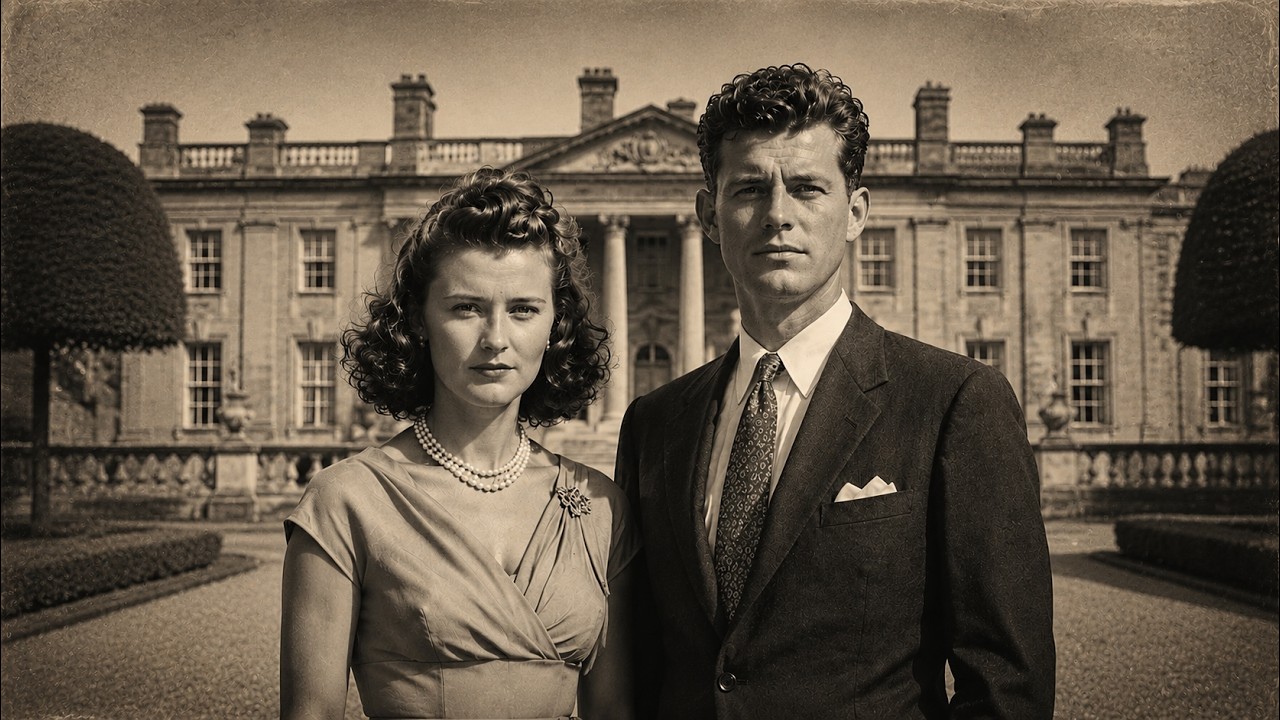
Her brother Jack sent his love from the Pacific, where he was recovering from the destruction of his patrol boat. She wore a pale pink dress and carried pink camellias brought from Chatsworth that morning, the first gesture from the Cavendish family that she belonged to them now. Four months and three days later, her husband was dead. Four years after that, so was she.
She was buried in a small churchyard in the English countryside, in the village of Edensor on the estate of Chatsworth in Derbyshire. The stone reads: Kathleen, 1920 to 1948, widow of Major the Marquis of Hartington, killed in action, and daughter of the Honorable Joseph Kennedy, sometime ambassador of the United States to Great Britain. Beneath her name are four words: Joy she gave, joy she has found. Only one member of her famous family stood by that grave.
Her father came. Her mother did not. Jack, the brother she had called her other self, did not. Nobody else came.
She was twenty-eight years old, buried not as a Kennedy but as a Cavendish, in the family plot of the English aristocracy she had chosen over everything she had been raised to be. The story begins in the last bright summer before the war. She arrived in London in the spring of 1938 as an eighteen-year-old, the daughter of the new American ambassador to Great Britain. The city fell in love with her.
She was not the great beauty of her generation, but she had something rarer, an absolute delight in being alive. The English press called her the American princess. She made her formal debut in May 1938 and was named debutante of the year. At a garden party at Buckingham Palace in July, she met a young English lord named William Cavendish, twenty years old, heir to the Duke of Devonshire, quiet and thoughtful and impeccably English.
They talked until the party ended. By the time September came and Germany invaded Poland, Britain declared war and Joseph Kennedy sent his family home. Kick was nineteen. She begged to stay.
Her father said no. She spent the next four years in America, attending the Finch School, volunteering with the Red Cross, working as a research assistant at the Washington Times Herald. She kept up with the war with the obsessive attention of someone who has people in it. But home was not a quiet place.
Rose Kennedy ran the household with precision. Sunday mass was not optional. The faith was architecture, the structure everything else was built on. What was expected of a Kennedy daughter was straightforward: you married within the faith, you did not marry a Protestant, you certainly did not marry the heir to one of the most ardently anti-Catholic aristocratic families in England.
Kick had always known this. She had also already quietly turned away from it. In July 1943, she wrote to Jack that she had found a way back. The American Red Cross was sending volunteers to London, and she had signed up.
She told Jack she had spent a day and a half in the country with Billy. For twenty-four hours, she wrote, I forgot all about the war. Billy is just the same, she added, a bit older, a bit more ducal, but we get on as well as ever. He proposed within the year.
The problem was the children. Billy was the heir to a dukedom built on the Protestant settlement. If his children were raised Catholic, they could not inherit the title. Five hundred years of it, Chatsworth and everything it represented, would pass to someone else.
Kick went to priests and sat with the question for months. She wrote to Joe, the eldest, who told her the truth, that she should follow her heart, that if Billy was the man she loved, the rest could be worked through. He was the only Kennedy who said that. Her father’s response was practical: he would not tell her what to do, but whatever she decided, the consequences would be hers to carry.
She never asked her mother. Rose told her that what she was contemplating was a mortal sin and that this was the darkest day she had ever known. She did not come to the wedding. Billy reported for duty on June 13, 1944, seven days after D-Day, as his battalion prepared to push into France.
Kick went back to work at the Red Cross and wrote to him every day. In early September, his battalion crossed the River Somme and pushed into Belgium. People came out to meet them, decorated the tanks with flowers, wept and cheered. Billy wrote to Kick from the middle of it.
I feel so unworthy of it all, he wrote, living as I have in reasonable safety and comfort during these years. And then: I have a permanent lump in my throat and long for you to be here. The letter was written sometime in early September 1944. He was dead within the week.
On September 9, he was shot and killed by a German sniper near the town of Heppen, Belgium. He was twenty-six years old. They had been married four months and three days. Kick wrote to a friend: Life is so cruel.
Writing is impossible. Then she stopped. Every Kennedy instinct said come home. Kick stayed.
Billy’s mother, the Duchess of Devonshire, wrote to her that she must never forget that marrying Billy had given him complete happiness. Thirty-three days after Billy was killed, the telegram came again. Joe was dead, killed on August 12 when his experimental aircraft exploded over the English Channel. The family had known for three weeks and had protected her.
She had lost her husband and her brother within a month. She sat with the Cavendish family for Christmas. In early 1945, she wrote to a friend: One thing you can be sure of. Life holds no fears for someone who has faced love, marriage, and death before the age of 25.
The war ended in the spring of 1945. Her mother asked her to come home. Her father suggested it would be wise. Jack was thinking about politics, and there was a place for her in the family’s plans if she wanted it.
She did not. England was her home. The Cavendish family had taken her in without conditions, and she had earned her place in that world. She chaired charitable committees and attended dinners and weekends in the country.
The Times of London would later write that no American, man or woman, who has ever settled in England was so much loved as she, and no American ever loved England more. But she had not settled. She had chosen. At a charity ball in 1946, she met Peter FitzWilliam, the eighth Earl FitzWilliam, thirty-five years old, extraordinarily charming, and still married.
His marriage was a wreck, and he was quietly pursuing a divorce, but no one could say when it would come through or what the church would make of it. Kick, who had already paid the full price of loving someone her family disapproved of, was not inclined to let complications stop her. By early 1948, she had made up her mind. She would marry him.
She wanted first to tell her father, not to ask permission, but to have his blessing. Joe Kennedy was in Paris that spring. She booked the flight. On May 13, 1948, Kick and Peter boarded a De Havilland Dove at Croydon Airport outside London.
The weather reports were not good. Peter told the pilot to fly anyway. The plane climbed to ten thousand feet and turned south toward France. An hour into the flight, it entered a storm over the region of Vienne.
For twenty minutes, the small plane was hurled through severe turbulence. When it broke through the clouds, it was in a steep dive. The pilot pulled back, and the stress exceeded what the aircraft could bear. A wing came loose, then both engines, then the tail.
The fuselage struck the ground nose first in a ravine on the Plateau de Langogne near the village of Sampzon in the Ardèche. All four were killed instantly. Kathleen Kennedy was twenty-eight years old. She had been on her way to ask her father’s blessing one more time.
She never got to ask. The family suppressed the circumstances, not the crash, which was in the papers within a day, but the relationship, the fact that she had been traveling with a man who was married and in the process of divorcing, a scandal the Kennedy family in 1948, with Jack’s political career just beginning, could not afford. Joe Senior flew to France and identified his daughter’s body. The Cavendish family organized the funeral.
They gave her a full Catholic ceremony and buried her in the churchyard at Edensor, in the earth of the country she had chosen. They did for her in death what her own family had been unable to do in life: they claimed her without conditions. Rose Kennedy did not come. She stayed in America.
Jack Kennedy, who had wanted to come to the wedding and could not, who had not come to the funeral, carried the loss privately. The family did not speak about her. She became a footnote, the sister who had gone to England and married the wrong man and died young. But the people who had known her did not forget.
For fifteen years, no one from her family came to the grave. On the afternoon of July 29, 1963, a helicopter broke the quiet over Edensor, and a single figure stepped out. John F. Kennedy, president of the United States, had broken from his official itinerary to fly to a small estate village in the English countryside.
He walked through the churchyard gate to the Cavendish family plot, knelt at his sister’s grave, placed flowers on the stone, and read the inscription. The visit lasted less than an hour. He wrote to the Duchess of Devonshire a few weeks later, saying that the arrangements at Edensor were beautiful, calling the inscription so appropriate and moving, and adding, I hope the next time we come, we can make a longer visit. He was assassinated in Dallas on November 22, 1963, one hundred and sixteen days after he knelt at his sister’s grave.
There was no next time. The churchyard at Edensor is quiet now. There are two markers at Kick’s grave. The first is the headstone with the four words that say everything and nothing.
The second is a small plaque set into the ground, placed in memory of John F. Kennedy, who visited this grave on 29th June, 1963. Billy is not there. He is buried in Belgium, in the ground where he fell.
They were married four months and three days, and they have been separated in death for more than seventy years. The grass grows over the stone, and the light changes through the afternoon. And somewhere beyond all the things this life required of her, the faith she gave up, the family she defied, the years of waiting and loss and beginning again, there is still the girl who walked into a Buckingham Palace garden party in the summer of 1938 and refused to be intimidated by any of it, who loved England so completely that she stayed, who gave everything she had and found in the giving something that cannot be taken back.
Joy she gave.