For decades, the story of World War II air superiority has been dominated by two names. The graceful, high-altitude elegance of the Supermarine Spitfire and the nimble, mass-produced lethality of the Messerschmitt Bf 109. These were the champions, the fighters that seemingly wrote the rules of aerial combat.
But here is the truth that history often neglects. For the Allied pilots operating over the English Channel in late 1941, the most terrifying sight in the sky was neither of those icons. It was a bulky, short, and seemingly crude machine powered by a massive air-cooled radial engine. A design that European engineers had dismissed as obsolete and inefficient for modern dogfighting.
This aircraft, the Focke-Wulf Fw 190, was a technological and philosophical paradox. It was heavy. It was muscular. It lacked the smooth lines of its contemporaries. And yet, when it arrived, it didn't just meet the standards of air combat. It shattered them completely, forcing the Allies into a desperate, existential scramble for survival.
How could a fighter designed in direct defiance of the accepted wisdom of the age become the dreaded Butcher Bird? Because its chief designer, Kurt Tank, wasn't interested in building an elegant airplane. He was interested in building a brutal, durable, and easily maintained machine. A true soldier's aircraft that prioritized survival and raw firepower over fragile, high-speed performance.
This is the story of how one man's vision broke every rule of air combat, and why that stubbornness forged the most feared fighter of the Second World War. We are about to uncover the simple radical truths that lay hidden beneath the terrifying power of the Fw 190.
To understand the Focke-Wulf Fw 190, we must first understand the looming crisis it was designed to solve. By the late 1930s, the German Luftwaffe had become dangerously dependent on a single machine, the Messerschmitt Bf 109. It was a superb revolutionary fighter, achieving initial dominance during the Blitzkrieg and the early stages of the Battle of Britain, but its limitations were rapidly becoming apparent.
The Bf 109 was a purebred racer adapted for combat. Its narrow undercarriage made ground handling treacherous for inexperienced pilots. Its compact airframe, dictated by the inline liquid-cooled Daimler-Benz DB 601 engine, limited its fuel capacity, resulting in famously short combat endurance. A critical flaw over the English Channel.
Crucially, the airframe was already stretched to its design limits. Every attempt to add armor, more fuel, or heavier cannons resulted in a diminishing return on performance. The Luftwaffe knew they needed a second string, a robust, powerful machine to complement the 109, a fighter capable of sustained, grueling combat.
In 1937, the Reich Air Ministry issued a request for a new fighter. They expected a derivative, another sleek, liquid-cooled, high-altitude interceptor. But Kurt Tank, the lead designer at Focke-Wulf, had a different, far more radical vision.
Tank's design choice immediately flew in the face of contemporary European aviation dogma. Instead of a liquid-cooled inline engine, he opted for the colossal air-cooled BMW 801 radial engine. This was the first great paradox. In Britain and Germany, the conventional wisdom dictated that a modern fighter needed the slim, low-drag profile of an inline engine to achieve high speeds. Radial engines, by contrast, were seen as bulky, drag-inducing powerplants best suited for slower bombers or transport aircraft.
But Tank saw the deep practical advantages. Firstly, reliability and durability. The radial engine, with its numerous cylinders arranged in a circle, offered redundancy. If a liquid-cooled engine took a single hit to its coolant system, the engine quickly seized, forcing the pilot to bail out or glide home. A radial engine, being air-cooled, could often sustain significant damage and keep running long enough to bring the pilot back to base. This was Tank's core philosophy. Prioritize the survival of the man and the machine.
Secondly, simplified logistics. The engine was far less complex to manufacture and maintain in field conditions. It eliminated the entire cumbersome system of radiators, coolant pumps, and vulnerable plumbing. A radial engine could be swapped out in the field in a fraction of the time needed for a DB 601, a monumental advantage for units operating from hastily prepared airfields.
The RLM initially scoffed at the bulky prototype. They demanded that Tank abandon the radial, but Tank, backed by the unwavering statistics of durability and the engine's raw power, stood his ground. The BMW 801 delivered a blistering 1,560 horsepower in its initial versions, significantly outpowering early Spitfires.
Tank's primary challenge became transforming that massive radial engine into an aerodynamically sleek package. The solution he devised was a masterstroke of engineering. So innovative that it effectively erased the radial engine's drag penalty. He housed the engine inside an extremely tight cowl and developed a sophisticated propeller spinner system that integrated the cooling fan directly into the nose. This fan, driven by a clutch system, acted as a miniature turbine, forcefully drawing air through the engine and then efficiently channeling it back over the fuselage.
The result was twofold. Excellent cooling and a dramatically reduced drag profile. The Fw 190 was physically short, giving it a stubby, potent look, earning it the early nickname Dora and eventually the more fearsome moniker, the Butcher Bird.
Tank's revolutionary thinking extended into the cockpit and the machine's overall structure. He famously declared that the primary asset of an air force was its pilots and their comfort and safety must be paramount. Unlike the cramped, minimal cockpit of the Bf 109, the Fw 190 featured a spacious, ergonomically designed cockpit with excellent visibility. Crucially, a wide-opening canopy that was easy to exit in an emergency.
The controls were also far more advanced. The Fw 190 was one of the first production aircraft to utilize electrically powered controls and trim tabs, replacing the confusing array of manual levers and cables found in older fighters. This reduced pilot workload dramatically, particularly during the high-g stress of combat, allowing the pilot to focus solely on the enemy.
Finally, the landing gear was designed wide and robust, a direct solution to the Bf 109's deadly narrow stance. Pilots could land the Fw 190 with confidence, a simple feature that spoke volumes about Tank's commitment to the operational fighter pilot, the man at the heart of the machine.
By 1941, the Fw 190, designated the Fw 190A-1, was ready. It was not built for theoretical altitude records or dazzling maneuvers. It was built to absorb punishment, endure long patrols, and deliver a devastating payload. It was built with the heavy hand of German industrial might. And it was about to unleash a shockwave that would halt Allied air superiority dead in its tracks.
The Focke-Wulf Fw 190 was introduced quietly in the summer of 1941. Initially deployed to Jagdgeschwader 26, JG 26, operating over the English Channel. Allied intelligence, lulled into a false sense of security by the continued dominance of the Bf 109, completely missed the significance of this new stumpy aircraft. They believed it was just another bomber escort or an experimental variant. This strategic arrogance would cost them dearly.
The true shock came during the massive German naval operation, the Channel Dash, Operation Cerberus, in February 1942. The Fw 190s of JG 26 provided top cover for the battleships Scharnhorst and Gneisenau. The British forces, launching waves of Fairey Swordfish torpedo bombers and escorting Spitfire Mk V fighters, expected a typical engagement against the Bf 109. What they encountered was a buzzsaw.
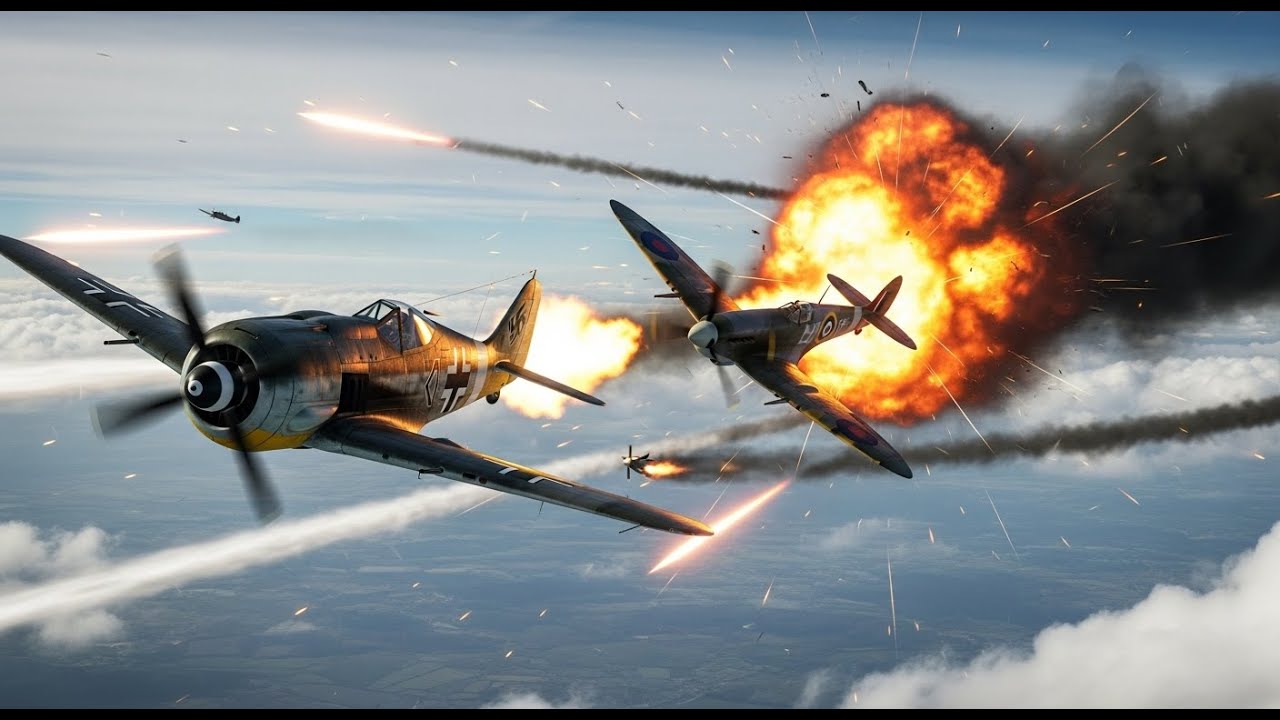
The Spitfire Mk V, the pride of the RAF, was instantly, tragically outclassed. At altitudes below 20,000 feet, where most of the fighting over the Channel took place, the Fw 190 A-1 and A-2 variants possessed devastating advantages.
The dogfight between the Fw 190 and the Spitfire Mk V was a clash of two diametrically opposed philosophies. The Spitfire's high-g turning ability versus the Fw 190s raw speed and violent acceleration.
The Fw 190 was faster in level flight and critically possessed a far superior rate of acceleration and rate of dive. A Spitfire pilot might try to turn inside the German, but if the Fw 190 pilot initiated a dive to escape, the Spitfire simply could not keep up. The rule became grimly simple. Dive and survive was the Fw 190's mantra. Attempting to follow meant instant death for the Spitfire pilot.
The difference in armament was a game-changer. The Spitfire Mk V typically carried four .303 machine guns and two 20mm Hispano cannons. The Fw 190 A-3 carried two synchronized 7.92mm machine guns above the engine, two 20mm MG 151 cannons in the wing roots, and two 20mm MG-FF cannons in the outer wings. This meant the Fw 190 delivered a truly shattering burst weight. A single second of fire was often enough to reduce an Allied fighter to flaming debris. Pilots didn't need to dogfight for minutes. They needed one clean burst.
As Kurt Tank intended, the air-cooled BMW 801 was a beast. Pilots recounted taking dozens of rounds into the engine cowl only for the radial to cough, sputter, and then roar back to life, carrying them home. For the liquid-cooled Spitfire, a single bullet to the cooling system was often a fatal strike.
The impact was immediate and devastating. The Royal Air Force's Fighter Command was thrown into turmoil, suffering unsustainable losses. Pilots described the Fw 190 as invincible and coming out of the sun like a screaming locomotive. For a horrifying nine months, until the introduction of the superior Spitfire Mk IX, the Fw 190 maintained almost total local air superiority over the Western Front, a period the Allies grimly referred to as the Focke-Wulf Terror.
Here is where the story shifts from technical triumph to strategic tragedy. The Fw 190 was arguably the best pure air superiority fighter in the world in 1942 and 1943. However, as the war dragged on, the demands of the Eastern Front and the escalating Allied strategic bombing campaign forced the Luftwaffe into a position of reactive defense. Instead of focusing the Fw 190 on its core strength, destroying enemy fighters, it was increasingly pulled into two resource-draining roles, fighter-bomber and heavy bomber interceptor.
Hitler, desperate for tactical support, ordered the Fw 190 to be heavily modified into fighter-bomber variants, the Fw 190F and G series. The cost was severe. While its rugged construction made it a durable ground attack platform, this decision was a colossal strategic misstep. A fighter that should have been eliminating Allied Spitfires and P-47s was instead risking its life attacking trucks and trains. Crucially, the best and most experienced Focke-Wulf pilots were lost to low-level ground fire, draining the Luftwaffe's most irreplaceable asset. Every Fw 190 pilot killed by anti-aircraft fire was a pilot no longer available to protect Germany's skies.
The deepest challenge came from the massive daylight bombing raids of the US Army Air Forces, USAAF, beginning in 1943. To counter the fleets of B-17 Flying Fortresses, the Fw 190 was modified into Sturmbock battering ram variants designed to withstand the defensive fire of the bomber box formations and destroy them at close range. These modifications were brutal. The Fw 190 was heavily armored, especially the canopy and cockpit, often with thick armored glass, and equipped with monstrous firepower, including two large 30mm MK 108 cannons that fired a potent, slow-moving shell.
The added armor and weight turned the elegant, muscular Fw 190 into a lumbering interceptor. The very characteristics that gave it an edge, acceleration and rate of climb, were severely compromised. It was slow and clumsy, making it extremely vulnerable to the arrival of the formidable American escort fighters, the P-47 Thunderbolt, and the superior, longer-range P-51 Mustang.
Imagine the scene. A flight of Sturmbock Fw 190s, heavy with armor, laboriously attempting to line up a pass against a B-17 formation. They have one chance. They must fly straight into a wall of coordinated machine gun fire to get close enough for their 30mm cannons to be effective. If they succeed, the bomber explodes. If they fail, they are easy targets for the accompanying P-51 Mustangs, which can fly rings around the heavy Focke-Wulf at altitude.
This wasn't air superiority. It was kamikaze defense. The Luftwaffe was forced to squander the world's most advanced airframe on a desperate, high-attrition, and ultimately losing battle.
In late 1944, Kurt Tank made one last magnificent effort to reclaim the Fw 190s dominance. Recognizing the need for a high-altitude fighter to take on the Mustangs, he replaced the radial engine with the powerful liquid-cooled Jumo 213 inline engine, extending the nose dramatically. This aircraft, the Fw 190D-9 or Dora, was arguably the finest piston-engine fighter of the war. Its performance at medium and high altitudes was outstanding, offering a combination of speed, climb rate, and maneuverability that could genuinely challenge the P-51.
But it was too little, too late. The Dora was often relegated to covering the takeoff and landing strips for the revolutionary Me 262 jet fighters, a grimly ironic role known as the Platzschutzstaffel, or airfield protection squadron. The piston-engine master was reduced to defending the future that was too fragile to defend itself.
The Fw 190 story is thus a testament to brilliant unconventional design, but also a haunting illustration of how strategic command errors and the sheer weight of industrial warfare can squander a technical masterpiece. Its true legacy wasn't just in the planes it shot down. It was in the planes it forced the Allies to build to survive.
The Focke-Wulf Fw 190, the Butcher Bird, was not just a successful fighter. It was an ultimatum delivered to the Allied Air Forces. Its abrupt, terrifying appearance in 1941 forced an immediate and drastic restructuring of Allied fighter development, defining the requirements for every fighter that followed it.
The direct result of the Fw 190s initial dominance was a scramble to field the Spitfire Mk IX. This highly anticipated version of the Spitfire, powered by the two-stage supercharged Rolls-Royce Merlin 61 engine, was a direct, desperate countermeasure. It finally matched the Fw 190s performance at various altitudes, evening the odds once more.
Later, the Fw 190s high-speed diving and rolling capabilities directly influenced the design specifications for American heavy fighters like the P-47 Thunderbolt, a machine that was built to meet the Fw 190s resilience and diving speed, and later the P-51 Mustang, whose high-altitude performance was absolutely necessary to defeat the Germans' best variants.
The Fw 190 proved that the future of air combat lay not only in high speed and altitude, the domain of the Messerschmitt, but in ruggedness, powerful acceleration, and sheer devastating firepower. Kurt Tank's radial-engine fighter, the one the RLM nearly scrapped for being too crude, proved that logistical simplicity and pilot survivability were just as crucial to winning a sustained war as sheer aerodynamic performance. The machine could take a hit, bring the pilot home, and be serviced quickly, allowing the Luftwaffe's shrinking pool of veteran pilots to survive and fly again. That was its quiet yet profound triumph.
By 1945, over 20,000 Fw 190s had been produced in various forms, a staggering industrial achievement. Yet, the story remains tinged with tragedy. The Fw 190 was a victim of its own success and the desperate strategic needs of its command. It was designed as a supreme air superiority fighter but was forced into roles as a ground attack Jabo and a slow, heavily armored bomber interceptor.
Every time an Fw 190 was tasked with destroying a tank or facing a fortified bomber box formation, it was a tactical victory potentially coming at the cost of a pilot who might have otherwise protected the German industrial heartland from the relentless Allied bomber streams. The brutal truth is that the finest air superiority machine of its time was squandered on secondary objectives.
It was an engineering marvel, a testament to the fact that sometimes the simplest, most practical solution, the soldier's aircraft, will always outperform the theoretically perfect one. The Focke-Wulf Fw 190 broke the rules of air combat. Not by being faster or higher, but by being tougher, better armed, and easier to live with. It demonstrated that power and practicality could indeed coexist, leaving an indelible mark on every fighter aircraft designed since.