On January 10, 1870, in Cleveland, Ohio, a 30-year-old businessman and his partners incorporated the Standard Oil Company. Over the following decades, they built on their initial $1 million investment by buying up smaller oil companies and refineries across Ohio and beyond, so that by 1890, Standard Oil was worth $100 million and controlled over 90% of US oil production. The founder, John D. Rockefeller, would become the world’s first billionaire and one of the most influential—and controversial—men in American history.
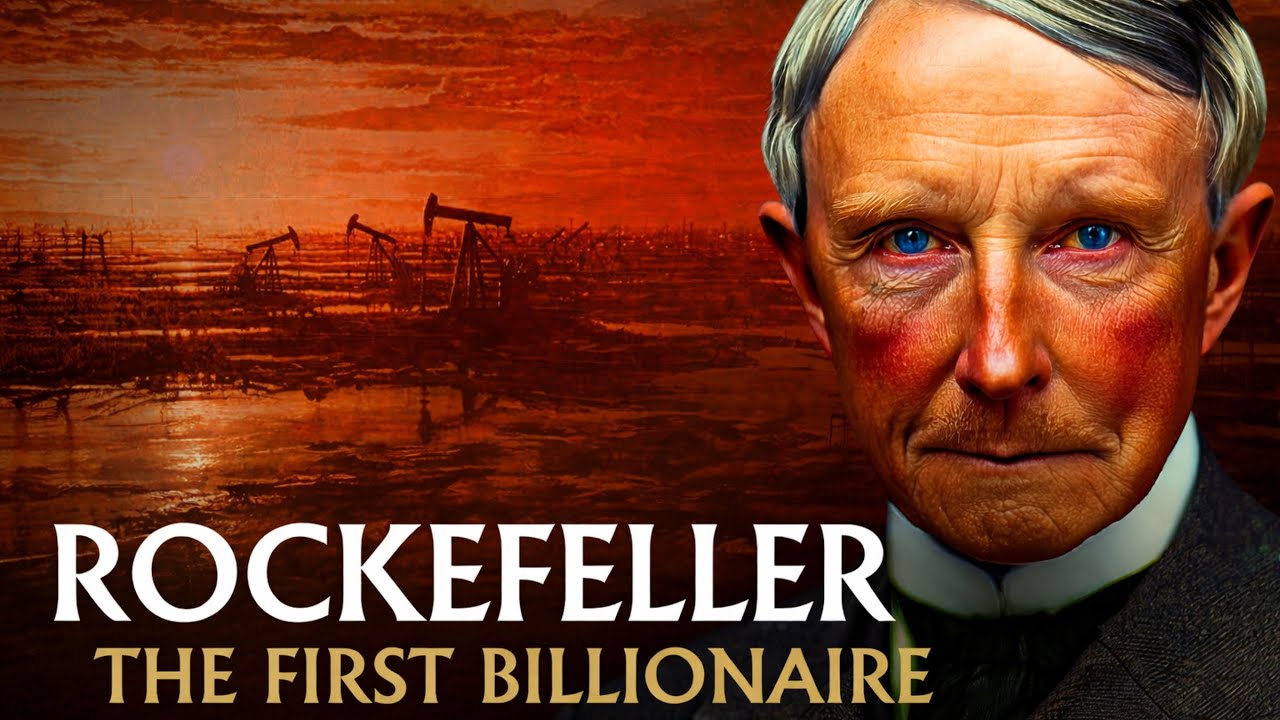
Born John Davidson Rockefeller on July 8, 1839, in Richford, New York, he came from a family with a complicated past. His father, William “Bill” Avery Rockefeller, was a traveling salesman who posed as a botanic physician, selling homemade medicines of dubious quality. He also loaned money at usurious rates to poor farmers, often with the aim of acquiring their properties when they defaulted. William later faced legal trouble for sexual assault and violent conduct involving a gun.
In late 1836, William met Eliza Davidson and married her in February 1837, despite already being engaged to another woman, Nancy Brown. Eliza was the daughter of a wealthy farmer, John Davidson, who was suspicious of William’s motives. After the marriage, Eliza discovered that Nancy Brown, hired as a housekeeper, was also William’s mistress, and the two women lived under the same roof for years. While Eliza had a daughter, Lucy, and a son, John, Nancy gave birth to two girls.
Eventually, the Davidsons forced William to send Nancy away with her daughters. Eliza later gave birth to another son, William Jr. , and more children followed. Despite his father’s questionable business practices, Bill Rockefeller achieved a degree of respectability in the 1840s in Moravia, New York, where he helped finance a local school.
The Rockefeller boys were given adult responsibilities early, which made them mature quickly. John attended the school his father helped establish and showed a natural aptitude for mental arithmetic. He was a quiet, introverted boy with a patient, methodical nature, influenced heavily by his mother’s Baptist faith. The 1840s were a time of economic expansion, and John D.
Rockefeller showed an entrepreneurial spirit from a very early age. As a boy, he bought candy by the pound, divided it into smaller portions, and sold it to his siblings at a profit. At seven, he found a nest of turkey chicks and raised them for sale. His father’s influence was significant; John idolized him as a strong, athletic man who brought home gifts and cash earned by both fair and foul means.
Bill Rockefeller negotiated aggressively and took advantage of customers’ ignorance, but he also paid his workers generously and met his contractual obligations. John’s later business practices would closely resemble his father’s, though he avoided the controversies that dogged him. After being indicted for sexual assault in 1849, Bill left Moravia. In 1850, the family moved to Owego near the Pennsylvania border, and around this time, John began to see his father for who he really was.
He started referring to his mother as a widow and, in adult life, avoided talking about his father. In August 1852, John and his brother William enrolled in the prestigious Owego Academy, but after a few months, the family moved further west to Strongsville, Ohio. In the autumn of 1853, the boys resumed their education in nearby Cleveland. In his school essays, Rockefeller expressed himself as an ardent abolitionist, a cause championed by the newly founded Republican Party.
He was close friends with Mark Hanna, who would later become a powerful Republican party boss and senator for New York. John hoped to go to university, but in May 1855, his father abruptly asked him to drop out of school and find a job. The request was connected to the double life Bill Rockefeller was living: he had met and fallen in love with 17-year-old Margaret Allen from Ontario while on his traveling doctor circuit, and in June 1855, he contracted a bigamous marriage with her, neglecting to mention his wife and five children. William realized he could not afford to maintain two families and encouraged his eldest son to find work.
After taking a three-month course at a commercial college, John began looking for employment in August 1855. He made a list of businesses he wanted to work for and visited them in person. After several weeks of no luck, his father suggested he could join him roaming the country. The prospect galvanized John to continue searching, and on September 26, 1855, the merchant firm Hewitt and Tuttle hired him as an assistant bookkeeper.
For the rest of his life, he would celebrate September 26 as “Job Day. ”
The teenager loved the job and examined every bill and invoice in detail, ensuring his employers were not swindled. He arrived at the office at 6:30 a. m.
and often did not return home until after 10 p. m. He also began keeping track of his personal income and expenditures in a red notebook he called Ledger A, which showed that as soon as he started earning money, he was making donations to charitable causes. By 1859, he was giving away 10% of his income, favoring Baptist causes but also giving money to black churches and helping two African-American slaves buy their freedom.
Despite an economic downturn in 1857, Bill Rockefeller decided to build a large house in downtown Cleveland to bring his first family under a single roof. John was left in charge of supervising the project and paying the contractors. His success convinced Bill that John was capable of being head of the family, and Bill went to live permanently with his second wife in Philadelphia. Although he would occasionally reappear in John’s life, the rapacious father detached himself just as his son was about to become the richest man in the world.
In January 1857, after junior partner Henry Tuttle left the firm, Rockefeller was promoted to chief bookkeeper on $500 a year, considerably below Tuttle’s salary of $2,000. After receiving a modest increase to $600, he began trading commodities on his own account. In April 1858, Rockefeller and his English friend Maurice B. Clark formed their own trading house, with each partner investing $2,000.
Rockefeller saved half the sum and borrowed the rest from his father at 10%. The partnership proved profitable, netting $4,400 in its first year and $17,000 in its second. The volatility of the commodities trade forced Rockefeller to seek more loans from his father, who often recalled the debt at inopportune moments. Rockefeller’s habit of making risky deals that paid off set him at odds with the more conservative Clark.
In April 1859, the firm brought in George Gardner, a former colleague of Clark’s from one of Cleveland’s leading families. Clark unilaterally changed the name of the firm to Clark, Gardner and Company, which slighted Rockefeller. He was also irritated when Gardner bought a yacht and invited him on a sailing excursion, believing such indulgences would undermine the firm’s access to credit. Gardner withdrew from the partnership in late 1862, and the firm reverted to Clark and Rockefeller.
Rockefeller’s timing was opportune, as the United States was about to embark on a period of immense expansion and economic growth. The end of the Mexican-American War and the California Gold Rush had opened the American West, and mass migration from Europe created a population boom. The US population in 1850 was about 23 million; it reached 50 million around 1880 and 100 million by the mid-1910s. In addition, the US was entering a period of pronounced industrialization, and a railway boom was beginning to connect the country from coast to coast.
There was also growing awareness that new types of fossil fuel could fuel the American economy. In November 1860, the 21-year-old Rockefeller voted in a presidential election for the first time, casting his ballot for Republican candidate Abraham Lincoln. Lincoln’s opposition to the expansion of slavery encouraged southern states to secede, leading to the outbreak of the American Civil War in April 1861. Rockefeller later claimed he wanted to serve the Union cause but decided to continue in business to provide for his family.
While John and William avoided military service by paying substitutes, their youngest brother Frank enlisted and was wounded twice. The disruption to north-south trade benefited the east-west trade via Cleveland, and Rockefeller and his partners profited handsomely. Rockefeller now entered the nascent oil industry. During the 1850s, America’s booming economy created a demand for lighting that outstripped the dwindling supply of whale oil.
In 1853, New York lawyer George Bissell saw indigenous Seneca people use black rock oil for medicinal purposes. The following year, he formed a company and commissioned Yale scientist Dr. Benjamin Silliman to investigate the feasibility of using rock oil for lighting and lubrication. In 1856, Bissell hit upon the idea of drilling for oil, and after several false starts, Edwin Drake struck oil near Titusville in August 1859.
It did not take long for the area to become teeming with men seeking to make their fortune. Meanwhile, a Canadian geologist, Abraham Gesner, had developed a method of producing lamp fuel called kerosene using petroleum. As the oil boom began in Cleveland, Clark and Rockefeller began handling small shipments of crude oil in 1860. When Clark’s friend Samuel Andrews approached the two men seeking capital for an oil refinery, Rockefeller was enthusiastic while Clark was more skeptical.
In 1863, Andrews, Clark, and Rockefeller joined two of Clark’s brothers in forming a company that set up operations under the name Excelsior Oil Works, adjacent to the railroad connecting Cleveland to the Pennsylvania oil fields. Although Clark and Rockefeller initially regarded oil as a sideline, the refinery was already more profitable than the rest of the business in its first year. Rockefeller’s improving financial prospects encouraged him to marry Laura Celestia Spelman, whom he had first met at Cleveland High School more than a decade earlier. Laura came from one of Cleveland’s wealthier families and had a commercial mind of her own.
Rockefeller did not propose until March 1864, and the couple married in September 1864. They had a daughter, Elizabeth, in August 1866, and a second daughter, Alice, who died just after her first birthday. The couple had two more daughters and, finally, in 1874, their only son, John D. Rockefeller Jr.
, who would inherit his father’s fortune many years later. Although several oil refineries had sprung up in Cleveland, Rockefeller’s was one of the few sufficiently capitalized to weather extreme market volatility. While others saw oil as a get-rich-quick scheme, Rockefeller retained a long-term perspective and proposed borrowing heavily to finance rapid expansion, believing the oil market would get bigger over time. When the cautious Clark brothers used their majority to vote down his proposals, Rockefeller prepared to break from them and secured Andrews’s support.
In January 1865, the Clarks threatened to dissolve the partnership, and to their surprise, Rockefeller agreed. The two parties held an auction for the company. The bidding started at $500 and quickly reached $60,000 before inching up to $70,000. Rockefeller was beginning to doubt whether he could afford the deal, but after Clark bid $72,000, he immediately responded with $72,500, and Clark decided he could go no higher.
That $500 was the making of John D. Rockefeller. On February 15, 1865, the new Rockefeller and Andrews partnership took over operations at the Excelsior refinery. Rockefeller was the senior partner, responsible for management, while Andrews handled scientific and technical details.
A few weeks later, the American Civil War came to an end with General Robert E. Lee’s surrender at Appomattox Courthouse on April 12, 1865. Ohio congressman and future President James Garfield prophetically remarked, “Oil, not cotton, is king now in the world of commerce. ” Despite its potential, the industry was still in its infancy, with accidents and explosions common, and fortunes lost as often as they were made.
In December 1865, Rockefeller established a second refinery in Cleveland known as the Standard Works and placed his brother William in charge. The enterprise was the largest and most profitable of the refiners in Cleveland, boosting profitability by selling a wide range of byproducts and controlling its own barrel making, shipping facilities, and railroad cars. American oil quickly made its way onto the international market, and in 1866, William Rockefeller established an office in New York City to build relationships with Wall Street bankers and manage exports. Although Rockefeller borrowed heavily in his early days, he earned the trust of bankers by paying his debts on time, enabling him to access credit in emergencies and survive crises that bankrupted rivals.
In 1867, Rockefeller brought in Henry Flagler, expanding the partnership to become Rockefeller, Andrews, and Flagler. Flagler’s stepbrother, Stephen Harkness, one of the richest men in Cleveland, contributed $100,000 in capital for a third of the business. Flagler was placed in charge of negotiations with the railroads, as transportation was one of the most significant costs in the refining business. Rockefeller’s Cleveland location allowed him to transport oil by water via Lake Erie or by the three railroads that ran through the city, allowing him to negotiate the best freight rates.
The railroads were in stiff competition with each other, and Jay Gould of the Erie Railroad offered Rockefeller a 75% rebate on transportation costs, while Flagler secured a major discount with the Lakeshore Railroad. In return, Flagler offered to supply 60 carloads a day, a commitment the Rockefeller refineries could not fulfill on their own, so Rockefeller used his position to coordinate shipments from rival Cleveland firms at preferential rates. The Lakeshore deal had major consequences for the oil industry, enabling Rockefeller to consolidate his leading position. By 1869, the Rockefeller partnership was the world’s largest refiner, employing 900 workers producing 2,500 barrels a day, accounting for 10% of global output.
Not long after, John and Laura moved to a brick house on Euclid Avenue, nicknamed Millionaire’s Row. The house itself was relatively modest, as Rockefeller was not inclined to show off his wealth and disliked ostentatious displays of it throughout much of his life. By 1870, the lure of oil had attracted so many players that supply was three times demand, causing the price of kerosene to plummet. Rockefeller believed the market was unsustainable and the industry was being ruined by excess competition.
He envisaged a large network of interrelated companies benefiting from economies of scale to reduce costs and control the supply and price of oil. In January 1870, Rockefeller dissolved the existing partnership and incorporated the firm as the Standard Oil Company, with himself as president, William as vice president, and Flagler as secretary and treasurer. Rockefeller was the largest shareholder with a 29% stake. Although 1870 was one of the toughest years in the oil industry, Standard could pay a 105% dividend at the end of its first year.
When prices continued to decline in 1871, leaving many competitors on the brink of bankruptcy, Standard was still profitable enough to pay a 40% dividend. In January 1872, Standard Oil raised another $2. 5 million to strengthen its balance sheet. With his massive war chest, Rockefeller was ready to bring rival Cleveland refineries into the Standard Oil family.
Late in 1871, Rockefeller was approached about an alliance with the Pennsylvania, Erie, and New York Central Railroads. They agreed to double freight prices overnight while offering generous rebates to a select number of refineries in Cleveland, Pittsburgh, and Philadelphia, who would form the deceptively named South Improvement Company. Standard Oil was to serve as an impartial umpire to guarantee agreed quotas of traffic between the three lines. However, news of the higher rates leaked out in February 1872, leading to strikes among oil producers.
In the three months between December 1871 and March 1872, Standard carried out the so-called Cleveland Massacre by buying out 22 of its 26 rivals in Cleveland. Rockefeller began by targeting his strongest rivals, knowing it would have a psychological impact on the weaker ones. When Colonel Oliver Payne, a Civil War veteran and Rockefeller’s former high school acquaintance, asked to see Standard’s accounts, he was bewildered by its profitability and agreed to sell. He soon became a valued member of the Standard Oil organization.
Rockefeller’s involvement in the South Improvement Company and his aggressive consolidation caused him to be vilified in the press. Critics argued he was forcing rivals out of existence and buying up their assets at a fraction of their true value. Following the Cleveland Massacre, Standard had the capacity to refine 10,000 barrels a day, a quarter of the world’s output. Rockefeller later justified his actions using religious imagery, claiming he was offering competitors a chance to get onto the Standard Oil ark before the flood swept them out of business.
He also believed his measures to stabilize the market would give workers greater job security. Nevertheless, the accusation emerged in the 1870s that Rockefeller was bent on acquiring a monopoly over the oil industry and abusing his market position. It was an issue that dogged him for half a century and would eventually result in the breaking up of Standard Oil decades later. Despite his victory in Cleveland, the railroads’ uniform rates placed Standard at a disadvantage compared to refiners further west.
In response, Rockefeller entered into an alliance with the Pittsburgh refiners in May 1872, forming the National Refiners Association, popularly known as the Pittsburgh Plan. The association would collectively negotiate lower prices with the railroads and guarantee profits for smaller refiners in return for production caps. When smaller refiners exceeded their quotas, forcing Standard to reduce its own output, Rockefeller abandoned the Pittsburgh Plan in June 1873, believing the only way to stabilize the market was to take full control. Events soon moved in his favor when an economic crisis known as the Panic of 1873 caused a six-year depression, during which crude oil prices plummeted to under 50 cents a barrel.
Rockefeller was in prime position to take advantage, as Standard Oil remained profitable despite operating only two of its six large refineries in Cleveland. In autumn 1874, Rockefeller and Flagler met with the proprietors of the leading refineries in Pittsburgh and Philadelphia. Once Warden realized Standard could sell kerosene for a profit at a price below his operating costs, he and Lockhart agreed to join forces with Rockefeller. Within two years, only a single independent refinery remained in Pittsburgh out of the 22 that previously existed.
Rockefeller also expanded his footprint in New York by acquiring Charles Pratt and Company, a deal kept secret, as he preferred with many smaller refiners to give the impression of a competitive market and avoid political backlash. In the mid-1870s, he continued to acquire refineries, and many former critics became Standard converts. The most prominent was John D. Archbold, who had been one of the most vociferous opponents of the South Improvement Company scheme.
Archbold became a senior figure at Standard Oil and represented Rockefeller in negotiations with producers. In September 1875, the Acme Oil Company was founded with Archbold as president to serve as a front for Standard’s acquisitions. In May 1875, Rockefeller acquired J. N.
Camden and Company in secret and used Camden as his vehicle to buy up refineries in West Virginia. In his mid-30s, John D. Rockefeller was master of the American oil industry, which effectively meant the global oil industry. While he owed much of his success to his close relationship with the Erie and New York Central Railroads, he was often in conflict with the Pennsylvania Railroad.
When the Pennsylvania set up the Empire Transportation Company to acquire oil pipelines in 1873, Rockefeller responded by building his own pipeline network. In 1877, the Pennsylvania took advantage of a dispute between Rockefeller and producers to connect new wells to its own pipelines. Rockefeller fought back by diverting oil to the Erie and New York Central, forcing the Pennsylvania to fire hundreds of workers and triggering a strike. The Pennsylvania’s president, Tom Scott, backed down and agreed to sell all of Empire Transportation Company’s assets to Standard Oil for $3.
4 million, including a fleet of obsolete steamships Rockefeller had to pay for out of his own pocket because his fellow executives refused to authorize the full amount. Standard continued to expand its pipeline network, and by 1879 it controlled almost the entire pipeline system in the country in addition to 90% of refining capacity. When Titusville producer Byron Benson formed the Tidewater Pipeline Company to build a 100-mile pipeline to Williamsport, Pennsylvania, Standard scrambled to buy up land and bribe legislators to block the way. Despite these efforts, the Tidewater pipeline was completed in May 1879.
The acceleration of American economic activity facilitated the enormous enrichment of Rockefeller and Standard Oil. The railway boom was reaching its peak, and oil was needed for a wide range of industrial activities. In September 1882, Thomas Edison began the electrification of America, but the American electricity grid was fueled by coal for decades to come, not petroleum. Conversely, electrification saw a sharp decline in the need for oil for lamp lighting in homes, though this was more than offset by increasing demand for Standard’s product in other areas.
In the 1890s, there were rapid advances in the development of automobiles, and in the 1900s, Ford’s Model T appeared, fueled by petroleum. Ships would soon be switching over to petroleum from coal as well. The scale of demand was mirrored in the size of crude oil production in the US. Around 1870, there were less than 5 million barrels of oil produced every year.
By the end of the century, that figure had increased twelvefold to nearly 60 million, and it nearly doubled by the mid-1900s as new wells in Oklahoma and Texas came on stream. Back in the early 1880s, the setback over the Tidewater pipeline was a sign that Rockefeller’s opponents were gaining strength. More worryingly, he and eight colleagues were indicted by the Pennsylvania state government for monopolizing the oil business. Rockefeller was sufficiently alarmed that he announced an end to the railroad rebates, and the cases against Standard Oil were dropped.
This coincided with a finding by the Hepburn Committee of the New York State Assembly that rebates were unlawful. However, the intervention came too late, as Standard Oil had already exploited them to achieve its dominant position. Rockefeller soon discovered that Byron Benson also preferred cooperation, and the two parties entered into an agreement. In 1882, Rockefeller’s associates acquired a minority stake in Tidewater, enabling him to strike a favorable market sharing agreement the following year.
Now in his 40s, Rockefeller was among the richest men in the country and increasingly notorious. In one of his rare interviews, he argued that with a business as large as Standard Oil, it was inevitable for malpractice to occur without senior management’s knowledge, but that he would intervene as soon as he became aware of the issue. Many states forbade companies from owning subsidiaries across state lines, so the Standard Oil Empire consisted of 41 separate companies. In 1882, the company’s lawyers came up with the innovative solution of creating the Standard Oil Trust, where nine trustees, including Rockefeller, were appointed to manage the interests of the company’s 37 stockholders.
Although the arrangement did not become public until six years later, the creation of the Standard Oil Trust was a major innovation in American corporate history, and the word trust soon became synonymous with monopoly power. In early 1884, Rockefeller moved his family to New York City, and in May 1885, company headquarters was formally transferred from Cleveland to a new ten-story office at 26 Broadway in Manhattan. Despite moving to the country’s economic capital, Rockefeller continued to keep a low profile and limited his social activities to the Fifth Avenue Baptist Church. As his fame grew, he was flooded with correspondence asking for charitable donations.
While concerned about poverty in cities, he did not want to encourage dependency and favored donating to educational institutions, supporting schools for women, African-Americans, and Native Americans. In 1882, he began supporting a black women’s college in Atlanta, Georgia, named Spelman Seminary, later Spelman College, in honor of his in-laws. In 1889, he offered $600,000 for the establishment of the University of Chicago, which was founded in 1892, and continued to give liberally to the institution. In June 1887, Rockefeller made his first trip overseas, taking a three-month holiday with his family in Europe.
In London, the family stayed at a hotel in Piccadilly and witnessed Queen Victoria’s Golden Jubilee parade. In Paris, Rockefeller realized he was internationally famous, as his arrival in every city was publicized in local newspapers. He reluctantly agreed to an audience with Pope Leo XIII after being advised it would please Standard’s Catholic employees. During his travels, Rockefeller observed his international competitors up close.
During the 1870s, oil was discovered near the Russian port of Baku on the Caspian Sea. By the 1880s, the Russian market had been cornered by Swedish businessman Robert Nobel and his brothers, including Alfred, the inventor of dynamite and founder of the Nobel Prizes. The Parisian branch of the Rothschild family set up the Caspian and Black Sea Oil Company, and in 1890, Royal Dutch was founded in the Dutch East Indies. The following year, London merchant Marcus Samuel set up what would become the Shell Transport and Trading Company, which merged with Royal Dutch in 1907 to form a rival business empire.
Rockefeller responded by establishing Standard’s own marketing offices in Europe. Despite increasing foreign competition, Standard’s control of the domestic US market remained seemingly unassailable owing to its control of pipelines. In the early 1880s, Standard revolutionized distribution by storing refined oil in large tanks, where its fleet of tank wagons would fill up before selling to customers. Rockefeller realized he could control oil prices by changing storage costs depending on market conditions.
Standard issued certificates against the oil in its pipelines, which could be bought and sold, thereby creating the oil futures market. However, Rockefeller bemoaned the pricing power of speculators, and Standard rapidly expanded its marketing division to control local markets, resorting to aggressive sales tactics to drive competitors out of the market. Rockefeller answered critics by stating that the company wanted to supply cheap oil to poor Americans, and defended profitability by arguing that the oil fields could run dry or that demand for oil might collapse. In 1892, the 53-year-old John D.
Rockefeller became the richest man in the world following the death of railroad tycoon Jay Gould. With around $100 million to his name, Rockefeller became the primary target of criticism from journalists and political reformers who contrasted the wealth of industrial capitalists with industrial workers who lived close to poverty. From the late 1870s, journalist Henry Demarest Lloyd published articles claiming that Standard Oil owed its monopoly to secret agreements with the railroads. In 1887, Congress set up the Interstate Commerce Commission to regulate standardized freight rates, which had little impact on Standard, which by then transported most of its oil through its pipelines.
In 1890, Congress passed the Sherman Antitrust Act to outlaw monopolistic behavior. In 1892, the Ohio Supreme Court ruled that Standard Oil of Ohio must leave the trust. Rockefeller continued to manage the business as a consolidated entity by transforming Standard Oil of New Jersey into a holding company. In 1893, Rockefeller clashed with steel tycoon Andrew Carnegie, who was troubled by Rockefeller’s investments in iron ore.
The dispute was easy fodder for newspaper cartoonists, but Carnegie soon made a deal with Rockefeller to buy his ore in exchange for a promise not to make steel. The same year, Rockefeller bought the estate of Pocantico Hills, some 20 miles north of New York City, which became a retreat as he stepped back from business. His mother had died in March 1889, though his elusive father continued to live until 1906. Rockefeller suffered from alopecia, a rare disease causing hair loss, depriving him of his iconic bushy mustache.
By mid-1897, he left John Dustin Archbold in charge at Standard Oil while retaining his title of president and his 30% stake, relying on his son John Jr. to keep him informed. In 1896, Rockefeller donated to Republican candidate William McKinley’s presidential campaign, managed by his school friend Mark Hanna. McKinley defeated William Jennings Bryan, and Rockefeller’s interests appeared secure.
He devoted more time to philanthropy, establishing the Rockefeller Institute for Medical Research in 1901, now Rockefeller University. McKinley won re-election in 1900 but was assassinated the following year and succeeded by his vice president, Theodore Roosevelt. From the progressive wing of the Republican party, Roosevelt filed dozens of suits against monopolies under the Sherman Antitrust Act and gained a reputation for trust busting. Rockefeller also faced a new wave of criticism after journalist Ida Tarbell published a lengthy exposé of Standard Oil for McClure’s magazine between 1902 and 1904.
Tarbell had grown up in Titusville, where her father operated production and refining facilities and believed Standard had destroyed his business. She highlighted Standard’s industrial espionage, price manipulation, and secretive ownership structures. While Rockefeller refused to address Tarbell’s accusations in public, in private he was infuriated when the media began to dig up details of his father’s shady past. John had known about his father’s bigamous marriage since the 1880s, but it became public knowledge following a press investigation in 1908.
While Standard fought back by sponsoring favorable publications and Rockefeller invited reporters to his golf courses, Standard faced increasing lawsuits from federal and state governments. In a high-profile 1907 case, federal judge Kenesaw Mountain Landis fined Standard over $29 million in relation to railroad rebates, but the judgment was overturned the following year. In 1908, Rockefeller supported Ohio Republican William Howard Taft to succeed Roosevelt as president. While Taft was temperamentally more conservative, he not only continued Roosevelt’s trust busting campaign but expanded it.
In 1909, a circuit court ordered the company to break up for violating the Sherman Antitrust Act. In May 1911, the Supreme Court dismissed the final appeal and gave the trust six months to disband. By the time of the breakup, Standard controlled 14% of the crude oil supply and 70% of the refined oil market. Rockefeller formally stood down as president of Standard Oil of New Jersey, which remained the largest single entity held by the family.
Standard shareholders received a corresponding stake in the 34 independent companies that emerged from the dissolution, including entities that would become Chevron, Exxon, and Mobil. The breakup gave the American public the opportunity to buy Standard shares for the first time, sending the stock skyrocketing and making Rockefeller the world’s first billionaire by 1916. Flush with cash, Rockefeller proposed the creation of the Rockefeller Foundation, chartered by New York in 1913, and contributed a total of $183 million. The foundation focused primarily on health and supported medical schools worldwide.
Over time, Rockefeller gave away most of his wealth to his children, particularly John Jr. , who helped manage his investments and served as president of the Rockefeller Foundation. However, John Jr. was responsible for one of the family’s darkest moments in his capacity as director of Colorado Fuel and Iron, in which his father held a controlling share.
When the United Mine Workers went on strike against poor working conditions in 1913, Junior supported the company’s efforts to break the strike. In April 1914, Colorado National Guardsmen and private guards hired by the company attacked the strikers, killing over 20 men, women, and children. While Junior’s actions received his father’s wholehearted support, Junior recognized the damage to the family’s public image and used Rockefeller Foundation funds to support the miners’ families. In September 1914, John and Laura Rockefeller celebrated their 50th wedding anniversary at Pocantico, but Laura had been in poor health and died the following spring.
The widower endowed the Laura Spelman Rockefeller Memorial with $74 million to support religious and educational causes, later merged with the Rockefeller Foundation. After the United States entered the First World War in 1917, Rockefeller’s image improved as he bought war bonds and supported allied causes. In 1918, he bought a winter home called The Casements at Ormond Beach, Florida, across the street from the Ormond Hotel developed by his former business partner Henry Flagler, who died in 1913. The two men had fallen out after Flagler divorced his second wife to marry a much younger woman, and Rockefeller only began visiting the area after Flagler’s death.
For the remaining two decades of his life, Rockefeller remained passionate about social and religious causes. He was pleased to see the prohibition of alcohol in 1920, but after a thriving black market developed, he did not object to its repeal in 1933. In retirement, he continued to invest in the stock market and lost nearly half of his remaining wealth during the Wall Street crash of October and November 1929. Undeterred, he acquired a million shares of Standard Oil of New Jersey, which was experiencing expansion under its third president, Walter Clark Teagle, coincidentally the grandson of Rockefeller’s first business partner, Maurice Clark.
Meanwhile, John Jr. helped revive New York City’s economic fortunes by financing the construction of Rockefeller Center, one of the world’s largest commercial complexes. Despite his reputation for secrecy as a businessman, Rockefeller was a jovial old man in his 80s and 90s and maintained the wish to live to 100. He fell just short, dying early in the morning of May 23, 1937, a few weeks short of his 98th birthday.
His body was taken by train from The Casements for a funeral in Pocantico, during which all the old Standard companies around the world stopped working to observe five minutes of silence. Following the funeral, his remains were transferred to Lake View Cemetery in Cleveland, where he was laid to rest alongside his mother and wife. A 70-foot obelisk, at the time the largest funeral monument in America, was erected there. John Davidson Rockefeller was a giant of American industrial capitalism and exemplified America’s Gilded Age.
Influenced in different ways by his mother’s Baptist faith and his father’s often dubious money-making schemes, Rockefeller became one of the richest men in history by creating a monopoly out of America’s fledgling oil industry. While critics attacked him for nefarious business practices, Rockefeller justified his actions by arguing they were a necessary expedient to prevent the oil industry from competing itself out of existence. He never managed to create a full monopoly, and his market dominance was gradually eroded by international competition and government intervention. After stepping back from Standard in the 1890s, Rockefeller pursued significant philanthropic projects, and the University of Chicago, Rockefeller University, and the Rockefeller Foundation continue to flourish over a century later.
The Rockefeller family would play a prominent role in American economic and political life in the decades following its patriarch’s death. John Jr. ’s son Nelson Aldrich Rockefeller served as Republican governor of New York, and would be appointed vice president of the United States by Gerald Ford in 1974, while another brother Winthrop served as governor of Arkansas. John Junior’s grandson, John D.
Rockefeller IV, better known as Jay, served as Democratic governor and later senator of West Virginia. Thus, Rockefeller not only built a company so large that the US government intervened to break it up into dozens of companies in 1911, he also established one of America’s great business and political dynasties.