In the summer of 1944, a 43-year-old SS general stood in a farmhouse in Normandy and gave an order. That order resulted in the execution of at least 41 Canadian soldiers who had already surrendered and no longer posed a threat to anyone. The man who gave it was no obscure functionary buried in the SS bureaucracy. He was one of the most decorated and celebrated combat commanders in the entire Waffen SS, a man who had fought in every major German campaign from Poland to Greece to Russia to France, whose soldiers worshipped him and whose enemies respected him.
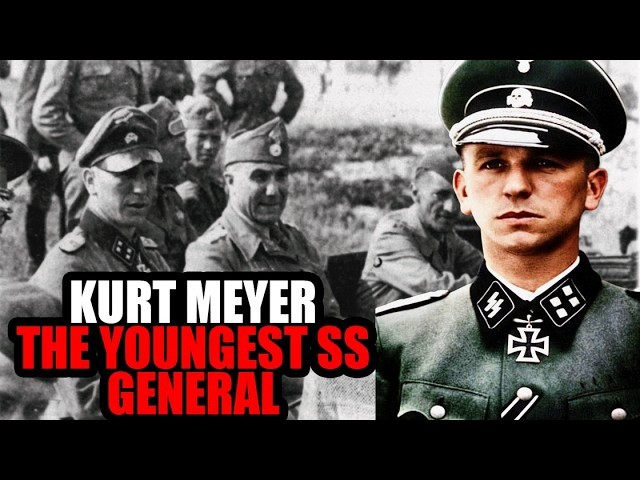
His name was Kurt Meyer, and they called him Panzermeyer. His story is one of the most complicated and uncomfortable of the entire Second World War, because it is the story of a man who was genuinely brilliant at the thing he had chosen to do, and who used that brilliance in the service of crimes that no amount of military talent can excuse. Meyer was born in October 1910 in Jüksheim in Lower Saxony. His early life was shaped by the poverty and instability of Weimar Germany.
He was not the son of a military officer or a Prussian landowner; he came from a working-class family that struggled through the economic chaos of the 1920s. Growing up in that environment, watching Germany humiliated and impoverished in the years after the First World War, shaped his politics in exactly the way the Nazi movement was designed to shape the politics of young men from that background. He joined the SS in 1931 at the age of 21, one of the organization’s earliest volunteers. From the beginning, he showed the qualities that would define his entire career: physical courage, aggressive energy, a natural instinct for leadership, and a complete absence of hesitation when it came to violence.
The SS recognized these qualities and promoted him steadily. By the time the war began in September 1939, Meyer was already a company commander in the Leibstandarte SS Adolf Hitler, the premier division of the Waffen SS and Hitler’s personal bodyguard unit. The war gave him the opportunity to demonstrate what he could do on a battlefield. Poland in September 1939 was his first combat experience, and he threw himself into it with the aggression and energy that would become his trademark.
He performed well enough to be given greater responsibility. Then came France in 1940, and Meyer performed well again. Then came Greece in 1941, and it was here that the first serious shadow fell across his combat record. During the Greek campaign, Meyer’s unit was involved in the capture of the Kleisoura Pass.
In the aftermath of that operation, Greek prisoners of war were killed, and the evidence suggests that Meyer was present and that the killings happened under his command. While the chaos of combat sometimes produces situations where the line between legitimate military action and war crime is genuinely difficult to draw, the pattern emerging in Meyer’s career would repeat itself in much more documented and unambiguous form three years later in Normandy. Before Normandy came the Eastern Front, and the Eastern Front was where Curt Meyer became a legend within the Waffen SS. The war in Russia suited his particular combination of talents perfectly: fast-moving, fluid, requiring constant improvisation and aggressive initiative.
Meyer thrived in it, leading his unit from the front with a personal fearlessness his soldiers found inspiring and his superiors found invaluable. The decorations accumulated: the Knight’s Cross, the Oak Leaves, the Swords, the highest military honors Nazi Germany could bestow. With each decoration came promotion, and Meyer rose through the ranks with remarkable speed. By the time he was given command of the 12th SS Panzer Division, Hitlerjugend, in 1944, he was one of the most celebrated combat commanders in the entire German military.
The Hitlerjugend Division was one of the most extraordinary military formations of the war, built almost entirely from boys born in 1926, teenagers recruited directly from the Hitler Youth into the SS. They were fanatical in a way that even the hardened veterans of the Eastern Front found remarkable; raised from childhood to believe that dying for Hitler and Germany was the highest possible achievement, they had not lived long enough to develop the survival instinct that makes older soldiers cautious. Meyer understood how to use this fanaticism, and he shaped the division into a fighting force that proved extraordinarily effective in the defensive battles of Normandy, holding ground against Allied forces that had every material advantage and inflicting casualties that Allied commanders found shocking. June 7, 1944, the day after D-Day, was when everything changed.
On that day, soldiers of the Hitlerjugend Division captured a number of Canadian soldiers from the North Nova Scotia Highlanders and the Sherbrooke Fusiliers near the Abbey of Arden, where Meyer had established his divisional headquarters. What happened to those prisoners is one of the best documented war crimes committed against Western Allied forces during the entire war. At least 41 Canadian soldiers who had been taken prisoner were executed, shot in the head at close range. Their bodies were found in the gardens of the abbey and in the fields around it.
The evidence collected after the war pointed directly to Meyer’s headquarters as the location where the order to execute the prisoners had originated. The broad outlines of what happened at the Abbey of Arden are not in dispute; the physical evidence was clear and the testimony of witnesses was consistent. Young Canadian soldiers who had surrendered and been disarmed were brought to the abbey and killed there. Some were killed in a courtyard directly accessible from the building where Meyer had his command post.
The argument about Meyer’s personal responsibility has centered not on whether the killings happened, which is beyond dispute, but on whether Meyer personally ordered them, or whether they were carried out by subordinates acting on their own initiative, or on the basis of a more general atmosphere of contempt for prisoners that Meyer had created within his division. The question of command responsibility becomes central here: even if Meyer did not personally give the specific order to shoot each individual prisoner, he was the commanding general of the division, physically present at the location where the killings occurred, and the culture of the Hitlerjugend Division was one he had shaped. The argument that a commanding general bears no responsibility for war crimes committed by his troops at his own headquarters strains credibility to the breaking point. The Canadian military tribunal that tried Meyer after the war clearly agreed.
Before that tribunal came months more of fighting in Normandy. Meyer’s performance as a combat commander during the Normandy campaign was genuinely impressive by any military standard. The Hitlerjugend Division faced overwhelming Allied material superiority and held its positions with a stubbornness that cost the Allies dearly. Meyer himself was everywhere, moving constantly between his units, appearing at crisis points, leading counterattacks personally.
In a different war, in a different army, in different circumstances, he might have been remembered simply as one of the outstanding divisional commanders of the Second World War. But this was not a different war, and it was not a different army. In August 1944, Meyer was captured briefly by Belgian resistance fighters but managed to escape, and he continued fighting through the retreat from Normandy and into Germany. In September 1944, at the age of 33, he was promoted to SS-Brigadeführer, making him the youngest divisional commander of general officer rank in the entire Waffen SS.
This promotion came with full knowledge of what had happened at the Abbey of Arden; the Canadian government had already raised the issue through diplomatic channels, and the German military knew that Meyer would face serious questions if Germany lost the war. Germany was by September 1944 very clearly losing it. Meyer was captured by American forces in December 1944 and transferred to Canadian custody. In December 1945, he was brought before a Canadian military tribunal at Aurich in Germany to face charges arising from the murders at the Abbey of Arden and from other incidents during the Normandy campaign.
The trial was one of the first major war crimes trials of the post-war period and established important precedents about command responsibility that influenced the development of international law in the decades that followed. The prosecution’s case rested on two foundations: first, the direct evidence linking the killings to his headquarters and to orders that had come from his command; second, the broader principle that a commanding officer bears responsibility for crimes committed by troops under his command when those crimes result from a climate of contempt for the laws of war that the commanding officer has created and tolerated. Witnesses testified to having heard orders that prisoners were not to be taken, the physical evidence from the abbey was conclusive, and the pattern of prisoner killings across the Hitlerjugend Division’s area of operations during June and July 1944 was too consistent and widespread to be explained as isolated acts by individual soldiers acting without sanction from above. Meyer’s defense was what would be expected from a man of his background and psychology.
He denied having given any order to execute prisoners, claimed the killings were unauthorized actions of individual soldiers, and presented himself as a professional soldier who had conducted himself according to the laws of war, maintaining this position with the same self-confidence and aggression that had characterized everything else he had ever done. In some respects, his defense was not entirely without merit, because the specific chain of command linking individual killings to specific orders from Meyer was difficult to establish beyond reasonable doubt in every case. The tribunal struggled with the gap between the overwhelming moral certainty that Meyer bore responsibility and the legal standard of proof required for conviction. The tribunal convicted Meyer on three of the five charges and sentenced him to death by shooting.
For a period of weeks, it appeared that the youngest SS general was going to be executed. Then something happened that reveals much about the politics of the post-war period and the way military solidarity can override moral judgment. The Canadian commanding general in Germany, General Christopher Vokes, reviewed the sentence and commuted it to life imprisonment. His reasoning was that while Meyer was guilty of the crimes of which he had been convicted, the death penalty was not warranted.
The decision was controversial at the time and has remained so ever since, because the families of the 41 Canadians executed at the Abbey of Arden had a reasonable expectation that the man responsible for their sons’ deaths would pay the full price the law prescribed. Meyer served his life sentence in a Canadian military prison and then in a German prison after his custody was transferred. His imprisonment was itself remarkable, because Meyer commanded such respect from the German military establishment and certain segments of German society that pressure for his release began almost as soon as his sentence was handed down. The argument made on his behalf was essentially that he was a soldier who had fought for his country, that the war crimes for which he had been convicted were the kind of thing soldiers do in war, and that singling him out for continued punishment was unfair.
This argument found sympathetic ears in Germany in the early 1950s as the Cold War changed the political calculus and West Germany became a valued ally rather than a defeated enemy. Meyer was released from prison in September 1954, having served nine years of his life sentence. He was 43 years old when he walked out of Werl prison. The reception he received told everything about how Germany was processing its recent past; he was greeted as a hero by veterans organizations and by large sections of the German public.
He threw himself into the life of a celebrated veteran, writing his memoirs, giving speeches, and becoming one of the founding figures of the HIAG, the organization of Waffen SS veterans that spent the next several decades lobbying for the rehabilitation of the Waffen SS’s reputation and for benefits for its veterans. Meyer was one of the most prominent voices in this effort, consistently arguing that the Waffen SS had been a military organization like any other and that its members deserved to be treated accordingly. The memoirs Meyer published in 1957 under the title Grenadier became one of the bestselling war memoirs in post-war Germany. They presented his career as the story of a brilliant and dedicated soldier who had served his country with distinction and had been unfairly singled out for punishment by the victorious allies.
The war crimes that had sent him to prison were minimized or explained away or presented as the kind of thing that happens in war. The 41 Canadian soldiers executed at the Abbey of Arden barely appeared at all. Curt Meyer died in September 1961 in Hagen in West Germany, exactly 17 years after the youngest general in the Waffen SS had received his final promotion. He was 51 years old.
The obituaries in the German press treated him with a respect that his victims would have found incomprehensible, because the story of who Meyer really was and what he had really done was being told differently in Germany in 1961 than it had been told at Aurich in 1945. The gap between those two tellings is itself a story about how societies choose to remember the things they have done and the people who did them. The 41 Canadian soldiers who died at the Abbey of Arden in June 1944 were young men from Nova Scotia and Quebec who had crossed the Atlantic to fight in a war not fought on their soil. They died not in battle, but after they had already surrendered, shot in the head at close range in the gardens of a French abbey.
The man who bore command responsibility for their deaths served nine years in prison and then spent the rest of his life being celebrated as a military hero. The contrast between those two outcomes is the final judgment on the story of Kurt Meyer, Panzermeyer, the youngest general in the Waffen SS, the man who was sentenced to death and lived, and the men whose deaths he was responsible for, who had no such luck.