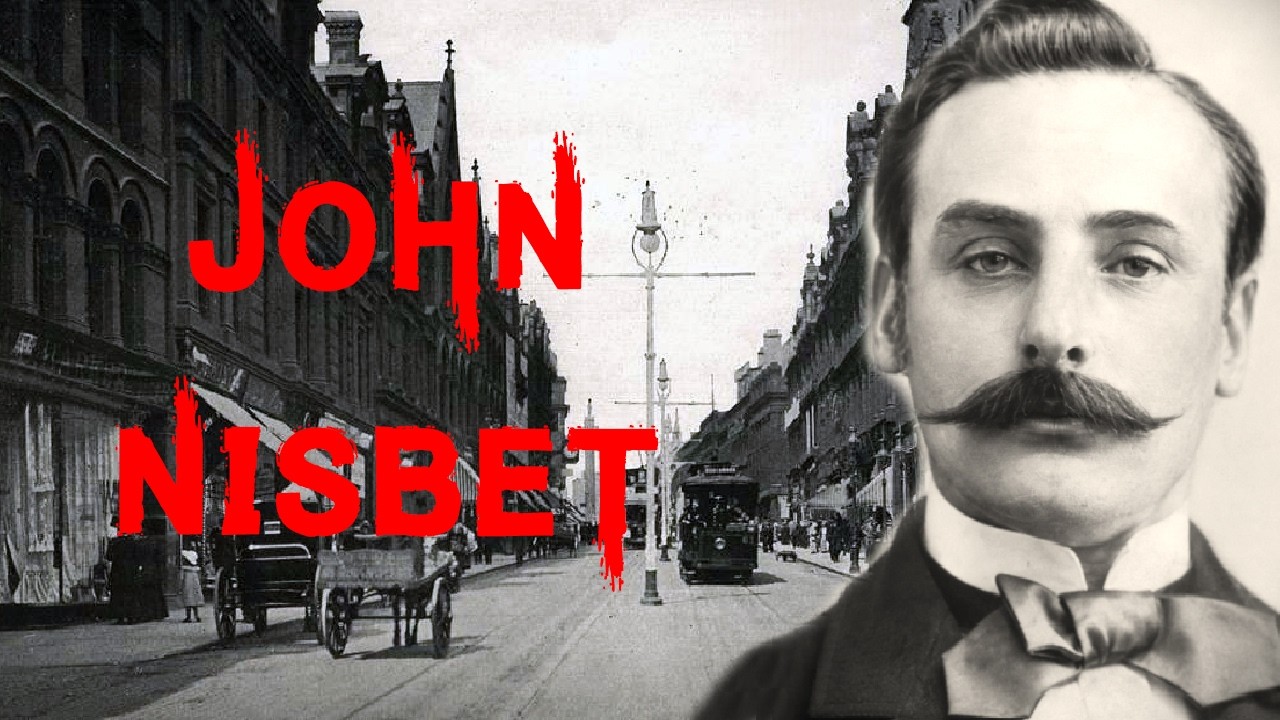
On the morning of March 18, 1910, John Innes Nisbet made his customary journey from his home in Heaton, an eastern suburb of Newcastle, to the city center. He was a cashier for the Stobswood Colliery Company, a position he had earned through twenty-eight years of steady, reliable service. Every other Friday, he withdrew the miners’ wages from Lloyd’s Bank and carried the money by train to the colliery, where the men were paid. That day, he collected three hundred seventy pounds and nine shillings, placed it in a small locked leather bag, and headed to Newcastle Central Station to catch the 10:27 train to Alnmouth, intending to alight at Widdrington.
The station was busy with the usual Friday traffic. Other colliery cashiers were making similar journeys, carrying wages for miners across Northumberland. Among them were Percival Harding Hall and a colleague from the Netherton Coal Company. As passengers began to board, Hall noticed Nisbet walking along the platform with another man.
The pair appeared to be looking for a smoking compartment near the front of the train, and Hall heard Nisbet say, “We will make this one a smoker. ” The two men entered the compartment together. Shortly after departure, the train stopped at Heaton Station, where it was Mrs. Nisbet’s custom to meet her husband as he passed through.
She was surprised to find him seated near the front of the train, since he usually sat in a compartment at the back or middle. She waved, and he lowered the window. They spoke briefly, and she reminded him not to be late home that evening because her aunt was coming to visit. He laughed and assured her that he intended to return directly home once his work was done.
As the train pulled away, Mrs. Nisbet caught a glimpse of the passenger seated opposite her husband. The compartment stood partly in the shadow of a tunnel, making observation difficult, but she could see that the man wore a light-colored overcoat with a turned-up collar. At 11:06, the train arrived at Stannington Station, where Hall and his colleague got off.
As they walked along the platform, they glanced into Nisbet’s compartment and saw him seated facing the engine, talking to a man sitting opposite. The train departed and six minutes later reached Morpeth. A passenger wearing a loose overcoat stepped onto the platform and approached the ticket collector, John Athy. The man explained that his ticket was only valid as far as Stannington, but he had forgotten to get off the train.
The conversation was cordial, and the man paid the excess fare and left the station. At the same time, a passenger named John Grant boarded the train. Not wanting to sit alone, he walked along the platform looking for a compartment with other occupants. As he passed the compartment where Nisbet had been sitting, he noticed it was empty.
The train continued north, stopping at Pegswood and Longhurst, where no passengers alighted, before arriving at Widdrington Station. The representative from the Stobswood Colliery Company was waiting on the platform, but Nisbet did not get off. The representative walked along the platform and looked through the carriage windows, but could not find him. The train left Widdrington and continued to Alnmouth, its final destination.
Once all passengers had disembarked, a porter named Thomas Charlton noticed an apparently empty compartment with its window left open. He went to close it, but when he opened the door, he found a horrifying scene. Streams of blood ran across the floor, and beneath the seats lay the body of a man, a hard hat and a broken pair of glasses beside him. The porter summoned the station master, who contacted the police.
Officers arrived and examined the compartment, finding a label inside the hat bearing the name J. I. Nisbet and the address 180 Heaton Road. The carriage showed evidence of a violent struggle, with blood-stained finger marks on the armrest, which police concluded had been left by someone using the seat for leverage while dragging a body to the floor.
The leather wage bag was missing. The body was removed to the mortuary, and the following day the police surgeon, Dr. Berman, conducted the postmortem. He found that Nisbet had been shot five times in the head and stated that any one of the shots would have caused instant death.
The attack, he concluded, had likely been completed in less than thirty seconds. The murder stunned the local community. A trusted cashier had been killed aboard a moving train, and the wages of hundreds of miners had vanished. The Stobswood Colliery Company offered a reward of one hundred pounds for information leading to an arrest and conviction.
Investigators began reconstructing the morning by tracing the movements of passengers and railway employees. Witness statements slowly built a picture of the journey. A commercial traveler named Charles Raven reported seeing Nisbet walking through the station with another man. An artist named William Hepple came forward and said he recognized the man as John Alexander Dickman, someone he had known for many years.
On Monday, March 21, 1910, John Alexander Dickman was arrested and taken to Gosforth Police Station in Newcastle. He admitted that he had traveled on the same train as Nisbet, but claimed he had been so absorbed in reading the newspaper that he missed his stop. He said he got off at Morpeth, paid the excess fare, and began walking toward the colliery, but became unwell and rested beside a field before abandoning the trip. He later returned to the station and caught the 1:40 train back to Newcastle.
He acknowledged knowing Nisbet by sight and said he had noticed him at the station that day, but denied traveling with him or speaking to him. Police remained unconvinced and searched his home, removing letters, financial records, gloves, clothing, and the light-colored Burberry coat Dickman had been wearing when arrested. An identification parade was arranged. Hall’s colleague could not make a positive identification, but after examining the men carefully, Hall pointed to Dickman and said, “If anyone of these is the man, it’s he.
” Dickman was charged with murder and brought before the magistrates, where crowds gathered outside, caught up in what the newspapers now called the sensational railway murder. A week-long remand was granted, and the investigation continued. About a month later, Nisbet’s missing leather bag was discovered at the bottom of an air shaft at Isabella Pit, a disused mine near Stannington. The money had disappeared, but investigators believed the location linked the disposal of the bag to an area familiar to Dickman.
The trial opened before Mr. Justice Coleridge on July 5, 1910, with Dickman pleading not guilty. The prosecution possessed remarkably little direct evidence. No witness had seen the murder, and neither the weapon nor the stolen money had been found.
Much of the case depended on a chain of circumstances. Many witnesses testified that they had seen Dickman and Nisbet together before the train departed. Charles Raven repeated his account of the pair walking toward platform five. William Hepple, who had known Dickman for more than twenty years, told the court he was definitely the man he had seen with Nisbet.
Percival Hall identified Dickman as the man sitting opposite Nisbet at Stannington. Ticket collector John Athy confirmed that Dickman was the passenger who left the train at Morpeth and paid the excess fare. Even Mrs. Nisbet, who had seen a man opposite her husband at Heaton Station, now claimed it was Dickman.
Dr. Robert Bolland testified about stains on articles of clothing found in the prisoner’s house. He had examined a portion of the left thumb of a suede glove and the left pocket of a pair of trousers, finding a dark red smeared stain on the glove and small spots of blood inside the pocket. He could not say whether the blood was human.
He also examined the Burberry overcoat Dickman was wearing when arrested and found a large stain on the left front. The coat was frayed and smelled faintly of paraffin, and the doctor stated that blood could have been washed out with either water or paraffin. Bank officials described Dickman’s worsening financial position, with debts increasing and possessions regularly pawned. Prosecutors argued he had a clear motive for seeking money unlawfully.
Police stated that four bullets had been removed from the body, and although they appeared to have been fired by different weapons, they believed paper had been wrapped around the smaller bullets so they could be fired from a single revolver. Evidence was presented that Dickman had purchased a revolver months before the murder, though the weapon was never found. The defense called only one witness, the accused himself. Dickman testified that he had been paid about five hundred pounds in commission on the sale of a colliery near Morpeth and had received bank shares worth about another two hundred twenty pounds as a legacy.
He said he did a considerable amount of betting and was generally very fortunate. He admitted speaking to the deceased at Newcastle Central Station that morning but said he never saw him after leaving the booking hall. He claimed the motion of the train going around a curve near Morpeth had revealed to him that he had passed Annitsford Station. He got off at Morpeth, paid the excess fare, and started walking, but became ill and rested before returning to catch the 1:40 train to Newcastle.
About the revolver, he said he had bought one by mail order but sent it back to Glasgow after its arrival, never actually opening it. He said the seventeen pounds found on him at his arrest was part of his betting reserve. Under cross-examination, Dickman claimed all he knew about the murdered man was that he was employed at the Newcastle Quay, and that he did not know Nisbet was a clerk or bookkeeper to a colliery company. He conceded that, having previously been connected with a local colliery, he was aware that money was drawn from the bank by check every two weeks and carried by someone to the colliery.
When asked why he had said he went to see Mr. Hogg, who knew nothing of an appointment, Dickman said he only wanted to speak to the gentleman and knew he would be there because it was payday. Asked who had been traveling in his compartment, he said there were about five or six people, but he could not say who they were or where they got out. The prosecution noted that the defense had failed to find any witnesses who could confirm they had traveled with him.
About the blood on the gloves, Dickman said he had not worn them since Christmas as they were a bad fit, and the stain on his coat was from bicycle oil, or perhaps from one of his many nosebleeds. The trial concluded on July 6. The prosecution argued that much of Dickman’s account lacked independent confirmation and that every person he claimed to be visiting that day had said they had no appointment with him. The defense urged caution, reminding the jury that no one had witnessed the murder, no weapon had been recovered, and none of the stolen money had been found in Dickman’s possession.
The case, they insisted, rested entirely on circumstantial evidence. Mr. Justice Coleridge delivered his summing up, and the jury retired. After deliberating for two and a half hours, they returned a verdict of guilty.
Asked if he had anything to say before sentence was passed, Dickman declared that he was entirely innocent and had no involvement whatsoever in the crime. The judge sentenced him to death. The conviction immediately became controversial. Supporters argued that Dickman had been condemned on circumstantial evidence alone, and campaigners organized petitions appealing to the Home Office for mercy.
As the execution date approached, the governor of Newcastle prison received a letter from someone claiming responsibility for the murder and insisting Dickman was innocent. The confession was investigated and dismissed. The reliability of Percival Hall as a witness was questioned. It was alleged that before Hall and his colleague were asked to identify Dickman, they had seen him alone in another room.
Hall did not deny this but insisted his identification was based on what he had seen on the day of the murder. The Home Secretary, Winston Churchill, reviewed the case and ordered additional inquiries. He expressed doubts about some evidence, particularly Mrs. Nisbet’s identification of the man in the compartment, but after reviewing the complete case concluded that the conviction was safe.
The appeal was rejected. On the morning of August 10, 1910, John Alexander Dickman was led from his cell at Newcastle prison to the gallows. He walked calmly to the scaffold and once again stated that he was an innocent man, and was hanged. The case remains debated to this day.
Some believe the chain of circumstantial proof pointed overwhelmingly to Dickman. Others remain unconvinced, noting that no murder weapon was ever recovered and that the case depended heavily on witness identification. What remains beyond dispute is the fate of John Innes Nisbet, a trusted colliery cashier who left home on his regular wage run and never returned.
His murder aboard a moving train transformed an ordinary March morning into one of the most enduring mysteries in British criminal history.