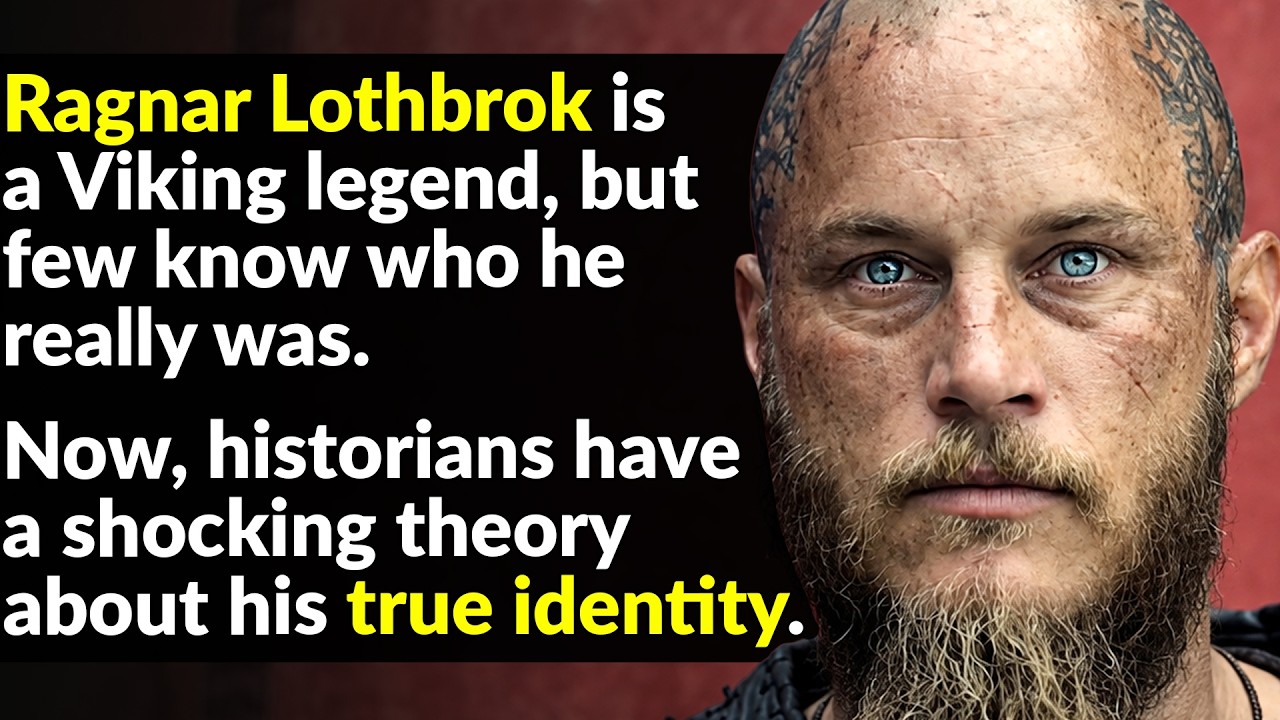
The stories of Ragnar Lothbrok are legendary, and few people can separate truth from fiction. But historians have a startling theory about his true identity. Between being a man and a myth, Lothbrok is a legendary Viking hero and king who, in his final horrific moments, predicted that his sons would avenge him with the Great Heathen Army. Most, if not all, of what history knows about Ragnar Lothbrok comes from semi-fictional sources.
Old Norse sagas, poems, and Icelandic chronicles paint a picture of a fearsome Viking warrior and Danish king. Yet, what is real and what is fictional remains debated. Where does the man end and the myth begin? The best available information suggests Lothbrok was the son of Sigurd Ring, the famous king of the Swedes and Danes.
His mother was said to be Alfhild, a Swedish princess from the small kingdom of Alfheimr. Nobility ran through his veins. Lothbrok, according to himself, was not merely noble. He was practically divine, boldly claiming to be a direct descendant of Odin.
This was more than self-aggrandizement, as his divine legacy helped legitimize his rule and struck fear into his enemies. The sagas describe Lothbrok as the largest and handsomest man eyes had ever seen, wise, good to his men, and harsh to his foes. In short, the ideal Viking. Lothbrok and his raiders were apparently so busy raiding and plundering that they failed to record their raids.
The richest accounts of his deeds come from Icelandic sagas composed decades or even centuries after his time. However, some scholars have agreed that at least part of Ragnar’s story is historically accurate. Some scholars argue that Lothbrok is actually a composite figure. They say that most of the exploits attributed to him are actually the real deeds of several Viking raiders whose victories slowly merged under one name.
Notably, this name does not even appear consistently in historical records. Historians rely mainly on the Anglo-Saxon Chronicle for their facts about Viking raiders, but even this generally reliable source offers little clarity on Lothbrok. The chronicle mentions two powerful Viking raiders in 840 A. D.
, one called Ragnall and the other Reginherus. Most experts believe both names refer to the same man, and that his exploits are truly legendary. The first act of heroism attributed to Lothbrok seems drawn directly from a fairy tale. Legend holds that Lothbrok faced a giant serpent, sometimes said to be a dragon, guarding the beautiful maiden Thora Borgarhjört.
Once he slew the beast, he rescued the girl and won her hand in marriage. One of the few facts most historians agree on is that Lothbrok had three wives. According to legend, his first wife was not Thora, but Lagertha, a fierce warrior woman. To win her hand, he killed a bear and a massive dog prowling outside her home.
The Danish historian Saxo Grammaticus provides some of the only accounts of Lothbrok’s turbulent marriages. He claimed Lothbrok had a son, Fridleif, and two daughters with Lagertha, but later divorced her. Thora Borgarhjört was his second wife, a princess, daughter of the Swedish king Herraud. Grammaticus records sons from this marriage: Radbard, Dunvat, Sigurd Snake-in-the-Eye, Björn Ironside, Agnar, and Ivar the Boneless.
Yet most historians believe Lothbrok’s famous sons had a different mother. According to the sagas, Thora died of an unknown illness. Lothbrok then fell in love with Kraka, an exceptionally beautiful and wise woman. The Saga of Ragnar Lothbrok states that Ivar the Boneless, Björn Ironside, and Sigurd Snake-in-the-Eye were the fruit of his marriage to Kraka, not Thora.
When Lothbrok met Kraka, she lived with a peasant couple, but Kraka was not her true identity. She was actually Aslaug, the hidden daughter of Sigurd Fafnisbani, the dragon slayer, and the fearsome warrior Brynhildr. In Gesta Danorum, Grammaticus’s most prominent work, another woman appears in Lothbrok’s life. While most sources agree he had only three wives, Grammaticus lists a possible fourth, Swanlaug, though this may simply be another name for Aslaug.
Lothbrok was not known for his fidelity. Grammaticus records that he fathered another son, Ubbe, possibly from an extramarital affair with an unnamed woman. The stories of Lothbrok slaying dragons and fighting dogs may be mythical, but his sons were certainly real. Multiple chronicles from different times and places confirm that many of them existed.
Ivar the Boneless, Ubbe, Sigurd Snake-in-the-Eye, Fridleif, Halfdan Ragnarsson, and Björn Ironside are all confirmed historical figures. Nearly each one surpassed their father. Since his sons were real, historians have struggled to find conclusive evidence that Lothbrok was also a real man. One piece of evidence comes from Chronicon Roskildense, a 12th-century document describing Lothbrok as the father of the cruel Norse king Ivar, likely Ivar the Boneless, and his brothers.
Around 1190, the Danish historian Sven Aggesen became the first person in recorded history to use Lothbrok’s full name as we know it today. Aggesen’s account gained weight due to his claim that Lothbrok’s son, Sigurd Snake-in-the-Eye, conquered Denmark, sent its king to Valhalla, married his daughter, and took the throne himself, all largely factually accurate. By the 12th century, the legend of Lothbrok had spread widely across the Norse world. The Icelandic scholar Ari Thorgilsson confirmed details of Lothbrok’s deeds between 1120 and 1133, specifically claiming that Ivar, son of Ragnar Lothbrok, ended the life of King Edmund of East Anglia.
The 9th-century poet Bragi Boddason composed Ragnarsdrápa, a skaldic poem that made Lothbrok a legend. Part of the difficulty in confirming Lothbrok’s life lies in the fact that nearly all information comes from Norse sources. This changed when the Norman historian William of Jumièges wrote about King Lothbrok of Denmark, who banished his son Björn Ironside from his kingdom. History certainly records that Björn raided and plundered from Normandy to the Mediterranean.
Writing his history of the Archdiocese of Hamburg-Bremen, the chronicler Adam of Bremen referred to Lothbrok in passing, writing about the cruelty of Ivar the Boneless and his Norse warriors toward Christians, and noting that Ivar was Lothbrok’s son. The famous stone tomb at Maeshowe in the Orkney Islands contains the only confirmed runic inscription that actually mentions Lothbrok. The tomb was built long before Lothbrok’s time. Its sons were bold.
Men of such strength and skill were rarely found. The mention of her sons has led some to believe Lothbrok was actually a shieldmaiden. Whether fact or fiction, man or myth, Lothbrok was one thing above all: terrifying. Multiple sources confirm he was a master of the Viking style of warfare, the terrifying blitzkrieg.
By striking hard, fast, and only when he held the advantage, Lothbrok instilled fear in his opponents before they could organize a proper defense. The Siege of Paris in 845 is one of the best-documented Viking raids in history and was certainly Lothbrok’s doing. Frankish accounts of the siege and plunder specifically name Reginherus as the leader of the attack, though historians hesitate to assert that Reginherus was actually Ragnar Lothbrok. But only Lothbrok could have done something as terrible and grand as what followed.
Before reaching Paris, on his way up the Seine, Lothbrok was said to have raided Rouen. This prompted Charles the Bald to split his army in half, allowing Lothbrok to easily destroy both. But he did not stop there. Reports indicate Lothbrok took more than a hundred prisoners and hanged them on an island in the Seine to demoralize the Frankish forces.
With his forces defeated and Paris plundered and burned, Charles the Bald had no choice but to surrender to Lothbrok. The legendary Viking’s terms were outrageous. Just to make him leave and hope he never returned, Charles the Bald paid Lothbrok an astonishing 7,000 livres of silver, one of the largest ransoms ever paid to the Vikings. Frankish historians were understandably upset by the ransom, but if their accounts are accurate, justice came quickly.
They claim that shortly after leaving Paris, Lothbrok fell severely ill and died in Denmark. Christian writers called it divine punishment. Departing from Frankish accounts and returning to Saxo Grammaticus, Lothbrok continued raiding after leaving Paris. Grammaticus claims Lothbrok raided the Irish coast in 851 and even established a settlement near modern Dublin.
From there, he sailed back and forth along the Irish and English coasts doing what he did best. The Icelandic sagas agreed, claiming Lothbrok went raiding in England, where he met a terrible end. According to these records, the Anglo-Saxon king Ælla of Northumbria captured Lothbrok and threw him into a pit of snakes in 865. Other accounts are less mythical.
One suggests he likely perished doing what he loved, raiding, meeting his end between 852 and 856 in a storm in the Irish Sea. Many scholars agree this version is probably more accurate. According to the 13th-century Icelandic Saga of Ragnar Lothbrok, by the time he sacked Paris, his sons Björn Ironside and Ivar the Boneless had already established reputations as fearsome Vikings. But Lothbrok did not want his sons to overshadow him.
So he sailed to conquer England with a small force of men and only two ships. Thus, according to legend, King Ælla was able to defeat him. When Lothbrok’s sons learned of their father’s death, they did what any true Viking would do. They flew into a rage.
They mobilized a force of 4,000 warriors and sailed for England. The Great Heathen Army was unlike any army the world had seen. When they reached Thetford, they immediately put their swords to work, killing Edmund the Martyr in a famous incident. Then they marched toward York, fulfilling their father’s last prophecy.
In that battle, Lothbrok’s sons defeated King Ælla and sent him to Valhalla, where Lothbrok was waiting. This victory paved the way for Viking occupation and eventually led to the creation of the Danelaw. Ivar led the Great Heathen Army for another five years, eventually dying in Dublin in 873. After that, Halfdan took command of Norse forces and conquered Wessex.
When the Danish king Bagsecg fell during the Battle of Ashdown, Halfdan seized the opportunity to make peace with the new powerful King of Wessex, Alfred the Great. Meanwhile, Lothbrok’s other sons were causing chaos elsewhere. Between 857 and 859, chronicles reference a fearsome Viking and skilled naval commander who raided Paris and its surroundings. This warrior is named only as Björn.
According to some sagas, Björn Ironside became king of Sweden and Uppsala, then passed the crown to his son Erik. Historians note these accounts, if taken literally, contain chronological inconsistencies. The legend of Ragnar Lothbrok, the tales of dragon slaying and prophecy, may have been an accurate construction to pave the way for Viking raids. Some historians believe most of what we know about Lothbrok was simply political propaganda.
If so, it was highly effective. Many of his sagas recall that the mere mention of his name was enough to spread panic among his enemies. For centuries after his death, across the northern lands, everyone wanted a piece of his glory.
Kings, leaders, and hardened Viking warriors claimed descent from the legendary Ragnar Lothbrok.