On the morning of March 8, 1862, the crew of the 50-gun USS Congress was preparing for a routine inspection when, at 12:45 p. m. , a column of thick black smoke appeared on the horizon. The officer of the deck handed his telescope to a shipmate.
“Finally,” he said, “that thing is coming. ”
It was a vessel unlike anything ever seen before, and its mission would change the course of naval warfare. The Confederate ironclad CSS Virginia was heading toward the Union fleet at Hampton Roads, carrying with it centuries of naval tradition on the verge of being overturned. Iron armor on ships was not a new idea.
In the third century B. C. , the king of Syracuse reportedly built a merchant ship sheathed in lead. In 1592, a Korean admiral repelled a Japanese naval attack using an iron-covered “turtle ship.
” The French launched the Gloire in 1859, the first ocean-going ironclad, and Britain followed with the Warrior. But none of those vessels had ever been tested in combat. That test would come on the waters of Hampton Roads. The Confederate Navy, starting from almost nothing, needed ships capable of breaking the Union blockade.
Secretary of the Navy Stephen Mallory, a former U. S. senator and chairman of the Naval Affairs Committee, understood the promise of ironclad technology. When Virginia seceded in April 1861 and the Gosport Navy Yard at Norfolk fell into Confederate hands, the opportunity emerged.
Federal authorities had ordered the destruction of the yard and the ships anchored there, including the steam frigate USS Merrimack. On the morning of April 18, 1861, fuses were lit, but the powder charges failed to destroy the drydock. The Merrimack was scuttled, but it was raised on May 30, and Mallory saw something in the burned-out hulk. Instead of building from scratch, he ordered the vessel converted into an ironclad at an estimated cost of $172,523.
The conversion was slow and difficult. The Confederacy had few skilled technicians, and only one rolling mill capable of producing the required iron plates. After nine months of intense work, the ironclad was commissioned on February 17, 1862, and renamed Virginia. She was 262 feet long, with a 178-foot casemate covered in two layers of iron plating, angled at 36 degrees to deflect enemy fire.
She carried ten guns and a 1,500-pound iron ram. The Virginia was not without problems. Her heavy draft of 23 feet made her difficult to maneuver, and she leaked. To compensate for miscalculations in weight, hundreds of tons of iron had to be loaded aboard.
By March 5, her waterline sat dangerously low, and her iron belt was only about six inches below the surface. She also needed a crew of 300 men, which proved difficult to assemble. Command was given to Commodore Franklin Buchanan, a 61-year-old Maryland native and grandson of a signer of the Declaration of Independence. He had been the first superintendent of the Naval Academy, and he left the U.
S. Navy when he mistakenly believed Maryland would secede. When it did not, his request to return was denied. On Saturday, March 8, 1862, with the weather favorable, Buchanan decided to act.
At 11:00 a. m. , the Virginia cast off and moved slowly down the Elizabeth River toward the Union fleet at Hampton Roads. Spectators lined the banks.
One skeptic shouted that the ironclad would never come back. At about 1:08 p. m. , Union lookouts spotted the approaching vessel.
Shells fired by federal ships and shore batteries bounced harmlessly off her armor. The Virginia opened fire on the USS Cumberland, and the 24-gun sailing sloop took devastating hits. Buchanan then ordered full speed ahead, intending to ram the Cumberland. The iron ram slammed into the sloop’s side below the waterline, tearing a hole so large “a horse and carriage could have passed through it.
” The Cumberland sank in about half an hour, her flags still flying from the mast above the water. The Virginia then turned her attention to the USS Congress. The 50-gun frigate ran aground while trying to escape, and after a fierce bombardment, she raised a white flag. When Confederate boats approached to accept the surrender, Union soldiers on shore opened fire.
Enraged, Buchanan ordered the Congress destroyed with hot shot. The ship burned for hours. During the action, Buchanan exposed himself to enemy fire and was shot in the thigh, losing command to Lieutenant Catesby Jones. In four hours of fighting, the Virginia had inflicted the worst defeat in U.
S. Navy history, a record that stood until Pearl Harbor on December 7, 1941. But the Confederacy’s dominance lasted only one day. The Union ironclad USS Monitor had been rushed to completion in New York, designed by Swedish engineer John Ericsson.
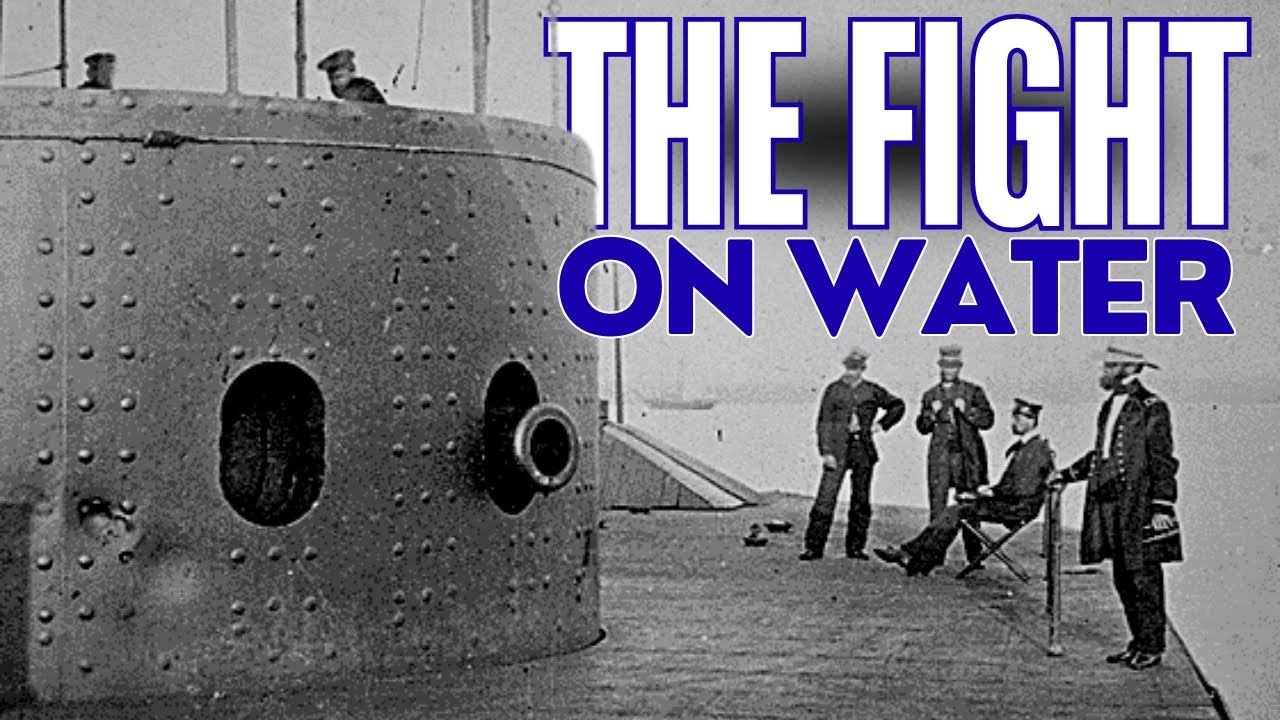
She was a radically different vessel: 172 feet long, with a flat iron hull and a revolutionary rotating gun turret carrying two 11-inch Dahlgren guns. Commissioned on February 25, 1862, under Lieutenant John L. Worden, she departed New York on March 6, towed down the coast through rough seas, and arrived at Hampton Roads around 9:00 p. m.
that same Saturday night. On the morning of Sunday, March 9, the Virginia returned to finish off the grounded USS Minnesota. But waiting in front of the frigate was the strange little “cheese box on a raft. ” The two ironclads met in a battle unlike anything ever seen before.
For roughly two hours, the two vessels pounded each other at close range. Shells bounced off both ships’ armor. The Virginia ran aground at one point and came under punishing fire from the Monitor. The Confederate ship managed to break free after burning oiled cotton and applying extreme boiler pressure.
Both ships tried to ram each other without success. Inside the Virginia, the casemate proved impenetrable. Inside the Monitor, the crew grappled with mechanical problems, including a turret that was difficult to rotate and a pilot house that blocked the guns from firing directly ahead. Around 11:00 a.
m. , a Confederate shell struck the Monitor’s pilot house directly. Fragments of iron and powder sprayed Lieutenant Worden’s face, and he was temporarily blinded. Command passed to Lieutenant Samuel Dana Greene.
The battle continued until about noon, when the Virginia, with the tide falling and concerns about being trapped in shallow water, withdrew toward the Elizabeth River. The battle ended as a tactical draw. Strategically, however, the fight was a Union victory. The Confederacy needed a decisive blow; instead, its ironclad’s one-day supremacy had been neutralized.
Within weeks, Union Major General George B. McClellan’s Peninsula Campaign forced Confederate forces to withdraw from Norfolk. Unable to sail up the James River due to her deep draft, the Virginia was run aground and destroyed by her own crew on the night of May 10-11, 1862, to prevent her capture. The Monitor survived only seven more months.
Ordered south in December 1862, she sank in a storm off Cape Hatteras, North Carolina, on December 31, 1862. Sixteen crewmen were lost. The two great ironclads never fought each other again. The Confederacy planned about 50 ironclads of the casemate design, with 22 commissioned.
The Monitor served as the prototype for more than 60 subsequent vessels, all of which came to be known as “monitors. ”
In 1973, marine archaeologists located the wreck of the Monitor about 16 miles off Cape Hatteras. In August 2002, her turret was raised from the ocean floor in a remarkable engineering operation, along with the remains of two of the crewmen who had gone down with the ship. They were buried with full military honors at Arlington National Cemetery on the 151st anniversary of the Virginia’s sortie.
The turret is now on display at the USS Monitor Center at The Mariners’ Museum in Newport News, Virginia. After March 9, 1862, no major navy in the world could afford to ignore the ironclad revolution. The age of wooden warships was over.