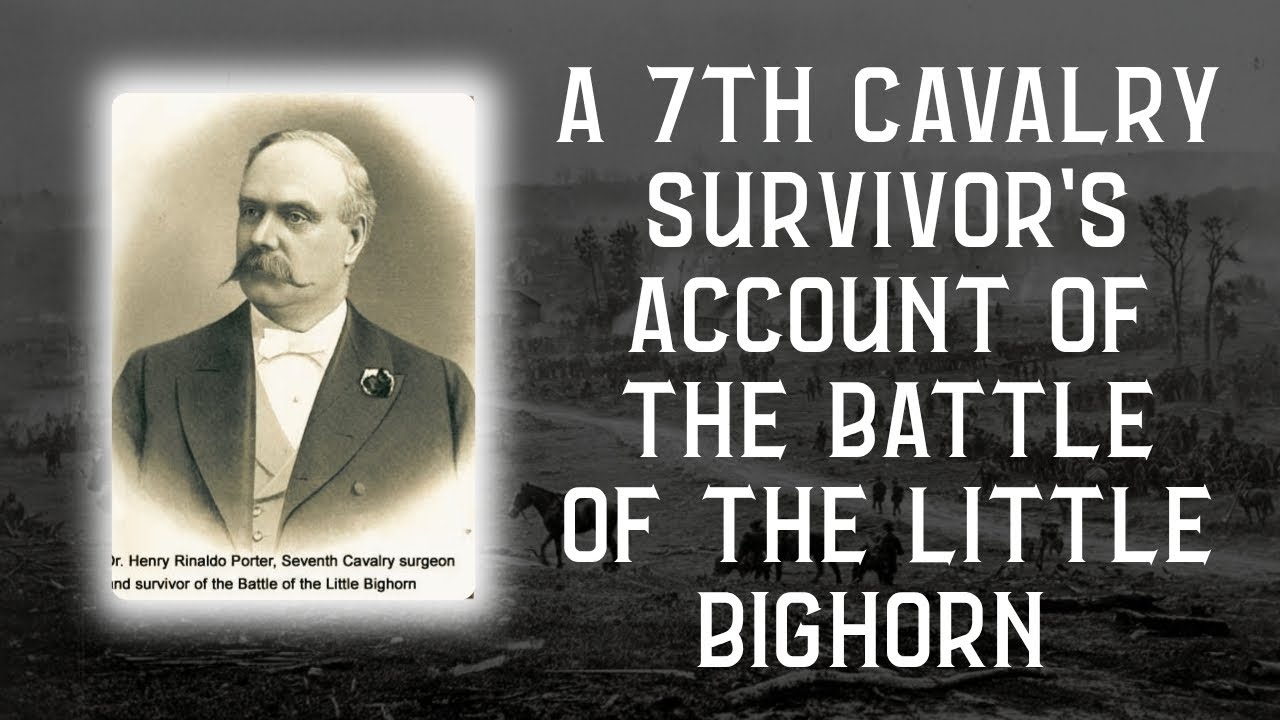
The battlefield surgeon who had ridden with George Armstrong Custer for years made a last-minute switch that saved his life, a decision sealed by a few blunt words from the chief surgeon who took his place. Dr. Henry Porter, who gave this firsthand account of the Battle of the Little Bighorn, watched Custer and his command ride off to their deaths while he survived with Major Reno’s battalion. The expedition left Fort Abraham Lincoln on May 17, 1876, under General Terry’s command.
Custer’s wife accompanied her husband on horseback as far as the Hart River, where she bid him an affectionate farewell and returned to the garrison. The march to Powder River in Montana was uneventful, save for spotting a lone horseman miles away through field glasses. The rider turned out to be Buffalo Bill, the noted scout and Indian fighter, who was attached to General Crook’s command then operating in the Black Hills region. He was off on an expedition of his own, hundreds of miles from any habitation.
After the command camped at Powder River, Major Reno was ordered out on a scouting expedition. He found a wide Indian trail leading west toward the Rosebud River. Custer was then ordered to follow the trail, with instructions to strike the Indians on the 26th. General Terry was confident his scouts had located the enemy precisely, a belief that results would demonstrate was correct.
Terry and General Gibbon were to approach by another route, striking the Indians in front while Custer closed in on the rear. Custer started from camp on Powder River on the morning of June 24th, with Porter sent along. They followed the trail all day and night. The night was very dark, and they lost the trail once, finding it again by lighting matches.
They proceeded until 4:00 on the morning of the 25th, camping in a deep ravine where the Indians could not see them. They were not allowed to unsaddle or unpack. Being very tired after the long ride, they laid down and slept, each man holding his horse by the bridle reins. In about an hour, scouts reported a large camp of Indians ahead.
The command was ordered to get ready for action. Custer came to Porter and said, “Porter, there is a large camp of Indians ahead, and we are going to have a great killing. ” At 6:00 they started, with Custer intending to charge the Indians in a body, supposing the command had not been discovered. Soon the scouts reported that the Indians had seen them.
Custer then decided to divide the command. He sent Colonel Benteen with three companies to the left, Major Reno with three companies in the center, and took three companies himself to the right, his idea being to surround the Indian camp. Captain McDougall was left in charge of the pack train. It was about 10:00 when the command was divided.
Just as they were ready to start, Custer came to Porter and said, “Doctor, I would like to have you go with me as you are younger and more robust and Dr. Lord, the chief surgeon, is not feeling very well. ” Porter replied, “All right, I would much prefer going with you. ” Custer said he would see Dr.
Lord and ask him to consent. They rode over to where Dr. Lord was, and Custer spoke to him about the arrangement. The doctor replied, “Not much.
I am going with you. ” Porter wrote: “The poor fellow in those few words saved my life and sealed his own doom. ”
Porter went with Reno. They had proceeded but a short distance when Captain Cook, Custer’s adjutant, came up and said the Indians were right ahead and they were ordered to charge them as fast as possible.
They went forward at a lively gait. When they came to the river, they discovered the Indians were on the opposite bank. They forded the river and suddenly came upon 10 or 15 Indians who were running. They then thought the fight was already won.
They rode some distance toward the Indian camp when suddenly a swarm of Indians rose up and poured a terrific fire into them. They dismounted and formed a skirmish line. At first there were only a few, then more and more appeared until the ground seemed fairly alive with them. They were all naked, their bodies painted hideously, and they rode their ponies bareback.
The fire became so hot that Reno ordered his men to mount and led them under cover of the woods. The Indians closed in, shooting through the branches and killing some of the men. A soldier was shot in the little clump of trees where Porter was. He dismounted and found the man mortally wounded.
Reno ordered the troops to mount and charge, and a running fight ensued. Porter’s horse was rearing and plunging, and he had all he could do to hold him. The Indians, in their mad pursuit of the troops, did not notice Porter in the timber. They were passing within ten feet of where he was.
He placed a bandage on the soldier’s wound as best he could and again mounted his frightened horse. As he was leaving, the poor soldier said, “For God’s sake, doctor, don’t leave me to be tortured by those fiends. ”
Bullets were flying thick and fast. Porter turned his horse loose and caught up with the troops, who had gotten half a mile away.
In that half-mile ride, he believed he was the target of a thousand rifles but escaped without a scratch. They again forded the river and took a stand on top of a steep hill. A few minutes later, Benteen with his three companies came up, as did McDougall with the pack train. Benteen, after leaving them when the command was divided, had gone west to the river.
Not seeing any Indians and hearing the firing, he rushed back and joined them. They fought there the remainder of the day, surrounded by 3,000 Indians while there were only 300 of them all told. The men dug rifle pits with their knives and tin cups. At dark, the Indians stopped firing.
Some men then crawled down to the river and secured water. They had been fighting in the broiling sun all day without a drop of water, and the wounded were begging for a drink. Porter had some brandy, but he told them it would make them worse. They insisted on having it anyway.
The next morning, the Indians again opened fire. Although Reno was the ranking officer, Colonel Benteen was really in command, and to his coolness and bravery those who were saved owed their lives. With the air thick with bullets and some piercing his clothing, he stood calmly directing the troops. Occasionally a band of Indians would dash up to within two or three hundred yards, and the men would charge them.
Several Indians were killed in these charges. Finally, one of the soldiers killed and scalped an Indian in plain view of the others. This frightened them, and they kept a safe distance afterward. A perfect storm of lead was poured in on them all day on the 26th until about 4:00 in the afternoon, when the firing gradually ceased.
They were frightened, thinking the Indians were up to some bloodier mischief. Finally, they saw them moving off in a body. That night, most of the soldiers slept and were much refreshed in the morning. After the Indians left, they were able to procure water.
They had all been nearly famished. During the morning of the 27th, General Terry and his command came up. He and his staff were all crying, and General Terry said, “Custer and his whole command are killed. We thought you were too.
” During the two days they were surrounded, the inquiry among the men for Custer was loud, and a court-martial for the general was freely speculated upon. After separating from them, Custer had gone through a rough country for four or five miles and attacked the Indians in the rear. As soon as they could, several officers and Porter went over to where Custer had fought and found what General Terry had reported. They found Custer’s body stark naked, as white and clean as a baby’s.
He was shot in the head and breast. The body of Captain Tom Custer, the general’s brother, was horribly mutilated. He was disemboweled, and his head had been crushed by a blow from a stone hammer used by the Indians. The only arrow wound Porter found was in his head.
He had the Sioux mark of death, a cut from the hip to the knee reaching to the bone. His heart was not cut out, as had been reported by Rain in the Face, one of the Sioux chiefs who took part in the fight. Porter cut a lock of hair from the head of each officer as he lay and gave it to their families on his return home. The steamer Far West was moored at the mouth of the Little Bighorn.
She was the supply boat of the expedition and had made her way up the Bighorn farther than any other boat. After burying the dead, they took the wounded on litters ten or twelve miles to the boat, and Porter was detailed to go down to Fort Lincoln with them. Colonel Smith, Terry’s adjutant general, was sent along with the official dispatches, carrying a traveling bag full of telegrams for the Bismarck office. Captain Grant Marsh of Bismarck was in command of the Far West, and the steamer performed a feat unequaled in western steamboating.
Marsh put everything in the most complete order and took a large supply of fuel. His orders were to reach Bismarck as soon as possible. The steamer never received the credit due her, nor did her gallant captain. The Bighorn is full of islands, and a successful passage is not an easy feat, but the boat made it without an accident.
After a thrilling voyage, at Fort Buford and Fort Stevenson they stopped a minute to tell the news. At Fort Berthold, a wounded scout was put off. Two of the wounded died, and they went ashore to bury them. Porter wrote that they approached home with something of that feeling that always moves the human heart, mixed with sorrow and gladness.
At 11:00 on the night of July 5th, they reached Bismarck and Fort Lincoln, having made 1,000 miles in 54 hours. Colonel Smith and Porter hurried from the landing uptown and called up Colonel Lounsbury, the editor of the Tribune, and the telegraph operator, J. M. Carnahan, who took his seat at the key and scarcely raised himself from his chair for 22 hours.
What he sent vibrating around the world is history.