In 1695, King Louis XIV of France quietly ordered that a nun living in a small convent near Fontainebleau receive a generous royal pension for life. No official explanation was given, and rumors spread immediately. Some whispered that she was the king’s illegitimate daughter. Others claimed something far more scandalous—that she was Black, or possibly even the queen’s secret child.
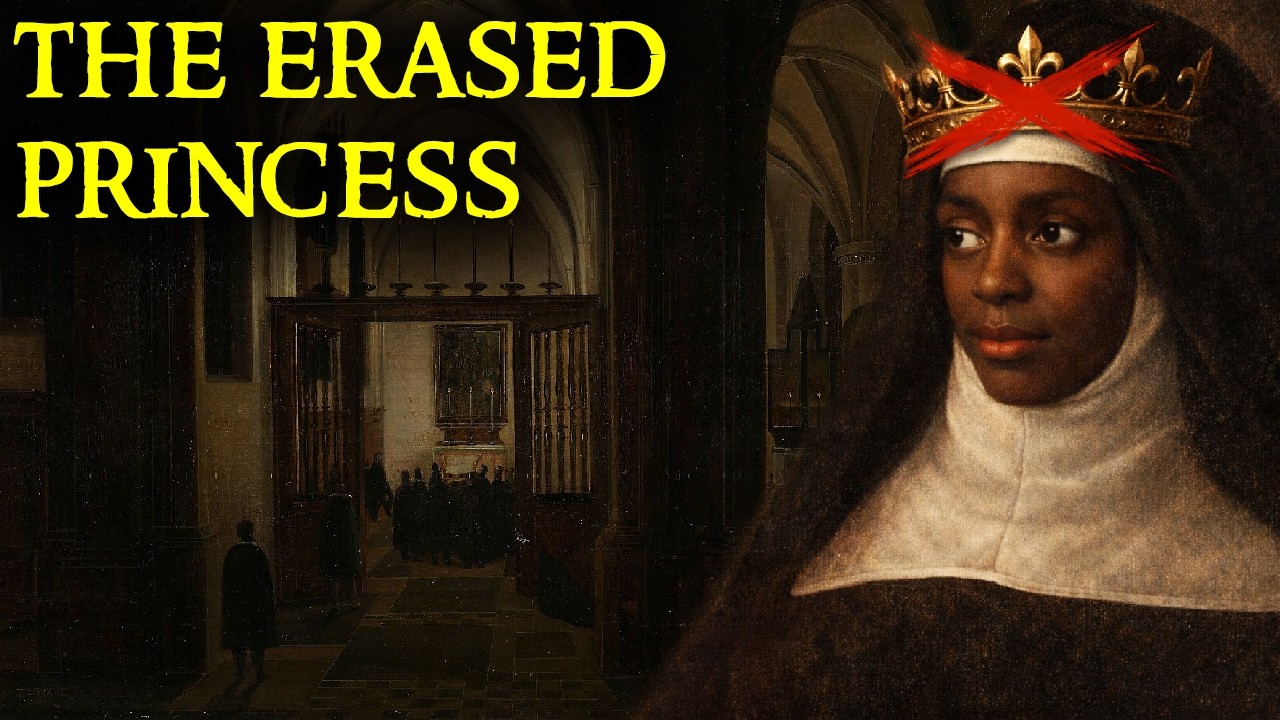
The woman at the center of the mystery was known as Louise Marie Thérèse, remembered today as the Black Nun of Moret. Her story is preserved in one of the most curious paintings produced in 17th-century France. The artwork, which depicts a Black woman dressed as a nun, was painted by an unknown artist sometime between 1695 and 1700. It now hangs in the Bibliothèque Sainte-Geneviève in central Paris.
The painting is remarkable for several reasons. In the 17th century, it was highly unusual to paint an ordinary nun at all. Even more extraordinary was the fact that the subject was a Black woman at a time when very few Black people lived in France, and even fewer were cloistered nuns. The painting remained hidden for centuries and was only discovered in 2014, found in an attic, restored, and eventually placed on public display.
Historians are unsure when Louise Marie Thérèse was born. Some studies suggest she came into the world around 1664, while others place her birth further back, in the late 1650s. The painting does little to clarify her age, as its exact date is unknown. She appears to be in her late 20s or 30s in the portrait, which is not considered a particularly skilled work.
Virtually nothing is known about her early life. She enters the historical record in the 1690s and 1700s, when several high-profile French figures began writing about her. Many prominent aristocrats visited her at the Benedictine convent of Villers-Cotterêts, located in north-central France near the Château de Fontainebleau, a residence frequently used by Louis XIV’s court, particularly during autumn hunting season. At the convent, she was known as La More—a term used in medieval and early modern Europe to describe dark-skinned men and women.
The central question is why a Black woman had ended up as a nun in northern France, and why so many aristocrats either wrote about her or traveled to see her. The answer, contemporaries believed, lay with the king and queen of France. Louise Marie Thérèse’s parentage is the only real reason she is known today. Contemporaries remarked on the unusual attention the royal family paid to her and regularly speculated about her origins.
Depending on which theory is followed, she is said to have been either the illegitimate daughter of Louis XIV or of his wife, Maria Theresa of Spain. Louis XIV ascended the throne in 1643 at just four and a half years old and ruled until 1715. He had many mistresses throughout his long reign and fathered numerous illegitimate children. Maria Theresa, the daughter of King Philip IV of Spain, had married Louis in 1660 as part of a peace agreement ending a long-running war between France and Spain.
She was well aware of her husband’s infidelities, but it would have been almost unthinkable for a reigning queen to bear illegitimate children of her own. There are three main theories concerning Louise Marie Thérèse and the attention she received from the royal family. The first claims she was a daughter of the king. By the middle of the 17th century, France had become a colonial power engaged in the slave trade between West Africa and the Caribbean.
While there were few Black women in France during Louis’s time, there were some. It is plausible that Louis fathered a daughter with a Black woman at the French court and sent her to a convent to be raised, with courtiers checking on her in later years and arranging a pension for her in 1695. There is limited evidence that Louis may have also fathered another dark-skinned child named Dorothy, mentioned in a few archive records of the time. But the evidence for her existence is even thinner.
Louis XIV was famously adept at secrecy, concealing whatever he deemed unfit for public knowledge, whether affairs of state or deeply personal matters such as his discreet marriage to Madame de Maintenon in 1683. The second theory, favored by many historians, holds that the Black Nun of Moret was actually the queen’s daughter. In the 17th century, it was common for royal families to retain people considered oddities at court, including dwarves and people from Africa. One such figure was Nabo, a Black dwarf said to be a resident of the court.
The theory suggests that Queen Maria Theresa engaged in a liaison with Nabo, resulting in a child who had to be secretly sent away to a convent to avoid royal embarrassment. There is another layer to this theory. On November 16, 1664, Maria Theresa gave birth to her third child, a daughter officially named Marie Anne. Barely six weeks later, the child was declared dead, and her body was publicly displayed before burial at Saint-Denis.
Proponents of this theory insist the child never died. They argue that a substitute body or an empty coffin was used to conceal a devastating secret—that the princess was Black. Alexander Bontemps, the king’s discreet first valet, is said to have quietly removed the child from court, sending her away under strict secrecy through religious houses before she disappeared into a Benedictine convent. Critics of this theory are unequivocal in their rejection.
Maria Theresa, raised in an intensely pious court, could not have borne a child by anyone other than the king, they argue. Royal births were public events closely watched by courtiers and foreign ambassadors, none of whom ever reported the birth of a Black princess. Some historians point instead to a grim medical reality: Marie Anne was born after a brutal delivery, premature and gravely ill, her skin darkened by a lack of oxygen—a detail later transformed into rumor. Louise Marie Thérèse’s name could support either theory.
Louise is the female counterpart of Louis, so the name could have been chosen whether she was the king’s illegitimate daughter or the queen’s. But the name alone does not automatically imply she was the biological child of either. She could have been given the names of both the king and queen if she were a sponsored orphan of the royal couple. That possibility forms the third theory: that Louise Marie Thérèse was a Black orphan simply given royal patronage.
This would explain the pension provided by the king in 1695 and why court nobles were occasionally sent to Moret to check on her. It was not uncommon for the crown to become the ward of infants in 17th-century France. Hundreds of orphaned women, for example, were sent to New France, modern-day Quebec, in the second half of the 17th century under Louis XIV’s patronage to help populate the French colony. Millions of North Americans today descend from these so-called daughters of the king.
Sources for Louise Marie Thérèse come from several prominent French aristocrats and court figures of Louis XIV’s reign. The king’s first cousin, the Duchess of Montpensier, kept an extensive diary during her own career at court. She noted that in addition to providing a pension, the king frequently sent people to Moret to check on the Black nun. The queen was long dead by then, having died prematurely in 1683 at age 44.
These accounts also claim that Louise was baptized at court before being discreetly removed to the convent, where she was notably well educated. Surviving letters reveal that she could read and write with ease. The best account of the Black Nun was produced by Louis de Rouvroy, the Duke of Saint-Simon, a prominent courtier and memoirist of the late 17th and 18th centuries. His enormous diaries are considered the finest account of the courts of Louis XIV and Louis XV.
Even he was unsure about Louise Marie Thérèse’s parentage. He wrote that there was a woman of color in the convent, placed there very young by Bontemps, the king’s valet. She received the utmost care and attention but was never shown to anybody. The queen and Madame de Maintenon always watched over her welfare, and she was treated with more consideration than the most distinguished people.
Saint-Simon recounted a telling incident. Hearing the king hunting in the forest one day, Louise forgot herself and exclaimed, “My brother is hunting. ” Court rumor held that she was a daughter of the king and queen hidden away because of her color, with the report spread that the queen had had a miscarriage. Many believed it, Saint-Simon wrote, but whether it was true or not remained an enigma.
Even a court figure with access to scores of people aware of the king’s and queen’s personal affairs could not say for sure what the real situation was. Louise Marie Thérèse’s later life is nearly as obscure as her early years. The queen was long dead by the end of the 17th century, and Louis XIV lived until 1715. After his death, there was little reason for the royal court to maintain contact with the mysterious woman at the convent at Moret.
What can be inferred suggests an outwardly ordinary existence—days spent in prayer, reading, and the routine labor of the convent—though the privileges she enjoyed set her apart, hinting at ties to the royal court that never fully faded. One document written by her in April 1725 attests to her continued life at the convent in her 60s. The last surviving document she signed was dated January 10, 1730. It is speculated that she died in 1732, but even this cannot be concretely established, though it is plausible, as she would have been around 70 years old, an advanced age by early 18th-century standards.
The story of the Black Nun of Moret has captured the imagination in modern times. The French writer Pierre Mariel de Jol came up with an elaborate theory in 1978 in his book, seeking to tie together the legendary tale of the Man in the Iron Mask and the story of the Black Nun. He claimed the mysterious prisoner was Nabo the Black court dwarf, imprisoned after the king discovered that the queen had borne the Black Nun following an affair with him. It made for a good story, but there is essentially no evidence to substantiate it.
Despite its lack of historical merit, the theory sparked renewed interest in Louise Marie Thérèse’s story. She and Nabo featured in the television series Versailles, produced between 2015 and 2018, which followed the theory that the Black Nun was the queen’s daughter. The 2014 discovery of her painting also generated fresh academic interest, with numerous papers appearing over the last decade. An exhibition entitled “The Moors of Moret” ran at a museum in Moret in 2019.
To this day, the story of the Black Nun of Moret continues to intrigue historians and the public alike. But sadly, the real truth of who her parents were will probably never be known for certain. The mystery endures as one of the most puzzling and enduring enigmas of the French royal court.