In 2016, a bottling plant in Gastonia, North Carolina, went quiet. For more than five decades, it had filled every bottle of Sundrop sold across the American South. There was no press release and no farewell ceremony. The machine simply stopped, and production moved to Tennessee—the same state where Mountain Dew, the drink that had spent decades borrowing Sundrop’s citrus-and-caffeine premise, was born in 1940.
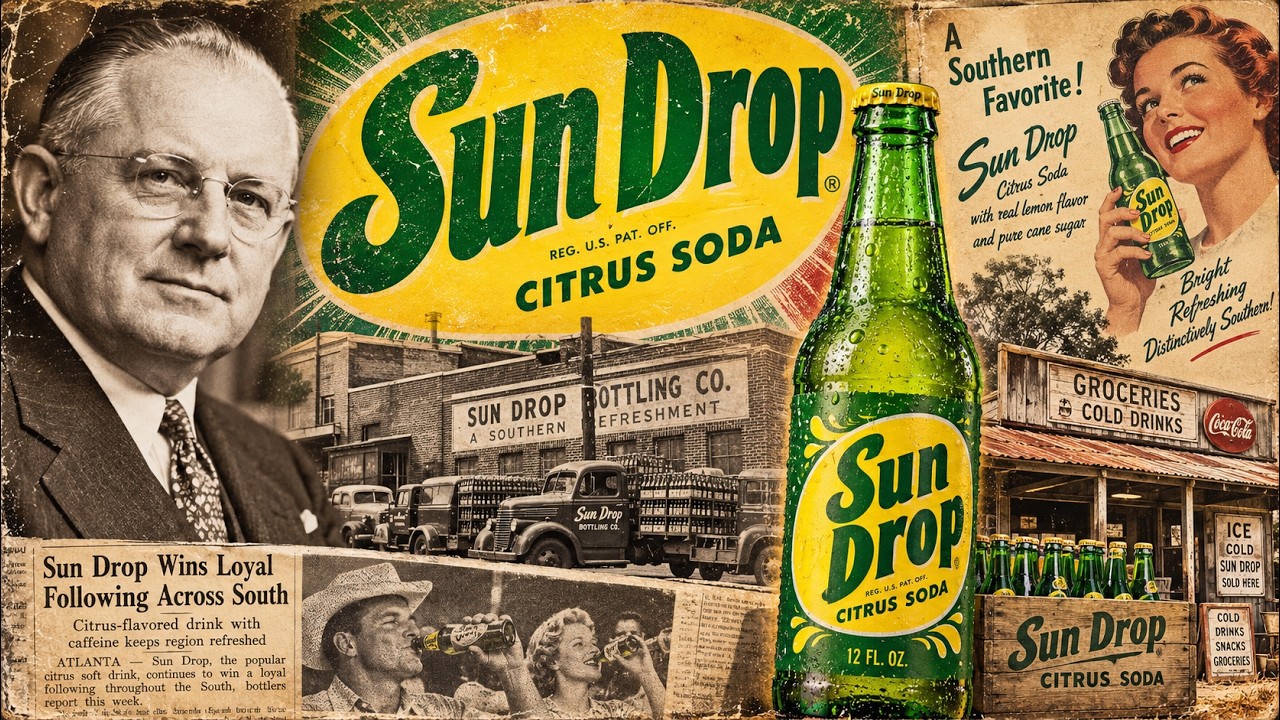
By then, Mountain Dew controlled roughly 80% of the citrus soda market in America. Sundrop, the drink that came first, held on to a fiercely loyal following in a handful of southern states. The real story of Sundrop does not begin with that factory closure. It begins with a recipe scribbled on a scrap of paper in a family car in Missouri, and with what four different corporations did to that recipe over the next six decades.
In 1928, Charles Lasier worked as a traveling salesman of beverage concentrates in New Haven, Missouri, a small river town near the Ozarks. He spent his working life listening to what regional bottlers wanted and could not afford to sell. According to one account, the idea arrived without ceremony: while riding through town in the family car, Lasier pulled out a scrap of paper and wrote down a formula—carbonated water, orange, lemon, and lime—then handed it to his son. Charles Lasier Jr.
worked as a lab technician at his father’s plant. Records suggest it took him roughly two years to turn that idea into something a bottler could actually sell. What he finished with was unusual for its time. Most sodas in the late 1920s were built around a single flavor note—root beer, cola, grape, or orange.
A soda combining three citrus fruits into one sharp profile was closer to an invention than a variation. It also carried a noticeably higher dose of caffeine than most sodas of that era, a detail that would later become the drink’s defining signature. Lasier did not commercialize the drink alone. He shared the formula with a friend, Charles P.
Nanny, a soft drink bottler in Gaston County, North Carolina, roughly 900 miles from New Haven. How the two men met is not fully documented, but their trades overlapped naturally. Nanny took the formula, refined the flavor further, and put it into full production in North Carolina—a decision that would decide which state the drink ultimately belonged to. Nanny was selling into a market with a gap in it.
American bottlers had root beer, cola, grape, and ginger ale locked down, but nobody had built a citrus soda into a genuine regional powerhouse. Southern drinkers had citrus fruit in abundance but almost nothing carbonated and cold that tasted like it. Nanny saw that gap as an opening nobody else had filled yet. The drink did not arrive on shelves as Sundrop everywhere at once.
In different southern markets, it circulated under different names—Sundrop Golden Cola in some counties, Golden Girl Cola in others. The formal commercial debut came in 1951, when Sundrop Cola was introduced at the American Bottlers of Carbonated Beverages Conference in Washington, DC. Gastonia, North Carolina, became its home, and Nanny’s operation there held the bottling contract for more than five decades. The caffeine was the detail that traveled fastest by word of mouth.
In a soda market where most citrus drinks were pitched as light and refreshing, Sundrop carried a kick regular soda did not. Truckers, factory shift workers, and farm hands in the Appalachian foothills noticed it before any advertisement told them to. A soda that woke you up was a different kind of product than a soda that just tasted good. The formula itself also stood apart.
Most citrus sodas of the era leaned on artificial flavoring alone—a cheap, one-note approximation of fruit. Sundrop built its citrus profile from actual orange juice concentrate layered against lemon and lime flavoring, giving it a rounder, less synthetic taste. The effect was sharper than sweet, and beneath the citrus sat a caffeine dose noticeably higher than a typical soda of the period. Nanny did not chase national distribution.
He built depth instead of width, securing shelf space in the drugstore counters, general stores, and corner groceries of the Carolina Piedmont, then pushing outward into Tennessee and Kentucky, county by county. This slow expansion made Sundrop feel local everywhere it went. A drinker in eastern Tennessee and a drinker in the Carolina foothills both experienced Sundrop as their own regional soda, not as a product shipped in from somewhere else. In 1970, Crush International bought the brand and forced one name onto every bottle.
Sundrop Golden Cola, Golden Girl Cola, and Golden Sun Drop Cola all collapsed into a single identity. For the first time, a drinker in eastern Kentucky and a drinker in the Carolina Piedmont were buying the same product under the same name. Sundrop’s advertising leaned into the reputation it had already built by word of mouth. Starting in the 1970s and continuing into the early 1990s, the brand found its public face in Dale Earnhardt, the NASCAR driver whose black number three car defined an era of southern stock car racing.
The partnership worked because Earnhardt’s fans and Sundrop’s drinkers were in large part the same people: working-class Southerners for whom a Saturday afternoon meant a race on the radio and a cold bottle in hand. Nowhere did regional ownership run deeper than in western Kentucky, at an event with no obvious connection to soft drinks. The Fancy Farm picnic, a political stumping tradition dating back to the 19th century where candidates for governor and senator stood before crowds of barbecue-fed Kentuckians, adopted Sundrop as its official drink. Not Coca-Cola, not Pepsi—Sundrop.
In a state where politics and church picnic traditions sat at the same folding table, the soda had become part of the ritual itself. Sundrop’s core territory ran through Kentucky, Tennessee, and North Carolina. But pockets of devoted drinkers also took root a thousand miles north, in Wisconsin and western Minnesota—Midwestern counties with no historical tie to the Carolina Piedmont. Fans living outside the bottling territory paid to have cases shipped to them rather than switch to a local soda.
During the wars in Afghanistan and Iraq, families mailed it to soldiers overseas. It was closer to homesickness with a barcode than ordinary brand loyalty. The drink also found a second life as a mixer. Its sharp, high-caffeine profile made it a natural partner for whiskey, rum, and vodka, and bartenders and home drinkers across the South began pairing it with liquor in ways its inventors never planned.
By 2010, Mountain Dew controlled roughly 80% of every citrus soda sold in the United States. Sundrop held a fiercely loyal fraction of the remainder, concentrated in a handful of states that treated it like a birthright rather than a beverage. The first sign that Sundrop’s identity was no longer fully its own looked like generosity. Under Procter & Gamble ownership in 1985, the brand expanded.
A new diet Sundrop, reformulated with aspartame, and a third variant called Cherry Lemon Sundrop were introduced the same year. On paper, this was a company investing in its product. In practice, it was the first crack in something that had never needed fixing. Sundrop’s identity had been built on one formula and one unmistakable caffeine jolt.
Splitting that identity into variants meant the brand was no longer one thing a southern drinker could point to and call theirs. The decision that set the collapse in motion was a sale. Crush International, which had unified the brand’s name in 1970, sold to Procter & Gamble in 1980. P&G held it through the 1980s, then sold its entire soft drink division to Cadbury Schweppes in 1989.
Cadbury Schweppes held Sundrop through the 1990s and 2000s before splitting its beverage operations into an independent public company in 2008, which eventually became Keurig Dr Pepper after a further merger. Three sales in 29 years meant three new leadership teams and three new sets of national priorities, none of which treated a regional southern citrus soda as a flagship brand. None of these buyers were hostile to Sundrop. A conglomerate does not need to dislike a small regional brand to starve it of attention.
It only needs bigger brands to worry about. Meanwhile, Mountain Dew, backed by PepsiCo’s national advertising machine, spent those same decades turning Sundrop’s original premise into a coast-to-coast phenomenon. The recovery attempts that followed were careful and incremental. Caffeine-free Sundrop launched in February 2002, answering health-conscious drinkers who wanted the citrus flavor without the caffeine.
A diet version of Cherry Lemon Sundrop followed in 2014. Both were reasonable business decisions, but neither gave the brand anything resembling Mountain Dew’s national shelf presence, and both spread an already small budget across more variants. The final blow was quieter than a dramatic boardroom decision. The bottling operation that had carried Sundrop since its earliest days, by then based in Concord, North Carolina, was sold to Carolina Beverage Corp.
, effective December 1, 2016. The plant closed for the first time since Charles P. Nanny had first put the formula into production. Production shifted north into Tennessee, and the supply chain no longer ran through the Carolina Piedmont.
The closure did not kill Sundrop. Keurig Dr Pepper kept producing it, kept it on shelves across Kentucky, Tennessee, and North Carolina, and kept the caffeine, citrus, and yellow-green color intact. But the last thread connecting the drink to a single southern hometown and a single independent bottler had ended. There is no dramatic revival to report—no scrappy small bottler buying back the original recipe.
Sundrop lives on as one line inside a portfolio owned by one of the largest beverage companies in America. What has not changed is who still shows up for it. In Kentucky, Tennessee, and North Carolina, and in the pockets of Wisconsin and western Minnesota, Sundrop remains a drink people defend rather than merely buy. Bottled versions made with real cane sugar rather than high fructose corn syrup circulate among loyalists who can tell the difference on the first sip.
Decades after Dale Earnhardt carried the Sundrop name across southern racetracks, the brand’s motorsport instincts resurfaced in a smaller way. IndyCar driver Ryan Hunter-Reay piloted a Sundrop-sponsored car in more recent years, a faint echo of a marketing strategy nobody at the company was actively planning to repeat. What Sundrop’s more than 90 years demonstrate is not a simple story about a good product losing to a better one. Mountain Dew did not out-taste Sundrop; it out-owned it.
One company, one national budget, and one unbroken chain of decision-making stood against a brand passed through four sets of hands, each of which treated it as a regional footnote rather than a flagship. What survived was a specific taste tied to a specific place, defended by people who had no reason to keep defending it except that it was theirs first. Every July at the Fancy Farm picnic in western Kentucky, a fresh bottle of Sundrop still gets poured over ice at a folding table crowded with barbecue plates.