In mid-February 1864, from his headquarters in Petersburg, Virginia, Major General George Edward Pickett replied to a Union general across the lines. Major General John J. Peck, commanding the Union District of North Carolina, had written to him twice. The first letter protested killings mentioned in a newspaper.
The second concerned an order he had only just learned about. Fifty-three North Carolina soldiers wearing Union uniforms had been captured during Pickett’s failed campaign against New Bern. Peck enclosed a list of their names. He described them as loyal and honest North Carolinians, formally mustered into the United States Army, and he expected them to be treated as prisoners of war.
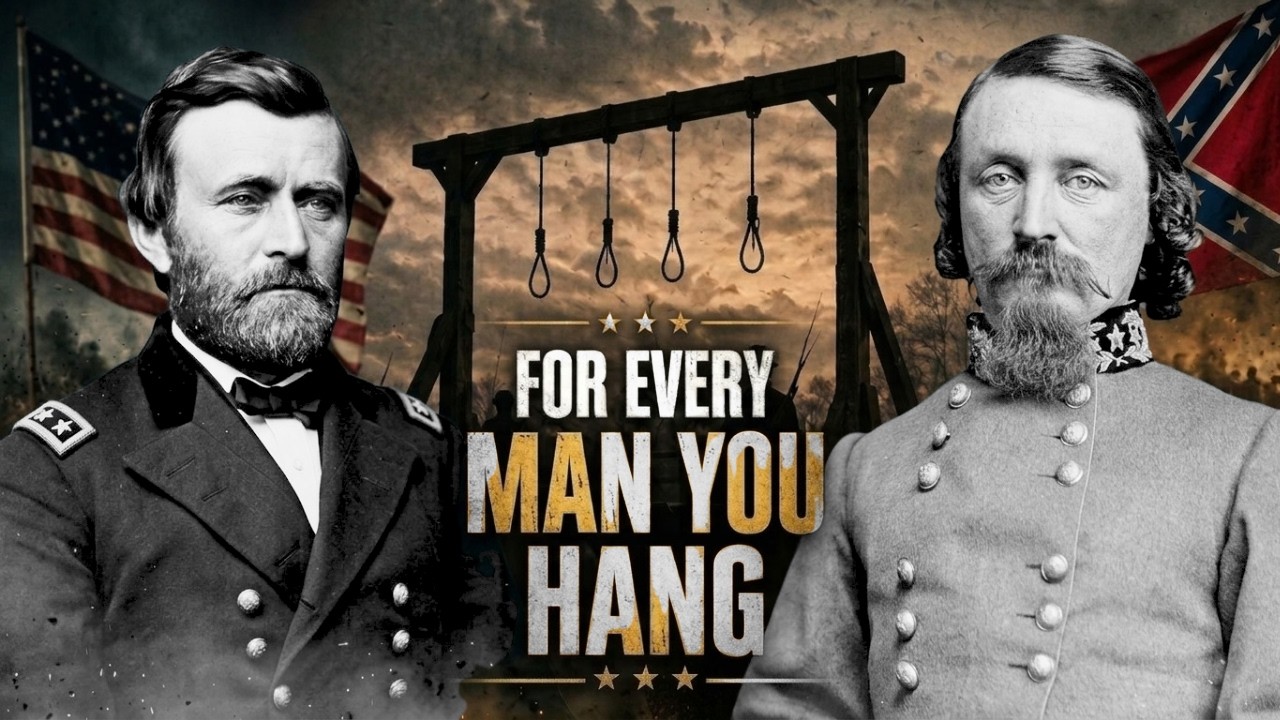
Over two days and two replies, Pickett’s answer was not polite. He wrote that he held roughly 450 officers and soldiers of the United States Army, and that for every man Peck executed, he would execute ten of his own. Then he did something crueler. He thanked Peck for the list, because it would help his officers identify deserters who had not yet been discovered.
He then told Peck what had actually happened. He enclosed a list of twenty-two men from the Union Second North Carolina Volunteers and wrote that they had been executed in accordance with the laws and customs of war. The list was not entirely accurate when written. Letters exchanged across the lines moved slowly.
By the time Peck read the reply, the argument was over. The men he had sought to protect had been hanged in a field outside Kinston, in four groups over eighteen days, before a Confederate brigade ordered to watch and before the townspeople, while their families waited to receive the bodies. Two of the twenty-two on Pickett’s list were still alive when he wrote it. Within a week, they were dead as well.
Here is the question that outlived every man in this story. They were Southerners. Many had worn Confederate uniforms in some form, and for some, whether they had ever truly been Confederate soldiers was the heart of the matter. They crossed into Union lines, took the oath, and put on Union blue.
They were captured wearing it. To the Confederacy, that made them deserters, and desertion in wartime carried the penalty of death by hanging. To the United States, it made them soldiers, and soldiers captured in uniform were prisoners of war. Both sides made promises to these men.
Neither side kept them. North Carolina was among the last states to secede, and its voters had rejected the idea once before. According to traditional statistics, it sent more soldiers to Confederate armies than any other Southern state and also produced the largest number of deserters. That contradiction drives this story.
By 1863, desertion had become a manpower crisis. In the months after Gettysburg, Robert E. Lee urged Jefferson Davis to impose the death penalty on deserters, singling out North Carolina men. Lee wrote that nothing would stop it except the uniform and unrelenting application of the death penalty.
Lee was describing a policy. Ultimately, someone had to carry it out. The men who would hang were not ardent Unionists. In eastern North Carolina, Confederate law allowed local defense units, partisan rangers, and bridge guards, organized to defend home territory, where men served a week at a time and returned home.
When they volunteered, men would later say they had been promised orally that they would never be taken outside the county where they lived. That is the first promise in this story. Nethercutt’s Battalion, near Kinston, was one of these units, and many of the men who would hang had served in it. In October 1863, Richmond consolidated these companies into a regular regiment, the Sixty-sixth North Carolina, intended for service outside the region.
Their commander, Major John Nethercutt, would later frame their reaction in one sworn sentence. The men complained that they had been treated unfairly. Fewer than half showed up. Some tried the courts.
The rest went to the woods or went home. The general in charge of the department responded with an official statement. No man who returned voluntarily would be punished. That general was George Pickett, the man most Americans knew from one afternoon at Gettysburg.
His first response to desertion was leniency, and most of the men did return. But some never came back. They crossed to the Union-held coast, with nothing but what they wore, families to feed, and one obvious source of income. The Union had been recruiting North Carolinians since 1862.
That year, a Union colonel named Rush Hawkins, working alongside naval officer Charles Flusser, encouraged local Unionists to volunteer. The first question recruits asked him, as Hawkins remembered decades later, was: “What is to become of us if we are captured by the rebels? ” Hawkins promised them protection to the utmost extent. That is the second promise in this story.
No record shows Hawkins ever met the men who would be hanged at Kinston. But the regiments he helped build were founded on that promise, and he carried it with him for the rest of his life. By the winter of 1863, recruiting for the Union on the occupied coast was no longer purely voluntary. Peck himself confirms this in writing, naming two methods: actual impressment and bounty recruiting.
Many of the men who died at Kinston would say they were threatened into enlisting. They were told that if they did not join, they would be carried across the lines and shot. They were mustered into Company F of the Second North Carolina Union Volunteers and promised bounties most of them would not live to collect. The Confederates had a name for North Carolinians in Union blue.
They called them “buffaloes. ” It was not a compliment. On January 18, 1864, Company F was sent to an advance post called Beech Grove, near Bachelor’s Creek, west of New Bern. It was a wooden fort hidden in the woods, manned by North Carolinians and a detachment of the 132nd New York under First Lieutenant Samuel Lyth.
Behind Union lines, inside a hidden fort, the new recruits felt safe from the men they had once fought beside. Around the same time, Lee proposed an operation to retake New Bern. Davis approved, and Pickett was placed in command over Robert Hoke, the North Carolina brigadier who had planned it. At the end of January, Pickett’s column moved toward New Bern.
The coordinated attack failed, and Pickett ordered a withdrawal toward Kinston. But the Confederates had found the advance post in the woods. The Union tried to warn Beech Grove, but everything went wrong. One courier got lost in the swamp.
Fog blocked the signal stations. Other couriers were killed or captured on the way. The North Carolinians, knowing what capture would mean for them, offered to get the garrison out by routes they had known since childhood. Lyth refused to move without orders.
When Confederate regiments appeared before the fort, he surrendered without firing a shot. Later accounts were harsh toward him, and most came from men with reasons to blame him, but the result is beyond dispute. On February 2, the Confederates captured them. Fifty-three men, practically the whole of Company F.
The prisoners wore new Union uniforms, and at first no one could see anything else. They were treated as ordinary prisoners of war. During the retreat, the army camped along Dover Road, wet and exhausted after marching through rain and mud. Word spread that there were North Carolina men among the prisoners, and soldiers came to look at them.
Two of the prisoners were identified, not by officers reading papers, but by men who had once stood beside them in the ranks of Company B, Tenth North Carolina Artillery. A sergeant named Blount King, along with Lieutenant H. M. Whitehead, recognized two men from their old company: David Jones, about twenty-one, and Joseph Haskett, about twenty-six.
They remembered Blount King well. He would reappear. What happened next is known mostly through King himself, in testimony he gave to federal investigators after the war. It is his memory, recorded long after the fact, not an official record.
But this is what he said. Pickett confronted the two men and asked where they had been. He listened to them. Then, according to King, Pickett said: “I suppose you will never go back again, you damned rascals.
I will have you shot, and all the other deserters. ” Jones replied that he did not care if Pickett shot him then or did whatever he pleased with him. King said Pickett then turned to his generals and said: “We must have a court-martial for these men soon, and after executing a few, the rest will stop deserting. ” One of the generals, Brigadier General Montgomery Corse, answered as King remembered it: “The sooner, the better.
”
It is tempting to read all this as the anger of a broken man, the general whose division was destroyed at Gettysburg venting at anyone nearby. Some popular accounts do exactly that. But the historian Donald E. Collins, who wrote the most detailed study of this case, reads it differently.
Not a man who lost his senses, but a commander carrying out a brutal deterrent policy, precisely the policy Lee had requested. If King’s memory was accurate, the fate of the prisoners was decided at that campfire. The courts-martial that followed were not held to determine what would happen. They were held to give it legal form.
A court-martial was organized almost immediately. Its composition, its speed, and what it refused to hear would all be debated later. According to the most careful reconstruction of events, the court considered twenty-seven cases, all for desertion. Twenty-two of those cases would end on the gallows.
One man was acquitted of desertion. What happened to the other four, this story could not trace. The other twenty-six men captured at Beech Grove were never brought before this court. They were sent north to prisoner-of-war camps.
The court met that first night in camp, in the rain. Haskett and Jones admitted to deserting, but insisted Union recruiters had forced them to take the oath. Enlist or be shot. Their claim was ignored.
They were sentenced to death by hanging on February 5, before Hoke’s brigade. Confederate deserters were usually shot. These two would be hanged, a death generally reserved for something worse than desertion. Whether the court intended it or not, the method carried a message.
In its eyes, these two had not merely deserted. They had crossed over to the other side. The prisoners arrived in Kinston on the fourth and were put in the county jail. Witnesses later described men sleeping on the floor, lacking food and bedding.
Those with families nearby fared better, as wives and neighbors brought food and blankets to the door when guards allowed it. On the morning of the fifth, a Confederate chaplain named John Paris visited both Jones and Haskett. He would write about them later, and his verdict was harsh: the most vile and hardened men I ever met in my life. That statement tells us a great deal about John Paris.
It tells us almost nothing about what two young men felt on the last morning of their lives. Meanwhile, the army faced a practical problem. Hangings were rare. Nobody had a rope, and nobody had a hangman.
Both were found. A sergeant was sent to get a rope from a shipment of pontoon bridge equipment and then to the execution ground. That sergeant was Blount King, the man who had identified Jones and Haskett at the campfire. He had served in the same company with them.
He told the county jailer, Isaiah Woods, that he volunteered for the job. After the war, questioned by federal investigators, he said he carried out orders against his will. Both stories cannot be true. He is the principal witness to what Pickett said at the campfire, and he is also the man who hanged the prisoners.
The story depends on him, and he cannot be fully trusted. The gallows stood in an open field, visible from the town. Hoke’s brigade was marched out and formed in a square around it. Hoke supervised the proceedings.
Pickett attended. A captain read the verdicts aloud. The nooses were placed. The two men were hanged.
Afterwards, King was seen cutting the buttons off their uniforms. The death of the two men did not stop the process. It accelerated it. Once it became clear how many former Confederate soldiers were in the group, cooperation became the only currency the prisoners had left.
According to Walter Harrison, Pickett’s inspector general, one sergeant had a list of his company members in his pocket, which he used to report men who had deserted from his unit. Harrison did not say who that sergeant was or what became of him. While the court sat at Kinston, it condemned five more men: John L. Stanley, Lewis Bryant, Mitchell Bussick, William Irving of Nethercutt’s Battalion, and Amos Armistead of Whitford’s Battalion, all on the same charge, facing the same fate.
Their old commander, John Nethercutt, came to visit them. Then he went to Hoke, the brigadier whose men had formed a square around the first gallows, and asked whether anything could be done. Hoke’s reply was short. He had his orders, and the men would be hanged.
On the eleventh, at Goldsboro, the court heard thirteen more men, one after another. Families came but accomplished nothing. Bryan McAllum later said he hired a lawyer for William Hadock, but the court refused to let him appear. Other relatives later reported that they were not allowed to bring witnesses.
Thirteen death sentences came out of that room. Hoke ordered the five previously condemned men executed the next day and ordered a larger gallows built to accommodate the coming numbers. On the twelfth, the five men were brought out. The oldest, Amos Armistead, forty-four and gray-haired, spoke for them.
He said he had erred when he volunteered upon reaching New Bern. Mitchell Bussick added that he had only joined because Union Army recruiters threatened to kill him. They ended with a message to their former comrades in the field. They had been wrong.
They regretted it, and no one should follow their example. It is impossible to know the true value of those words. They were spoken at the foot of the gallows before the army that was about to hang them, with a chaplain recording them for his own purposes. They may have come from genuine remorse.
Or from fear, or a last hope of mercy, or an attempt to protect the families who would have to keep living in that county. No one in that field recorded which motive was at work. An aide read the verdict. The nooses were placed around their necks.
Seven men were now dead. Thirteen men waited in prison. They spent their last hours with their families and in prayer. John Paris, the chaplain who had called the first two men hardened, was with them and wrote about it afterward.
He described a wife saying goodbye to her husband, a mother taking a last look at her son, a sister embracing her brother. In the same account, he portrayed their grief as shame, the shame these men had brought upon their family names. Paris did something else in that cell. While the condemned men talked, he collected the names of civilians they said had encouraged them to leave the Confederate army.
He passed those names to General Hoke. The chaplain who baptized them also passed the names of their neighbors to the general. His sympathy and his contempt sat side by side, and that was the true condition of the town. Catherine Summerlin was granted a brief goodbye with her husband, Jesse.
While she was there, another prisoner, William Hadock, asked her to make sure his clothing reached his mother. Paris wrote that eight of them were baptized inside the cell. On the morning of the fifteenth, two more, John and Joseph Brock, were taken to the Neuse River and baptized there by the Reverend George W. Camp.
On the fifteenth, the brigade formed a square in a field behind the town around the new, larger gallows. The thirteen walked across the soft sand of an old field toward the platform. A staff officer read the charges and verdicts. They climbed the steps and stood in a row.
They were offered the chance to speak. If any of them did, no one recorded their words. The trapdoor fell. Surgeons confirmed death, and the troops marched back to camp.
Twenty men were now dead. This time, the hangman was not Blount King. Some of the dead were buried in a shallow grave at the base of the gallows. Families who wanted them back had to ask.
Bryan McAllum went to General Hoke to ask for the body of his brother-in-law so he could bury him in the uniform of the United States Army. According to McAllum’s account, Hoke asked him whether an honorable man would bury someone in a Yankee uniform. Even in death, the question of what these men had worn remained in dispute. One widow testified she had no wagon to carry her husband home, so she sent her teenage son and a young nephew.
They found the body and brought it home. Other widows lived inside Union lines and could not cross into Confederate Kinston at all. Their husbands stayed where they fell. Not every case before the court ended on the gallows.
One man, Clinton Cox, was found not guilty of desertion. Acquittal did not mean freedom. Cox remained a prisoner, and he would die in prison. Southern newspapers called these men traitors.
The court did not. Every man executed at Kinston was executed for desertion, a military charge a panel of officers could decide in a single evening. Two of the condemned still waited. Elijah Kellum and William J.
Hill of Whitford’s Battalion. Kellum’s case is the hardest to pass over. He was a young, illiterate farmer, and later testimony raised doubts about whether the Confederate army had ever accepted him for service at all. According to one account, he was rejected for physical unfitness for Confederate service, and only later accepted into a Union regiment.
A Confederate recruiting officer testified otherwise. If the first account is true, the Confederacy executed a man for deserting an army that had never really accepted him. Meanwhile, the letters still moved slowly across the lines. To follow them, we must return to February 11.
Pickett’s first letter, dated that day, was written before he knew any of this. He had read in a newspaper that the Confederates had hanged a captured Black soldier wearing Union uniform. He enclosed an order signed by Abraham Lincoln the previous summer, requiring that for every Union soldier killed in violation of the laws of war, a Confederate soldier be executed in return. He wrote as though the killing must have happened without Pickett’s knowledge, asked him to punish the responsible party, and stated he would refrain from executing a Confederate soldier until he knew what Pickett had done about it.
Who that soldier was, this story cannot tell you. He is the first man to die in this story, and the one we know least about. Then, around February 13, Peck first learned that the men of Company F had been captured. He wrote again, including the names of the fifty-three men, calling them loyal and honest North Carolinians, formally mustered into the Second North Carolina Infantry.
When Peck wrote that letter, seven of those men were already dead. By the time it reached Pickett, twenty were dead. It is easy to read Pickett’s thanks for the list and conclude that Peck had handed him a death warrant. The timeline does not support that.
Peck sent the names to protect the men. By the time the names arrived, the list could do little good or harm to them. On the sixteenth and seventeenth, Pickett wrote the replies with which this story began. The threat, the thanks, and the list describing all twenty-two men as executed, though the last two were still alive.
Those replies were still in transit when Peck learned, on the twentieth, of the first hangings from a copy of the Fayetteville Observer. Peck told Pickett that eight Confederate officers, from colonel to captain, were held at Fort Monroe as hostages to guarantee the safety of the surviving North Carolinians. Pickett prepared to answer executions with executions and moved to secure his prisoners in case retaliation escalated. He also stated his legal position as clearly as possible.
These men were deserters from military service, captured while bearing arms against their own flag. If Peck could prove the eight officers had deserted the Union army, Pickett had the right to hang them. If he could not, and executed them anyway, he was simply committing murder. Peck’s final letter offered no legal argument.
He told Pickett his duty had been performed and closed with a single sentence: “The blood of these unfortunate men will be upon you and your associates. ” On the twenty-second, Elijah Kellum and William Hill were hanged. The numbers on Pickett’s list were now exact, and the principle of ten-for-one never came. Peck forwarded the report to General Benjamin Butler, who passed it to Ulysses S.
Grant, who refused to authorize any retaliation. He had already made his position clear in an earlier letter to Confederate General Joseph E. Johnston. He stated he would not claim any right of retaliation to punish men who had actually been mustered into the Confederate army and then joined the Union.
The eight officers at Fort Monroe were never executed. None of Pickett’s 450 men were executed either. The only threat in all this correspondence that anyone carried out was the one aimed at the twenty-two. On February 28, six days after the last execution, John Paris was given Hoke’s entire brigade as his congregation.
He preached on the killing of the twenty-two, comparing the deserters to Judas and Benedict Arnold. The sermon was printed and distributed. The purpose of the executions was announced from the pulpit: not justice for twenty-two men, but a lesson for others. That lesson failed.
Later in 1864, men of Pickett’s division were still deserting, and Pickett complained that Jefferson Davis kept pardoning condemned men. On the other side of the lines, a Union officer reported extreme fear and demoralization among the North Carolina soldiers still serving in his ranks. The executions may not have stopped Confederates from deserting. They may have made Union sympathizers think twice about enlisting.
Then the war ended, and the Kinston case did not disappear, because the people who witnessed it were still alive, living in the same county. In September 1865, Captain W. H. Doherty, an assistant quartermaster at New Bern, began pressing for Pickett and Hoke to be brought to justice for killing United States soldiers while they were prisoners.
He is the main reason any investigation was ever conducted, more than any other person. No one knows why he cared so much. An investigative commission heard witnesses who had been there: widows of the executed men, veterans of both armies, and townspeople who had stood in that field. The most damning testimony came from John Nethercutt, the major who had begged Hoke to spare his men.
He described what his battalion actually was and what his men had been promised. From that testimony, the commission concluded that a number of the executed men had been in local defense service, not the regular Confederate army, and could not have been guilty of the crime for which they were hanged. On November 18, 1865, the commission named those responsible for what had happened. Pickett, who approved the sentences.
Hoke, who carried them out. The officers of the court-martial, and the men who had served as hangmen. The commission’s recommendation was explicit. A military commission should be appointed to try them.
Pickett did not wait to learn the outcome. With Jefferson Davis in a cell at Fort Monroe and charges against Lee increasingly likely, he took his family into exile in Canada for a time. In Washington, the first commission’s report reached the office of Judge Advocate General Joseph Holt, the army’s chief lawyer, and Holt dismantled it. He said the commission had misunderstood Nethercutt’s testimony, that the evidence on that point actually leaned toward proving the men were deserters, and that it had questioned far too few witnesses.
He described the dead as murdered men. In the same report, he concluded the evidence before his office could not yet support charges against those responsible. Murdered men. Not yet a case.
In the same report. This was only his first reading of the file. The case was not closed. A second investigation was ordered.
The second commission met at Raleigh on January 23, 1866, and hit a dead end. Witnesses did not want to talk, for fear of being seen as informers. Memories, as the investigators dryly noted, had become defective. They searched state records and enlistment rolls, and went looking for the court-martial records themselves.
They did not find them. That must be stated precisely, because it is where many accounts go wrong. The records were never proven destroyed. They simply could not be found by federal investigators in 1866, in a defeated region with uncooperative witnesses.
Meanwhile, something else was on its way to Holt’s office. George Pickett’s own wartime letters. Holt found his evidence in Pickett’s own words. In the ten-for-one letters, in the thanks-for-the-list letters, Pickett declared his responsibility for the executions as the commander in charge.
That, Holt concluded, was evidence on which charges could be built. His recommendation changed entirely. Arrest Pickett. Hold him for trial.
The letters Pickett had written to intimidate a Union general in 1864 became the strongest evidence against him in 1866. On March 12, while the second commission was still working in North Carolina, Pickett wrote to Grant. The two men had known each other before the war. Pickett’s letter was a careful attempt to take a position.
He described persons of ill will attempting to stir up past troubles and asked only for confirmation that his parole from Appomattox would protect him. He did not deny what had happened. In correspondence that year, he wrote plainly: “I approved the sentences. ” Four days later, Grant forwarded the request to President Andrew Johnson with his personal endorsement.
He wrote that he knew Pickett personally as an honorable man. He admitted the punishment had been harsh and that what Pickett had done could not be easily justified. Then he made the argument that mattered most to him. He warned that a trial would reopen the question of whether the United States intended to honor the contract made to secure the surrender of an armed enemy.
Pickett’s strongest defender did not say Pickett was right. He said peace was worth more than a trial. There is an irony in that. Two years earlier, Grant himself had drawn the very distinction that might have saved many of the twenty-two, between deserters actually mustered into Confederate service and men who had never joined at all.
On March 29, the second commission submitted its report. It agreed the Confederacy could legally execute genuine deserters, but not men of the home defense battalions or bridge guards, and not men who had crossed the lines before being conscripted. The little evidence it found suggested some of the executed men had previously served the Confederate cause in some capacity. But it could not prove whether that made each of them a deserter.
After diligent search, the commission found sufficient grounds to charge only one man: George Pickett, the man Grant had just called honorable. In July, Holt again recommended Pickett’s arrest and trial. Nothing happened. In December, the government informed Congress that no proceedings had been begun.
Secretary of War Edwin Stanton added another reason. He was waiting for the full opinion of the Supreme Court in Ex parte Milligan, a case that cast serious doubt on trying anyone before a military commission once civilian courts had reopened. So why was he never tried? Not for a single reason.
Grant’s intervention carried enormous weight. But so did the lost court records, the witnesses unwilling to testify, a second commission that could identify only one man with certainty, and legal ground that shifted beneath the very idea of military trial. Each problem made the others harder to overcome. The case simply stopped.
Pickett returned to his home in Virginia, entered the insurance business in Richmond, and died in 1875. His funeral in Richmond came the same week the statue of Stonewall Jackson was unveiled. According to Collins, the Richmond Dispatch delayed news of Pickett’s funeral for two days to give the statue wider coverage. Twenty-two men in four groups over eighteen days.
Two on February 5, five on the twelfth, thirteen on the fifteenth, and two on the twenty-second. They were not the only men of Company F to die. The rest went north to Confederate prisons, where death continued. The gallows was only the fastest of the ways they could die.
Two promises were broken to these men. The Confederacy promised the home guard units they would never be taken outside their homeland, and then moved them. The Union promised its North Carolina recruits protection if captured, and could not protect them. Rush Hawkins, who made that promise, wrote that his grief and shame were beyond measure.
In an account written in 1868 and finally published in 1897, he poured his anger on Grant himself for refusing to help bring Pickett to trial. Each of those twenty-two men received a trial. Some trials lasted minutes, held at night in a camp in the rain before officers who already knew what the general wanted. But the forms were observed.
The charge was read. The verdict was recorded. Their names were entered in a register. The man who approved their sentences had his name entered in no register.
No charge, no verdict, no acquittal. No court ever decided whether they were deserters or prisoners of war. Even their memory faded, and their identities with it almost immediately. Witnesses before the first commission spoke of three groups of hangings, not four.
The New York Times announced on March 18, 1864, that twenty-four men had been hanged at Kinston. A historical marker erected in Kinston listed twenty-two names but stated plainly that they had deserted the Confederate army, the very point in dispute for some of them. Even their names survived in different spellings. And here they are, as recorded by the historian Donald Collins.
Their names were as follows: Joseph Haskett, David Jones, John L. Stanley, Lewis Bryant, Mitchell Bussick, William Irving, Amos Armistead, John Brock, Joseph Brock, William Hadock, Jesse Summerlin, Andrew Britton, Lewis Freeman, John Freeman, Calvin Hoffman, Stephen Jones, Louis Taylor, William Doherty, Charles Cuthrell, William Jones, Elijah Kellum, and William J. Hill.