The seven Sutherland sisters stood in a single line beneath the gaslights of a New York stage, their hair pooling on the floorboards behind them. When all seven let their locks down together, they displayed an awe-inspiring thirty-seven feet of thick hair. By the early 1880s, Sarah, Victoria, Isabella, Grace, Naomi, Dora, and Mary had become the first hair celebrities in American history—women compared to Rapunzel, followed through the streets by fans who begged to snip a strand. It was an improbable fame, rooted in an eccentric childhood on a farm in Cambria, a small community in Niagara County, Upstate New York.
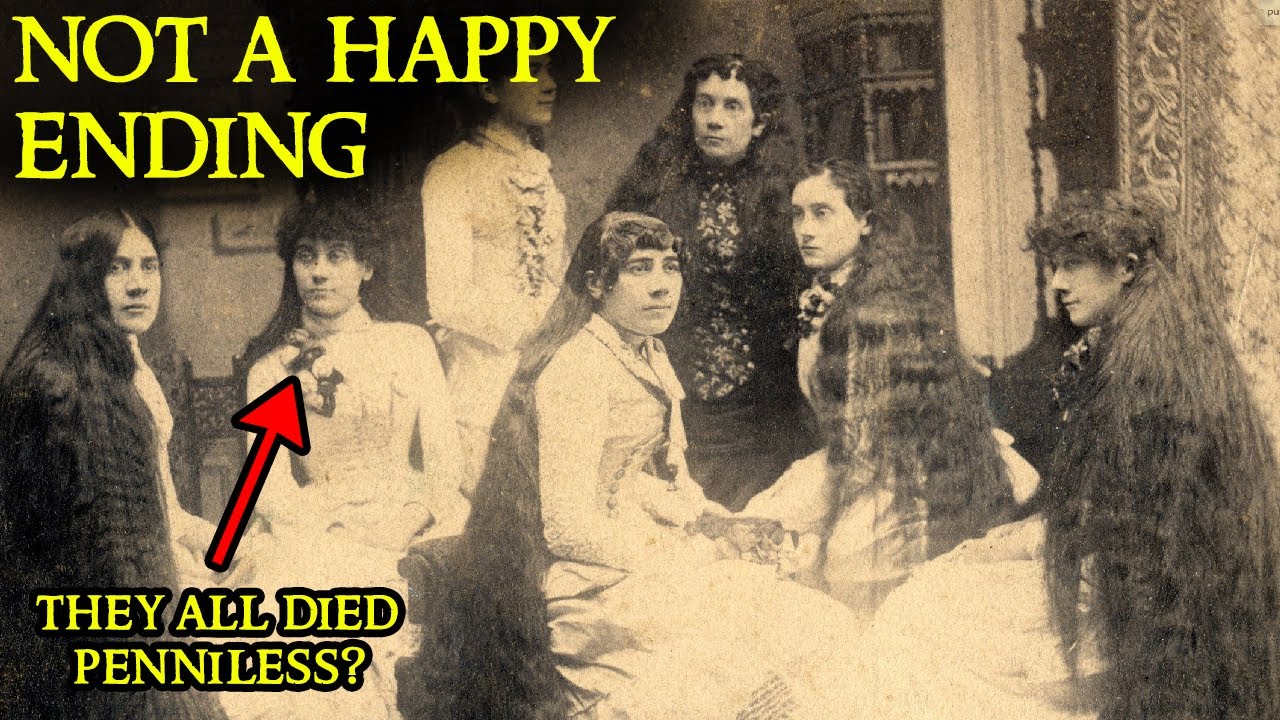
The sisters were born between 1845 and 1862 to Fletcher and Mary Sutherland, with a seventeen-year gap separating the eldest, Sarah, from the youngest, Mary. The family was not affluent. Their father was a turkey farmer with little work ethic, and he largely left the chores to his daughters, who labored barefoot on their land. Their mother, Mary, was the more unusual influence.
She insisted her daughters never cut their hair and made them apply a foul-smelling ointment to their scalps, claiming it would make their hair grow thicker and longer. Whatever the ointment’s actual merits, the strangeness of their childhood would later supply the family’s fortune. Fletcher Sutherland was a poor farmer but a natural salesman, smooth-tongued enough to once secure work in the service of President James Buchanan. That talent for selling, combined with his wife’s obsession with the daughters’ hair, became the foundation of everything that followed.
While the girls were still young, Fletcher trained them to play musical instruments and soon had them singing in the local church choir. At first, they were simply a quiet family act in a rural county. But as the sisters grew older, their hair grew longer, and members of the congregation began showing up not for the singing but to marvel at the sisters’ extraordinary locks. Their mother died in 1867, when Sarah was in her early twenties and Mary was only five.
The sisters no longer had to endure the foul-smelling ointment, but their father had already recognized the commercial potential of their hair. Around that time, Fletcher began transforming the seven sisters and their brother Charles into a touring band, playing county fairs and community theaters across New York. They were billed as the Concert of the Seven Sisters and One Brother. By the 1880s, Charles was dropped from the act, and the sisters made their Broadway debut in New York City.
They then toured the southern states, visiting cities like Pensacola, Atlanta, and New Orleans. Their celebrity, however, rested on their hair rather than their voices. Victoria, the second eldest, possessed an enormous seven feet of hair that trailed along the ground behind her when let down during performances. The youngest, Mary, had six feet.
Naomi wore hers in a braid of four feet, but it stretched to five and a half feet when unwound. In a period when long, lustrous hair was the height of Victorian and Gilded Age style, and when writers such as Charles Dickens described heroines in glowing terms for their long locks, the Sutherland sisters became instant objects of fascination. Fletcher Sutherland was not content with the cash flowing from their performances. He wanted profit from the hair itself.
Concocting a hair-growing tonic, he marketed it as the secret behind his daughters’ miraculous length. The Seven Sutherland Sisters Hair Grower was effectively snake oil, made from magnesium, salt, witch hazel, and Bay Rum—along with a somewhat worrying amount of hydrochloric acid. There was no science behind it, but because the sisters’ hair was all the rage, the tonic sold in enormous quantities across the eastern United States by the early 1880s. The sisters’ success soon attracted the interest of showmen.
In an age before television and motion pictures, traveling spectacles were the primary form of popular entertainment, and none was more esteemed than the Barnum and Bailey Circus, typically billed as The Greatest Show on Earth. Barnum and Bailey won the bidding war in the early 1880s to add the Sutherland sisters to their show. There, the sisters were different from many other acts. The circus was filled with performers who were treated as freaks, often because of medical conditions like gigantism or dwarfism that the public had no scientific understanding of at the time.
Those performers were paid to be gawked at yet shunned by society. The Sutherland sisters, by contrast, were lionized. When they performed in New York, people followed them down the street in broad daylight, attempting to snip locks of hair from their heads. Working with the circus organizer Harry Bailey, Fletcher Sutherland began producing and mass-marketing more hair tonics.
By the late 1880s, they were selling new concoctions, including one that claimed to reverse male pattern baldness. It was clearly ineffective—the problem remains unsolved more than a century later—but that did not stop it from selling in huge quantities. In 1883, the Seven Sutherland Sisters Corporation was founded to market the hair products, with glowing reviews from chemists asserting the tonics achieved miracle results. By the end of 1884, less than two years after its founding, the company had made ninety thousand dollars in sales, equivalent to millions in today’s money.
When Fletcher Sutherland died in 1888, the sisters’ incomes increased substantially. For years, he had been siphoning off a large portion of their earnings into his own pockets. Once the sisters gained direct ownership of the company, they proved to be shrewd businesswomen in their own right. They developed clever marketing slogans and appeared at packed beauty demonstrations on Fifth Avenue in New York and in other busy shopping districts across American cities.
By the 1890s, the company had offices not only in New York and Chicago but also in Cuba and Canada. Millions of bottles of their hair tonic had been sold, distributed through more than twenty-five thousand dealers. Their business methods foreshadowed those later used by twentieth-century cosmetics tycoons such as Elizabeth Arden. With wealth came indulgence.
The sisters shopped lavishly, accumulated luxury homes, and many chose not to marry in order to retain control of their financial affairs. Instead, they lavished attention on pets, treated extravagantly in a precursor of modern celebrity obsessions with dogs and cats. Their public image expanded with their fortune. By the 1890s, they were frequently featured in publications like Harper’s, The New York Times, and The New Yorker.
Signed photographs and memorabilia sold for large sums. One admirer reportedly offered Victoria thousands of pounds to cut off all her hair, a sum equivalent to hundreds of thousands of pounds today. In the mid-1890s, the sisters built a lavish mansion back in Niagara County, a grand statement of their pretensions. It was built like a princess’s castle, complete with turrets and cupolas.
Crystal chandeliers and the most expensive wood decorated every room. Beds were imported from Europe, and even the servants’ quarters were built on an impressive scale. The horses at the house wore shoes made of gold. Those lavish expenses would ultimately undo the sisters.
In the early 1900s, the sisters began fighting over the company’s profits. Several began using drugs such as opium and cocaine, which could be obtained at pharmacies at the time, increasing their erratic behavior. A major source of income dried up when they stopped appearing in the Barnum and Bailey show. Naomi had died young in 1893, and Victoria, the second eldest, was the next to go.
The real decline came in the 1910s, as fashion turned against long hair. Short bobs became the style, and as the look went mainstream, sales of the Sutherland Sisters’ tonic shrank dramatically. When Isabella died in 1914, the family fortune was rapidly draining away. After Sarah, the eldest, died in 1919, the three remaining sisters—Grace, Dora, and Mary—headed to Los Angeles, hoping to profit from the growing celebrity culture out west.
Dora died in a car accident there in the 1920s. Mary and Grace tried to keep the crippled hair business alive in an era that no longer esteemed long locks, but they slipped into destitution, living in an abandoned house. The company finally went completely bankrupt in 1936. Mary, psychologically unstable, was committed to Buffalo State Asylum in the mid-1930s, where she died in 1939.
Grace died destitute in 1946 in her early nineties. The seven Sutherland sisters had experienced one of the earliest examples of American celebrity—a rags-to-riches story followed by a return to rags. Their fame had been built on forty years of hair, phantom science, and relentless promotion, and when fashion moved on, so did the fortune.