In 1021, on the shores of Newfoundland, warriors who had raided Paris and conquered England found themselves running for their longboats. These were Vikings, masters of medieval warfare, fleeing through unfamiliar forests from hunters they called skraelings, a Norse word meaning wretched ones. They had come to establish a colony in Vinland, a land of rich soil, timber, and wild grapes, a paradise compared to the frozen misery of Greenland. Within days, that dream was over.
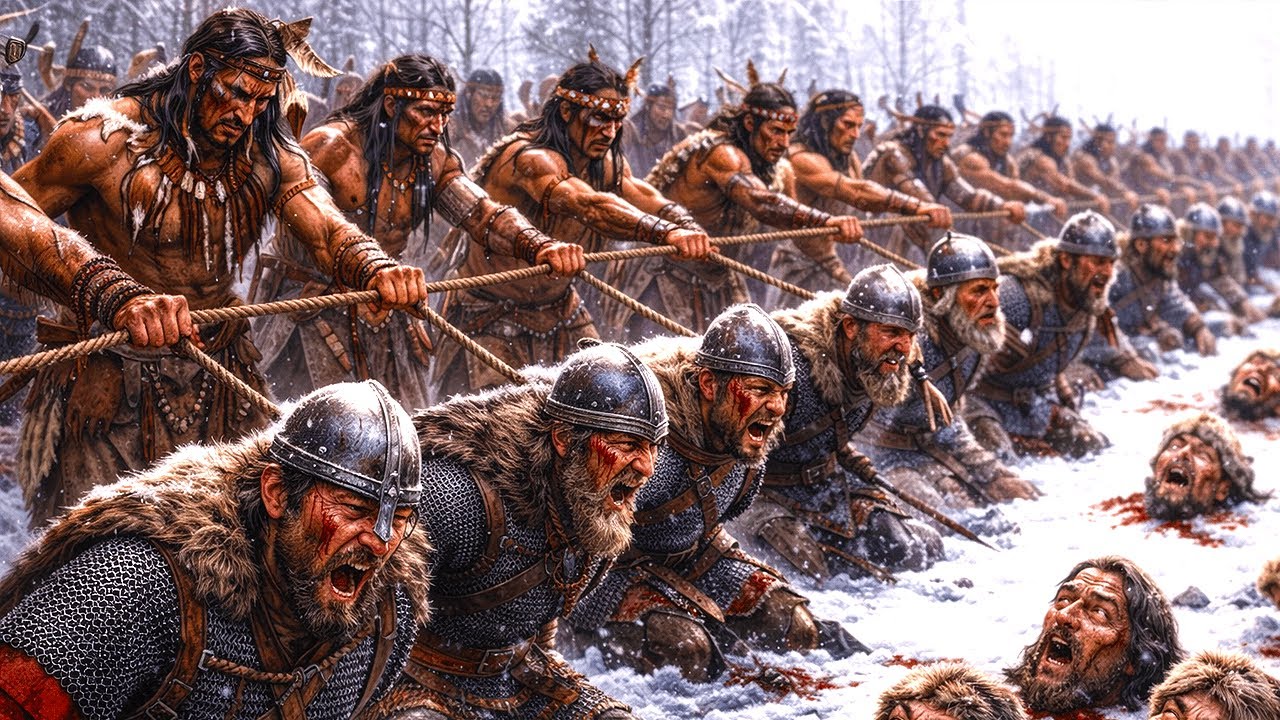
The Norse expansion into North America had come to a permanent halt, nearly five centuries before Columbus set sail. The Vikings had been pushing westward for generations. Iceland fell, Greenland fell, and the Atlantic itself seemed to offer no limit to their ambition. In the year 1000, Leif Eriksson had discovered Vinland by accident.
His brother Thorvald followed, seeking glory. But Thorvald’s expedition met a violent end. When the Vikings encountered nine natives sleeping under overturned canoes, they killed eight of them. One escaped, and the Norse had made their first enemy.
Shortly after, an arrow with a stone point struck Thorvald beneath the arm, the one gap in his armor. He pulled it out and said he had gotten a good land, but would enjoy little benefit from it. He died within hours. The following year, a wealthy merchant prince named Thorfinn Karlsefni arrived with the largest Norse expedition yet.
One hundred sixty settlers, including women and children, thirty battle-hardened warriors in mail armor, five longships, cattle, tools, and dreams of permanent settlement. Karlsefni had learned from Thorvald’s death. He chose a defensive position near the coast, built longhouses designed for defense, and posted sentries day and night. He would not repeat his predecessor’s mistakes.
The natives, likely Beothuk hunters, had watched the pale strangers since the first landing. They had seen them cut trees, take resources, and kill without warning. They studied Viking habits, their routines, their weapons, and their vulnerabilities. Where the Vikings saw empty wilderness, the natives saw a homeland under threat.
Two worldviews were about to collide. For a time, it seemed peace might hold. Natives approached with furs, and Karlsefni, hoping for trade, offered them milk from his cattle. The strange white liquid fascinated them.
Laughter replaced suspicion. Furs were exchanged for red cloth and milk. Children peered from behind their mothers, and warriors lowered their weapons. For a few precious moments, Vinland might have been shared.
Then something went wrong. According to the sagas, a native, fascinated by Viking steel, reached for an axe. A Viking moved to stop him. Hands grabbed, a struggle followed, and the axe fell.
Blood sprayed across the trade goods. Whether the victim was Viking or native, the sagas differ, as does whether it was an accident or an attack. What matters is that trust died in that instant. The native grabbed the axe and ran into the forest, and his people vanished within heartbeats.
The settlement transformed from trading post to military camp. Days of silence followed. No natives appeared. Broken arrows were found deliberately left on paths.
Footprints appeared and vanished. The waiting itself became a weapon. Patrols returned shaken, swearing they had felt eyes on them in the darkness. The Vikings had trained for open battle, for shield walls and pitched combat, but they had no answer for an enemy they could not see.
When the assault came, it came at dawn, and it defied every rule of medieval warfare. Hundreds of canoes swept in from three directions at once. The ocean approach, the river flank, and the forest edge all erupted at the same moment. The Vikings counted thirty boats, then fifty, then stopped counting.
Each carried five to eight warriors. Simple mathematics turned terrifying. At least three hundred attackers against thirty armored warriors and a hundred thirty settlers. The first volley darkened the sky.
The Vikings raised their shields and formed the wall that had never failed them. But the natives did not fight like European armies. They used shorter bows that fired high trajectories, raining arrows down from angles no shield wall could cover. Projectiles curved over helmets and found gaps between shields.
The unbreakable wall began to break. The natives had studied Viking tactics, and they had developed counters. They feigned retreats, drawing young warriors into the tree line where concealed fighters rose from the undergrowth. In the open, Viking axes were devastating.
In thick forest, long handles caught on branches, and heavy mail exhausted the men who wore it. The natives moved through familiar terrain, tomahawks finding every armor gap. They even climbed trees in darkness, waiting above the paths, and rained arrows straight down where shields could not protect. Within the first hour, eight Vikings were dead and twelve wounded.
Only four native casualties could be confirmed. The kill ratio that should have favored steel was not happening. Worse, the forest claimed the living. Men who had navigated trackless seas became lost within fifty yards of camp.
Every tree looked identical. Sounds echoed deceptively. When they called for help, they revealed their positions to native hunters. The turning point came with a burst of chaos.
Karlsefni’s bull, brought for breeding, broke free from its pen, maddened by the smell of blood. It charged through the combat zone. To the Vikings, it was livestock. To the natives, who had never seen cattle, it was a demon.
Warriors who had faced armored Vikings without flinching fled from the bellowing monster. Its horns caught one man and tossed him aside. The psychological impact was instant. What other demons did these strangers command?
Karlsefni seized the moment and ordered a retreat to the longhouse. The Vikings fell back step by step, shields locked, dragging their wounded. The bull’s rampage had bought them precious minutes. But the respite was brief.
Outside, the natives regrouped with frightening speed. Fire arrows began falling, and the wooden longhouse became a potential death trap. Women and children fought the flames while the men held the walls. Dawn revealed the full horror.
Eleven dead, nineteen wounded, and only about twenty men still able to fight. The natives’ numbers had not decreased. If anything, more canoes dotted the water, and more shadows flitted between the trees. The mathematics of annihilation were clear.
The final assault came with disciplined coordination. Fire arrows increased. Tomahawk throwers worked in teams, one to make the Vikings raise their shields, another to exploit the opening. The noose tightened inexorably.
Karlsefni faced the hardest decision of his life. Stay and die heroically, or retreat and live with shame. But these were not just warriors, there were women and children. The merchant prince made his choice.
He ordered the retreat to the ships. The withdrawal was a fighting retreat, a hollow square with civilians in the center, moving toward the beach. Natives pressed from all sides, sensing victory. The hundred yards to the ships felt like miles.
Five Vikings volunteered to hold the rear, knowing it meant death. They stood shield to shield and bought time with their lives. As the longboats pushed off the blood-soaked beach, the Vikings abandoned everything they could not carry. The forge was left standing.
Iron tools lay scattered in the dirt. The dreams of permanent settlement were trampled into the mud. In the final moment, as the last longboat pushed off, an arrow from the tree line struck the helmsman in the throat. The message could not have been clearer.
The natives could kill them whenever they chose. They survived only because they were allowed to leave. Native warriors danced on the blood-stained beaches. They had done the impossible.
They had defeated iron with stone and expelled invaders without surrendering their land. The Vikings had suffered fifteen confirmed dead, twenty-three wounded, and several more who died during the voyage home. That was one-third of their fighting force. The natives had lost fewer than twenty, according to the sagas.
The technological advantage had meant nothing. The psychological damage was even greater than the physical. These Vikings had grown up on stories of invincibility. Their fathers had conquered England, their grandfathers had terrorized France.
Now they fled like whipped dogs from enemies they had dismissed as wretches. During the voyage home, the wounded whispered about warriors who fought like forest spirits and eyes in the trees. The new world had broken something fundamental in Norse confidence. Karlsefni made his decision before they reached open ocean.
This land wants us dead, he told his council. No one argued. Vinland’s riches were not worth Viking blood. The survivors returned to Greenland with their lives, if not their honor.
Sometimes wisdom means knowing when you are beaten. The abandoned settlement became a classroom for the natives, who studied their enemy’s weapons and methods. Vikings artifacts became trophies and sacred objects. The battle sites became sacred ground, and the story of the pale strangers who could be beaten spread through trade networks.
When Europeans returned centuries later, they faced people whose ancestors had already won this war once. Modern archaeology has confirmed the saga accounts. At L’Anse aux Meadows, Viking buildings stand exactly where the stories placed them. Carbon dating places the site in 1021 precisely.
Tree rings do not lie. Even the abandoned forge remains, as the sagas claimed. The Vikings represented inevitability. They carried steel, armor, and an expansionist culture that had never accepted a boundary.
They should have won. Every material advantage favored them. Yet they were so thoroughly defeated that they never tried again. Their entire civilization, built on conquest and westward expansion, accepted a frontier it would not cross for five hundred years.
In those forests, a few hundred native warriors accomplished what no European army could. They stopped the Vikings cold. The deeper lesson was written in the Newfoundland woods. Technology alone does not guarantee victory.
Terrain, determination, and tactical adaptation can defeat any invader. You cannot conquer a people who are the land they defend. Vikings understood oceans. Natives understood forests.
In Newfoundland, the forest won.