In June 1944, a British transport ship pulled away from the Normandy coast with German prisoners packed below deck, many of them hungry for days. Then the ship’s mess opened and a line formed. Sausage, mashed potatoes, white bread, coffee. One plate was not enough.
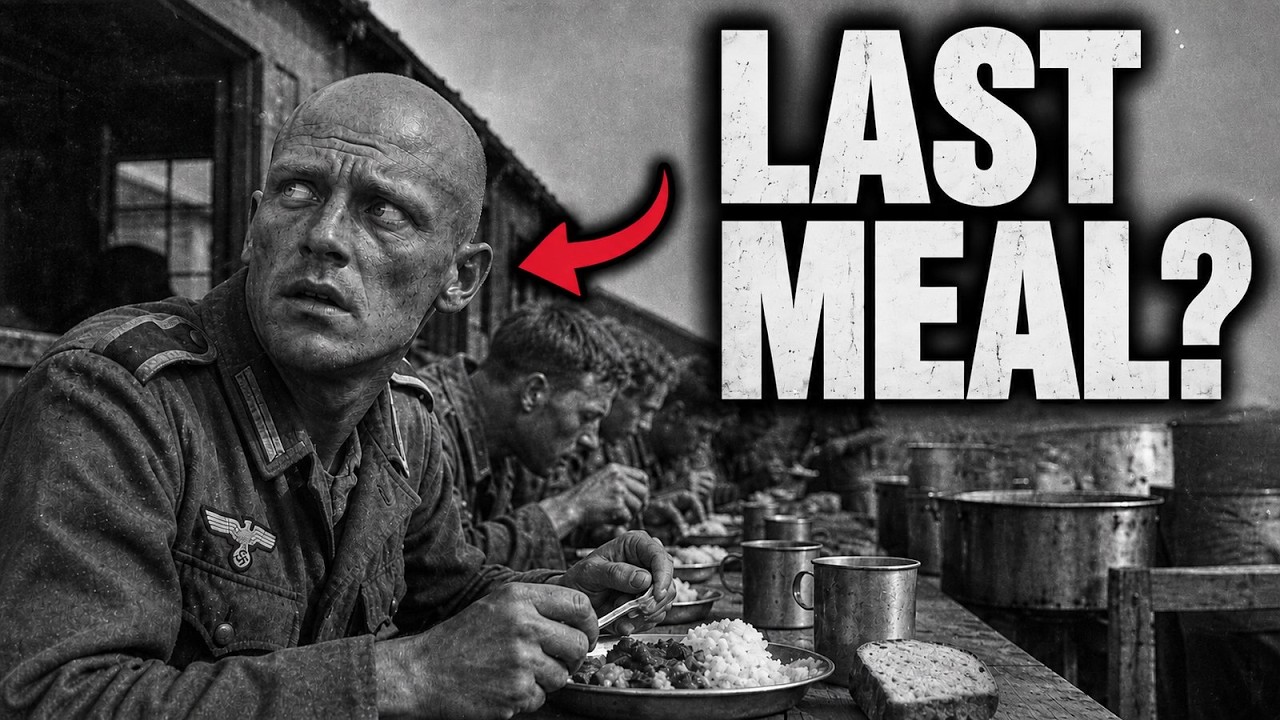
Prisoners went back for a second helping, then a third. According to one of them, the American mess officer finally lost his temper, shouting that the ship carried only 800 German prisoners, yet 8,000 servings had already been handed out. The prisoner telling that story was 19 years old. His name was Paul Golz.
Three days earlier, he had been an ammunition runner hiding in a Norman foxhole. He had no idea that the sausage on his plate was the first move in a considerably longer argument, one that would follow him across the Atlantic, into an American army camp in Virginia, and through the rest of his life. For years, Nazi Germany had described America as a weak, divided, and decadent country. Now a poor farmer’s son was standing in a chow line being fed by it.
Golz came from a poor farming family. In January 1944, he was a soldier in the German army, and his unit was ordered to the Eastern Front. He never made it there. He fell ill with diphtheria and scarlet fever and spent weeks out of action.
By his own account, when he recovered, almost everyone in his company of fifty who had gone east was dead. He credited luck for the rest of his life. On April 4, 1944, his nineteenth birthday, he was reassigned to a machine gun team. From there, his unit marched more than 500 miles to help defend the French port of Saint-Nazaire.
When the Allies never came to Saint-Nazaire, the unit was sent to Normandy. On the heights near Cherbourg, Golz helped set up what German soldiers called Rommel’s asparagus: logs driven into open fields and strung with barbed wire, meant to wreck gliders and snare paratroopers. On the morning of June 6, he was near Carentan on his usual errand to a French farmer for fresh milk. The farmer told him to get out, because the Americans had landed with tanks; he had heard it on the radio.
Golz’s team was sent toward Sainte-Mère-Église, the first village in Normandy to be liberated. Along the way, hungry and thirsty, he looked for chocolate or anything else to eat. In a hedgerow, he met his first American: a paratrooper holding up a rifle with a white sock tied to the barrel. The man was shaking.
Golz told him in German that he would not hurt him. When the paratrooper offered a drink from his canteen, Golz made him take the first sip. Three days after the invasion, on June 9, his team was covering the company’s withdrawal. After firing on a column of American trucks, they dropped into old foxholes.
When Golz looked up, an American Sherman tank was sitting at the only way out of the pasture. Soldiers called for them to come out with their hands up. It was over. On the way to the beach, Golz walked past wounded German soldiers crying out for help.
He remembered thinking that there would be no hero’s death after all. There was only a field, a column of men, and the long walk toward Utah Beach, where thousands of ships and landing boats were still crowded along the shore. They boarded a British transport, and that is where Golz ate his first meal as a prisoner of war. It did not stop his hunger, and it started something else.
The picture of America that German soldiers had been given was not subtle. Nazi propaganda described a country run by bankers and gangsters, split by race and class, rich but soft, a nation of shopkeepers and movie stars that would never stand up to a real army. Its popular music was condemned as degenerate. Jazz in particular had been attacked by the regime as foreign and corrupt and was pushed off German radio in the 1930s.
That does not mean every soldier believed every word. But when almost everything you learn about another country comes from the same source that tells you everything else, some of it sticks. Golz never said exactly what he expected to find. What he said was simpler: he had been a poor farmer’s boy, and the war and capture gave him a look at another kind of life.
From England, a train carried him north to Scotland. There, along with about two thousand other German prisoners, he boarded the Queen Mary. In peacetime she had been the most glamorous liner on the Atlantic. In the war, she was painted gray, nicknamed the Gray Ghost, and used as a troop ship capable of carrying well over ten thousand soldiers in a single voyage, fast enough that German submarines rarely caught her.
Now she was carrying the men who had been shooting at those soldiers. By the time Golz crossed, the United States was already holding a vast number of German prisoners. Altogether, about 425,000 would pass through American camps. Most had been captured first in North Africa and Italy, then in France, and they were spread across hundreds of camps from the southeast to the Pacific Northwest.
Golz was sent to Camp Patrick Henry near Newport News, Virginia. The camp was mainly a staging area where American soldiers waited to ship out for Europe, and it also held German prisoners. He would spend two years there. What he described bears little resemblance to what the propaganda had promised.
He worked in the kitchen and grew vegetables in a garden, a farmer’s son suddenly back in the dirt. He learned to bowl, listened to American radio programs, mowed lawns, played football, and made friends with Americans. He called it a good time. Somewhere between the kitchen, the garden, and those friendships, he also learned English.
He tasted Coca-Cola for the first time. He met the comedian Red Skelton, one of the best-known entertainers in the country. He sat in a cinema and watched Mickey Mouse. He heard jazz, the music his own government had called poison.
Prisoners who worked were usually paid eighty cents a day in coupons, which could only be spent at the camp canteen on things like candy, tobacco, and toiletries. Why would a country at war with Germany take such care of the enemy? Part of the answer is law. The Geneva Convention of 1929, which both Germany and the United States had signed, required that prisoners be fed rations equal in quantity and quality to those of the detaining power’s own base troops.
The United States took the rule seriously, in part because it had thousands of its own soldiers in German hands and wanted Germany held to the same standard. A prisoner in an American camp was supposed to eat what an American soldier at a stateside base ate. Not everyone at home liked that. Americans were living on ration stamps for sugar, meat, butter, and other basics.
Some newspapers and angry citizens complained that German prisoners were being pampered. The camps even picked up a nickname: the Fritz Ritz. The army’s answer was that treating prisoners properly was the best protection for American prisoners overseas. But feeding men like Golz was only half of what the army was doing.
It was also trying to change what they believed. Golz remembered that his camp showed prisoners a film about the concentration camps, which he recalled as factories of death. He said that afterward, the prisoners were punished with a week of nothing but bread and water. He did not explain why, and the reason is not clear from his account.
What can be said is that the American side of this experience included both the sausage and the evidence, and that after Germany surrendered in May 1945, the army began to pull back some of the privileges it had once granted. In 1946, the army sent Golz to Scotland, where he and other prisoners were put to work rebuilding roads. Germany had lost the war, but the Allies still needed labor. He finally went home in 1947 as a free man.
He returned to a country in ruins. The winter of 1946 to 1947 was one of the coldest in living memory, and millions of Germans were short of food and fuel. Work was hard to find. What Golz had was English.
He applied to the German Foreign Service, and the language he picked up in an American prisoner of war camp helped him get the job. Over the years, he was posted to Madagascar, Nigeria, and Togo. He never made it back to the United States. Decades later, at 94, Golz sat in his home near Bonn and thought about the invasion that had changed his life.
He said it had been a stroke of luck. He had seen a different life, and he considered himself fortunate. But what he kept returning to was not the food, the Coca-Cola, or the cinema. It was the Americans who had died on the sixth of June, and a question he could not answer: why did America give their young men for us?
Paul Golz died in October 2021. Nazi propaganda had told him what America was supposed to be. A sausage, a plate of mashed potatoes, and a cup of coffee did not argue with it. They just arrived.
For a nineteen-year-old farm boy standing in a ship’s mess line, that was how the argument began.