Noon in Rome, sometime in the fifth century BC, and a man is being led up the southern face of the Capitoline Hill toward the edge of a cliff. His hands are bound. The crowds below, in the open space of the Forum, have stopped to watch. He has been consul of Rome three times.
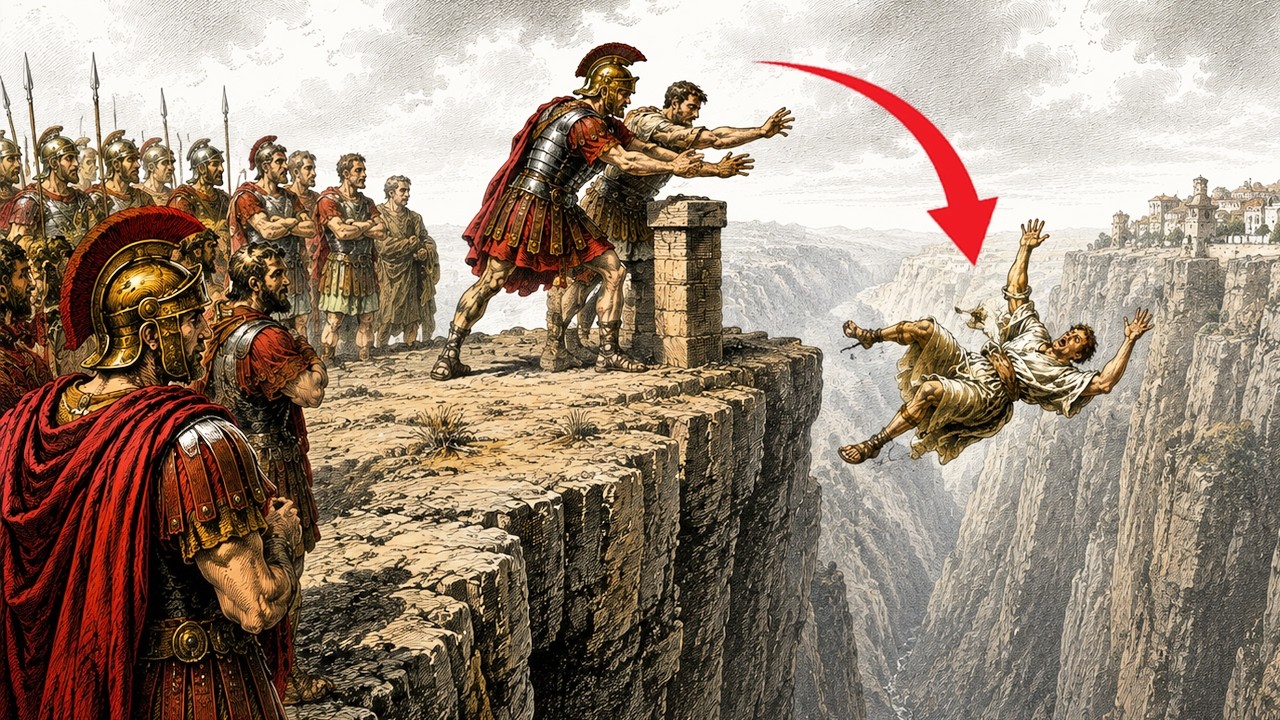
He has stood at the summit of the state, and in the next ninety seconds he will be lifted off the ground, carried those final steps toward a pale rocky edge, and hurled headfirst into the air. Beneath him, the fall is roughly eighty feet, the height of an eight-story building, onto shattered rocks. You are standing in the Forum. You can see him at the edge.
Every senator, every merchant, every slave carrying a basket on his head has stopped to watch. This is not a secret execution. This is theater, and Rome has built a stage for it that will keep operating for the next five centuries. From the first documented case in 485 BC to the last in AD 43, Rome will throw its enemies from this cliff for 527 years.
That is longer than the United States has existed, longer than the Ottoman Empire lasted. Twenty generations of Romans grew up watching bodies fall from the same edge, learning in silence exactly what it meant. The rock has a name. It is called the Tarpeian Rock, named for a young woman crushed to death in this very place by the enemies she tried to help.
Her story is why the rock exists. In Rome’s earliest years, the city is barely a city. It is a cluster of hills, a few thousand people, a king, and a fortress. The fortress sits on the Capitoline Hill, the same hill from which that condemned consul will one day be thrown.
In the fortress lives a young woman named Tarpeia. She is the daughter of the commander of the guard, Spurius Tarpeius. In some versions of the story, she is a Vestal Virgin, sworn to purity and loyalty. Outside the fortress walls, an army has been camped for weeks.
They are the Sabines, neighbors of the Romans, farmers and warriors from the hills to the north, led by their king Titus Tatius, a man who has invaded Roman territory over a feud that began with the abduction of brides. They have been sleeping on the cold ground for a month, far from home, hungry and tired. And they have been watching the walls of the fortress for a weakness. Tarpeia becomes that weakness.
No one knows why she did it. Some Roman writers say she was seduced by the gleam of Sabine gold. Others say she fell in love with their king. What is known is that she slipped out of the fortress and offered Titus Tatius a deal.
She would open the gates for them. In return, she asks for what they wear on their left arms. She means their golden bracelets. She means to become rich.
But when the Sabines pour through the gate she has opened, they repay the deal in the most literal and brutal way possible. They wear their shields on their left arms too. And so they throw their shields upon her. She is crushed beneath the weight of what she asked for.
Some accounts say she was buried on the hill. Others say her body was thrown from the cliff itself. In either case, the edge on the southern face of the Capitoline bears her name, the Tarpeian Rock. And here something extraordinary happens.
Rome does not erase her. Rome does not bury the story. Rome carves it into the geography of the city itself. So that every traitor who comes after her dies in the same place the first one died.
Because in Rome’s mind, the traitor did not deserve to die anywhere. The traitor deserved to die here, specifically. To understand why, look up. Directly above the cliff, the Romans will later build the most important building in their world.
In the sixth century BC, Lucius Tarquinius Superbus, Rome’s seventh and final king, began one of the most ambitious construction projects in the history of the young city. He leveled the summit of the Capitoline Hill. He destroyed old Sabine shrines. And on the platform he created, he began building the Temple of Jupiter Optimus Maximus, Jupiter the Best and Greatest, the most sacred building in the entire Roman world.
When finished, it dominated the city’s skyline for centuries, and its location was directly, materially, and deliberately above the execution cliff. The highest religious authority in Rome, the state god, the god of victory, the god by whom every consul swore before taking office, had his house built directly above the cliff from which traitors were thrown. When the condemned man stands at the edge, the temple of the king of the gods is behind him. Every step of this march is a message.
This is theology carved into terrain. The distance from the platform of the Temple of Jupiter to the edge of the Tarpeian Rock is not a mile. It is not even a hundred yards. It is a few seconds of walking.
The Romans built the house of their gods so close to the traitor’s cliff that you could carry an offering from one to the other without effort; glory and disgrace in the physical center of the city, separated by no more than the width of a courtyard. The rock was not used carelessly. It was used by law. A special board of judges, the quaestores parricidii, investigators of murder and serious crimes, decided who was sent to the cliff.
Ordinary murderers, ordinary thieves, ordinary criminals were dealt with in the Carcer, the state prison at the foot of the same hill, where they were strangled in a dark stone chamber called the Tullianum. The first historically confirmed case, the first man Roman historians can name with real dates and real charges, comes in 485 BC. His name is Spurius Cassius Vecellinus. He is not a minor criminal.
He is a patrician, a three-time consul, a man who negotiated treaties with foreign powers, led armies, and stood at the top of the Roman state until the year before. He proposes an agrarian law. He says public land should be distributed, part to Rome’s poor, part to Rome’s allies. To the contemporary ear, this sounds like ordinary policy.
To Rome’s nobles in 485 BC, it sounds like something darker. It sounds like a man buying the loyalty of the masses. It sounds like a man setting himself up as king. And in a republic that had, within living memory, expelled its last king, there is no worse charge.
The trial is held before the people themselves. Cassius is charged with perduellio, treason against the republic. Livy gives us the shape of the trial, not the words, but the shape is what matters because Cassius has a choice. He can give up the land law.
He can bow his head. He can grovel, and there is a chance, however small, that a man of his standing survives by exile. Or he can hold to what he proposed. He can insist that giving land to the poor is not tyranny but justice.
He can force the state to publicly kill a former consul, and let the record show what Rome does to those who try to help the common people. Spurius Cassius did not back down, and that is why he is climbing the hill a few days later. The formula that the sources preserved is chillingly bureaucratic. Murderers, traitors, perjurers, and thieving slaves convicted by the quaestores parricidii, this is the phrase, were thrown from the cliff to their deaths.
Cassius falls into the first category. His body will fall from the same edge where Tarpeia died, and with him, the historical record of the Tarpeian Rock officially begins. But Cassius is only the first name. Over the next five centuries, more will follow him on that road.
Some will be criminals, some conspirators, and some, perhaps most disturbingly of all, will be men who once saved Rome, punished for the crime of being too beloved by the wrong crowds. Around 390 BC, an army of Gauls led by a chieftain named Brennus sacked Rome. The entire city fell. Only one place held out, the Capitoline citadel, the very hill we have been standing on, the last defensive position in the entire Roman world.
One night, the Gauls attempted a silent attack up the slope. They nearly succeeded. It was not the guard who woke the defenders. It was the sacred geese of Juno, whose warning cries reached one man, Marcus Manlius, a soldier who rushed to the wall and hurled the first climbing Gaul over the cliff.
He saved Rome. He was given the title Capitolinus, “son of the Capitol. ” He was Rome’s living hero. Then, a few years later, he made the same mistake Cassius made.
He looked at the common people, his fellow citizens drowning in debt and being sold into slavery for defaulting, and he tried to help them. He paid some of their debts from his own fortune. He spoke against the harsh treatment of the poor. And in doing so, he began to look to the nobles not like a hero, but like a man buying an army of loyal followers.
A king in waiting. Read that again. The man who threw a Gaul off the Capitoline Hill to save Rome was thrown by Rome from the same hill within a decade. The ground he defended became his execution platform.
The Romans did not miss the irony. They engineered it. Manlius stood trial. The first assembly, held within sight of the Capitol, could not bring itself to convict him.
So the trial was moved. It was reconvened outside the city, on ground bearing none of his glories. And there, out of sight of the capital, the vote went against him. He was led back to Rome, climbed the hill he had defended, and was thrown from the Tarpeian Rock.
His house on the Capitoline was demolished. His family was forbidden for generations from using his first name, Marcus. Rome tried to erase him from memory. With Cassius and Manlius, the pattern is set.
The Tarpeian Rock is not merely a place for ordinary enemies. It is for a very specific kind of enemy: the Roman who gains too much popularity among the poor, the commander his soldiers love too well, the reformer who threatens the balance of the state. It is a cliff dedicated, more than anything else, to the crime of ambition. Modern historians, sifting through Livy and Dionysius and other sources, count about fifteen documented cases of the rock being used or threatened between the Second Punic War and the age of Claudius.
Fifteen cases we know by name. The real number over five centuries is certainly higher. Soldiers who fled during Hannibal’s invasion of Italy were dragged back and thrown from it. Slaves caught in undeniable theft were thrown.
Perjurers who lied under sacred oath were thrown. Each of them walked the same march up the hill, past the crowd, to the edge below the temple. The exact location of the execution edge on the Capitoline Hill remains, even today, a matter of dispute. What is undisputed is the height of the drop to the rocks at the base.
It is a fall of eight stories onto uneven, hard stone. Stand at that edge in your imagination. The stone is pale, eroded. Below you, the Roman Forum stretches out.
Temples, the senate house, market stalls, winding streets. From this height you can see the entire city you grew up in. If it is midday, you can see people looking up. You can see them waiting.
Then hands settle on your shoulders. They are the executioners, often public slaves assigned to the task. The fall itself takes a little over two seconds. In those two seconds, a human body accelerates from rest to nearly forty miles per hour.
There is no controlled landing. There is no survival. The rocks at the base are jagged, exposed, and crucially visible from the Forum. This last detail is not accidental.
Rome could easily have walled off the base of the cliff. Rome could have removed the body quickly. But Rome did neither. The point of the Tarpeian Rock was for everyone to see where you fell.
Here the darkest logic of the practice becomes clear. Strangulation in the prison at the foot of the hill was quick, private, and crucially clean. The rock was its opposite. It was slow, public, and messy.
A body falling from eighty feet onto stone does not land peacefully. It breaks. It becomes exposed. By leaving it visible at the base of the cliff, sometimes for hours, Rome ensured the punishment did not end with death.
It continued in the memory of everyone who walked past. There is a Roman idea for which we have no precise English word. The word is infamia, public disgrace, the loss of civic honor. The Tarpeian Rock was, more than anything else, a machine for manufacturing disgrace.
Its purpose was not merely to kill you. Rome had cleaner ways to kill you. Its purpose was to ensure that after your death, no one would ever speak your name with respect again. In the first century BC, the orator Marcus Tullius Cicero warned, in a phrase preserved by later writers, that the distance between the Capitol and the Tarpeian Rock was very short.
He was not being poetic. He was being perfectly serious. From the summit of Rome’s glory to the edge of its shame was a matter of seconds, and every Roman knew it. Most cultures separate their sacred and their shameful.
The temple on a hill, the execution ground somewhere out of sight. Rome did the opposite. Rome placed them on the same hill. Rome built the temple of the king of the gods directly above the cliff of traitors, and Rome kept this arrangement for centuries, because the arrangement itself was the message.
Honor and disgrace were not far apart. They were adjacent, separated by a few steps, or one single misstep. By the late Republic, in the century of Cicero and Caesar and Pompey, the rock had become a political tool as much as a routine legal device. Agitators threatened their enemies with it in speeches.
And when conspirators were condemned, they sometimes ended up there. It was the perfect way to strip a Roman of everything he had represented. When a senator was thrown from that cliff, he was not merely killed. He was officially declared an enemy of the state, ranked lower than an ordinary criminal.
His name was struck from monuments. His family inherited the disgrace rather than the property. But the rock did not kill only senators. This is what most modern accounts get wrong.
The Tarpeian Rock, in its long history, was an indiscriminate killer. To understand what Rome really intended with this cliff, you have to look at the executions history almost forgot. At some point in the mid-Republic, the exact year lost, a slave was caught in Rome stealing. The Latin term for it is furtum manifestum, theft in which the crime was undeniable.
The slave and the stolen goods were caught in hand. He was not from Rome. Perhaps from Gaul, Greece, Syria, or North Africa. He was brought to the city in chains as a child, sold in the market, put to work in a house or workshop.
He is not a political actor. He poses no threat to the state. He committed, by any modern standard, a crime against property. Under Roman law, a slave was not a person.
A slave was property that could speak. Yet in this case Rome chose to end his life not by beating, not in the shadows of his master’s house, but by the same ritual it used for former consuls. He was marched up the same hill. He climbed the same steps.
He stood on the same edge. Because for Rome at that moment, the slave who betrayed his master’s trust and the senator who betrayed the republic’s trust had done the same thing. They had betrayed the system, and whichever kind of betrayal it was, the cliff was its fate. During Hannibal’s invasion of Italy in the Second Punic War, Rome faced the worst military crisis in its history.
Entire armies were annihilated. Soldiers fled in terror. When the tide of war finally turned, Rome rounded up the deserters and some were condemned to death from the rock. Imagine that point of view.
You are a farmer’s boy from Campania or Etruria. You were conscripted. You watched your friends killed by Carthaginian cavalry. You fled.
And now, years later, you are climbing the same hill a former consul climbed, to face the same execution at the same edge. This is the message Rome wanted to carve into the mind of every citizen. The rock did not care who you were. Consul or slave, hero or thief, senator or soldier, if you betrayed trust, the path was the same.
That was the promise of the Tarpeian Rock. And that is why it lasted 500 years. The rock fades, not in battle, but quietly replaced by Augustus, the first emperor, who kept the old titles, old buildings, and old rituals, but emptied them all of meaning. In the reign of Tiberius, the second emperor, the Praetorian prefect Lucius Aelius Sejanus rises to enormous power.
For years he is the second man in the empire, feared by senators, courted by ambitious families. Then in AD 31 he falls. Tiberius turns on him. Sejanus is executed.
His allies, the men who rose with him, who bet their careers on him, who married their daughters into his family, are hunted down. Some are strangled. Some exiled. And the sources tell us that at least one was condemned to death from the Tarpeian Rock.
A man of the empire, condemned by an emperor, killed by a punishment invented for enemies of a republic that no longer existed. The political system of Rome had changed completely. The senate was hollowed out. The people had lost their voting power at trials.
The old republican world was gone. But the cliff remained. Because the message the cliff carried, that betrayal would be met with public disgrace, was a message every system, republican or imperial, wanted to send. The last recorded execution comes twelve years later.
The year is AD 43. The emperor is Claudius. A man was convicted of treason against him. His name is lost.
The charges are lost. But the sentence is not. He is led up the hill. He is marched before the crowds.
He is thrown from the Tarpeian Rock, 527 years from Spurius Cassius in 485 BC to this unknown man in AD 43. One cliff. One fall. One message.
After AD 43, the historical record goes silent. The rock does not disappear. It is still there. Still mentioned in speeches and letters and legal texts, still standing on the southern face of the Capitoline Hill.
But something has changed. Executions of the emperor’s enemies increasingly happen quietly, indoors, behind palace doors. The empire discovered that murder does not need spectacle. It can be done more efficiently, with less risk of the crowd sympathizing, if it happens where no one can see.
And so the rock stops being a place and becomes a memory, a metaphor. But the rock had already done its work. For more than five centuries, it shaped Rome’s concept of who the traitor was. And the meaning it built into the city’s geography would outlive the republic, outlive the empire, and in some ways outlive Rome itself.
The full record of the Tarpeian Rock, as far as historians have been able to reconstruct it, spans five centuries of falls. That number is certainly a minimum. It includes only cases where a surviving source tied a specific person to that specific cliff. The real number, including the deserting soldiers thrown in groups, the slaves whose executions were recorded as a legal phrase, the forgotten political conspirators in truncated records, was definitely higher, perhaps much higher.
We count only those whose falls history bothered to write down. So here is the answer to the question we started with. Why did Rome maintain, for more than five centuries, a form of execution that was slower, messier, and more public than any alternative? Because Rome was not merely trying to kill traitors.
Rome could kill traitors in several ways. Rome was trying to erase them. Strangulation in the Carcer ended a life. The fall from the Tarpeian Rock ended a life and a reputation.
It shattered the body publicly, in sight of the crowd, at the base of the sacred temple, so that the memory of the man became inseparably linked to the disgrace of his death. His descendants would live with that shame. His name would be struck from monuments. His family would be forbidden from using his first name.
The killing was the easy part. The humiliation was everything. In a society with no prisons for long sentences, no televised trials, no newspapers, the state needed a way to anchor its authority in the imagination of every citizen. It had to ensure that when any Roman considered breaking an oath, stealing from his master, or conspiring against the senate, one image came to mind: the image of the cliff.
And it needed that image to be so vivid, so specific, so tied to a real place in the real city, that no one could ever forget it. That is what the Tarpeian Rock was. Rome’s memory of what happens to a traitor, carved into the side of the hill. Consider what happened to the men we have met.
Spurius Cassius Vecellinus, the three-time consul and agrarian reformer, did not simply die. In the years after his execution, later Roman reformers, especially the Gracchi brothers centuries later, were compared to him as a warning. His name became synonymous with dangerous ambition. It was used to threaten men for more than 300 years after his death.
Marcus Manlius Capitolinus, the man who saved the Capitol from the Gauls, was punished even after death. His house on the Capitol was demolished. His family, the Manlii, made an official decision that no son of the family would bear the name Marcus again. The name itself was too dangerous.
A hero of Rome became, by the will of his own descendants, deliberately forgotten. The nameless slaves, the deserting soldiers, the followers of Sejanus, the last man in the reign of Claudius, none of them has a grave you can visit. Most have no names in the historical record. Their falls are mere footnotes.
But the cliff they fell from is still there. If you go to Rome today, you can walk to the southern side of the Capitoline Hill and stand at its base. The rock is a real place. It still counts its victims.
But the end of the practice was not the end of the story. The Tarpeian Rock, the place, the name, the idea, outlived every system that used it. And what it became in the centuries after the last body fell is arguably more important than what it was while it was being used. By the late first century AD, the executions had stopped, but the rock went nowhere.
It sits on the southern face of the Capitoline Hill for the next two thousand years, watching the empire rise and fall around it. When Rome was sacked in AD 410 by the Visigoths, the rock was there. When the Western Roman Empire collapsed in AD 476, the rock was there. When the popes rebuilt the city, when the Renaissance came, when Napoleon marched through Rome, when the modern city was built layer upon layer over the ancient one, the rock was still there.
Standing. Waiting. Empty. One thing most accounts of the story miss: the Tarpeian Rock you can visit today, the exposed cliff face on the southern side of the Capitoline, is not exactly the edge the Romans used.
Two thousand years of urban development have raised the ground level at the base of the hill by several meters. What was once an eighty-foot fall onto exposed rock is now a much shorter drop onto a level of the city that did not exist when Cassius and Manlius were thrown. The killing edge, in the literal sense, has been buried under the rubble of history. You can stand on the cliff, but you can no longer see what a Roman would have seen looking down.
Yet the memory of what happened there is rooted in language we still use. When Cicero warned that the distance between the Capitol and the Tarpeian Rock was barely worth mentioning, he was not only describing the geography of Rome. He was describing the nature of power itself: how quickly the celebrated become the condemned, how the same crowd that raises a leader can watch his fall weeks later. That idea, in its various forms, has been quoted by politicians, historians, and writers for 2,000 years.
Every time someone speaks of how thin the line between glory and disgrace is, they are, whether they know it or not, quoting a Roman cliff. Because that is what the Tarpeian Rock ultimately was. It was not a punishment, not really. Rome had harsher punishments.
It was not a deterrent. Deterrents work quietly, out of sight. It was something stranger and darker than either. It was a mirror, a physical, geographical mirror that could not be ignored in the heart of the city, telling every Roman one sentence about himself.
It said: “You are one bad decision away from that edge. ” The consul, the slave, the soldier, the hero thrown from his own citadel, the girl whose name the rock still bears, all of you. And that mirror is the reason Rome kept it standing, unused, for centuries after the last body fell. The temple of the gods looked down on the execution cliff, and between them, the entire story of Roman power was told in a few steps.
Return one final time to the beginning, to the bound man being led up the hill in the fifth century BC. He was, as we said, a former consul. He stood at the summit of the state, and in the next ninety seconds he will fall. What you understand now, and did not understand then, is that the fall was not the punishment.
The fall was fast. The punishment was the march, the crowd, the temple behind him, and the realization that everything he had built would end on an edge named for a girl who died before Rome was Rome. The rock was not killing him. The rock was erasing him.
The Romans understood something most civilizations forget. Killing an enemy is easy. Any system can do it. But erasing an enemy, ensuring that no one will speak his name for centuries after his death except with contempt, that requires ritual.
That requires geography. That requires a cliff in the heart of your city, a temple above it, and a road between them that everyone in the city can see. That is what the Tarpeian Rock truly was. Not a place of death, but a place of forgetting.
And the fact that we still talk about it twenty centuries after it stopped being used is the final silent proof that Rome, for all its cruelty, could not quite make the men on that cliff disappear.