In the autumn of 2025, in a bank vault in the Canadian province of Quebec, three men in their sixties gathered around a simple table and watched a bank employee place a small brown leather suitcase before them. It was the kind of bag one carries when leaving in haste, perhaps forever, with worn corners and leather softened by time. Inside, wrapped in yellowed paper, lay an object the world had been searching for, and arguing about, for more than a century. Karl von Habsburg-Lothringen, the grandson of the last Emperor of Austria, opened the bag himself and began lifting away the paper piece by piece.
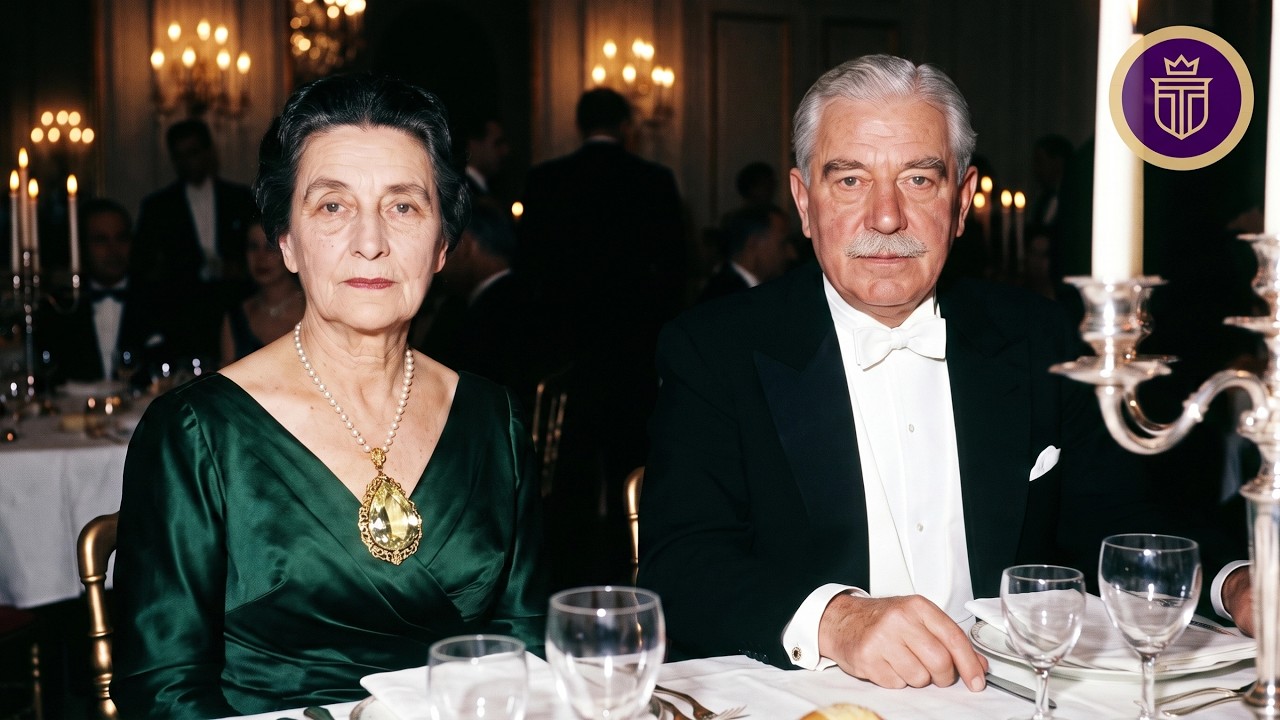
The others leaned in, because none of them had ever seen what lay within. When the final layer was pulled back, they were looking at the Florentine Diamond, 137. 27 carats of pale yellow stone, still in the irregular nine-sided cut given to it by a Venetian jeweler in the year 1615. It had not been recut, broken, smuggled, or pawned, as generations of experts had suspected.
No one had touched it. The diamond had been sitting in that bank vault since about 1940, placed there by an exiled empress who had carried it out of her collapsing empire and then sworn her family to silence for decades. The survival of the diamond itself was not the most surprising part. What stunned the world was the silence.
For a century, the Republic of Austria, the European press, gem dealers, novelists, and even art-crime experts at the Federal Bureau of Investigation had worked on the assumption that the Florentine had been lost or destroyed, with many privately accusing the Habsburgs of selling their greatest jewel in secret. The truth, when it finally emerged, was the opposite of theft. A stone that had passed through four dynasties and vanished from the historical record had been preserved, intact, by the family that had always owned it. Not in defiance of the law, but in silent defiance of a republic that had spent decades trying to take it away from them.
The documented history of the diamond does not begin in a European court, but in the mines of southern India. In the early sixteenth century, a remarkable rough yellow crystal came out of the ground at Golconda, the same celebrated source that produced the Koh-i-Noor and the stone that would one day be known as the Hope Diamond. According to accounts drawn from later Medici inventories, the Portuguese colonial governor of Goa, Dom Luís de Castro, acquired the rough crystal from a local ruler and entrusted it to the Jesuits in Rome for safekeeping. In time, it reached Florence.
A competing legend, dismissed by most serious gem historians, claimed the diamond was cut in Bruges by the Flemish jeweler Lodewyk van Berquem for Charles the Bold, Duke of Burgundy, and that it was taken from the duke’s corpse after his death at the Battle of Nancy in 1477 by a soldier who sold it for a few florins. The story has survived because it is good theater, but it has no basis in the physical evidence. The cut visible in every surviving description is an elaborate Indian double rose cut, not the simpler faceting used by fifteenth-century European jewelers, and the weight matches no documented Burgundian stone. The real buyers were bankers, not soldiers or popes.
Ferdinando I de’ Medici, the Grand Duke of Tuscany, purchased the rough crystal from the Castro family for 35,000 Portuguese escudos, a price that showed how seriously the great banking dynasty of the Renaissance took the acquisition. Ferdinando’s son, Cosimo II, who ruled the duchy, gave the stone to the skilled Venetian jeweler Pompeo Studenti, working in Florence. The polished jewel was delivered on October 10, 1615, in the shape it still holds today, an irregular nine-sided cut with 126 facets arranged as a double rose. For the next generation, the Florentine was the showpiece of the Medici court.
In 1657, the French jeweler and traveler Jean-Baptiste Tavernier, a man who had handled more gemstones than almost anyone alive, was granted a rare opportunity to examine it and pronounced it the largest diamond in Europe, with a pale lemon-yellow color and a distinctive double rose form. He valued the stone at 600,000 scudi, a figure that placed it among the most precious objects on the continent. The Medici guarded their treasure with deliberate secrecy, and almost no one was allowed to weigh it. But wealth could not solve the problem that eventually ended the dynasty, the lack of male heirs.
When the last Medici grand duke, Gian Gastone, died without a successor in 1737, the diamond left Florence for Vienna. Its fate was settled not on a battlefield but through one of the great marriages of the century. In 1736, Francis Stephen of Lorraine married Maria Theresa of Austria, founding the Habsburg-Lorraine dynasty that would rule a vast Central European empire for nearly two centuries. By the Treaty of Vienna of 1738, the entire Grand Duchy of Tuscany passed to Francis Stephen, and with it the diamond, which was moved north to the imperial treasury at the Hofburg Palace in Vienna.
There it was placed in Cabinet 13 among what the dynasty called the private imperial court jewels, kept separate from the crown jewels and listed as personal family property. That distinction was a mere accounting formality in the eighteenth century. A century later, it would become a legal weapon. The diamond accompanied the family through its greatest moments.
When Francis Stephen was crowned Holy Roman Emperor in 1745, the Florentine sat in his imperial crown. In 1810, Marie Louise of Austria, the archduchess who became Napoleon Bonaparte’s second wife, received the jewel as part of her marriage settlement, and she brought it back to Austria when Napoleon’s empire collapsed in 1814. By the nineteenth century, the Habsburgs finally did what the Medici never had, they measured the stone with precision. In 1865, the director of the imperial mineral cabinet documented its exact weight and characteristics, and a plaster cast was made so that a replica of rhinestone could be matched to the original color.
The official description of that color was wine mixed with water, a delicate phrase for the famous pale yellow glow. The diamond was photographed, mounted in a hat ornament, and that single black-and-white image would later become the only visual reference in the world for a century. The Habsburgs, by documenting their jewel so carefully, were unknowingly preparing the evidence that would one day prove they still possessed it. In the final weeks of the First World War, the empire that had protected the diamond for almost two centuries collapsed in a matter of days.
On the morning of November 1, 1918, Emperor Charles I, the last Habsburg ruler, realized his kingdom could not be saved. With crowds demanding a republic in the streets of Vienna, he turned to his loyal court official, Count Leopold Berchtold, and entrusted him with a delicate and urgent task. Berchtold and his men went to the imperial treasury, emptied dozens of pieces from the display cases in Cabinet 13, and smuggled the collection across the border into Switzerland on November 4, 1918, three days before Charles formally renounced his role in Austrian affairs. Among the pieces were the Florentine Diamond, still set in its hat brooch, the diamond crown worn by Empress Elisabeth, known as Sisi, a diamond bracelet with a large emerald that Maria Theresa had worn on sleigh rides, and many others.
The jewels were first deposited with the Swiss National Bank in Zurich. Once across the border, the diamond was no longer simply private ornament, but contested property. The new Austrian Republic passed laws aimed at seizing Habsburg property for the state, and the Italian government filed a claim of its own, arguing that the Medici had bequeathed the diamond to the people of Florence. The family’s defense rested on two facts.
The Austrian attorney general declared in 1921 that the collection, including the Florentine, was the private property of the Habsburg-Lorraine family, and the Allied Reparations Commission rejected Italy’s claim in 1923, confirming the diamond as private family property. Because the jewels sat in a Swiss bank vault, Austrian confiscation laws, meant for assets inside Austria, could not reach them. The legal position was solid in theory. In practice, the family was about to be plunged into a mystery that would last a hundred years.
The gap between the law and the object is where the entire riddle began. The European press, seeing an exiled family reduced to poverty, assumed the jewels had been sold. Suspicions sharpened when Charles made two failed attempts to retake the Hungarian throne in 1921, ending in his arrest and forced exile to Madeira, where he died of pneumonia on April 1, 1922, leaving the twenty-nine-year-old Empress Zita a widow with eight children and almost no resources. Rumors of betrayal followed.
A Swiss diamond dealer, Alois de Sonnheimer, claimed in memoirs published in 1966 that family jewels were offered to him by the emperor’s private secretary, a man named Bruno Steiner, and that pieces were broken up and sold. In Sonnheimer’s account, the Florentine itself had been taken from its setting and dismantled. A 1923 New York Times article reported that Steiner had been arrested for questioning over the loss of the Austrian crown jewels, and a later account claimed Sisi’s diamond crown was last seen in 1921 after Steiner wore it during a drunken spree before it vanished forever. The theory that a trusted insider turned some Habsburg jewels into cash has never been seriously disputed.
What remained disputed for a century was whether the Florentine itself had been sold, and the discovery of the stone in its original form in 2025 answered that question. But for decades, the theories multiplied. Serious gem historians generally believed the diamond had been recut and sold, most likely in the United States. A 99.
52-carat yellow cushion-cut diamond that appeared on the American market in 1923 was briefly suspected, and in 1981, a brilliant-cut yellow diamond of just under 82 carats was said by its owner to have been recut from an old form. Others claimed the stone had been smuggled to South America, pawned to fund Charles’s Hungarian adventure, seized by the Nazis, or secretly returned to Vienna by American troops after the Second World War. All of them failed for a single reason: none of the theorists knew that Empress Zita had placed the diamond in a bank in Quebec and lived with the secret until her death in 1989. Zita was born a Bourbon-Parma princess in 1892, became Empress of Austria at twenty-four, and was a widow with eight children by twenty-nine.
She did not surrender to despair. The family moved from Spain to Belgium, where they lived through the 1920s and 1930s, and her eldest son, Otto, campaigned publicly against the growing Nazi threat. When Germany annexed Austria in March 1938, the family was declared an enemy of the state. When the German army struck Belgium and France in May 1940, Zita was fleeing again, this time with eight children and the surviving Habsburg jewels.
At the Spanish border, a guard recognized the former empress and allowed her to cross, and she asked him to admit all the desperate refugees waiting in line behind her. He did. The family moved from Spain to Portugal and, with American help, to North America in 1940, finally settling in a modest life in Grand-Mère, Quebec, where Zita grew to love French Canada. Throughout the journey, she carried the jewels in a small bag, described by her family as an emigrant’s suitcase, the kind one uses to carry one’s last possessions while fleeing.
Once she could breathe again, she placed the bag in a bank vault in Quebec, around 1940, in a bank and a city whose names the family no longer remembers precisely. When she returned to Europe in 1953, she deliberately left the jewels behind. She told only two of her sons, Archdukes Robert and Rudolf, where the collection was hidden. Everyone else, including her eldest son Otto, the most prominent surviving Habsburg, was kept in the dark.
The instructions were clear: the location was to remain secret for one hundred years after Charles’s death, until at least April 1, 2022. The motive was practical, not sentimental, rooted in a family history of exile and confiscation. Before their deaths, Robert and Rudolf passed the secret to one son each: Lorenz von Habsburg-Lothringen and Simeon von Habsburg-Lothringen. The knowledge moved vertically, from father to son, and never spread horizontally.
Otto died in 2011 without ever knowing the diamond still existed. Even Karl, the current head of the family, did not know. He first learned of the jewel in 2024, when Lorenz and Simeon finally told him. When the one-hundred-year term expired in April 2022, the two guardians alerted Karl in 2024, and the decision was made to reveal the secret.
The official announcement came in November 2025, with the New York Times granted exclusive access. In October 2025, Karl, Lorenz, and Simeon traveled to Quebec together, accompanied by journalists and Christoph Kürkçü, the sixth-generation owner of A. E. Köchert, the Viennese firm that had served the imperial Habsburg court as court jewelers since 1814.
Kürkçü brought his instruments, a portable balance, a refractometer, and an electronic diamond tester. Karl opened the worn suitcase himself and removed the yellowed paper wrapped around each jewel, moving toward the diamond, which was wrapped separately from the rest. The three men, all living in Europe, were seeing the family treasure for the first time in their lives. When the last paper was lifted, the Florentine appeared, still brilliant, still mounted in the jeweled brooch recognizable from the old photograph that had been the world’s only reference for a century.
Kürkçü, a man who had spent his life surrounded by precious stones, described the moment as sublime, a moment one experiences perhaps once in a lifetime. He noted that the cutter had left some of the original crystal surface intact along the edges, a true craftsman he said, with a color he compared to a fine Scotch whisky. He also observed something less reassuring: the diamond was not held firmly in its setting, suggesting that someone might once have begun the process of selling it separately, perhaps even thought of dismantling it, before changing their mind. The vault did not contain everything.
Kürkçü prepared a checklist from the 1918 imperial treasury catalog, and many pieces were missing, including a 44-carat diamond crown and Sisi’s famous diamond crown, last said to have been seen when Steiner wore it. Still, the recovery was real. For Karl, the most moving object in the bag was not the diamond at all, but the medal of the Order of the Golden Fleece, the dynasty’s highest honor, founded in 1430. Karl von Habsburg-Lothringen, born in 1961, inherited the headship of the family from his father Otto on January 1, 2007.
He uses no title, since Austrian law abolished all noble titles in 1919. He served as a member of the European Parliament from 1996 to 1999, trained as a pilot in the Austrian Air Force, and from 2008 to 2020 headed Blue Shield International, an organization devoted to protecting cultural heritage in conflict zones, work that brought him face to face with the kind of cultural loss his own family had suffered. He described the discovery simply. The Florentine is in a bank vault in Canada with other family jewels, he said.
In a strict sense, the jewels were never lost. Very few people knew where they were. The manner of the revelation reopened the legal question. Almost immediately, the Austrian Deputy Chancellor and Minister of Culture stated that if the Florentine Diamond proved to be the property of the Republic of Austria, he would initiate proceedings for its return.
By December 2025, Austria had formally established the Florentine Commission, a panel of experts tasked with assessing whether the state had a legitimate legal claim, with results expected by autumn 2026. The Austrian position rests on the 1919 Habsburg Law declaring Habsburg property to be state property, and on the claim that the imperial jewels were state regalia. The Habsburgs argue that the jewels were kept in a separate register as private family property, that they were outside Austrian territory when the 1919 law was passed, and that Austrian law cannot reach property that was first in Switzerland and then in Canada. To support their case, the family commissioned a report from the British historian Richard Bassett, who concluded that the jewels are private property and that the Austrian Habsburg Law has no relevance.
The family has placed the collection in a Canadian trust under Quebec law, with the direct descendants of Charles I and Zita as beneficiaries. They do not intend to sell the diamond and have refused to value it. Plans are underway to display the collection at the National Museum of Quebec in Quebec City, and the Florentine Commission is expected to report by autumn 2026, a verdict that will determine whether Austria formally demands the return of the collection. The revelation came at a strange moment.
It followed the theft of the crown jewels from the Apollo Gallery in Paris, when thieves used a truck-mounted crane to break in, and the contrast was stark. Public institutions had failed to protect priceless treasures entrusted to them, while a dynasty long suspected of having lost or sold its diamond had guarded its inheritance through sustained secrecy. A diamond taken through imperial conquest and dynastic marriage, hidden by the family that owned it, had survived because one determined widow chose silence over display and kept her word so faithfully that even the head of her own family remained ignorant until the year before it was opened. The family did not hide the diamond because they had stolen it.
They hid it because they had twice learned the consequences of the world knowing what they possessed, and they concluded that a stone no one could see was a stone no one could take.