Heinrich Himmler built the largest private army in modern history while Germany was running out of everything needed to sustain it. At its peak, the Waffen SS numbered nearly a million men organized into 38 divisions, consuming steel, fuel, ammunition, and human lives on a scale that alarmed even the Reich’s finance ministers. The question that has occupied historians ever since is why he kept building it long after the war was lost and the economy could no longer support it. The SS began as a personal bodyguard for Adolf Hitler in 1925, and when Himmler took command in January 1929, it had fewer than 300 members.
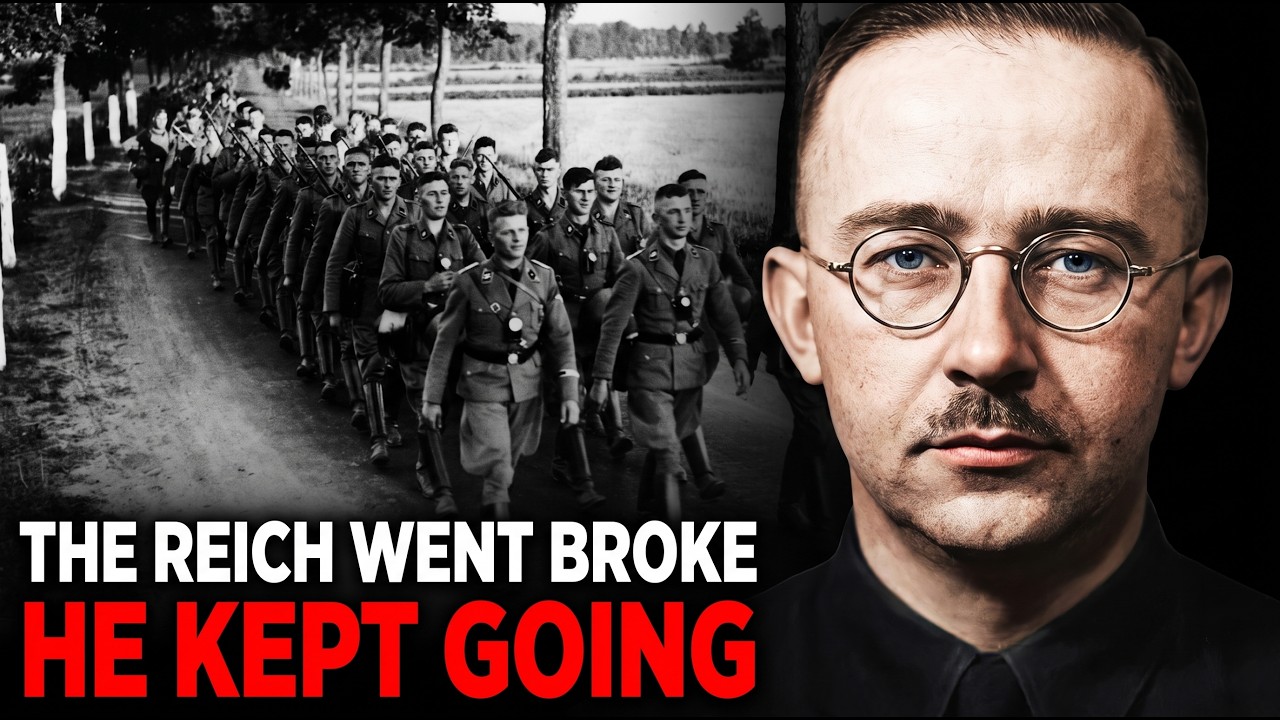
He was 38 years old, earnest and bespectacled, a former agricultural student from Bavaria who had once raised chickens and had no military experience. What he possessed was an almost mystical belief in racial ideology, a gift for organizational detail, and an ambition concealed so carefully behind deference to Hitler that rivals failed to recognize it until too late. By 1933 the SS had grown to 52,000 men and was becoming the central nervous system of Nazi terror. The armed formations that would become the Waffen SS began forming that year and in 1934.
They proved their value to Hitler on the night of June 30, 1934, when SS units participated in the murder of Ernst Röhm and dozens of other SA leaders during the Night of the Long Knives. The operation showed Hitler that Himmler’s men would kill on command without hesitation, something the professional army officers with their codes and traditions could never fully offer. When Germany invaded Poland in September 1939, the SS-Verfügungstruppe fielded roughly 18,000 men. Their performance was mixed, with disproportionate casualties reflecting tactical training that lagged behind Wehrmacht standards.
The campaign also saw the first major SS atrocities against Polish civilians and Jewish communities, a preview of what would follow on a far larger scale in the Soviet Union. Himmler drew a characteristic conclusion from the campaign’s deficiencies: the solution was not to slow down but to expand, recruit more men, and build more divisions faster than anyone thought possible. The campaign in France in 1940 gave the SS formations their first test against a sophisticated European opponent, and they performed well enough to silence some critics. But casualties remained higher than in comparable Wehrmacht units, and the rivalry between the two armed forces was rooted in a fundamental disagreement about what an army was for.
For the professional officer corps, an army existed to fight wars according to established principles. For Himmler, the armed SS existed to embody and protect the racial order the Nazi state was creating. The invasion of the Soviet Union in June 1941 committed four SS divisions to the Eastern Front, roughly 100,000 men. They fought with genuine tactical aggression and suffered grievous losses.
The Totenkopf Division lost more than half its strength by the end of 1941, and Das Reich was so badly damaged it had to be withdrawn for months. The winter crisis outside Moscow, the first catastrophic reversal of the war, forced Himmler to confront an impossible contradiction. His ideological standards for recruitment, racial purity tests that required proof of Aryan ancestry back to 1750, had made the SS small. The Eastern Front made that smallness militarily unsustainable.
His response was to expand the recruiting pool while maintaining the fiction of racial purity. Beginning in 1941, the Waffen SS recruited heavily from Germanic and Nordic populations in occupied countries. Norwegians, Danes, Dutch, Flemish Belgians, and Swedes were organized into divisions fighting for “European civilization” against Bolshevism. For Himmler, this was not merely expedient.
He genuinely believed he was building a pan-European racial army that transcended national boundaries. The battle for Kharkov in early 1943 cemented the Waffen SS’s reputation as a fighting force of the first order. Following the destruction of the German Sixth Army at Stalingrad, Soviet forces recaptured the Ukrainian city and threatened to tear apart the entire southern front. The SS Panzer Corps, comprising the Leibstandarte, Das Reich, and Totenkopf divisions, spearheaded Field Marshal Erich von Manstein’s counteroffensive.
The operation was a tactical masterpiece, ending with Soviet forces expelled from the city at enormous cost to both sides. Himmler drew precisely the wrong lesson. Where another leader might have concluded that his three elite divisions represented an optimal force to be husbanded carefully, Himmler decided he needed ten or twenty more. Through 1943 and 1944, new SS divisions were formed at a rate of roughly one every two months.
Some were genuine combat formations built around experienced cadres with good equipment. Many more were not. Divisions were raised from Bosnian Muslims, Ukrainians, French volunteers, Walloon Belgians, and the Waffen SS began accepting conscripts from Romania, Hungary, and Yugoslavia. By late 1944, Himmler could list on paper nearly 40 divisions drawn from perhaps 15 national and ethnic groups.
The expansion was economically devastating. Each SS Panzer division required approximately 300 tanks, 15,000 to 20,000 men, several thousand vehicles, and enormous ongoing consumption of fuel, ammunition, and spare parts. The SS funded part of its ambition through an economic empire built on concentration camp labor. The gap between what Himmler planned and what Germany could deliver widened with every passing month of 1944, even as Soviet offensives destroyed Army Group Center and Soviet offensives chewed up SS divisions like everyone else.
The competition for resources reached its most damaging point in the allocation of armored vehicles. Wehrmacht Panzer divisions defending the approaches to Germany were chronically short of tanks while SS elite divisions received priority allocation of the newest Tiger and Panther vehicles. This partly reflected Hitler’s confidence in the SS and his distrust of the army, amplified to near psychosis after the July 20, 1944 assassination attempt by Wehrmacht officers. In the aftermath, Himmler was appointed commander of the reserve army, giving him control of the replacement system for the entire German army.
He used the position to funnel additional resources to his formations. By the autumn of 1944 he was the second most powerful man in Germany, and he was using his power to continue building an army the country could not supply. The final expression of this dynamic was the Ardennes offensive of December 1944, the Battle of the Bulge. Germany committed its last strategic armored reserve, spearheaded by the Sixth SS Panzer Army under Sepp Dietrich.
The plan, to capture the Allied fuel depot at Liège and drive to Antwerp, was delusional. The fuel shortage was so severe that the attack was planned on the assumption that German units would capture Allied fuel dumps en route. When the advance bogged down, the assumption translated into catastrophe. During the advance, soldiers of the Leibstandarte massacred approximately 84 American prisoners at Malmedy on December 17, 1944.
The massacre was not an aberration within the SS system. It was an expression of the organizational culture Himmler had built over fifteen years. By the first days of January 1945 the offensive was finished. The elite SS Panzer divisions were shipped east to Hungary, where they participated in counteroffensives around Lake Balaton, once again tactically impressive and strategically futile.
When Dietrich’s exhausted divisions failed to achieve their objectives, Hitler ordered them stripped of their honorary cuff titles, to which Dietrich reportedly replied that he would sooner be shot than carry out such an order. Even in February and March 1945, with Germany collapsing, SS recruiters were attempting to enlist men from occupied territories, plans existed for divisions that existed only as names and officer cadres, and concentration camp inmates were being considered for service. The bureaucratic machinery of expansion kept turning long after any military rationale had disappeared, driven by institutional momentum and the psychological impossibility of stopping. Himmler’s own fate in the final weeks of the war revealed the ultimate emptiness of his ideology.
In February 1945, without Hitler’s authorization, he made contact with the World Jewish Congress representative Count Folke Bernadotte to offer Germany’s surrender to the Western Allies in exchange for his personal safety. When Hitler learned of this betrayal in the final days of April 1945, he stripped Himmler of all offices and ordered his arrest. The man who had commanded nearly a million soldiers fled in disguise, shaving his distinctive mustache and adopting a false identity. He was captured by British soldiers near Bremen on May 22, 1945.
During a medical examination the following day, he bit down on a cyanide capsule concealed in his teeth and was dead within minutes. He was 44, buried in an unmarked grave to prevent it becoming a pilgrimage site. The army he built essentially ceased to exist with the regime it served. The last battles of the Waffen SS were fought in the ruins of Berlin.
Outside the capital, formations surrendered or dissolved across Germany, Austria, and Czechoslovakia. Many soldiers attempted to pass themselves off as ordinary Wehrmacht men, but the blood-type tattoo most SS soldiers bore on their upper left arm was an almost unforgeable marker that Allied investigators learned to look for. The post-war reckoning produced uneven outcomes. The International Military Tribunal declared the SS a criminal organization in 1946.
The Malmedy trial at Dachau charged 73 members of the Leibstandarte, and the commander responsible for the massacre, Joachim Peiper, was sentenced to death. But allegations of improper interrogation methods led to the commutation of all death sentences, and Peiper was released in 1956. In July 1976 his house in France was set on fire and his burned body was found the following morning, killed by former resistance fighters. Other commanders faced similar patterns of commuted sentences and early releases.
Kurt Meyer, who commanded the 12th SS Panzer Division Hitlerjugend in Normandy, where his troops murdered Canadian prisoners, was sentenced to death, then had his sentence commuted and was released in 1954. He became a prominent figure in HIAG, the veterans organization that worked to rehabilitate the Waffen SS’s reputation, until his death in 1961. The rehabilitation narrative that HIAG advanced, that the Waffen SS had been soldiers like any others, was historically false and has been increasingly recognized as such by historians from the 1980s onward. The true cost of Himmler’s enterprise was measured in the six million Jews murdered in the Holocaust, the millions of Soviet civilians and prisoners killed in the genocidal war of annihilation, and the tens of thousands of Allied and German soldiers killed in battles that SS tactical effectiveness made longer and more costly than they would otherwise have been.
Himmler’s army was formidable at its best and wasteful at its worst, a demonstration that military competence and moral depravity are not mutually exclusive. The record of its crimes was documented and preserved, and the argument that it was an ordinary army was ultimately defeated by the historians who spent the following half century in the archives.