On the night of April 18th, 1886, a woman the size of most men lay screaming in the dirt of Utah Street in El Paso, Texas, clutching her groin as blood ran through her fingers. Across the porch, a smaller woman stood in a doorway holding a still-smoking Colt 44. She fired again, missed, smiled, and walked back inside. It took six men to carry the wounded woman home, hauling 230 pounds of dead weight and bleeding flesh through the door of 19 South Utah Street while her girls wept behind them.
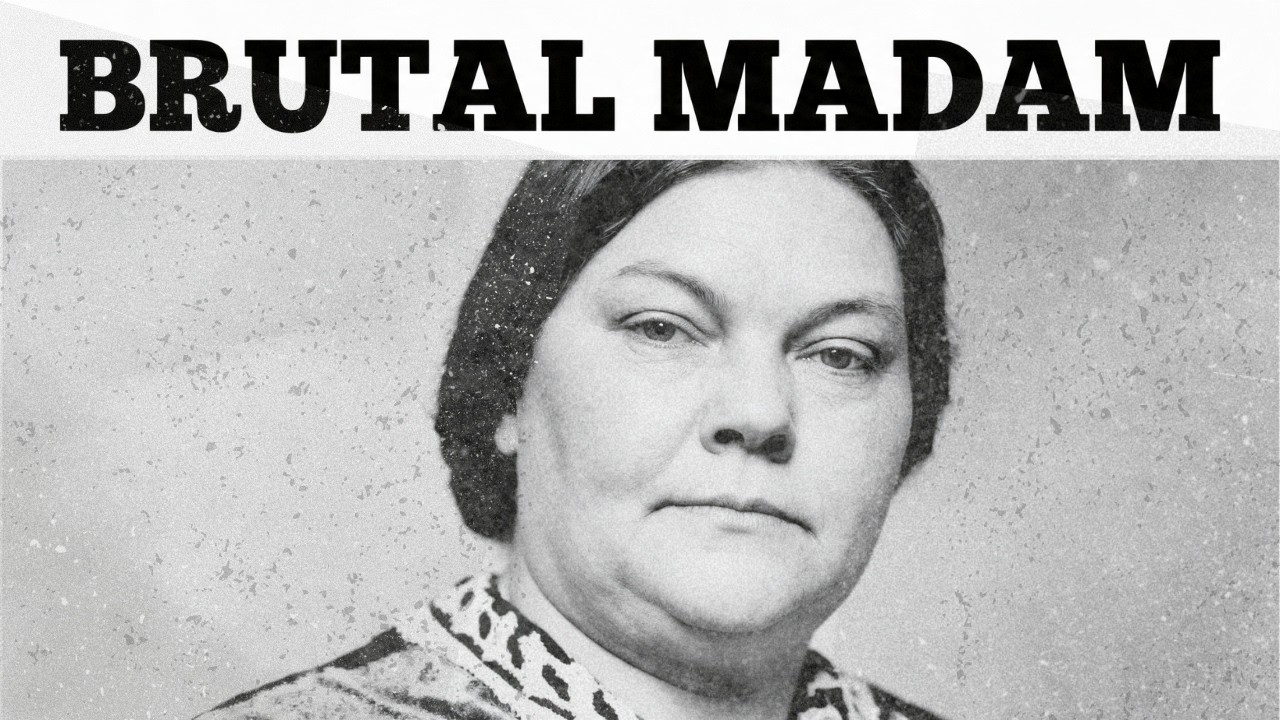
Her name was Alice Abbott. She had built the first brothel on that street, and she ran the biggest parlor house in the most profitable vice district west of New Orleans. Within twenty-four hours, the El Paso Herald would turn the worst night of her life into the funniest story the territory had heard all year—and a single misspelled word would follow her to an unmarked grave. Almost nothing survives about Alice Abbott before El Paso.
No confirmed birth date, no birthplace, no parents, no marriage certificate, no maiden name. The entire record of her life before 1880 amounts to one verifiable fact: she arrived from Louisville, Kentucky. Whether she was born there or simply worked there last before heading west, no source settles. She carried no husband, no family, and no documented past.
The frontier was full of people like that, people whose histories had been erased by distance or by deliberate choice. Nobody asked, and if they did, nobody wrote the answer down. What she did carry was capital and a plan based on a future nobody else in El Paso had yet imagined. El Paso in 1880 was not a city.
It was a scattering of adobe buildings on the north bank of the Rio Grande, baking at the far western tip of Texas, with a population of 736. There was no railroad, no telegraph reaching most of the surrounding territory, no paved road, no sewer system, no organized fire company, and no police force worth the name. The Mexican border sat at the river, and the nearest American settlement of any size was days of hard riding in every direction. It was a place you ended up when you had run out of places to be respectable—or a place you chose if you had the nerve to bet on something nobody else could see yet.
Alice Abbott chose it. She was six feet tall, weighed better than two hundred pounds, and every surviving account uses the same language about her: she was enormous, she was loud, she filled a room. She arrived with enough money to build a commercial operation and enough physical authority to run it without a man standing behind her. Within months, she did something no other woman in El Paso had done.
She built a purpose-built brothel at 19 South Utah Street—not a converted rooming house, not a room above a saloon, not a crib, the one-room operations where the lowest tier of working women received customers for fifty cents to a dollar a visit. Alice built a parlor house, a proper one, with multiple rooms furnished with care and women she hired and managed, charging three to five dollars a visit. That was serious money in 1880, when a working man on the frontier earned a dollar a day. Her clientele was not drifters; it was men with means: merchants, cattlemen, officers from Fort Bliss.
She called herself the best housekeeper in the USA and kept a photograph album documenting the interior of her brothel and the women who worked for her. She was not hiding. She was advertising. And she was there before the railroad came.
On May 19th, 1881, the Southern Pacific steamed into El Paso, followed by other lines until the little adobe crossing on the Rio Grande became the junction point for five major railroads. The population exploded, from 736 in 1880 to over ten thousand by 1890. Gas lighting, running water, electricity, and telephone service arrived. Brick replaced adobe, banks opened, hotels went up.
And every train brought men with money and no supervision: cattlemen, miners, soldiers, speculators, drifters—almost none of them with wives. The gap between men with cash and women with no other options was the engine that built Utah Street. Prostitutes settled into the blocks south of the commercial district, and Utah Street became the center. Parlor houses lined it, with women in fancy dresses charging three to five dollars.
Below them, crib girls worked one-room apartments for fifty cents to a dollar. Below them, streetwalkers had no permanent location at all. By the mid-1890s, more than six hundred women worked within the district’s boundaries—in a city of roughly fifteen thousand. The city of El Paso did not merely tolerate what was happening on Utah Street.
It depended on it. In 1882, El Paso imposed a fine of five dollars per week on every working prostitute. That money did not go into a general fund; it went directly to pay police and fire department salaries. The officers who patrolled Utah Street were being paid by the women who worked there.
Every madam who paid her weekly fine was literally underwriting the institution supposed to regulate her. The city taxed the madams, recorded them in the city directory, and looked the other way—as long as nothing forced respectable El Paso to stare at what was happening six blocks from the nearest church. The bargain was never written down, but every woman on Utah Street understood its terms: pay the fine every week, stay within the boundaries, do not cause a scene the newspaper cannot ignore, and the city leaves you alone. Not protects you.
Leaves you alone. In 1886, the fine doubled to ten dollars, and more than 150 prostitutes marched to an El Paso city council meeting to protest. The city took the money anyway. The fine hit the poorest women hardest: a parlor-house girl could cover it in a visit or two, but a crib girl earning fifty cents needed to see ten to twenty men just to pay the city.
That was the system Alice Abbott lived and paid into for over a decade. She was not an outlaw; she was a licensed operator in a regulated industry the city refused to call an industry. Then Eta Clark opened a house across the street. Eta was five feet tall, red-haired, French Canadian by origin, with a temper and a shrewdness with money.
She placed her parlor house directly across Utah Street from Alice’s. The two biggest operations on the most profitable block stared at each other across the dust, competing for the same wealthy customers and the same popular girls. For a time, they were friends—Alice’s photo album contains a photograph of Eta, later crossed out in ink by Alice’s own hand. But by the mid-1880s, the two most powerful women on Utah Street hated each other openly, and the entire district knew it.
In April 1886, a girl named Bessie Culvin became the breaking point. She was the star attraction at Alice’s house, the most sought-after woman in the district, and the most valuable asset Alice had. Losing her was not a personal insult; it was an economic catastrophe. Bessie and Alice had been fighting for a year over money and working conditions.
On the evening of April 18th, Bessie stormed out of Alice’s parlor, cursing at the customers, crossed Utah Street, and walked into Eta Clark’s house. Eta hired her on the spot. Alice sent two girls to retrieve her, but Bessie refused, and Eta backed her up. Alice did not send a third messenger.
She went herself. She crossed the street, climbed the porch steps, and pounded on the door. When Eta opened it a crack, Alice threw all 230 pounds against it. The door tore off its hinges, crushing Eta’s face.
Eta grabbed a brass gas lighter and swung; Alice knocked the blow aside and punched Eta hard enough to send her sprawling into her own bedroom. Eta got up, retrieved her revolver, and came back with a Colt 44. She fired. The bullet struck Alice to the right of the pubic arch and tore through her body.
Alice screamed, lurched out of the hallway, and collapsed in the middle of Utah Street. Eta followed onto the porch and fired a second shot, missed, and, according to multiple witnesses, smiled as she turned and went back inside. Six men carried Alice home. Dr.
Alustice determined the bullet had passed through without striking vital organs, giving her fifty-fifty odds against blood poisoning. Alice survived. But the wound was not the worst thing that happened to her that week. The El Paso Herald ran the story the next morning under a banner headline.
The reporter, attempting anatomical precision, wrote that Big Alice had been shot in the public arch. He meant pubic. One letter changed everything. The misprint became the territory’s favorite joke.
For months and possibly years, men in the street, in the shops, and in the gambling halls approached Alice and asked the same question: How is your public arch feeling today? The newspaper never corrected it, and nobody with authority said a word in her defense. Then the courts confirmed what the Herald had already made obvious. On April 27th, the preliminary hearing was held in Alice’s own room while she was still bedridden.
Eta was bound over to the grand jury under a two-thousand-dollar bond, charged with attempted first-degree murder. The trial began on May 13th. The jury retired to deliberate and came back in fifteen minutes. Not guilty.
What you cannot do in fifteen minutes is seriously deliberate on a charge of attempted murder. That verdict was decided before anyone sat down. The courts decided it was simply too amusing to punish the little woman who shot the giant in the groin. El Paso sided with the smaller woman because the narrative was better that way.
Alice Abbott’s humiliation was complete—shot, mocked, and now the woman who shot her walked free after a deliberation shorter than a lunch break. Alice did not appeal. She went back to work, opening her front door every morning to look directly across the street at the woman who shot her and the woman a jury freed in fifteen minutes. Every day the joke followed her.
The men never tired of it. And after the dust settled, she somehow talked Bessie Culvin into coming back to work at her house—the girl who started the whole catastrophe came back, meaning Alice still had enough pull to recover her most valuable employee from the woman who shot her. The rivalry continued, but something inside Alice had changed. She was no longer building; she was enduring.
She waited two years. In the early hours of July 12th, 1888, a fire broke out at Eta Clark’s parlor house. Eta and all her girls were asleep inside. Everyone escaped alive, but the house and everything in it were destroyed.
Eta Clark went from parlor-house madam to streetwalker overnight. Alice had hired men to set the fire—most sources describe them as a couple of drunks. Nobody died, but that was luck, not intent. Setting fire to a wooden structure in the middle of the night with women sleeping inside was attempted murder by a method that allows no precision, and Alice Abbott was willing to risk that.
The case collapsed on gaps in the evidence. The court system that let Eta go for shooting Alice now let Alice go for trying to burn Eta alive. The law on Utah Street failed on both sides with equal indifference. The arson did not save Alice.
She was still on the same street, paying the same fine, looking at the same blackened lot. Whatever sympathy she might have earned from being shot, the arson erased. Eta Clark did not disappear. A man named JP Deer, one of her regular clients, was so attached to her that he built her a new parlor house out of his own pocket.
His wife divorced him over it and left El Paso with their children. Deer did not seem to care. He and Eta lived together as husband and wife for the rest of her working life. Eta rebuilt, recovered her trade, and operated into the new century with Deer’s financial backing.
In February 1890, Alice leased her brothel to a younger woman named Tilly Howard, an orphan who had run away at twelve and been talked out of drowning herself by a railroad crew. Tilly transformed the house with velvet drapes, carved mahogany furniture, oriental rugs, and crystal decanters. She understood that the product was not the women but the experience—the comfort and the illusion of civilization. The house Alice built became the most famous parlor house in the Southwest.
Tourists were shown the building as a landmark. People said, That is Tilly Howard’s. Nobody said that used to be Alice Abbott’s. The house survived; the name did not.
The last six years of Alice Abbott’s life produced almost no documentation. The woman who had built the first brothel on Utah Street before the railroad arrived, who had been shot in public and mocked in the newspaper, spent her last years invisible. On April 7th, 1896, she died of a heart attack in her early forties. No funeral announcement, no mourners listed, no minister named.
She was buried at Evergreen Cemetery, and her death went entirely unreported in the El Paso newspapers—the city was consumed that week by a boxing match and municipal elections. The record does not say who was with her. Nobody recorded the exact plot, and nobody placed a marker. In the decades since, no one has been able to determine precisely where in Evergreen Cemetery the first woman to build on Utah Street was laid to rest.
Three of the big five madams lie in that cemetery: Tilly Howard has a headstone, May Palmer has a flag, and Alice Abbott has nothing. The system that El Paso built worked exactly as designed. The fines were collected, the police were paid, the vice stayed in its boundaries, and the respectable citizens never had to look at the women whose money kept everything running. When the women were shot, the city laughed.
When they were burned out, it shrugged. When they died, it did not notice. The madams paid into a system that had never once paid them back, and the debt was never settled. Alice’s photo album survives, with the photograph of Eta Clark crossed out in ink by Alice’s own hand—a grudge that outlasted both of their lives.
The weapons from that night in April 1886 are preserved too: the brass gas lighter tagged as exhibit A, and the Colt 44 with exhibit B scratched into the frame. The evidence was cataloged and photographed. The woman who was shot did not even get a death notice. Utah Street is now South Mesa Street, and no marker acknowledges what happened on that ground.
The street name itself was changed, as if renaming it could erase what the old name meant.