In August 1943, Allied commanders meeting in Quebec approved a decision that contradicted every military doctrine of the era. Rabaul, the mightiest Japanese fortress in the Pacific, would not be assaulted. It would be bypassed, isolated, and left to rot. The decision was made for a simple reason: taking Rabaul by force was estimated to cost between 30,000 and 50,000 American casualties.
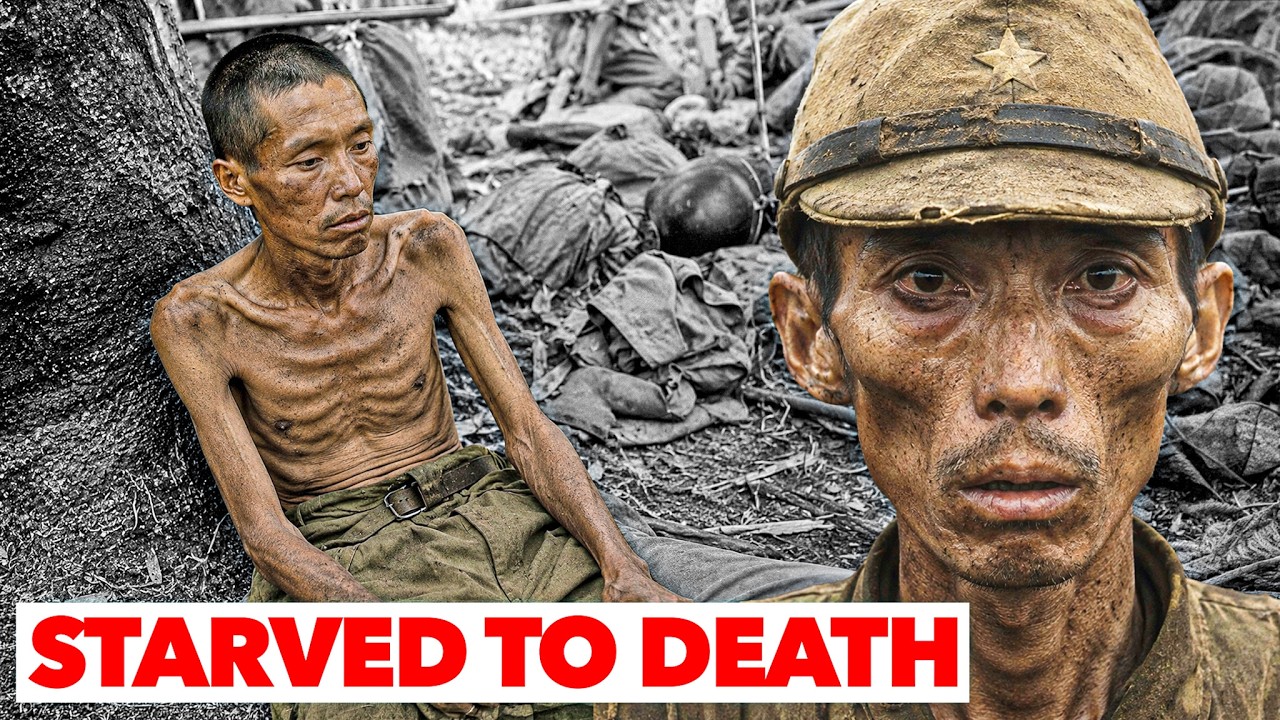
What happened to the roughly 100,000 Japanese soldiers inside that fortress over the next two years became one of the most devastating and least told episodes of the Pacific War. To understand what America chose to leave behind, one must understand what Rabaul was at its peak. The Japanese had seized the colony from the Australians in January 1942 in an operation so swift and overwhelming that the Australian garrison barely had time to evacuate. What Japan found was Simpson Harbor, a natural anchorage so deep and well protected that it ranked among the finest in the Southwestern Pacific.
It could shelter hundreds of warships at once, and the surrounding terrain, volcanic ridges, dense jungle, and natural choke points, made the position defensible from every direction with a fraction of the troops needed to capture it by force. Japan understood what it held and built accordingly. Over eighteen months, Rabaul was transformed into the most heavily fortified Japanese position outside the home islands. Four airfields were constructed and expanded to support hundreds of aircraft.
A tunnel system bored into the volcanic rock was extensive enough to shelter planes, ammunition, fuel, and men from any bombardment America could deliver with the weapons of 1943. Coastal batteries covered every approach to the harbor. Anti-aircraft positions were so thick that American bomber crews called Rabaul the most dangerous target in the theater. The garrison grew to roughly 100,000 men, making it the largest Japanese military concentration outside China.
American planners looked at those numbers in mid-1943 and reached a conclusion that changed the war. Tarawa had cost nearly 1,000 American lives in 76 hours on a tiny coral atoll, a fraction of Rabaul’s size. The lesson was clear. General Douglas MacArthur had originally conceived Operation Cartwheel as a direct assault on Rabaul, the keystone of Japanese power in the Southwestern Pacific.
Every convoy to the Solomons, every air operation over New Guinea, every naval movement in the theater was supported from Rabaul. But the casualty data from Guadalcanal and the early Solomons operations, combined with a new understanding of what air and naval power could do to an isolated position, changed his mind. MacArthur argued not that Rabaul could not be taken, but that taking it was unnecessary. If American forces could interdict its supply lines and neutralize its airfields through sustained bombardment, the base would become strategically irrelevant regardless of how many troops remained inside.
A garrison of 100,000 men with no supplies, no air cover, and no ability to intervene elsewhere was not a threat requiring elimination. It was a burden Japan would have to feed and supply indefinitely while America moved on to targets that mattered. The Joint Chiefs approved the revised plan. Rabaul would be isolated, neutralized, and bypassed.
The men inside would survive as best they could on what they had and whatever slipped through a blockade that grew tighter as American strength increased. The isolation was not a single event but a gradual tightening. The first stage was air. American and Australian aircraft began systematic attacks on Rabaul’s airfields in late 1943, not to destroy the fortifications, which was impossible, but to destroy the aircraft that gave the base its offensive power.
The air battles over Rabaul in November 1943 were among the most intense of the Pacific War, with severe losses on both sides. Japanese losses became so heavy that the Combined Fleet withdrew its carrier air groups to prevent their complete destruction. By February 1944, Japanese air power over Rabaul had been reduced to the point where the airfields, though physically intact, were no longer operationally viable. The second stage was naval.
American submarines intensified operations against the shipping routes connecting Rabaul to the Japanese supply system. Destroyers and transport aircraft attempting to run supplies into the harbor found the approaches increasingly deadly. By mid-1944, the supply reaching Rabaul had fallen to a fraction of what the garrison needed, and even that fraction came at costs Japan could not sustain. The third stage was geography.
As American forces leapfrogged up the New Guinea coast and through the Solomons, Rabaul moved progressively behind the front lines. Not because anyone advanced toward it, but because the war moved away from it in every direction, leaving it in a pocket of Japanese-held territory with no strategic significance and no prospect of regaining any. The men inside did not learn simultaneously that they had been abandoned. Senior commanders had a clearer picture.
General Hitoshi Imamura, commanding the Eighth Area Army from Rabaul, understood by mid-1944 that the island’s role in Japanese planning had ended. What the commanders could not do, within the framework of Japanese military culture, was tell the men the truth. Soldiers were told the garrison was conducting a strategic holding operation of great importance to the empire. They were told reinforcement and relief were planned and would come.
They were not told the war had moved on without them. What the men could observe for themselves was more honest than official communications. The supply ships stopped coming on any regular schedule. The aircraft disappeared from the airfields over weeks.
The air raids became infrequent and then almost stopped entirely, not because America had decided to spare them, but because there was nothing left at Rabaul worth the cost of the bombs and the risk to the crews. By the end of 1944, most of the garrison understood the picture, even if nobody was permitted to say so directly. The mathematics of survival were brutal. A Japanese soldier in the field required approximately 600 calories per day from military rations.
At 100,000 men, that was 60 million calories daily. Over two years, roughly 43 billion calories had to come from somewhere. The supply ships getting through delivered only a fraction. The agricultural capacity of the Rabaul Peninsula could supplement but not replace the missing supplies.
The adaptation the garrison undertook was one of the most remarkable organizational achievements of the Pacific War. Entire battalions were redirected from military duties to agricultural production as their primary function. Officers trained for combined arms tactics spent their days supervising the cultivation of sweet potatoes and taro. Soldiers fished in repurposed boats, built irrigation systems, and bred pigs and chickens.
The engineering capacity built for fortifications was redirected toward food processing. What they built was not a military operation in any conventional sense. It was a society, and whether that society could survive until the war ended was entirely out of its hands. The garrison’s internal life was shaped by contradictions.
They were soldiers in a fortress with no military function. They were members of a garrison theoretically engaged in a war but without a meaningful offensive operation in over a year. Senior commanders maintained the forms of military routine, unit formations, training exercises, inspections, partly to prevent psychological collapse and partly to preserve the official fiction that the isolation was temporary. Below that level, a different culture emerged.
Units reorganized across formal boundaries. Soldiers from different branches worked side by side on farming plots, developing an interdependence no official order had created. The garrison also built an informal intelligence picture from intercepted radio transmissions and whatever reliable accounts slipped through the blockade. While those 100,000 men farmed and fished and waited, the war bypassing them moved at a pace across a geographic scale that made their situation increasingly irrelevant to both sides.
MacArthur’s forces seized Hollandia in April 1944, secured the Vogelkop Peninsula by July, and were positioned for the return to the Philippines by October. Nimitz’s Central Pacific campaign drove through the Gilberts, Marshalls, Marianas, and Carolines, bringing American air power within range of Japan itself. The bypassed garrisons, Rabaul, Truk, Wewak, dozens of others, were left in place, their relevance declining with each American advance. The garrison watched American B-29s flying north toward Japan at altitudes beyond the reach of what remained of Rabaul’s anti-aircraft guns.
They were visible evidence that the decisive battles were being fought without them. Japan surrendered in August 1945. General Imamura complied with the surrender order, formally capitulating to Australian forces in September 1945 in a ceremony conducted with full military formality. Australian officers noted the garrison maintained military bearing throughout, a telling detail about what the isolation years had and had not done to the men.
Of the approximately 100,000 men at Rabaul at its peak, the number who survived to surrender was substantially lower, reflecting deaths from tropical disease, malnutrition, and the continued trickle of Allied air attacks that never entirely stopped. The survivors were visibly diminished, though their survival rate was significantly better than that of some other bypassed garrisons that lacked equivalent agricultural capacity. Repatriation took months, requiring enormous logistical effort to move 100,000 men back to a Japan that no longer resembled the empire that had sent them. The decision to bypass Rabaul represented a fundamental shift in military thinking.
The traditional doctrine, that a strong enemy position had to be neutralized by direct assault before advancing past it, was replaced by the recognition that air and naval power could impose a strategic neutralization at a fraction of the human cost, provided one accepted the slower timeline and the discomfort of leaving a large enemy force alive behind the lines. The 100,000 men of Rabaul were not defeated in battle in any conventional sense. They were made irrelevant, a different kind of defeat with no moment of resolution. They were the proof of concept for an idea that changed warfare permanently.
The cost, measured in two years of hunger and isolation and the slow understanding that the battle they had trained for was never going to come, was paid entirely and without appeal by the men inside the perimeter. Nobody came. Not because America could not come, but because America decided the 100,000 men inside were more useful to Japan as a burden than as an enemy worth fighting. The men who made that decision were right.
The men who lived it paid for being right with two years of their lives inside a fortress the war had chosen to forget.