When Jeanne Lanvin died in 1946, she left behind something no other fashion designer had ever dared to create: the oldest continuously operating couture house in Paris, built not on ambition or fame, but on a mother’s love for her daughter. The story of how a 13-year-old errand girl from a poor Parisian family became one of the most influential figures in fashion history is one of the most extraordinary narratives the industry has ever produced. Born on New Year’s Day 1867, Jeanne was the first of 11 children in a cramped Parisian apartment where her father’s modest journalist salary barely kept poverty at bay. At 13, she was sent to work as an errand girl for a milliner, sprinting through the streets to deliver hats while absorbing the silhouettes of the elite.
By 18 she was a full apprentice, and in 1889, at just 22, she opened her own millinery shop on the Rue du Marché Saint-Honoré. For years, Jeanne was a master of technique without a muse. That changed in 1897 with the birth of her daughter, Marguerite Marie Blanche. After her brief marriage to Count Emilio Di Pietro ended in divorce in 1903, Jeanne poured everything into dressing her little girl, creating garments so exquisite that strangers on Paris streets stopped to ask who made them.
She understood something no other designer of the era had grasped: children need clothes designed for their bodies, with freedom of movement and joy, not merely scaled-down adult fashions. In 1908, Jeanne opened the first dedicated children’s department in Paris. Mothers who came for their daughters’ dresses began asking whether she could create something exceptional for them too. This reversed the usual fashion hierarchy—Lanvin grew from children’s wear into adult couture, not the other way around.
By 1909, the house was officially registered with the Chambre Syndicale de la Couture Parisienne, placing Jeanne shoulder to shoulder with the giants of her age. While contemporaries like Chanel embraced modernist minimalism, Jeanne made a defiant choice: she said no to the boyish flapper silhouette and reinvented the robe de style. Reaching back to 18th-century paniers and 19th-century crinolines, she created a voluminous yet modern gown with a fitted bodice and flowing skirt, free of the rigid armatures that had once tormented women. Critics called it retrograde, but her clients—the most sophisticated women in Paris—understood instantly.
The robe de style became a global phenomenon and remained a staple of the house for over a decade. In 1924, Jeanne established Lanvin Parfums. Her first great fragrance success, My Sin, launched in the United States in 1925 and became a sensation across the Atlantic, capturing the daring spirit of the American Roaring Twenties. But her most personal achievement came in 1927, when she created a perfume for her daughter’s 30th birthday.
Working closely with perfumer André Fraysse, she crafted a scent meant to be an olfactory portrait of Marguerite herself. Named Arpège by Marguerite, a serious mezzo-soprano who loved the musical term for notes played in graceful sequence, the fragrance was built from more than 200 ingredients and was designed to unfold slowly on the skin. The bottle became as iconic as the scent. A black glass sphere capped with gold, it featured a medallion by Art Deco artist Paul Iribe depicting a mother and daughter in a garden, based on a 1907 photograph of Jeanne and Marguerite at a costume ball.
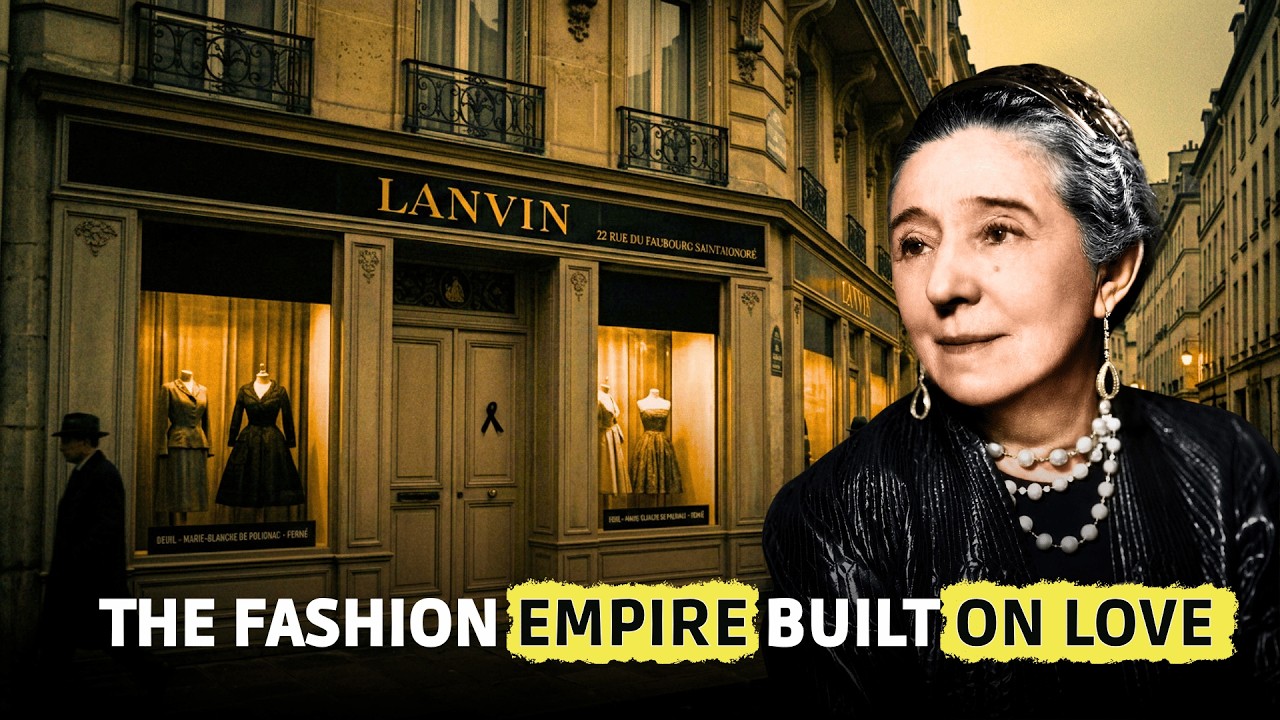
While other luxury houses worked to distance their products from their origins, Jeanne deliberately embedded her founding story into the bottle itself. Arpège has remained in continuous production since 1927 and is still one of the world’s best-selling fragrances. By the mid-1920s, Lanvin was an empire. The couture house occupied most of the grand building at 22 Rue du Faubourg Saint-Honoré.
Designer Armand-Albert Rateau created interiors with lacquered walls, bronze fittings, and a distinctive palette of blue, gold, and ivory. Jeanne established a women’s ready-to-wear line, a lingerie department, a fur atelier, and a home decoration service. In 1926, she launched Lanvin Sport and Lanvin Tailleur, a men’s wear operation virtually without precedent for a female couturier, attracting politicians and artists who wanted a modern alternative to stiff traditional tailoring. Her signature color, Lanvin blue, came from a quest that began in the churches of Florence.
Jeanne was devoted to the frescoes of Fra Angelico, whose transcendent ultramarine blue made from crushed lapis lazuli seemed impossible to replicate. In 1923, she established her own dye factory in Nanterre, experimenting for years until she achieved a blue of remarkable depth and luminosity. It became the visual DNA of the house, appearing in embroideries, fabrics, packaging, and ribbons, a silent signature of quality and prestige. At its peak in the late 1920s and 1930s, the Lanvin atelier employed approximately 800 skilled workers.
Unlike most couturiers who oversaw their houses from behind a desk, Jeanne worked directly at the cutting table, draping, pinning, and sculpting fabric on live models without drawings. Her perfectionism was legendary—she would personally unpick an entire day’s embroidery if a single bead was a millimeter out of place, yet her workers found her presence profoundly inspiring. When Germany invaded Poland in September 1939 and Paris fell in June 1940, Jeanne, then 73, faced the most difficult decision of her career. The Nazis planned to dismantle the entire French haute couture industry and relocate it to Berlin and Vienna.
Jeanne joined forces with Lucien Lelong, president of the Chambre Syndicale, and other leading designers to convince the German high command that Parisian fashion could not be transplanted. Against all odds, they succeeded, and by keeping her house open despite severe fabric shortages, Jeanne was credited with helping save over 12,000 skilled workers from deportation to forced labor camps. After Paris was liberated in August 1944, the couture industry was barely alive. In 1945, Jeanne joined more than 50 couturiers to create the Théâtre de la Mode, dressing 70-centimeter wire dolls in meticulous miniature haute couture complete with tiny shoes and real jewels.
These dolls toured London, San Francisco, and New York, proving to the world that the creative spirit of Paris had survived. Jeanne Lanvin died on July 6, 1946, at the age of 79, a year after the liberation. She had continued working until very near the end, guiding the house through six decades without a single meaningful interruption in creative output. She died having invented a silhouette, created a fragrance that would last nearly a century, pioneered men’s wear, transformed interiors with her decoration service, and funded a school that trained workers in the decorative arts.
Marguerite took over the house after her mother’s death and steered it until 1958, maintaining the core values and quality standards Jeanne had established. When Marguerite died in 1958 without an heir, the direct family line was severed, and the house entered decades of corporate ownership, its light dimming until it became known as fashion’s sleeping beauty. In 2001, designer Alber Elbaz arrived to awaken it. His designs, which he described as hugs rather than restrictive garments, made Lanvin the favorite of Hollywood stars like Tilda Swinton and Meryl Streep.
But Elbaz understood that the true power of the house lay in its founder’s legacy. He worked in Jeanne’s preserved 1930s office, surrounded by her books and travel mementos, and sent his team into her archives for inspiration. He knew that to push the oldest couture house in Paris into the future, he had to keep its beating heart intact. The mother-daughter bond that started everything was always the house’s visual signature.
In 1922, Jeanne commissioned Paul Iribe to create a logo based on that 1907 photograph: a woman and a small girl in a garden, the child reaching upward in a gesture of affection and trust. While other fashion houses used monograms, heraldic symbols, or initials, Jeanne put a candid moment between herself and her real daughter on every box, bag, and ribbon the house produced. No other fashion house has ever dared place its founding motivation so directly on its logo. What Jeanne actually left behind cannot be measured only in clothes.
The robe de style proved that femininity and modernity were not opposites, an argument that still resonates in fashion today. Arpège demonstrated that a fashion house could extend its identity into fragrance with complete sincerity. The 800 artisans trained in her atelier carried her exacting standards throughout Parisian couture, spreading her values through the entire industry. And perhaps most importantly, she proved that a woman with no patron, no formal education, and no aristocratic connections could build one of the most significant creative institutions in Paris with her own hands, her own mind, and her own boundless love.
Ultimately, Lanvin was never about the cloth but the soul within it. From a mother’s first stitch to a global empire, the answer to the house’s founding question—what does it mean to dress someone you love—remained the same. It was an unbreakable bond of beauty, crafted to last.