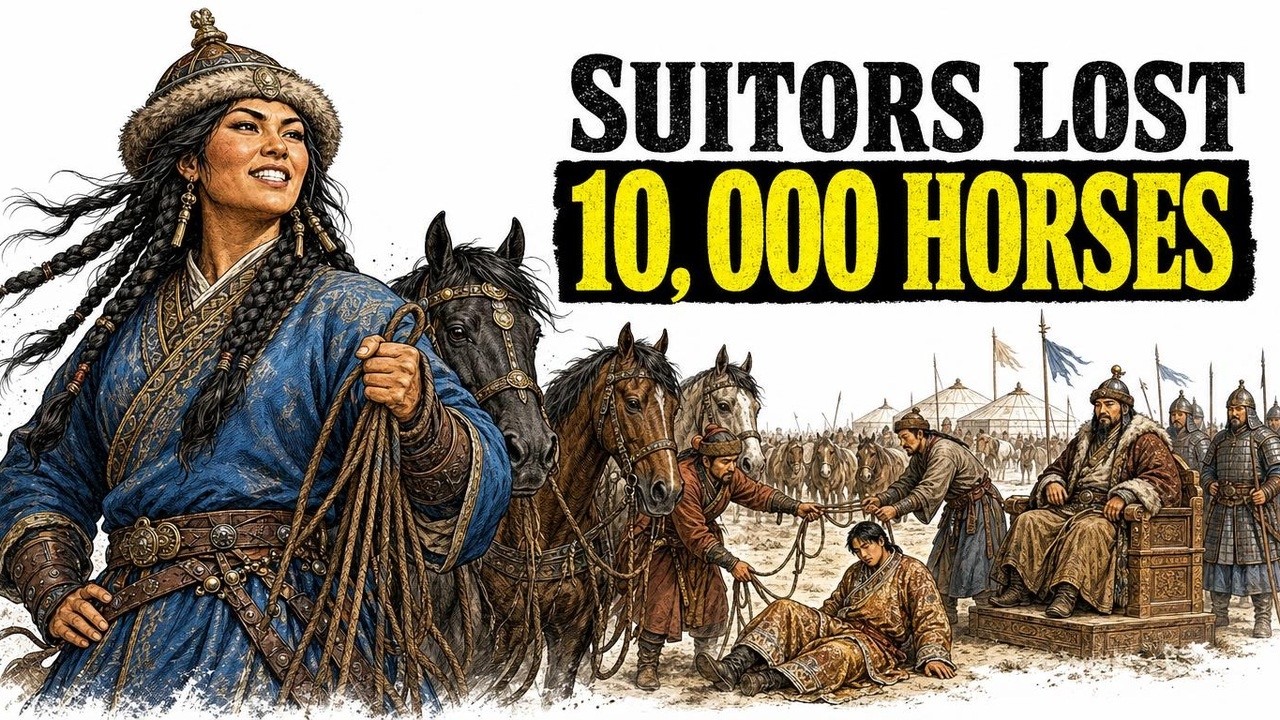
The crack of a knee echoed across the dry plain as a woman the size of a warrior stood over a defeated giant. Her name was Khutulun, daughter of Kaidu, a grandson of Genghis Khan. She did not wrestle for sport. She wrestled for horses, taking a hundred from every man she broke in the dirt, building a herd on the bones of her challengers.
Kaidu ruled from the Talas Valley in what is now Kyrgyzstan, fighting a civil war against his cousin Kublai Khan, the Great Khan who ruled China from Khanbalik, the city that would become Beijing. Kaidu saw Kublai’s empire as a sickness, soft and tamed by cities and silk. He raised Khutulun to be a weapon, a symbol of the old Mongol ways, sharpened into propaganda made of flesh and muscle. Khutulun was trained from childhood in the harsh life of the steppe.
She learned to ride before she could walk, to hunt with eagles, and to fire a war bow from a galloping saddle. She mastered the Parthian shot, the trick of firing backward at pursuers that had broken armies since the time of Crassus. Her father wanted a daughter who could win, and he shaped her into the most feared fighter of her generation. Marco Polo recorded her name, calling her Aigiarne, which meant shining moon in the Mongol tongue.
He wrote that she never lost a match and that her father’s herds grew fat on the horses of beaten men. Rashid al-Din, the Persian historian who served the Ilkhanate rulers, also recorded her, describing how she rode into battle beside her father, snatching enemy commanders from their saddles like a hawk taking a sparrow. The wrestling was sacred to the Mongols, one of the three manly games. Kaidu turned it into a public weapon.
Any man could marry Princess Khutulun if he could beat her on the ground. Win, and he took her hand. Lose, and he handed over a hundred war horses. Men came from across the steppe, titans of the fighting clans, and left with broken arms and shattered pride.
She counted her winnings in hundreds, then in thousands. Marco Polo wrote that her herd grew to ten thousand horses won on the wrestling ground. That was not a dowry. It was a war chest on four legs.
Every throw was a public humiliation of some rival clan, a message that their strongest men could not stand against a woman of her blood. Her success made her a target within her own family. She had fourteen brothers, princes of the horde, who led raids and won battles but always fell short of her shadow. One brother, Orus, was Kaidu’s favored son, expected to inherit the khanate.
He watched his father turn to Khutulun first, ask her opinion first, weigh her judgment above his own. Jealousy curdled into whispers that she used sorcery to steal the strength of men. The rumor spread beyond the family. In the courts of the Ilkhanate and the Golden Horde, envoys carried word of the unmarried, unbeaten daughter.
Kaidu’s enemies used her story to paint his whole house as a thing gone wrong. A khanate ruled by a woman with a bow, they said, was proof the old ways bred chaos. The final showdown came when a giant warrior from the old Khwarezmian lands rode into Kaidu’s camp. He staked a thousand horses against the match, and if he lost, he would not simply pay.
He wagered that if Khutulun lost, she would marry him. The whole camp gathered to watch. Kaidu, fearing the stranger’s reputation, asked her to throw the match. She refused.
She fought, and in a brutal contest, she broke the giant’s knee, dropping him to the ground in front of a thousand warriors. She was not only a wrestler. She was a general who fought at the point of the spear. She rode in charges of five thousand riders, looking for the enemy commander.
She would circle his guard, find the gap, and lean from her saddle to haul him off his horse, carrying him back as a captive. The men who saw their leader vanish lost the thread of the fight, and the command collapsed. At the siege of Herat in 1270, she did not storm the walls. She surrounded the city, burned the farms, fouled the water channels, and flung the pieces of captured men over the walls with trebuchets.
At night, the drums did not stop. When the assault came, the defenders were starved and hollowed out. The city was sacked, and the heads of the dead were stacked into a mound outside the gate. Her brothers fought on every campaign, but their deeds looked dim beside hers.
The soldiers whispered that Tengri himself had touched her. She was called by names of praise that her brothers could not match. The break came near the Amu Darya. Orus led a raiding party into a trap, and his command was being butchered.
Khutulun took five hundred riders and charged up a rocky slope into the arrows, killing the enemy general herself. She took his head and his standard, holding both up for the enemy army to see. She saved Orus, but she also showed him for what he was in front of every man who lived through it. Orus would not forgive it.
He began to gather the brothers who felt as he did. They met in tents where the flaps stayed shut, and they counted who would stand with them. The whispers changed shape. Now they said she had witched her father, poisoned him until he named her heir with a rotted mind.
The Great Yassa, the code of law Genghis had bound his people to, had never seated a woman as ruling khan. Kaidu died in 1301 after ruling for forty years. In his final fevered moments, he called his commanders, his sons, and his whole court to his ger. He was too weak to rise.
His voice came out dry and cracked, but the words carried through the camp. None of his sons, he said, was fit to follow him. Only one of them could rule. He pointed at his daughter.
Only she could rule. It was his final order, but it was also a death sentence. A khanate could not pass to a woman without the consent of the kurultai, the assembly of princes and commanders. The assembly was full of men who owed her nothing and feared her everything.
Kaidu’s ally Duwa, khan of the Chagatai lands, wanted a weak successor he could steer, not a woman who commanded the army’s love. Kaidu’s body was not yet cold when the plotting began. Orus led the brothers in a pact to end her. Men with old grudges were bought with land and titles.
A knife across the throat in her sleep. Poison in her food. An arrow in her back on a hunt. In the first week, her guard caught three killers.
Two died without a sound. The third named the brother who sent him. It changed nothing. The plot was not one man’s work.
It was a vote. Khutulun saw the trap. She retreated. She called her commanders together and spoke of unity, saying her father’s last words had come from fever, not judgment.
She named Orus, the brother whose assassins she had killed the week before, and threw her weight behind him, making him khan. It saved her life, but it made her a living reproach that sat just past the light of his fire. Orus did not hold the crown. Duwa pushed for Chapar, another of Kaidu’s sons, easier to bend.
The brothers who had sworn a blood pact against their sister turned their knives on one another. The house of Kaidu began to devour itself. Khutulun kept command of the army. Her veterans watched her pull battles back from the edge, and her name was on their lips when the columns marched.
She was the power behind the throne, and her very presence made each new khan look like a puppet. The brothers understood this could not stand. They went after the thing that made her untouchable, the legend. The old sorcery talk came back with sharper edges.
Now they said she had poisoned her father, spoon by spoon, until he named her heir. The fear of her began to sour into fear of something that should not exist. Feeling the ground shift, Khutulun made one more move. She married.
She did not take a prince or a great chief. Rashid al-Din names her husband Abtakul, a man of the Qoros from her mother’s people, a soldier without wealth or ambition. Some said his kin had been caught in a plot against Kaidu, and she spoke for him and took him as her own. The message to her brothers was plain.
She would not raise a dynasty against them. They did not read it as peace. They read it as fear. The unbeaten warrior, so frightened of her own family, had married a captive for cover.
It was blood in the water. The last years of her life dissolve into rumor. The chronicle written under her family’s authority says she died in 1306, fallen in battle on campaign. A clean death.
An honorable death. And almost certainly a lie. A warrior of her rank, ringed by her own guard, does not simply fall. Was she overwhelmed by chance?
Possible. Was the plot finally carried out under the noise and smoke of a battle where one arrow among thousands raises no questions? Far more likely. Within a few years, the brothers’ war ruined everything their father spent forty years holding together.
Chapar and Orus fought. Duwa’s heirs pressed from the Chagatai side and bled the house of Ögedei white. By 1309, Chapar had surrendered, and the line that had once held the Great Khan’s own throne was finished as a power on the steppe. Its lands were carved up between the Chagatai Khanate and the Yuan.
Everything Kaidu forged was gone inside a decade of her death. Killing her was not enough. The legend outlived the woman, and a dead legend was still a reproach to the small men who ruled after her. The later chroniclers, many Persians writing for her family’s rivals, reshaped her.
They kept the wrestling and threw away everything that gave it meaning. The political weapon became a fairy tale. The ten thousand horses stopped being a war chest and became a girlish dowry. The sieges, the fouled wells, the drums that broke men’s sleep, the mound of heads outside Herat, all of it vanished from the page.
The general was edited into a stubborn maiden. In the early 1700s, the French orientalist François Pétis de la Croix picked up a version and set it in a collection of Eastern tales. He moved her off the steppe and into China. He turned the wrestling into a contest of riddles.
He gave her a new name, Turandot, meaning daughter of Turan, recast as the daughter of a Chinese emperor. The story passed to Venice, where the playwright Carlo Gozzi put her on stage in 1762 as a cruel princess who beheads suitors who fail her riddles. The German poet Friedrich Schiller translated and reworked Gozzi’s play in 1801, and Goethe staged it at Weimar. The final stroke landed in an Italian opera house.
Giacomo Puccini took Gozzi’s version and made it his last work, Turandot. He died in Brussels in November 1924 with the ending unwritten. Another hand, Franco Alfano, finished it from Puccini’s sketches. When the opera first played at La Scala in Milan on the 25th of April, 1926, the conductor Arturo Toscanini brought the orchestra to the bar where Puccini’s pen had stopped.
He laid down his baton and turned to the packed house, saying that here the master had died. The audience filed out in mourning, not knowing they were also burying a warrior a second time. The woman who had ruled ten thousand horses and named a khan with her own voice became a ghost in a costume of someone else’s making. The world could not swallow the real Khutulun.
A conqueror as ruthless as any grandson of Genghis. Her truth was too raw to keep. History finished what her fourteen brothers could not.
It erased her, took a warrior, and dressed her in silk and riddles so that almost no one would remember the woman who was once the most dangerous fighter alive.