On October 24, 1971, at Tiger Stadium in Detroit, 54,000 spectators watched a receiver jog back toward the huddle with 62 seconds left on the clock. Then he clutched his chest and collapsed onto the grass, convulsing. Dick Butkus of the Chicago Bears, one of the most fearsome men in sports history, froze for half a second. Then he began screaming and waving his arms toward the sideline, as if the fallen player were his own brother.
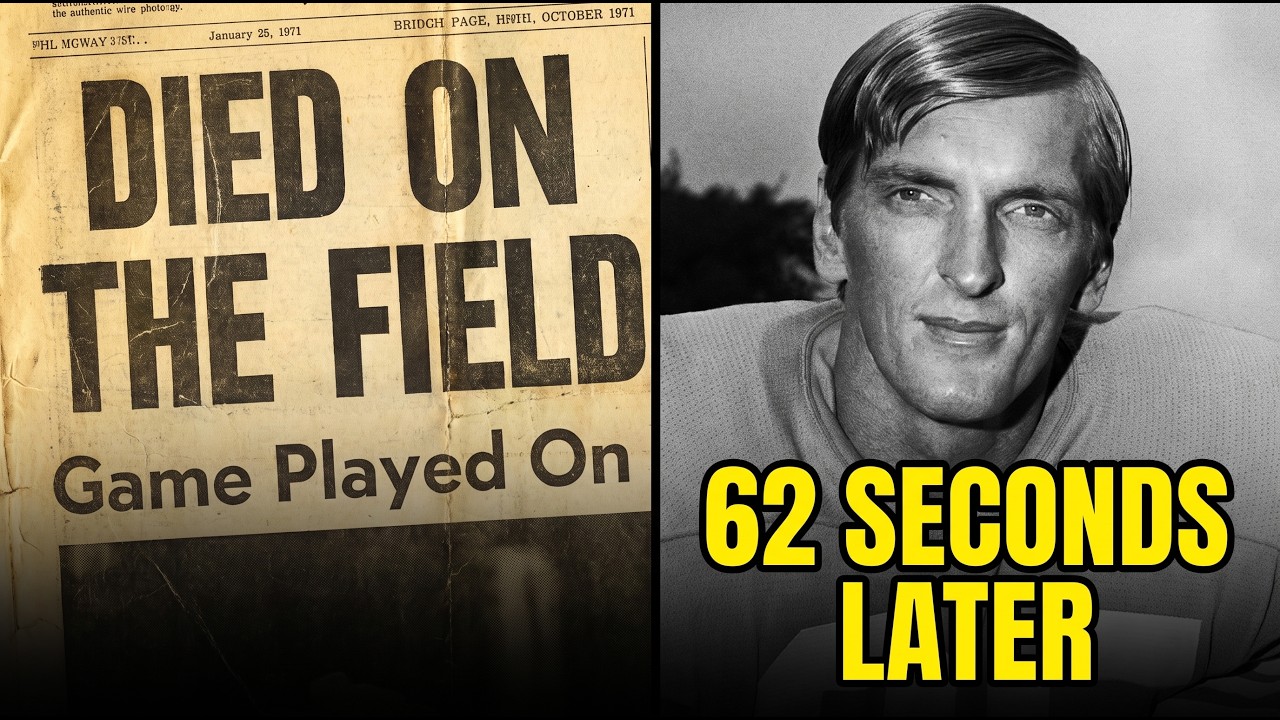
No one in that stadium realized they were witnessing something that had never happened before in NFL history and would never happen again. History remembers Chuck Hughes as a grim footnote, the only player ever to die on an NFL field during a game. What history overlooks is everything that led to that 60-second collapse and everything that followed, which most fans were never told. To understand what happened on that field, you have to understand who Chuck Hughes really was.
His path to the pros never made sense on paper. He was born in Philadelphia in 1943, one of 13 children, and grew up in a home where nothing came easily. His family later moved to Texas, where Hughes developed into a slender, undersized kid in Abilene who ran faster and caught the ball better than boys twice his size. Off the field, he did not inspire fear.
Friends remember him as a young man who preferred a cowboy hat to a suit, sang along with Waylon Jennings whenever he could, and loved nothing more than a quiet afternoon on the golf course, where he once played alongside stars like Chi Chi Rodriguez and Lee Trevino. A college coach named Bam Phillips offered him a scholarship at a small school called Texas Western, now known as the University of Texas at El Paso. But before Hughes played a full season, Phillips left for another job, and the new coaching staff canceled the scholarship entirely. Most 18-year-olds would have gone home.
Hughes stayed anyway, paying his own way to remain on the roster of a team that no longer owed him anything. By the time he left Texas Western, he held school records that stood for years, including a single game with 17 receptions and more than 400 all-purpose yards. He worked his way into the NFL in 1967 as a fourth-round pick of the Philadelphia Eagles, spent three seasons mostly on special teams, and eventually landed with the Detroit Lions in 1970, where he quietly posted the best year of his career. For a kid once told football did not want him, that alone was a hard-won victory.
Then, in August 1971, things began to go wrong. Almost no one watching him play that October had any idea. In a preseason game against the Buffalo Bills late in the fourth quarter, with the outcome already decided, Hughes took a hard hit to his ribs and side. He got up, walked off, and finished the game, standing on the sideline as if nothing had happened.
This was the kind of hit football players are trained from childhood to shake off without a second thought. Then, in the locker room afterward, alone with no cameras and no crowd, he collapsed. He spent four days in the hospital. Doctors suspected a spleen injury, perhaps a kidney or lung problem.
No one could confirm the exact issue, and the tests available in 1971 were not advanced enough to look deeper. Eventually, without a real diagnosis, he was released and allowed to keep playing. Over the next two months, Hughes secretly complained of sharp pains in his stomach and chest. He thought it was heartburn, acid reflux, or just normal wear and tear after five years of taking hits most people never see on television.
He kept telling teammates and coaches it was not that bad. He kept attending practice, preparing for Sundays, and doing exactly what every coach of that era wanted to see from a player fighting for his roster spot. Here is what almost no one was told. What actually happened in that game against Buffalo was not a spleen injury at all.
It was a heart attack, his first. Seven weeks before he died on that field in front of 54,000 people, Chuck Hughes’ heart had already tried to kill him once, quietly, in an empty locker room. And the men responsible for his care sent him home with a misdiagnosis. No one would know it, least of all Hughes himself.
So on the night of October 23, 1971, he did something entirely unremarkable. He and his wife Sharon got into an argument at a party. It was not about football or money or anything that would have made headlines. It was about their two-year-old son and whether he should be allowed to chew gum.
The argument escalated more than either of them expected. Neither apologized. Sharon went home. Chuck returned to the team hotel.
They assumed, as every couple does after a small quarrel, that they would talk it over the next day. They never spoke again. The next day, with the Lions trailing the Bears 28-23 and just one minute left in the game, Chuck Hughes went onto the field as a replacement for the injured Larry Walton. This was not supposed to be his moment at all.
Two plays later, he caught a pass for 32 yards, putting Detroit in scoring position. A real, meaningful contribution to a game he was never supposed to play in. Three plays after that, with the ball in the air headed toward another receiver near the end zone, Hughes jogged back toward the huddle, no more than a decoy. No one was even watching him.
All eyes in the stadium were on the pass that had just fallen incomplete a few yards away. And in that moment, he fell to the grass near the 20-yard line, clutching his chest. Dick Butkus was standing right beside him. He watched Hughes convulsing violently on the wet grass and realized immediately, in a way the rest of the stadium had not yet registered, that this was no ordinary injury.
He turned and waved both arms above his head, screaming for help from anyone on either sideline. Doctors and trainers from both teams rushed onto the field. A physician sitting in the stands ran down and climbed over the wall to help. An ambulance drove onto the field, and Chuck Hughes was carried away unconscious in front of a crowd that had fallen into absolute silence.
Then, in a decision that seems incomprehensible by today’s standards, the officials restarted the clock. Sixty-two seconds remained, and both teams finished the game to the final whistle while a 28-year-old man was taking his last breaths in an ambulance a few hundred yards from the field. Chicago won the game. No one on that field knew at the time whether Chuck Hughes was still alive.
He was pronounced dead at Henry Ford Hospital that evening. The autopsy revealed what no one had discovered in August or at any point in the following two months. Hughes had advanced, undiagnosed coronary artery disease. One of his coronary arteries was 75 percent blocked.
His family had a documented history of heart disease, something no one ever connected to his complaints of stomach pain. A blood clot had broken free and stopped his heart completely. Later, doctors described it in one haunting sentence: Nature had given this 28-year-old the heart of a man twice his age. All 40 of his Lions teammates traveled to San Antonio for his funeral, along with head coach Joe Schmidt.
An insurance company quietly set up a $10,000 trust fund for his two-year-old son, the same little boy whose gum had caused an argument no one thought would matter. Here is what no one expected, and what most highlight reels do not mention. In 1972, Sharon Hughes filed a $21. 5 million medical malpractice lawsuit against Henry Ford Hospital, arguing that if her husband’s condition had been properly diagnosed in August, he might still be alive today, sitting in the living room, watching his son grow up.
It took two more years to reach a settlement. In October 1974, nearly three years after her husband collapsed on that field, the case was quietly settled for an undisclosed amount. There was no trial, no headline-grabbing verdict, just a private acknowledgement of what everyone close to the family had believed for years: that a timely diagnosis could have changed everything. The Detroit Lions eventually retired his number 85, one of very few numbers in team history to receive that honor.
A small, permanent reminder hanging in a building most fans walk past without a second glance. For exactly 52 years, Chuck Hughes remained the answer to one grim trivia question: the only player in NFL history to die on the field. Then, on a Monday night in January 2023, Damar Hamlin, a 24-year-old safety for the Buffalo Bills, collapsed on the field after a routine tackle. His heart had stopped from a direct blow to the chest.
This time, both teams stopped playing immediately. The game was suspended within minutes and never resumed. It is hard not to notice the 52-year gap between those two decisions. One was a decision to blow the whistle and keep playing.
The other was a decision by an entire league to finally stop. Chuck Hughes never received that same mercy. He endured two months of unexplained pain that no one took seriously enough. A simple argument over a piece of gum was the last conversation he ever had with his wife.
And 62 seconds of football were played around his body while he was already gone. What this story asks of us is not complicated, but it deserves to be told carefully. Chuck Hughes did not die because he stayed silent. He died because of a hereditary heart condition that the medicine of 1971 could not detect, and because an entire sport and an entire generation had built a culture that trained men not to mention pain at all.
So much so that even when his body was screaming for help, no one around him fully listened, including the doctors who examined him twice. That culture did not kill him alone, but it built the walls of silence. Everything else had to break through those walls first. Perhaps the real tribute is not remembering how he died on that field in front of 54,000 people.
It is remembering that taking pain seriously, whether your own or someone else’s, was never a weakness. If you feel discomfort in your chest, do not wait to see if it goes away. Go see a doctor. If this story moved you, remember the image of Butkus screaming for a stranger.
The argument that turned into a final goodbye. The 52 years it took before anyone finally stopped the clock.