Carson McCullers wrote one of the great American novels at twenty-three, but her life was a long, bitter war against a failing body. A series of strokes left her severely paralyzed, and in the end she composed her work with a single finger, an extraordinary mind trapped in a broken frame. Her tragedy was not only physical. Her soulmate was Truman Capote, another dreamy southern prodigy, but where he chose the spotlight and turned scandal into art, she wanted only one thing, to be loved.
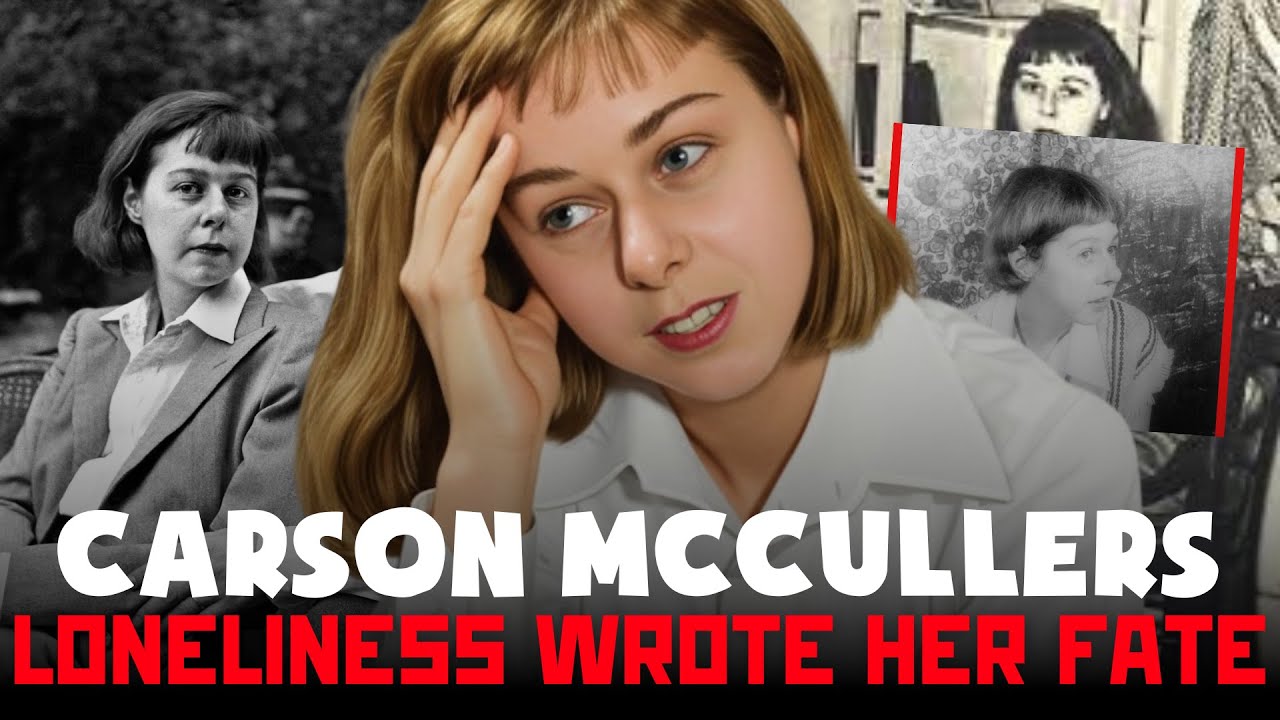
She spent her life in one-sided love with people who would never love her back, and even Capote betrayed her, mocking her after her fall. This is the story of a girl who dreamed like Capote but died in silence at fifty, nearly forgotten. The key to Carson McCullers lies in the place that shaped her, Columbus, Georgia, where she was born on February 19, 1917. This was not the romantic South of Gone with the Wind.
It was a South still carrying the wounds of the Civil War and Reconstruction, crushed by the Great Depression, where poverty was not a possibility but a daily fact. Columbus was a stifling steel-mill town, suffocating not only from the humid Georgia heat but from the social climate. Everything had its rules. Jim Crow laws divided Black and white.
Strict gender codes dictated how men and women should behave. Religious rules in the Bible Belt watched every action. Anyone who deviated, physically, emotionally, or intellectually, was not merely different but abnormal. That strangeness became the foundation of the Southern Gothic genre, which found its horror not in old castles and ghosts but in decaying families, buried secrets, repressed desires erupting into violence, and the peculiar figures living at the edges of town, giants, dwarves, fanatical preachers.
Flannery O’Connor once said that southern writers recognize freaks because they still live close enough to see them. For a sensitive soul, this environment demanded a choice, submit and be crushed, or build a rich inner life as a refuge. Carson chose the refuge. Born Lula Carson Smith, she was a contradiction from the start.
Her father, Lamar Smith, was a quiet, gentle jeweler and watchmaker who gave her a love of small details, her safe harbor. Her mother, Margaret Watersmith, was his opposite, a woman of enormous suppressed ambition trapped as a small-town housewife who poured all her hopes into her firstborn, convinced her child was a genius. This combination of a contemplative father and an ambitious mother created immense internal pressure, but the outside world shaped her most. While other girls played with dolls, she was isolated and reading, unnaturally tall, painfully thin, clumsy.
In her teens she rebelled, cutting her hair short like a boy’s and wearing pants or suits, an act of social defiance in 1930s Columbus. She was immediately marked as strange, ridiculed and ostracized. She became one of her own characters before she wrote them: Mick Kelly, the tomboy dreaming of music and beauty in a cruel world, and Frankie Addams, the awkward twelve-year-old desperate to belong to anything at all. Then came the tragedy that shaped the rest of her life.
Around thirteen or fourteen, she fell seriously ill with high fever, agonizing joint pain, and exhaustion, the classic symptoms of rheumatic fever. Today it could have been treated with antibiotics, but in 1930s Georgia doctors misdiagnosed it as growing pains or neurasthenia. The untreated disease silently attacked her heart, permanently scarring its valves. At fourteen her body became a time bomb, a damaged heart that would struggle for the rest of her life, forming blood clots that would travel to her brain and cause the devastating strokes that took everything but her talent.
The illness gave her an urgent sense that time was not endless and a deep empathy with physical pain and being trapped in a body that would not obey. Her first escape was music. Encouraged by her mother, she studied piano and showed extraordinary talent. Her mother planned for her to attend Juilliard in New York.
In 1934, at seventeen, she boarded a train north carrying her tuition money. What happened next became family legend. She lost the money in New York, perhaps left on the subway, perhaps stolen, perhaps secretly sabotaging herself out of fear of the audition. The dream was gone.
Too ashamed to call home, she stayed, alone and penniless in the Great Depression, working as a waitress, a typist, and a piano player in a seedy Greenwich Village bar. To fill her time she enrolled in evening creative writing courses at Columbia University, where she met Whit Burnett, the editor of Story magazine, who had discovered talents like J. D. Salinger and William Saroyan.
He recognized her raw gift instantly. For the first time, she understood that her years of alienation were not a curse but her greatest asset. The pianist died, but the writer Carson McCullers was born. During this turbulent time she met the man who would be her greatest love and greatest tragedy.
James Reeves McCullers Jr. was a handsome, charming young corporal from Alabama, also a writer with a sensitive soul and a feeling of not belonging. They recognized each other immediately, two southern misfits lost in the North. In 1937, when she was twenty, they married, and she became Carson McCullers.
It was a complex union from the start, based on real love, mutual dependence, conflicting ambitions, and an unspoken understanding of their complicated desires. She was drawn to women, which Reeves seemed to tolerate. He encouraged her writing and believed in her genius. They moved to Charlotte, North Carolina, where in a small apartment the twenty-two-year-old Carson began writing the novel that would change literary history.
She called it The Mute, then understood it needed something deeper. She structured it like a fugue, multiple independent voices intertwining, each telling its own story of loneliness around a silent center. There was Mick Kelly, the tomboy aching for music and beauty. Dr.
Benedict Mady Copeland, the Black doctor burning with rage against racial injustice yet isolated from his community. Jake Blount, the radical labor organizer, an alcoholic prophet of economic justice crying in the void. And a café owner watching them all, a witness to broken lives. In the heart of the storm Carson placed John Singer, a deaf-mute.
Because he cannot speak, the others assume he understands. They mistake his silence for wisdom and confess their secrets to him, projecting their hopes and fears onto a blank screen. But Singer himself is obsessively devoted to another deaf-mute, Spiros Antonapoulos, a simple, greedy, almost childlike man. Singer worships him just as the others worship Singer.
The point was devastating, loneliness is an endless chain. Every hunter searches for a heart to cling to, but that heart is busy searching for another. She found her title in a poem by Scottish writer Fiona MacLeod: The heart is a lonely hunter. Reeves was her first reader, reading every chapter as it appeared.
Seeing the genius flowing from his wife, he stepped aside from his own writing ambitions, typing the final manuscript with care. In 1939 it reached Houghton Mifflin, and the editors were stunned. How could a twenty-three-year-old from a small Georgia town penetrate the minds of an elderly Black doctor, a drunken drifter, and a café owner? On June 4, 1940, The Heart Is a Lonely Hunter was published.
It was an explosion. Critics called it a miracle. Time named it the discovery of the year. Poet May Sarton declared, a genius has appeared.
Overnight, Carson McCullers became the most prominent literary phenomenon in America. She and Reeves moved to New York, to 7 Middagh Street in Brooklyn Heights, a brownstone rented by literary editor George Davis, who imagined an informal artistic commune where the era’s most creative minds could live and work together. It became known as February House, because many of its residents, including Carson, were born in February. W.
H. Auden attempted to impose order, assigning bathroom schedules and collecting rent. Benjamin Britten’s piano playing echoed through the halls. Gypsy Rose Lee, the famous burlesque star, was writing her bestselling mystery novel, reading chapters aloud to Auden as critic.
There were eccentric couples and constant parties fueled by cheap sherry, discussions lasting until four in the morning. In this whirlwind, Carson, at twenty-three, was the queen, the newest genius. But one person was crushed by it all. Reeves, once the supportive husband who typed her manuscript, now found himself ignored while Auden celebrated Carson.
His envy turned poisonous, and he began drinking heavily. Their already complicated marriage cracked under the pressure of fame. Carson, trapped between her collapsing husband and her dazzling new world, did what she always did when faced with complex feelings. She found an impossible love, the Swiss writer and photographer Annemarie Schwarzenbach, a ravishing, androgynous, tormented morphine addict.
Carson pursued her desperately with burning letters, but Annemarie kept a kind, firm distance. The chaos produced her next work, Reflections in a Golden Eye, published in 1941, a dark, intense novel set in a southern military base, full of repressed desire, cruelty, and an absurd murder. She dedicated it publicly to Annemarie. The literary world was horrified, hundreds of readers canceled subscriptions, calling it morbid and immoral.
But the pressure of writing two major novels, the chaos of February House, her crumbling marriage, and her drinking culminated around 1941 when she was only twenty-four. She suffered what was likely her first major stroke. A severe headache, blurred vision, weakness on her left side. The doctors called it nervous exhaustion, a hysterical woman’s illness.
They told her to rest. She fled to her mother’s house in Columbus. Margaret, the iron-willed woman who had always believed in her daughter’s genius, became her caretaker, protective but controlling. While her body weakened, her mind sharpened.
Confined to her bedroom, she began writing again, a more intimate novel about three lost souls in a southern kitchen during a long, hot summer. She called it The Member of the Wedding. Frankie Addams, the twelve-year-old girl neither child nor woman, isolated and aching to belong, was Carson herself. Frankie’s obsession with joining her brother’s wedding, her irrational belief that she could go on the honeymoon with them and become part of a we, was a painful metaphor for Carson’s lifelong search for connection.
The writing was agonizing. She was bedridden, her hands hurt, her vision blurred. Some days she could write only a single sentence, but she persisted. During this struggle, a new figure entered her life.
A nineteen-year-old boy with platinum blond hair sought her out. He had not yet published a novel but was already a legend in underground literary circles. His name was Truman Persons, soon to be known as Truman Capote. Their meeting was an instant recognition, almost mystical.
They were mirror images, southern Gothic twins. Both understood what it was to be different. He would later call her his soulmate. She read his early stories and saw pure talent.
She said the simple, legendary words he would cherish his whole life: My God, you’re a writer. For a time, they were a true bond of outcasts. She finished The Member of the Wedding in 1946. It was a triumph, perhaps even greater than The Heart Is a Lonely Hunter.
Critics praised her profound understanding of adolescent psychology. The success led her to Yaddo, the prestigious artists’ retreat, where she deepened her friendship with Capote and gained a third kindred spirit, Tennessee Williams. The playwright understood her pain, her isolation, her black humor. They became a legendary trio, Carson, Truman, and Ten, drinking and laughing and reading one another’s work, a fortress against the ordinary world.
For a brief moment, she seemed to have found balance. But the time bomb was still ticking. In 1947 she traveled to Paris. There her worst nightmare struck.
A massive, unmistakable stroke. Her entire left side, shoulder to foot, was paralyzed. She was thirty years old. The diagnosis was now clear, the devastating effects of rheumatic heart disease.
Flown back to New York on a stretcher, she became bedridden and wheelchair-bound, told her career was likely over. Everything before had been prologue. The real fight had just begun. Her mother bought a large Victorian house in Nyack, New York, overlooking the Hudson.
It became her entire world for the last twenty years of her life, a refuge and a prison. The stroke had irreparably damaged her brain. Her left side was completely paralyzed. The hand that once dreamed of being a concert pianist was now crippled, clenched into a claw.
She would never play piano again. Margaret cared for her with near-fanatical devotion, bathing and feeding her, but it was total control. In the early months Carson suffered unbearable nerve pain and a deep, understandable depression. She considered suicide.
At thirty, everything seemed over. Then Tennessee Williams, now at the height of his fame after A Streetcar Named Desire, came to visit. He had read The Member of the Wedding and seen not just a novel but a play. He told her, darling, this is not a novel, it’s a play.
The idea seemed insane. How could a nearly plotless novel about a twelve-year-old’s inner life become a Broadway play? And how could a severely paralyzed woman who could barely sit up write it? For Carson, it was more than a challenge.
It was a lifeline. In her room in Nyack, she wrote the entire script herself, slowly, painfully, using a single finger of her right hand. She solved the problem of Frankie’s rich internal monologues by having her break the fourth wall and speak directly to the audience, a bold technique that worked brilliantly. Tennessee Williams read her drafts and used his enormous influence to persuade skeptical producers.
They cast a young unknown named Julie Harris as Frankie and blues legend Ethel Waters as the housekeeper Berenice. On January 5, 1950, the play opened on Broadway. Carson, weak and afraid, sat in her wheelchair at the back of the theater. The audience was not merely impressed but captivated.
When the curtain fell, there was a moment of silence, then a wave of applause. The play won the New York Drama Critics’ Circle Award for Best Play and ran 501 performances, making Carson truly wealthy. She had done the impossible. She had overcome death with her art.
But alongside this triumph, her personal tragedy unfolded quietly. Reeves, living in self-imposed exile in Europe, heard of her success. He wrote letters full of regret, saying he still loved her, that he wanted to care for her. Carson, isolated by illness, lonely, still bound to her first husband, agreed to remarry him in 1951, against the advice of all her friends, especially Tennessee Williams.
It was a catastrophic mistake. Reeves became the caretaker of a wealthy, sick woman, and the burden crushed him. He drank more than ever. In 1953 they moved to a house outside Paris, hoping for a new beginning.
Instead they found a private hell. One September night, Reeves entered her bedroom, eerily calm, and proposed a suicide pact. He had a large bottle of sleeping pills. They would take them together.
Carson looked at the man she had loved since she was twenty and saw a killer. She pretended to agree, saying she was too tired, asking if they could do it in the morning. He agreed and went to his room. She waited until he passed out, then crawled to the phone and called a friend in Paris, whispering, he’ll kill me, save me.
The friend drove through the night and brought her to the airport. Carson fled to New York. She never saw Reeves again. Weeks later came news from Paris.
He had been found dead in his hotel room, having taken the pills alone. Carson McCullers was now completely alone, imprisoned in her wheelchair. In her house on the Hudson, under her mother’s constant control, she settled into a life defined by two things: unceasing physical pain and an iron will to keep existing as a writer. She refused to give up.
I must write, she famously declared. If I do not write, I will not exist. She learned to type with one finger on a special electric typewriter beside her wheelchair. There she began her final ambitious novel, a decade-long ordeal called Clock Without Hands.
Set in the 1950s, it dealt directly with the growing civil rights movement, focusing on a pharmacist dying of leukemia and a brilliant young Black man determined to confront the old racist system. Published in 1961, it received respectful reviews but little enthusiasm. She had finished it. She had written it with one finger.
She had proven she was still alive. She still fell in love the way she always had, obsessively, idealistically, almost always unrequited. She developed a passion for a young psychiatric aide named Mary Mercer, writing romantic, longing letters, receiving only friendship in return. While Carson faded into respectable isolation, Truman Capote was at the height of his glory.
He published Other Voices, Other Rooms, Breakfast at Tiffany’s, and in 1966 made history with In Cold Blood, becoming the most famous, richest writer on earth. In November 1966 he threw his legendary Black and White Ball at the Plaza Hotel, the social event of the century. Every important person was there. Carson McCullers, his soulmate, was not invited.
She was in Nyack, fifty years old, barely ninety pounds, exhausted from illness. But oblivion was not the last betrayal. As Capote’s fame grew, something turned bitter inside him. He resented being compared to her.
To build himself up he tore her down, publicly, viciously. He mocked her in interviews, spread malicious rumors, lied that she had stolen from him, a claim impossible by simple chronology since she was famous before him. Most cruelly, he imitated her, entertaining acquaintances with her stroke-weakened voice, jeering at her physical condition, calling her a serial killer or a praying mantis. It was systematic character assassination by the woman who had been his first champion.
Tennessee Williams was horrified and never forgave Capote’s cruelty. He understood Capote was attacking Carson because she represented the artistic truth he feared he had sacrificed for fame. In the meantime Carson’s body was failing completely. After her mother’s death in 1955, her health declined sharply.
She was diagnosed with breast cancer and underwent a mastectomy, followed by other surgeries. She suffered recurring small strokes, each taking a little more of her. Still she continued, writing a final play, The Square Root of Wonderful, a painful autobiographical drama about a failed marriage. It opened on Broadway in 1957 and was a critical and commercial disaster, closing after forty-five performances.
In August 1967 came the final stroke, a massive cerebral hemorrhage. She fell into a coma. After forty-seven days, on September 29, 1967, Carson McCullers died at fifty. Her death made the papers but not the front pages.
The world was busy with Vietnam and the Summer of Love. Her death, like her last years, was quiet. Truman Capote, according to rumor, shrugged when he heard the news. He lived seventeen more years, watching his talent consumed by scandal, dying alone and disgraced.
Carson was gone. Her legacy endures. She was a champion of the marginalized, giving social outsiders rich inner lives long before others did. Without Frankie Addams, there might have been no Holden Caulfield.
She was a prophet of modern loneliness, understanding that the great human tragedy is not that no one speaks to us but that no one truly listens. John Singer is the perfect metaphor for an age of social media, a blank screen onto which we project our hopes and hear no answer. And her life itself was a monument to human will, a paralyzed woman who wrote novels with one finger in unrelenting pain. Capote got the world, the fame, the money, the parties.
Carson got a room, and the pain, and the ghosts. But Capote died trying to convince the world he was a genius. Carson died simply being one. She wrote with her heart, and that is why her heart broke early, broken by illness, by Reeves, by Annemarie, by Capote’s betrayal.
But she gathered the shattered pieces and, with one hand in the dark, built a cathedral. She did not die in silence. She only finished speaking. She left the books, and in them she told all the outcasts, all the lonely people of the world, that she had seen them.
She made their loneliness more bearable. She turned their pain into art.