A television character who was never paid to promote a product ended up becoming one of the most effective brand spokespeople in American history. In 1972, Corporal Walter “Radar” O’Reilly, the baby-faced company clerk on the hit series M*A*S*H, was written to love grape Nehi soda. He drank it throughout the war zone setting of the show, traded rations to get it, and clutched the tall purple bottle like a child holding a stuffed animal. Across 11 seasons and 47 episodes, grape Nehi became inseparable from the character’s identity, as recognizable as his oversized glasses and his teddy bear.
Nehi sales climbed measurably during those years, not because the company paid for product placement, but because one fictional farm boy from Iowa made a purple soda feel like home. Nehi was already 48 years old in 1972. It had survived the Great Depression, outlasted Prohibition, and even put its name on the entire corporation behind it. It had dressed Hollywood stars in its colors and placed their faces in thousands of drugstore windows.
Yet, by the time M*A*S*H made the brand famous all over again, the company behind Nehi had already quietly abandoned its own creation. The real story begins in Columbus, Georgia, in 1905. At that time, Columbus was a mill town on the Alabama border, built on textile money and river commerce, a place where a man with a trade could make a living and a man with an idea could watch it die quietly. Claude A.
Hatcher was born in Dawson, Georgia, the son of a wholesale grocer. He trained as a pharmacist at the Louisville Medical School, a credential that in the early 1900s meant real expertise in chemistry and formulation. He briefly operated two drugstores before selling one and moving to Columbus with his father to enter the family wholesale grocery business. Bottled soft drinks were spreading across America, and wholesalers like Hatcher noticed that distributors were charging what they liked.
That cold commercial observation, not a grand dream, became the beginning of everything. Hatcher decided to make his own beverages. In the basement of the Hatcher Grocery Company, he began formulating drinks. The first results were modest: Royal Crown Ginger Ale, a cream soda, and a root beer.
Customers kept asking for more, and his own volume kept climbing, so by 1905 he founded Union Bottling Works. His first cola, Chero-Cola, grew steadily. By 1920, Hatcher had signed franchise agreements with more than 700 independent bottling plants across the South and Midwest. Then Coca-Cola sued him, claiming the name Chero-Cola violated its trademark on the word “cola.
” Hatcher fought the lawsuit for years while expanding distribution, but in 1923 a judge ruled against him. The word “cola” had to come off the name. A drink called simply Chero went nowhere, and sales slipped. In 1924, Hatcher introduced something different: a line of fruit flavors, including grape, orange, and peach, in a bottle unlike anything on the market at the time.
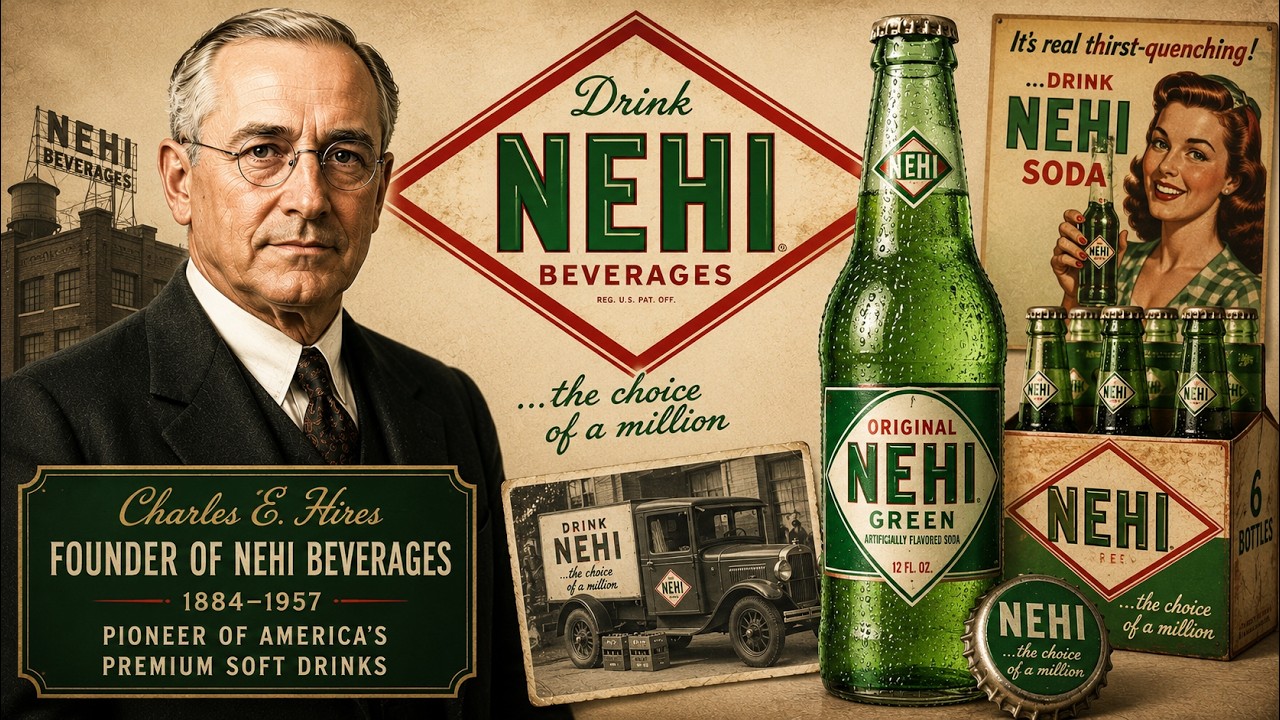
The bottle stood 12 inches tall, nearly twice the height of the standard 6-inch containers competitors used. It was impossible to miss on a shelf. Hatcher named the soda Nehi, pronounced “knee-high,” because the bottle came up to your knee. The name was both a joke and a boast, and in retrospect one of the shrewdest branding moves a regional soda company had ever made.
From 10,000 cases in 1924, Nehi grew to more than 600,000 cases annually by 1928, a remarkable increase in just four years. Hatcher did not hesitate. In 1928, he renamed the company after the soda. Chero-Cola became the Nehi Corporation.
What made Nehi work was actually simple. The American fruit soda market in 1924 was thin and inconsistent, with flavors that varied from city to city and batch to batch. Hatcher built his formula around intensity. His grape was unmistakably grape, his peach tasted like a Georgia peach in August, and his orange was bright and clean.
The carbonation was calibrated more tightly than most competitors managed, with finer bubbles and a cleaner finish. Drinkers noticed without being able to say exactly why. Then there was the bottle itself, a full foot of glass with a distinctive long neck that made it look almost architectural next to squat competitors. Customers reached for it because they could see it.
At 12 cents a bottle, the price was competitive in most markets. Hatcher understood that his customer was not wealthy and priced accordingly. Distribution was built on the franchise model, independent bottlers licensing the formula and running their own delivery routes. The system could expand into a new city without Hatcher spending a dollar on construction.
By 1928, that network reached from Georgia to the Great Lakes. Nehi sat in drugstore coolers, general stores, roadside stands, and lunch counters across the South and Midwest. The 1930s nearly killed the company. The Depression hit consumer spending hard, and Nehi revenues fell during the early years of the decade.
Then in 1933, Claude Hatcher died at just 52 years old. He had built the company from a basement formula into a corporation bearing his soda’s name, but he did not live to see what his successor would do with the cola formula he had been quietly developing in his final years. H. R.
Mott, the company’s sales director, took the helm. He was not a chemist. He was a salesman, which in 1933 was exactly what the company needed. In 1934, Mott introduced Royal Crown Cola, the product Hatcher had been developing as a direct challenge to Coca-Cola and Pepsi.
It was smoother than Coke, slightly less sweet than Pepsi, and priced to undercut both. Royal Crown Cola did not merely succeed. It began to consume the company’s identity from the inside. By the late 1930s, RC Cola, as drinkers called it, was outselling Nehi fruit sodas in most markets.
The franchise bottlers who had built their routes around grape, orange, and peach were now leading with cola. The company that had renamed itself after a fruit soda was quietly becoming a cola company. Meanwhile, Nehi entered its advertising era, and for a decade it was extraordinary. The campaigns of the late 1930s and 1940s were built around a daring visual device: print advertisements that featured a woman’s legs, skirt hemmed at the knee, stockings visible, positioned next to the tall bottle.
The imagery was suggestive without being explicit. The tagline reinforced the bottle’s defining feature: “Nehi, in great flavor. ” The ads ran in national magazines, on cardboard placards, in drugstore windows, and on billboards. They became part of the visual vocabulary of the era.
Then the celebrities arrived. In 1944, Nehi launched campaigns featuring Bing Crosby, Joan Crawford, Shirley Temple, Hedy Lamarr, and Lucille Ball. These were the most recognizable faces in American entertainment, holding Nehi bottles against the backdrop of the famous leg imagery. In September 1947, Nehi placed full-color cardboard signs featuring Hedy Lamarr in 5,000 drugstore windows simultaneously.
The campaigns worked. National sales climbed through the mid-1940s, and the franchise network stretched from Georgia to the Pacific Northwest. The war years helped Nehi in an unexpected way. Sugar rationing hit every beverage company, but Nehi’s decentralized franchise model allowed regional bottlers to source locally and keep shelves stocked while larger centralized brands ran short.
Then came M*A*S*H and a second peak nobody planned for. In 1972, the show premiered on television, set during the Korean War but actually reflecting the Vietnam conflict America was living through. In the middle of it all stood Corporal Walter “Radar” O’Reilly, who drank grape Nehi across 11 seasons and 47 episodes. Nehi did not pay for that.
There was no licensing deal, no placement agreement, no marketing strategy that put the bottle in Gary Burghoff’s hand. It simply happened. Grape soda sales climbed during those years in ways the company’s own advertising budget had not produced in a decade. It could not save the brand, because by 1972 the company that made Nehi had already stopped being the Nehi Corporation.
It had stopped being that 17 years earlier. The shift began in the 1930s, when RC Cola was introduced as a secondary product. By the early 1950s, Royal Crown Cola sales were running 10 times higher than Nehi sales in the same distribution network. In 1955, the company made it official and changed its name to the Royal Crown Company.
Four years later, it became the Royal Crown Cola Company. The fruit soda that had grown so quickly in the 1920s was now a secondary line in a cola company’s portfolio. Its name was gone from the door. Its advertising budget shrank.
Its shelf presence followed the money, and the money was following RC Cola. Through the 1960s, competition intensified. Coca-Cola had Fanta. PepsiCo developed its own fruit lines.
Regional brands like Crush and Sundrop had spent years building followings in the exact markets where Nehi was strongest. Nehi had no national advertising budget to answer with. The Cola Wars of the 1970s and 1980s delivered the final blow. Royal Crown did have one historic innovation.
In 1962, it launched Diet Rite, the first commercially produced calorie-free diet soda in American history, beating both Coca-Cola and Pepsi to the market by years. Diet Rite briefly became the fourth-best-selling soda in the United States. Then the government moved. In 1969, the FDA banned cyclamate, the artificial sweetener that gave Diet Rite its calorie-free formulation.
Diet Rite was reformulated and diminished, and it never recovered its position. Both rivals moved into the diet soda space with budgets that Royal Crown simply could not match. RC Cola fought through the 1970s, but by the early 1980s its market share had slipped to the low single digits nationally. Franchise bottlers who had sustained the distribution network for decades began signing agreements with Coca-Cola and Pepsi instead.
A bottler who dropped RC Cola dropped Nehi with it. Nehi flavors disappeared one by one without announcement. Chocolate Nehi, Nehi Lemonade, Wild Red, Blue Cream, and others were gone. The lineup narrowed to just orange, grape, and peach, kept alive only by demand in specific regional markets, particularly the Southeast.
In 2000, Cadbury Schweppes acquired Royal Crown Cola, and Nehi became an asset in a British conglomerate’s beverage portfolio. In 2008, the Dr Pepper Snapple Group absorbed the brand entirely. The name on the door had changed four times since Claude Hatcher died in 1933. Nehi still exists.
It is now a brand of Keurig Dr Pepper, offering orange, grape, and peach. It remains strongest in a corridor running from Georgia through Tennessee into Kentucky. According to people who still look for it, the best place to find Nehi today is a Cracker Barrel restaurant. The collectors found the brand long before the nostalgia industry did.
Vintage merchandise, including embossed glass bottles and porcelain enameled metal signs, trades actively on eBay and at antique auctions. A common embossed Nehi bottle from the 1940s sells for $20 to $100 depending on condition. A rare sign in working condition can fetch $500 or more, and one original Nehi advertising sign sold at auction in 2023 for $973. One surprising detail: Gary Burghoff, who played Radar O’Reilly, has said in interviews that the grape soda was written into the character as a piece of behavioral detail.
A soldier in a war zone who drinks grape soda worked because it was true to the character. Nehi never spent a dollar on it. There is another enduring cultural echo. In the 1983 film A Christmas Story, the famous leg lamp that Ralphy’s father wins is shaped like a woman’s leg in a fishnet stocking.
That lamp was modeled directly on Nehi’s advertising imagery from the 1940s, the seated woman’s legs and the skirt hemmed at the knee. Millions of people have laughed at that lamp without knowing what it was referencing. What Claude Hatcher built in a Columbus basement was never supposed to outlast him by a century. It was supposed to solve a practical problem.
The ambition was local. The result was national. Some brands die completely. Some survive as footnotes.
Nehi survives as something harder to name, present enough to be tasted, faded enough to be mourned, and remembered most clearly as the ghost inside someone else’s story.