The crowd is soaked before the first song ends. Hundreds of shaken bottles crack open at once, spraying soda over thousands of fans in Detroit. The drink is orange, red, and electric blue. Fans call the ritual a shower, and they call themselves Juggalos.
It has repeated at nearly every Insane Clown Posse concert since the early 1990s. The soda company at the center of this ritual has never signed an endorsement deal with the band. Not one dollar has changed hands. No contract, no co-branding.
The most visible cult symbol in American subculture belongs to a company that has stayed almost entirely silent about it. But the real story of Faygo is not about a rap duo, a soaked T-shirt, or a whoop whoop echoing through a Michigan arena. It is the story of the last regional soda company in America that refused to become Coca-Cola and survived for over a century precisely because it never tried. The story begins in Detroit in November 1907.
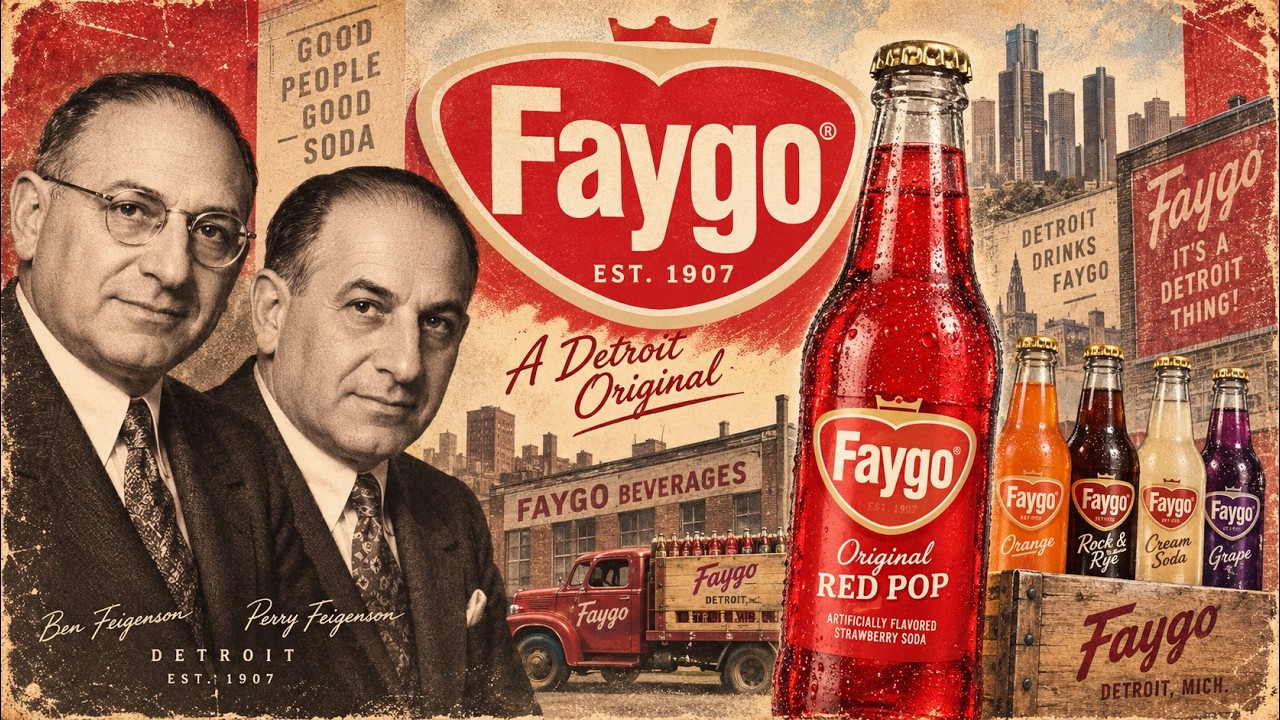
Ben and Perry Feigenson were not soda men. They were bakers, Russian Jewish immigrants who had recently arrived in Detroit. They had spent their working lives around ovens, not bottling lines. Detroit in 1907 was a city on the edge of transformation.
The automobile industry was still young, and the assembly line was still years away from Henry Ford’s factories. The streets around the Feigenson brothers’ neighborhood were filled with fellow immigrants chasing the same promise: steady work, a roof, a future for their children. What the brothers had was a trade and a habit every baker develops: an intimate knowledge of flavor, texture, and sweetness built from years of frosting cakes. That knowledge became the entire foundation of the company.
In November 1907, they began bottling lager beer, mineral water, and soda water from a small operation on Detroit’s near east side. It was not glamorous. Two brothers with buckets, bottles, and a wagon. In early 20th century America, soda water was still largely sold as a tonic, dispensed at drugstore counters, flavored thin, priced for middle-class customers who could afford a treat.
For the immigrant and working-class families crowding into cities like Detroit, that kind of soda barely existed. It was not made for them, priced for them, or sold anywhere near them. Ben and Perry saw this plainly. They did not need a market study.
They needed only to look at their own neighborhood and their own customers. And they had something no drugstore chemist had: a stockpile of cake frosting recipes built for sweetness and flavor. They adapted those recipes directly into their first soda flavors: strawberry, fruit punch, and grape. Sweet, simple, and instantly recognizable to anyone who had ever tasted the brothers’ baking.
They charged three cents for a single bottle, two bottles for a nickel. It was a price built for a factory worker’s pocket, not a pharmacist’s clientele. There was no factory behind it. The brothers manufactured what they could, then closed the line down and went out to sell it themselves door-to-door, block by block, because the drinks contained no preservatives and had to move fast.
To make the arithmetic work, the Feigenson family lived above the bottling plant itself. Winters were lean. Soda sales dropped when the weather turned cold, so the brothers filled the gap by selling bread and fish. Whatever kept money moving through a Detroit winter, they did it.
A nickel from a loaf of bread was still a nickel. It worked. Within a decade, the brothers had saved enough to buy their own homes. They hired their first employee and bought a second horse and wagon, doubling their delivery reach across Detroit’s east side.
New flavors followed, including sassafras soda and lithiated lemon. A small detail buried in this early growth would define the brand for the next century. Customers listening to the hiss and crack of a bottle opening began calling the drink “pop,” after the sound the cap made when it broke the seal. The Feigenson brothers picked up the word themselves.
It stuck. By the early 1920s, the operation had outgrown its original space, and a new plant was built on Detroit’s Boom Street. Two bakers, a wagon, and a recipe book meant for wedding cakes, repurposed for soda bottles, had become the foundation of one of the most recognizable regional soft drink brands in American history. Faygo’s breakthrough was never a secret formula guarded behind patents.
It was a set of decisions made by two former bakers about what a soda should taste like, look like, cost, and reach. The original flavors carried something drugstore soda water did not: real sweetness built from cake frosting recipes rather than medicinal syrup. A customer used to drugstore soda water could taste in a single sip that this drink had been built by people who spent their careers thinking about how to delight a customer, not medicate one. The brothers kept expanding through the 1920s with sassafras soda, a spiced dark root beer-style drink; lithiated lemon, flavored with a lithium salt additive that was legal and common at the time; and rock and rye, a fruity, spice-forward soda named after a Prohibition-era whiskey cocktail.
The name itself was almost an accident of practicality. Through the 1910s, the company operated as the Feigenson Brothers Bottling Works, a name too long to fit legibly on a small glass bottle. In 1921, the brothers shortened it to Faygo, a clipped phonetic version of the family name. It was chosen because it fit on the label.
That constraint produced one of the most recognizable four-letter brand names in American beverage history. Price drew Faygo’s sharpest line against competition. A bottle cost three cents, two bottles for a nickel. At a moment when drugstore soda fountains charged a premium for flavored tonic aimed at middle-class customers, Faygo was priced for a factory floor.
In the 1910s and early 1920s, Detroit’s automobile plants were paying production workers up to five dollars a day, the wage increase Henry Ford introduced in 1914. A nickel for two bottles of Faygo was a treat that fit inside an ordinary week’s budget. Reach began with a wagon, then a second wagon, then a hired employee. In 1923, the Feigenson brothers made their first real leap in scale by purchasing their first delivery truck.
A horse-drawn wagon could cover a neighborhood; a truck could cover a city. Faygo was building the infrastructure of an actual regional beverage business, reaching general stores and corner grocers across Detroit’s working-class neighborhoods rather than drugstore soda counters. When national Prohibition took effect in 1920, beer production became illegal overnight, and beverage companies that had built their identities around alcohol were forced to shutter or reformulate. Faygo did not face that reckoning.
The company had never depended on beer. Soda water and fruit flavors were already carrying the business. Prohibition simply removed a side offering the brothers had barely leaned on. In 1935, Faygo moved to a larger plant on Gratiot Avenue on Detroit’s east side, a building that remained the company’s production home for the rest of the 20th century and into the 21st.
The real transformation from a Detroit neighborhood soda into a regional household name happened on television. In the 1950s, the company began running animated commercial spots with cartoon mascots and jingles. In the 1960s, Faygo secured advertising time during televised Detroit Tigers broadcasts. Faygo commercials arrived in the same living room moment as baseball season itself, tied in the memory of an entire generation to summer and the ball game.
The centerpiece of that era was a mascot known as the Faygo Kid and a run of jingles simple enough for children to sing from memory after a single hearing. One jingle, built around the image of a Faygo boat, became popular enough in the 1970s that the company pressed it onto vinyl records. Roughly 75,000 copies sold. A soda jingle on a record moving units in the same market as actual music showed how deeply Faygo’s advertising had lodged itself into Michigan’s cultural bloodstream.
In July 1967, Detroit erupted into one of the deadliest urban uprisings in American history. Sparked by a police raid on an unlicensed after-hours bar, the unrest spread across five days, leaving 43 people dead, more than a thousand injured, and roughly 40 million dollars in property damage. The National Guard moved through the city as entire blocks burned. The Faygo plant sat inside this landscape on Detroit’s east side and emerged from the week largely untouched.
By 1967, roughly 75 percent of the company’s production workforce was Black, in a city where racial tension between residents and a mostly white police force had been building for years. Accounts from the period point to a specific reason the plant was spared: the Feigenson family had a reputation for treating workers decently in a way that was not universal among Detroit employers of the era. One family member later recalled finding IOUs for worker wages left on her father’s desk that summer, evidence of a company choosing to keep paying people even while the business was straining to survive the same crisis engulfing the city. That same instinct appeared again during a company strike in 1980.
Rather than treat picketing workers as adversaries, one of the family owners ordered workers to break up wooden shipping pallets and hand the wood over to the striking employees. Firewood for the men standing outside the plant. It was not a gesture calculated for public relations, but it captured something structurally unusual about Faygo: even in moments of direct conflict with its own workforce, the family treated employees as neighbors rather than line items. By the final decades of the 20th century, the Gratiot Avenue plant had expanded to roughly 300,000 square feet, absorbing adjacent bottling buildings once owned by Coca-Cola and Pepsi.
Faygo products were produced across 11 plants nationwide as needed, reaching 33 states, primarily concentrated across Michigan, Ohio, Indiana, and western Pennsylvania. More than 50 delivery trucks ran routes to smaller retailers, even as the company shipped in bulk to chain store warehouses. Ben and Perry Feigenson ran the company themselves until the mid-1940s, when they stepped back and passed control to their sons. Faygo remained a family-run operation for a full 55 years.
By the time that ownership era reached its peak, Faygo was generating roughly 100 million dollars in annual sales and employing around 550 people, still headquartered in the same neighborhood where two immigrant bakers had once lived above their bottling shed. That regional comfort was about to be tested. In 1978, Michigan passed a mandatory container deposit law, one of the first and strictest in the country, requiring a 10-cent deposit on every bottle and can sold in the state, refundable only when the empty container was returned. For national giants like Coca-Cola and Pepsi, absorbing new packaging logistics was an inconvenience.
For Faygo, a company whose entire identity was built on being the cheapest bottle on the shelf, the law struck at the exact foundation the business had stood on since 1907. Retooling packaging lines and managing a statewide return system cost money that had nowhere comfortable to go. The deeper problem was what the deposit law revealed: a business built for one region with one pricing strategy facing a regulatory and competitive landscape that was steadily nationalizing around it. In 1985, the Feigenson family sold Faygo to TreeCo, after running the company for 78 years.
Two years later, in 1987, ownership passed again, this time to National Beverage Corporation, a Florida-based holding company that also owned the West Coast soda brand Shasta. The reasoning was straightforward: a regional soda company squeezed by new packaging laws and facing a market dominated by two national giants needed capital and scale that a fourth generation of the family could not easily provide. National Beverage offered the resources to keep the Gratiot Avenue plant running and the flavors on shelves. What changed was something quieter.
Faygo stopped being a company that belonged to Detroit. It became a division in a Florida conglomerate’s beverage portfolio, sitting alongside Shasta on the same balance sheet, evaluated by executives who had never lived above a bottling plant. For most Faygo drinkers, the ownership change was nearly invisible. The bottles looked the same, the flavors tasted the same, and there was no dramatic closure or bankruptcy filing.
It was not a company that died, but a company that quietly stopped being able to call itself its own. A second factor ran underneath the ownership change. Faygo had built its entire identity around never trying to compete nationally. That strategy allowed it to survive for 78 years as a family business, but it also left the company permanently boxed inside a regional ceiling.
While Coca-Cola and Pepsi built global distribution networks and marketing budgets that dwarfed entire regional economies, Faygo stayed where the Feigenson brothers had planted it: 33 states at its widest reach, a fraction of the shelf space held by either national competitor. The attempt at adaptation came in the form of expanded flavor lines, including the Royal series introduced in the 1960s and a catalog that eventually reached more than 50 distinct flavors. It kept loyal Midwestern customers engaged, but variety within a region is not the same as expansion beyond one. Faygo never broke out; it simply got deeper in the ground it already occupied.
The final years of independent family control did not look like other corporate collapse narratives. The papers were signed in 1985, ownership changed again in 1987, and the Gratiot Avenue plant kept running. The trucks kept moving. The flavors stayed on shelves.
Detroit kept the name; Florida kept the company. Nothing visible broke. Everything invisible did. Faygo did not need to be resurrected because it never actually died.
The Gratiot Avenue plant that opened in 1935 is still standing, still bottling, still employing workers on Detroit’s east side today under National Beverage Corporation’s ownership, on the same ground the Feigenson family chose nearly a century ago. In the years after the family stepped away, a new kind of ownership emerged, not corporate or legal, but cultural. In the late 1980s and early 1990s, a Detroit rap duo performing as Insane Clown Posse began building a mythology around what they called the Dark Carnival. At an early show, according to accounts from the band, one half of the duo, performing under the name Violent J, grew frustrated with hecklers and threw an open bottle of Faygo directly at them.
The crowd’s reaction was excitement. The band noticed. What started as one spontaneous gesture became a signature: shaken open bottles of Faygo sprayed over entire audiences at every subsequent show, a ritual fans came to call the Faygo shower. Over the following decades, the ritual became central to the band’s fan base, a subculture that named itself Juggalos.
Faygo fit the symbolism perfectly. It was cheap, colorful, and built from its very first bottle in 1907 for people without much money: factory workers and immigrant families, the exact demographic Juggalo culture openly embraced. Being soaked in a drink that cost pennies a bottle became a badge, an embrace of being broke, of being overlooked, of belonging to something the mainstream did not understand. Faygo’s response to all of this was by most accounts a shrug.
The company has never signed an endorsement deal with Insane Clown Posse. Faygo’s own historical materials barely mention Juggalo culture. Part of that distance may be practical: in 2011, the FBI classified Juggalos as a loosely organized gang in an official threat assessment, a label that made any formal corporate association a legal and reputational risk. When asked directly by reporters over the years, Faygo’s head of marketing tended to answer politely and say very little.
For an older generation of Detroiters, the loyalty runs on a different register. Red Pop remains by most accounts the brand’s bestselling flavor. A taste that for someone who grew up on Detroit’s east side in the 1950s or 1960s cannot be substituted by any national soda. It is a specific physical memory: a corner store on the walk home from school, a cooler at a Tigers game, a refrigerator in a childhood kitchen that always had a few flavors of Faygo because it was what the family could afford and what the family actually liked.
A surprising thread rarely makes it into the brand’s official history. The recipes were never really secret in the way most companies guard their formulas. Faygo’s origin, cake frosting adapted directly into soda syrup by two bakers with no formal chemistry training, was always closer to a family recipe than an industrial trade secret. The company’s flavor variety grew out of the same instinct that built the original three flavors in 1907: try something sweet, see if the neighborhood likes it, keep it if they do.
Faygo’s story does not resolve into a moral about ambition destroying a good thing or corporate greed swallowing a beloved brand. It resolves into something stranger and more specific to Detroit: a company that refused generation after generation to become bigger than its own neighborhood, and in refusing, became something almost no other regional soda maker in America managed to become. Still standing, still bottling on the same street, still tasting the way it tasted when a factory worker in 1920s Detroit paid a nickel for two bottles after a shift. It is a story about what a company gains and what it permanently gives up when it decides its own backyard is enough.
Somewhere in Detroit tonight, someone is cracking open a bottle of Red Pop, the same flavor born from the same frosting recipe, bottled a few miles from where two brothers once lived above their own shop more than a hundred years ago.