A photograph taken on a beach in Jamaica in the early 1970s shows two of the most famous faces in the world lying in the sand together, laughing at something no one else would ever know. At the time, it looked like nothing more than two beautiful people enjoying an ordinary afternoon. It was not ordinary, and it was not the beginning of a fairy tale, no matter how many magazine covers said otherwise. What happened between the woman in that photograph and the man beside her would end a marriage, end a career, and leave her decades later still trying to explain what really happened behind the doors of a beach house the whole world assumed was paradise.
Before she was the girl in Love Story, before there was ever a Steve McQueen in her life, Elizabeth Alice MacGraw was a bookish young woman from Pound Ridge, New York, the daughter of an artist mother and a father who ran a chain of gas stations. She attended Rosemary Hall in Connecticut, then Wellesley College in Massachusetts, where she studied art history and literature, the kind of girl who seemed destined for a quiet, cultured life rather than movie premieres and paparazzi. She was not chasing Hollywood. Hollywood found her almost by accident.
While still a student, she had headshots taken by a well-known photographer, an experiment aimed mostly at pleasing her future in-laws rather than launching a career. Instead, the photographer offered her a job as a stylist, and that small, almost incidental decision quietly set the rest of her life in motion. After graduating, she landed a job assisting a photographer at Harper’s Bazaar, working behind the scenes of fashion magazines, styling shoots, and running errands for editors like the legendary Diana Vreeland, whose exacting standards shaped MacGraw’s eye for image and presentation for years afterward. She spent roughly six years on that side of the camera before ever imagining she might step in front of it.
In 1960, still in her early twenties, she married a Harvard-educated banker named Robin Hoen, a man from precisely the sort of established, socially prominent family she had once hoped might welcome her into their world. The match lasted barely a year and a half before the two divorced, a quiet failure that taught her, long before Hollywood ever entered the picture, how quickly a marriage that looked perfect on paper could come apart in practice. She drifted into modeling next, appearing in the pages of Vogue, building a reputation less as a show-stopping beauty and more as a fresh, natural, almost collegiate face at a time when fashion was starting to crave exactly that. She had no formal acting training and no particular plan to become a movie star, but her stillness and unforced elegance caught the attention of people who made films for a living.
Her first appearance on screen, in a forgettable 1968 picture alongside Kirk Douglas, went almost unnoticed. Within a year, she would be standing on a stage accepting an award for a performance that made her one of the most talked-about new actresses in America. In 1969, MacGraw starred in Goodbye, Columbus, a wry comedy that won her a Golden Globe as the most promising new star in Hollywood. It was a strong debut, but nothing compared to what came a year later.
Love Story arrived in theaters in December 1970 and became a genuine cultural phenomenon, a tearful, tender romance between a wealthy young man and a sharp-tongued working-class girl that left audiences sobbing in darkened theaters across the country. Opposite her stood Ryan O’Neal, and together the two became one of the defining screen pairings of the era, their chemistry so convincing that fans spent years assuming there had to be something real between them off camera as well. The film earned more than a hundred million dollars worldwide, an almost unthinkable sum at the time, and turned its two young stars into household names overnight. MacGraw received an Academy Award nomination for Best Actress, and in 1972 she was voted the top female box office draw in the entire world, an extraordinary distinction for an actress who had appeared in only a handful of films.
Grauman’s Chinese Theatre pressed her hands and feet into wet cement, an honor typically reserved for performers with decades of work behind them. Behind that success stood Robert Evans, the head of production at Paramount Pictures, the man who had personally cast her in Love Story and who would go on to shepherd some of the most important films of the decade, including The Godfather and Chinatown. Evans had once had a brief acting career of his own, and by the time he met MacGraw, he had become one of the most powerful men in the industry. MacGraw and Evans married in 1969, and in 1971 they welcomed a son, Josh.
On paper it was the perfect Hollywood partnership, the golden actress and the powerful studio executive, treated by the industry as a kind of royal couple. But Evans was, by his own admission, a man consumed by his work, measuring his days in productions greenlit and deals closed rather than time spent at home. MacGraw has said that even during the best years of their marriage, she often felt like a supporting player in the larger drama of her husband’s career. In 1972, Evans encouraged MacGraw to take a role in a gritty crime thriller called The Getaway, directed by the notoriously volatile filmmaker Sam Peckinpah, playing the wife of a bank robber trying to survive on the run after a botched heist.
The production moved between locations in Texas and New Mexico, far from the studio lots and social circles MacGraw had grown used to in Los Angeles. Her co-star was Steve McQueen, already one of the most famous men on the planet, a screen icon known simply as the King of Cool. MacGraw would later admit that she sensed trouble from almost the moment they met, recognizing almost immediately how easily she could fall for him, and understanding the danger even as she walked toward it anyway. McQueen was twelve years older than she was, magnetic in a way that had little to do with traditional handsomeness and everything to do with presence, carrying an undercurrent of unpredictability that made him both thrilling and unsettling to be around.
The two began an affair during filming, one that quickly became impossible to hide. By the time production wrapped, MacGraw had filed for divorce from Evans. The scandal was everywhere. Newspapers and gossip columns feasted on the story of the wholesome Love Story actress leaving her powerful husband for the swaggering bad boy of American cinema.
In the more conservative entertainment climate of the early 1970s, an affair of this scale was treated less like gossip and more like genuine news. She was cast, fairly or not, as the ungrateful young star who had abandoned the powerful man who made her famous for the thrill of a more dangerous romance. Robert Evans later insisted that his years with MacGraw meant more to him than any of his other marriages, and remarkably, the two managed to remain close friends for the rest of his life. McQueen was born in March 1930 in Beech Grove, Indiana.
His childhood was anything but stable. His father left before he was old enough to remember him, and his mother struggled with alcohol and moved in and out of his life, eventually sending him to live with relatives on a Missouri farm. As a teenager, he was sent to a boys’ reform school in California, where he spent more than a year, at times in solitary confinement. At seventeen, he enlisted in the Marine Corps, where he was demoted multiple times for various infractions, though he was also credited with helping rescue several fellow Marines during a training accident in frigid waters.
He drifted toward acting almost by chance in New York, studying at the Neighborhood Playhouse and picking up small stage and television roles. His breakthrough came with the television western Wanted Dead or Alive, which made him one of the most recognizable men on American television by the late 1950s. But it was the movies that made him a legend. The Magnificent Seven in 1960 established his screen presence, and then came The Great Escape in 1963, in which he played a captured American pilot who attempts a dramatic motorcycle dash toward the Swiss border, an image that became one of the defining pictures of 1960s cinema.
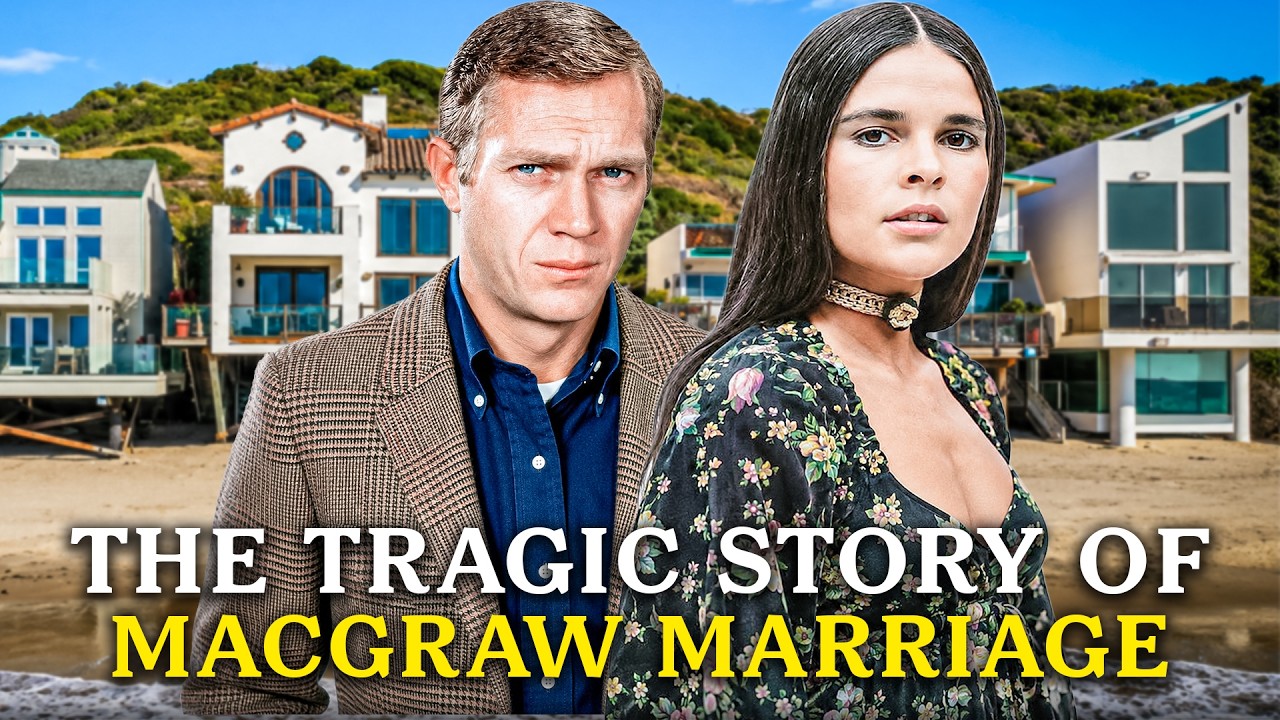
He earned an Academy Award nomination for The Sand Pebbles in 1966, and two years later, Bullitt gave audiences one of the most famous car chases ever filmed through the streets of San Francisco. By the time he met Ali MacGraw, McQueen was, by some measures, the highest-paid actor in the world, surrounding himself with fast cars and motorcycles, competing seriously in professional racing, and cultivating a reputation for being difficult and demanding total control on set. He had already been married once before, to a dancer named Neile Adams, a marriage that had ended amid its own reported turbulence and infidelity on both sides. Steve McQueen and Ali MacGraw were married in July 1973 in a small private ceremony beneath a cottonwood tree near Cheyenne, Wyoming.
There was no grand Hollywood spectacle, no red carpet, no army of photographers. The guest list was small, largely just their children, and the judge who performed the ceremony reportedly left a golf game to officiate. Afterward, the couple settled into a secluded home in Malibu close to the beach. For a while, at least on the surface, it looked like exactly the kind of life the public wanted to imagine for them.
MacGraw described those early days with genuine warmth, recalling long afternoons spent on the sand and barbecues with friends, a relaxed, unhurried rhythm that felt like a different world from the pressures of studio politics she had just left behind. But comfort in that beach house came at an enormous cost. At the moment she married McQueen, Ali MacGraw was arguably the most in-demand actress in America. Robert Evans, even after their divorce, had been developing major projects with her in mind, including The Great Gatsby and Chinatown, both destined to become defining films of the 1970s, with the roles of Daisy Buchanan and Evelyn Mulwray waiting for her.
She walked away from both of them, and the roles instead went to other actresses who would go on to earn some of the most memorable performances of the decade. Industry insiders at the time were reportedly baffled by the decision. But there was no compromise to be found. McQueen’s expectations were absolute, and MacGraw, by her own later admission, was too deeply in love and too uncertain of her own footing in the relationship to push back the way she might have during any other chapter of her life.
McQueen did not want a wife who worked. He made it plain that he expected MacGraw to be at home rather than on a film set. She stepped back from acting almost entirely and devoted herself to raising her son. Those who observed the marriage up close described a relationship defined less by partnership than by possession.
McQueen’s jealousy was constant, a low hum of suspicion that shaped nearly every part of daily life. He wanted to know where she was, who she spoke to, whether she still harbored any pull toward the career and the identity she had given up for him. MacGraw has said that she lived throughout the marriage with the persistent, quiet certainty that he would eventually leave her. There were also, according to multiple accounts published over the years, patterns of behavior from McQueen toward the women in his life that crossed into physical volatility, incidents that were rarely discussed publicly at the time but that later biographers have described as part of a broader, troubling pattern.
MacGraw herself has suggested that his difficult childhood left him with a kind of restlessness he never fully resolved, a need to test the people closest to him again and again, as though he could never quite believe that anyone would choose to stay. By 1976 and into 1977, the marriage had become, by MacGraw’s own later description, deeply troubled. The affection that had defined those early Malibu afternoons had curdled into something closer to a standoff, two people who still cared for each other but could no longer find a way to coexist without one of them disappearing into the other’s shadow. The couple separated in 1977 after roughly five years together, dating back to the beginning of their affair on The Getaway.
Their divorce became official in 1978. MacGraw did return to acting following the divorce, appearing in the 1978 trucking drama Convoy and later taking on further film roles, including Players in 1979 and Just Tell Me What You Want in 1980, before landing a leading role in the television mini-series The Winds of War in the early 1980s. She continued working sporadically through the 1980s, including a stint on the primetime soap opera Dynasty. But the momentum she had carried into the early 1970s never fully returned.
The years she had spent away from the industry had cost her a place in Hollywood’s leading tier that would prove impossible to fully reclaim. McQueen continued making films after the divorce, including the Western Tom Horn and the action picture The Hunter, both released in 1980. He remarried that same year to a young model named Barbara Minty. Only months earlier, McQueen had been diagnosed with mesothelioma, an aggressive form of cancer strongly linked to asbestos exposure.
On November 7, 1980, Steve McQueen died in Mexico following surgery related to his illness. He was fifty years old, and his death arrived barely two years after his marriage to MacGraw had officially ended. MacGraw, by her own account, was devastated by his death despite everything that had happened between them. In interviews given decades later, she has spoken about him with a complicated tenderness, describing a man she was, in her words, obsessed with almost from the moment they met, and a connection that never entirely faded even after the marriage itself had become unsustainable.
She never remarried. Robert Evans remained a close friend until his death in October 2019 at the age of eighty-nine, and she stood beside him publicly when he received his star on the Hollywood Walk of Fame in 2002. When Evans passed away, MacGraw spoke publicly about their son and the life they had shared, choosing warmth over any lingering resentment from decades earlier. Today, Ali MacGraw lives a quiet life in Tesuque, New Mexico, a home she settled into in the mid-1990s after fire destroyed the Malibu house she had lived in for years.
In 1991, she published a candid memoir titled Moving Pictures, in which she wrote openly about both marriages, about the sacrifices she made, and about the slow process of rebuilding an identity that had spent years defined largely by the men beside her. When she looks back on her marriage to Steve McQueen, she does not frame it purely as a tragedy, nor does she pretend it was the fairy tale the magazines once sold to the public. It was, in her own telling, a period defined by genuine passion and genuine damage, two things that existed side by side and were never easy to separate. The photograph from that Jamaican beach reads very differently once you know everything that came after it.
It was never simply the beginning of a Hollywood fairy tale. It was the opening chapter of a story about what a woman is willing to give up for love, about the particular danger of loving someone whose fame and force of personality can quietly swallow another person’s identity whole, and about what it costs years later to piece that identity back together. Ali MacGraw did eventually get her career back on some level, and more importantly, by her own account, she got herself back, one quiet year at a time, far from the beach houses and the headlines, in a small town in New Mexico that never asked her to be anyone’s leading lady at all.