On December 13, 1862, darkness settled over a Virginia meadow soaked in human blood. Beneath a haunting crimson night sky, roughly 7,000 wounded men lay freezing to death in the mud, their shattered bodies locked to the earth by ice. For over a century, history textbooks have reduced this day to a tragic tactical miscalculation of the American Civil War. But the terrified journals of the soldiers who barely survived reveal something far darker.
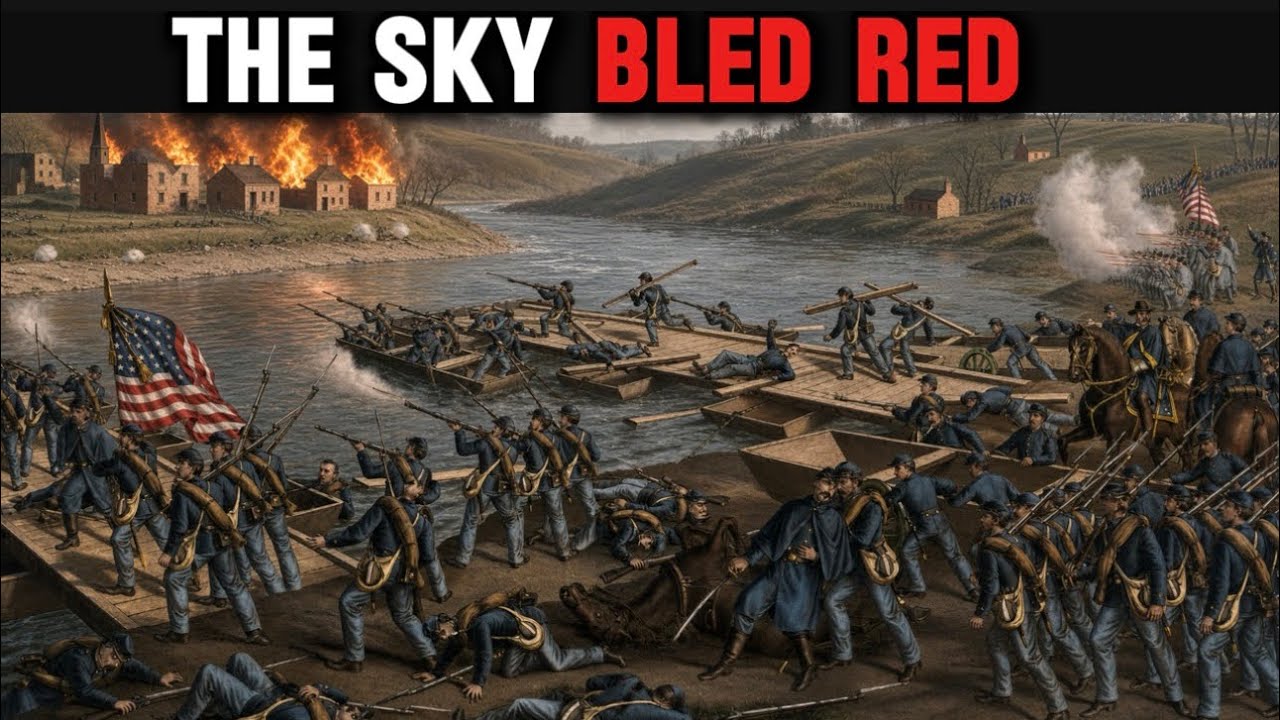
The Battle of Fredericksburg was an unholy descent into industrial slaughter, urban combat, and a night sky so grotesque that 40,000 men believed they were witnessing the end of the world. Freezing river fog shrouded the Rappahannock on the morning of December 11th, masking a bureaucratic failure that turned the cold water red before the main battle even began. General Ambrose Burnside had planned to surge his massive federal army across the river in a lightning surprise movement, catching the Southern forces off guard before they could entrench. But a catastrophic delay in delivering wooden pontoon bridges from Washington turned that tactical surprise into a death trap.
For nearly three weeks, the Union Army sat trapped on the northern bank at Falmouth, forced to watch through telescopes as the enemy transformed the heights across the river into an impenetrable fortress of earth, stone, and iron. Hidden inside the hollowed-out brick structures along the city’s waterfront sat a small lethal garrison waiting to unleash hell on the engineers tasked with bridging the gap. William Barksdale’s brigade of Mississippi marksmen had turned the abandoned homes, cellars, and warehouses of Fredericksburg into an interconnected network of sniper nests. Every window had a rifle barrel poking through the shadows, and every wooden wall was sandbagged to protect the shooter inside.
When Union engineers stepped down to the water’s edge in the freezing darkness to lay the heavy pontoon boats, the riverbank erupted into a terrifying sheet of muzzle flashes. Bullet after bullet tore through the heavy mist, turning the icy Rappahannock into a churning nightmare of wooden splinters and screaming men. Union pontoon builders working in open light were cut down in broad daylight like target dummies at a firing range. Men were shot through the forehead while carrying wooden beams, their lifeless bodies plunging into the freezing current and floating downstream past their horrified comrades.
Union pontoon commanders went through three full rotations of men in less than an hour, watching every officer and soldier who stepped onto the unfinished bridge get swept off by rifle fire. General Ambrose Burnside, watching the brutal paralysis from a mansion across the river, finally snapped under the psychological pressure and ordered an unprecedented measure in American military history. Over 140 heavy siege guns and field cannon lined up along Stafford Heights unleashed an apocalyptic bombardment directly onto the historic town of Fredericksburg. For over two agonizing hours, heavy explosive shells, solid iron cannonballs, and incendiary rounds rained down on centuries-old homes, churches, and shops, creating a continuous roar that shook the earth for ten miles in every direction.
Thick black smoke turned high noon into pitch black midnight as historic brick houses collapsed into the streets and timber-frame homes burst into towering infernos. Women, children, and elderly residents who had refused to abandon their homes huddled in terrifying darkness beneath cellar foundations, praying as falling masonry threatened to bury them alive. Yet when the heavy artillery smoke finally cleared, Barksdale’s Mississippians crawled out from their reinforced cellars, wiped the red brick dust from their rifles, and took up their positions once again along the riverbank. Desperate to break the bloody deadlock, Union commanders called for a suicidal amphibious assault that would force America’s first taste of modern urban combat.
Daring infantrymen from Massachusetts and Michigan piled into open wooden pontoon boats, using heavy oars to push themselves across the exposed river under a murderous hail of rifle fire. Dozens of men were hit before their boats even reached midstream, their blood staining the bilge water as their comrades frantically paddled past the floating corpses of their friends. When the wooden hulls finally scraped against the muddy southern bank, the surviving soldiers charged up the steep river bluff with fixed bayonets, storming the city streets in a desperate bid to flush out the snipers house by house. Clearing the ruined city quickly degraded into a brutal fight where survival was measured inch by inch and room by room.
Union infantry kicked down heavy oak doors, spraying rifle fire into dark living rooms and throwing bayonets down dark cellar staircases without knowing who was waiting in the shadows. By the time the Mississippi marksmen were finally forced to withdraw late that afternoon, the streets of Fredericksburg were littered with smashed furniture, fallen chimneys, and hundreds of mangled corpses frozen into the mud. Frustrated, terrified, and pushed to the absolute edge of human sanity by the river crossing, the victorious federal troops completely lost control, turning their rage upon the ruined city itself. What followed was one of the most disgraceful incidents of mass looting in Civil War history.
As entire regiments rampaged through the abandoned mansions and modest homes, soldiers dragged priceless velvet couches into muddy alleyways, smashed historic grandfather clocks with the butts of their rifles, and used bayonets to cut valuable oil portraits out of their golden frames. Drunken soldiers paraded through the smoke-filled streets wearing stolen hoop skirts and expensive silk dresses over their mud-caked uniforms, while others hurled fine French porcelain and crystal chandeliers against brick walls in a wild frenzy of destruction. Library shelves were pulled down, rare books were tossed into muddy streets to serve as makeshift stepping stones, and family heirlooms accumulated over generations were smashed into dust. When night fell on December 12th, the once great city of Fredericksburg was a gutted, glowing shell of ash echoing with the sound of drunk singing soldiers surrounded by the ruins of a destroyed civilization.
Leaving the smoking, ransacked ruins of the town behind them, the next morning Union soldiers marched toward a long, gentle slope to the west that would soon become the ultimate American slaughterhouse. Standing on the heights above stood General Robert E. Lee’s Confederate army, entrenched in a position so naturally powerful that even the most inexperienced soldier could see the suicidal nature of attacking it. At the base of the height lay a sunken wagon road, shielded from the town side by a stone wall over four feet high that formed a perfect ready-made breastwork.
Behind that stone wall sat four dense ranks of Confederate infantry, while high above them on the crest, dozens of heavy artillery pieces commanded every single square inch of the open plain below. General James Longstreet looked out over the open fields leading up to Marye’s Heights and made a chilling assessment that should have made any commanding general reconsider his plans. Longstreet dryly assured his commander that not a single chicken could live on that field once his artillery opened fire, as he had lined up his guns so precisely that they could sweep the slope like a broom. Yet completely blind to the reality of the terrain and clinging to an outdated tactical playbook, General Burnside ordered a full frontal infantry assault against the stone wall.
He believed that sheer numbers and cold bayonets could shatter the Confederate line if his men simply advanced with enough determination. When the order to charge was given on the morning of December 13th, thousands of Union soldiers stepped out from the cover of the town onto an open plain intersected by deep, freezing drainage ditches. There was absolutely no cover on that muddy slope, no trees, no boulders, and no terrain features to shield a man from the cold eyes of the defenders above. The moment the long blue lines stepped onto the open turf, the Confederate artillery on the heights unleashed a devastating crossfire that tore open massive gaping holes in the advancing ranks.
Solid iron cannonballs bounced through the soft mud at horrifying speeds, tearing off limbs, decapitating soldiers, and ripping men completely in half in a split second. Explosive shells detonated directly above the heads of the advancing columns, showering the men with thousands of red-hot, jagged iron fragments that sliced through wool coats, muscle, and bone. Entire files of men were erased in a single blinding flash, leaving behind a nauseating haze of vaporized blood that floated over the muddy ground. Yet bound by rigid military discipline and sheer bravery, the surviving soldiers closed the gaps in their ranks, stepped over the screaming remains of their comrades, and kept marching straight up the hill.
As the federal troops finally reached the lower slope and got within rifle range, the stone wall at the sunken road seemed to explode in a continuous, deafening wall of fire. The defenders behind the wall were organized into a staggering rotation system. The front line fired, then immediately stepped back to hand their empty rifles to men behind them who reloaded, allowing a non-stop storm of lead to sweep the field. Thousands of heavy lead mini balls ripped through the air with a terrifying high-pitched whistle, slamming into human bodies with a sickening sound.
Wave after wave of federal regiments stepped into that invisible killing zone, only to be sheared down like standing wheat before a mechanical scythe within seconds. The impact of the rifle fire was so concentrated that the front ranks of the attacking force were frequently lifted off their feet and knocked backward onto the men advancing behind them. Among those ordered to march into this impossible storm was the famous Irish Brigade, a hard-fighting unit composed largely of poor Irish immigrants who wore sprigs of green boxwood in their caps to honor their homeland. Carrying emerald battle flags adorned with golden harps, the Irishmen let out a fierce Gaelic battle cry and charged directly up the bloody, slippery slope toward the sunken road.
They stepped over layers of fallen federal soldiers, pushing farther up the hill than almost any unit that had gone before them, determined to prove their loyalty to their adopted nation through sheer courage. Across the field, huddled safely behind the four-foot stone wall, sat the infantrymen of the 24th Georgia, a unit composed almost entirely of fellow Irish immigrants who instantly recognized the green boxwood sprigs in their enemy’s hats. Tears reportedly streamed down the cheeks of the southern defenders as they recognized their own countrymen. Yet they performed their grim duty without hesitation, reloading as fast as their hands could move.
The Georgia Irishmen poured volley after volley of devastating lead point blank into the advancing Northern Irishmen, cutting down their own brothers in a heart-wrenching clash of absolute tragedy. The green boxwood sprigs that had been proudly tucked into Union caps just minutes earlier were soon scattered across the mud, stained dark red with the blood of the men who wore them. Out of the 1,200 brave men of the Irish Brigade who had stepped onto that plain, over 500 fell in a matter of fifteen agonizing minutes, leaving their shattered remnants to crawl frantically behind mounds of dead horses and fallen comrades for cover. Desperate to rescue his pinned-down army, General Burnside ordered division after division to assault the exact same position, sending fourteen separate waves of men to face the exact same horrific fate.
Officers who knew the attacks were nothing short of organized murder nevertheless drew their swords, turned to their men, and led them forward into the storm of fire. Whole brigades were completely wiped out of existence in less time than it takes to read a single page of text, leaving regiments reduced to tiny, shivering handfuls of traumatized survivors. As the short winter afternoon began to fade into twilight, the open plain below Marye’s Heights had been transformed into a nightmarish sea of torn flesh, muddy uniforms, and broken weapons. Thousands of wounded men who were too badly injured to crawl back to the safety of the Union lines were left abandoned in no man’s land, helpless against the biting, merciless Virginia cold.
Wet clothes soaked in sweat and fresh blood quickly froze solid, encasing injured limbs in stiff, ice-encrusted suits of armor that accelerated hypothermia and frostbite. Men with open abdominal wounds or shattered thigh bones lay helpless on the frozen turf, watching helplessly as their own blood froze into crimson icicles against their skin. The extreme cold caused the moisture inside exposed open wounds to crystallize, creating an agonizing sensation that survivors later described as having hot liquid fire poured continuously over their torn muscles. As the darkness deepened, a sound rose from that pitch-black field that haunted every surviving veteran for the rest of their natural lives.
It was a single, unearthly, endless wall of agonizing sound, a collective rhythmic groan produced by thousands of dying men simultaneously weeping, praying, and screaming for help. Men called out frantically for their mothers, begged their comrades by name to come shoot them to end their misery, or pleaded with the heavens for a single drop of water to quench their burning thirst. Back in Washington DC, President Abraham Lincoln sank into a profound, terrifying psychological darkness as the true scale of the disaster reached the White House. Lincoln paced the halls of the executive mansion late into the night, reportedly muttering that if there was a worse place than hell, he was currently living in it.
The tragic loss of over 12,000 Union soldiers for absolutely zero strategic gain sparked outrage across the northern public, bringing the Lincoln administration to the absolute brink of political collapse and threatening to crush the northern war effort entirely. Across the river in his command tent, General Ambrose Burnside completely collapsed under the crushing weight of his catastrophic failure. Overcome with overwhelming guilt and grief for the thousands of men he had ordered to their deaths, Burnside wept openly in front of his staff officers in a heartbreaking display of mental exhaustion. In a desperate, wild fit of guilt, he announced his intention to personally lead his old division in one final suicidal assault against the stone wall.
But his horrified generals physically restrained him and refused to obey the order. Realizing that his army was on the verge of total mutiny and complete destruction, Burnside finally ordered a full secret retreat under the cover of a dense, blinding fog. On the night of December 15th, tens of thousands of exhausted, traumatized northern soldiers packed heavy mud around the wheels of their artillery carriages and wrapped cloth around their horses’ hooves to muffle all sound. They slipped silently back across the Rappahannock on pontoon bridges, abandoning the ruined town and the bloody field they had paid so dearly to conquer.
When the Confederate army cautiously advanced onto the abandoned field the next morning, they found a scarred, blackened wasteland that looked as though it had been blasted by an unholy fire. The historic town of Fredericksburg was a hollowed-out ghost city of standing chimneys, shattered brick, and burned-out rubble, completely stripped of life and beauty.