In late May 1864, Robert E. Lee set what many considered the most dangerous trap of the Civil War. He had pulled his Army of Northern Virginia back to the North Anna River, roughly thirty miles north of Richmond, and ordered his engineers to dig a five-mile line of fortifications. But it was not a straight defensive line.
The Confederates built an inverted V, with the apex anchored at a place called Ox Ford, a critical river crossing. The design was elegant. When Grant’s army crossed the river, it would have to split into separate columns. Each segment would be isolated, unable to see or support the others.
Lee, positioned on the interior lines of the V, could strike one isolated Union column at a time and destroy Grant’s army piecemeal. Grant had been driving south for three weeks without pause. His Army of the Potomac had fought through the Wilderness, a nightmare of burning forest, then Spotsylvania Courthouse, where eighteen hours of close combat at the Bloody Angle left thousands of casualties. Every previous Union commander had retreated after such losses.
Grant simply kept moving, trying to find Lee’s flank and push past him. This refusal to retreat infuriated Lee, who had spent years maneuvering Union generals into withdrawing. Grant would not play that game. On May 23, Union forces reached the North Anna.
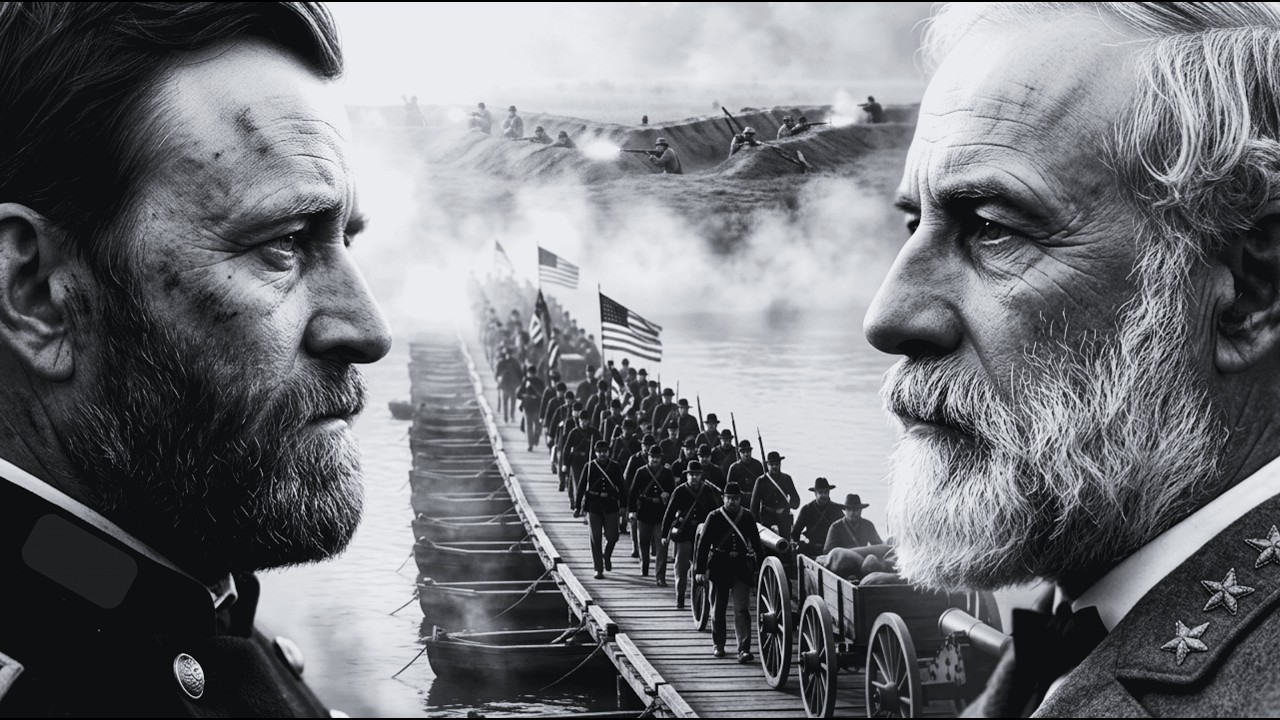
At dawn, Brigadier General James H. Wilson’s cavalry crossed first, skirmishing with Confederate pickets. By midday, the V Corps pontoons arrived, and General Gouverneur Warren began moving his men across at Jericho Mills. A.
P. Hill saw the opportunity. Union units were strung out in column, half on one side of the river, half on the other. Hill’s Georgians launched fierce assaults against the crossing point, costing Warren roughly 377 casualties, but the Union bridgehead held.
Further east, at Chesterfield Bridge, Colonel John W. Henegan’s small South Carolina Brigade held a single redoubt against Winfield Scott Hancock’s massive Second Corps, delaying the Union advance long enough to slow the entire movement. The trap was working. The Union commanders realized they had walked into a divided position and immediately halted their advance, digging in where they stood.
Hill’s attack at one end, Henegan’s stubborn defense at the other, it all looked like Lee’s plan was unfolding exactly as designed. For the first time in the campaign, Lee had Grant where he wanted him. But on May 24, Lee was seriously ill, confined to his tent with fever and weakness, unable to ride the lines or direct his commanders in real time. His subordinates gathered at his tent and received their orders.
Lee urged them to strike now, hard and coordinated. The Union army was divided, and the opportunity would not last. But the execution depended on men who were exhausted and, in A. P.
Hill’s case, weakened by illness themselves. The assault stalled. Communications broke down between the Confederate columns. Hill did not know what Richard Anderson was doing.
Anderson did not know what Richard Ewell needed. What should have been one coordinated hammer blow became a series of uncoordinated local fights. While Lee’s subordinates fumbled, Grant understood the danger he was in. His army was split into three pieces, isolated between Lee’s two wings.
His officers were alarmed. A retreat across the river was the obvious choice. Grant refused. He had roughly 68,000 effective men against Lee’s 53,000.
His infantry could dig entrenchments faster than the Confederates could coordinate an attack. Time and material advantage were on his side. So Grant ordered his men to halt, dig in, and wait. His aide Horace Porter later recorded Grant sitting at his headquarters at Mount Carmel Church, chewing an unlit cigar and sketching notes on a map while his officers worried.
Grant told his generals that if Lee attacked, they would be ready. He ordered strong fortified positions, allowing the Confederates to come to him. Union soldiers worked frantically through the day and night, piling up earthworks. They understood how vulnerable they were, and their digging had a desperate urgency.
But Grant had made a calculation. His intelligence pointed to Confederate disarray, and he understood that Lee’s absence was the flaw in the trap. Without Lee personally commanding, the Confederates would hesitate, delay, and fail to strike with the necessary coordination. The attacks came, but they were not what Lee had planned.
On May 24, Brigadier General John B. Gordon led a fierce assault on the apex of the V at Ox Ford, where Hancock’s Second Corps was entrenched. The Confederates lost roughly 500 men and gained nothing. Hill pushed forward, Ewell and Anderson ordered their corps into action, but the coordination never materialized.
They were trying, but they were also exhausted, hampered by difficult terrain, and facing Union soldiers who were entrenched and ready. Subordinates made independent decisions instead of executing one unified plan. By May 25, the greatest opportunity of Lee’s career was gone. The trap that should have destroyed Grant’s army had produced only skirmishes and failed assaults.
Lee, lying in his tent, could only listen to the sounds of fighting and wait for reports of a success that never came. Meanwhile, Grant was already planning his exit. He did not wait for Lee to perfect an attack. Grant sent an optimistic wire to General Halleck in Washington, reporting that he had Lee’s army where he wanted it and that the enemy were brought to bay.
Then he disengaged his army from the trap and moved southeast toward the Pamunkey River. He left behind a rear guard and cavalry screen to make it appear that the Union army was still at North Anna. By May 26, before Lee fully realized what was happening, Grant’s main body was crossing the Pamunkey, angling further south toward Richmond. Lee had set the perfect trap, Grant had walked into it, and then he had simply walked out the other side.
When Lee understood that Grant had escaped, he was devastated. Accounts from the period record his profound disappointment at the lost opportunity. The chance to crush Grant piecemeal had evaporated. By the numbers, North Anna was inconclusive.
Union casualties were estimated at roughly 2,000 men, Confederate casualties at roughly 2,000 as well, with 304 killed. Compared to the slaughter at Spotsylvania and the bloodbath that would follow at Cold Harbor, the losses were relatively light. No decisive breakthrough was achieved by either side. But the real result was psychological.
For Lee, North Anna proved that Grant was unlike any Union commander he had faced. Grant did not panic when trapped. He did not retreat when cornered. Lee had spent years breaking Union generals, forcing them to doubt themselves and withdraw.
Grant simply refused. His calm under pressure, his refusal to let fear shape his decisions, neutralized Lee’s most brilliant tactical design. A Union officer later recalled watching Grant ride along the entrenchments during the battle, smoking a cigar and nodding at the fortifications like a man reviewing completed work while everyone around him was terrified. The straightforward mechanic of the outcome was material.
The Union brought roughly 68,000 men to the North Anna River to Lee’s 53,000, and Grant used those numbers, his artillery, and his entrenched position to absorb whatever the Confederates could throw at him. His psychology helped, but the advantage in men, time, and terrain was decisive. Against an opponent with overwhelming material power and infinite patience, even Lee’s best trap ran out of answers. After North Anna, Grant continued his relentless push toward Richmond.
He marched to Cold Harbor, where the campaign reached its bloody climax, then pivoted to Petersburg, where he settled into a siege that lasted until the spring of 1865. Lee never set another trap as promising as the one at North Anna. He fought on with the same tactical brilliance, but he knew that no matter how clever his position, Grant would simply refuse to be broken. That knowledge shaped the rest of the war.
On April 9, 1865, Robert E. Lee surrendered to Ulysses S. Grant at Appomattox Courthouse. In the post-war years, Lee reflected with respect on Grant’s persistence and his willingness to accept casualties, traits that had fundamentally separated Grant from every Union commander who had come before him.
The psychological balance of power had shifted at the North Anna River on May 23, 1864, when Lee set his finest trap and Grant refused to be caught.