By the time Jeb Stuart finally reached Gettysburg, it was early evening on July 2, 1863. The Confederate cavalry chief rode at the head of a column of dusty, exhausted men whose horses were gaunt and stumbling after nine days of hard riding, skirmishes, and the burden of a captured wagon train that had become more curse than prize. The flamboyant plume still sat in Stuart’s hat, but the usual swagger had been worn down by exhaustion and something heavier: regret. Robert E.
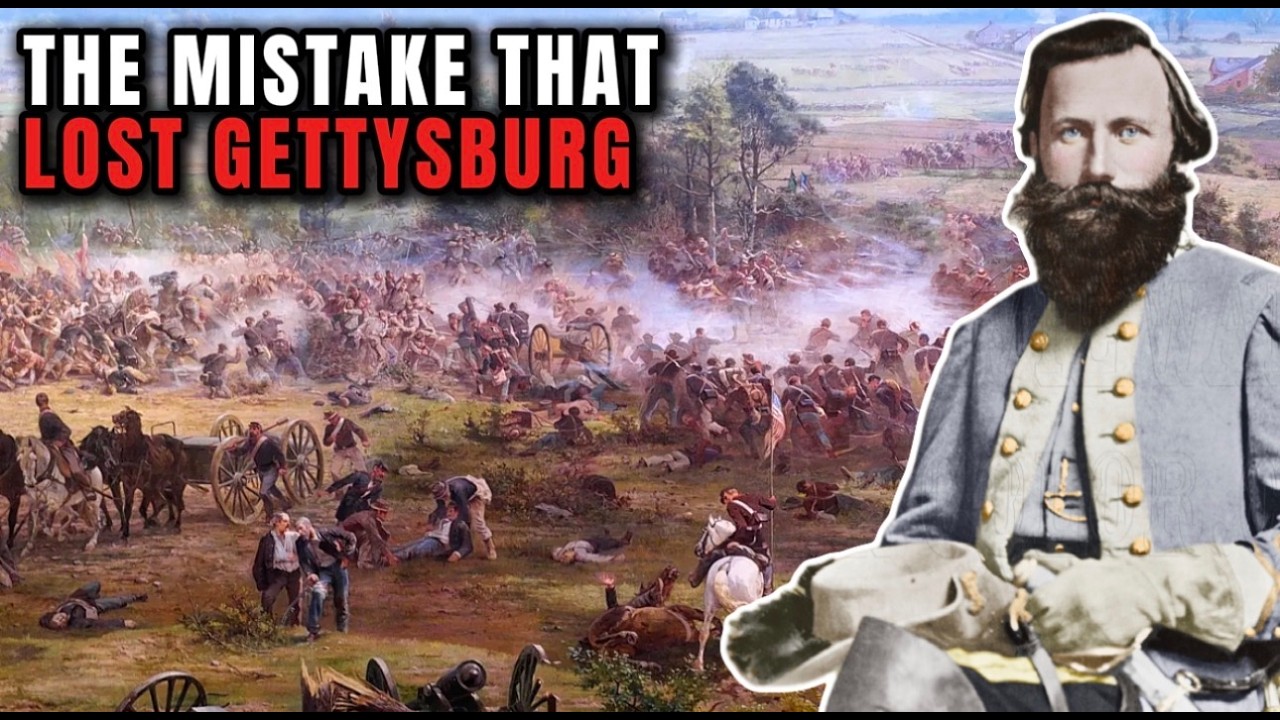
Lee stood waiting near the Lutheran Seminary. When Stuart reined in and saluted, Lee looked at him for a long moment. “General Stuart,” he said quietly, “where have you been? ” Stuart tried to smile.
“I have brought you 125 wagons and their teams, General. ” Lee’s reply was soft but cut like a saber. “Yes, General, but they are an impediment to me now. ”
That single exchange has echoed through every history of the battle ever since.
Because by the time Stuart finally reached his commander, the Army of Northern Virginia had already stumbled into the fight of its life without its eyes and ears. Lee had been marching blind for days. He did not know the full strength or exact position of the Union Army of the Potomac. He did not know that George Meade had replaced Joseph Hooker in command.
And he certainly did not know that the Federals were concentrating faster and in greater force than anyone expected. The result was an accidental collision at Gettysburg that would decide the fate of the Confederacy. But the real story does not begin on those ridges outside town. It begins ten days earlier on the roads of Northern Virginia, when Jeb Stuart made a choice that must have seemed brilliant at the time and only later revealed its terrible cost.
James Ewell Brown Stuart was thirty years old in the summer of 1863 and already a legend. Born in Virginia and educated at West Point, he had turned the Confederate cavalry into a weapon that struck fear into the North. Twice he had ridden clear around the entire Union Army, once in 1862 during the Peninsula Campaign and again before Antietam, each time bringing back prisoners, captured supplies, and priceless intelligence while humiliating the enemy. Newspapers called him the Cavalier of the Confederacy.
Lee called him the eyes and ears of my army. Stuart wore the praise like his yellow sash and ostrich plume, but he also delivered results. By June 1863, however, the shine was starting to tarnish. On June 9, at Brandy Station, Virginia, Union cavalry under Alfred Pleasonton caught Stuart completely by surprise.
For the first time in the war, Federal horsemen fought the Confederates to a standstill in a massive all-day cavalry battle. Southern newspapers were merciless. One Richmond editor wrote of “negligence and bad management. ” Stuart felt the sting deeply.
He had always been the hunter, never the hunted. Now his carefully cultivated reputation was under fire. That same month, Robert E. Lee was preparing the most audacious move of the war: an invasion of Pennsylvania.
After the victory at Chancellorsville, Lee wanted to take the fight north, feed his army off northern farms, threaten Washington, and perhaps force a peace. The Army of Northern Virginia slipped away from Fredericksburg in three columns screened by the Blue Ridge Mountains. Stuart’s job was to keep the Federals from discovering the movement. For two weeks, his troopers did exactly that.
At Aldie, Middleburg, and Upperville, they fought sharp rear guard actions that kept Union probes from piercing the screen. Lee’s army marched north undetected. But as the infantry crossed into Maryland, Lee needed more from his cavalry. On June 22 and 23, he sent Stuart written orders.
The language was careful but not ironclad. Stuart was to leave two brigades behind to guard the mountain passes. With the remaining three, under Wade Hampton, Fitzhugh Lee, and John Chambliss, he could, if he judged it possible, pass around the Union Army, harass it from the rear, collect supplies, and then swing north to take position on the right flank of Richard Ewell’s Second Corps. The key phrase was, “If you can pass around their army without hindrance.
”
Stuart took his best men and rode east. From the very first hours, things began to unravel. On June 25, he tried to slip through Glasscock’s Gap in the Bull Run Mountains. Union infantry blocked the way.
He had to swing south and east, losing a full day. Near Fairfax Courthouse on the 27th, a small detachment of the 11th New York Cavalry charged straight into his resting column in a suicidal saber attack. The Federals were cut to pieces, but the fight cost Stuart another half day while he paroled prisoners and rested exhausted horses. That night, he scribbled a dispatch to Lee reporting the Union Army’s northward movement and his own progress.
The message never arrived. By June 28, Stuart’s column crossed the Potomac at Rowser’s Ford and entered Maryland. The men were jubilant, enjoying fresh country and fresh barns. They destroyed canal barges loaded with supplies.
Then, outside Rockville, just a few miles from Washington itself, they spotted a long Union wagon train rumbling toward them: 125 of the best US Army wagons loaded with oats, bacon, bread, and hay, guarded by only a handful of troops. Stuart’s men pounced. Not one wagon escaped. The haul was spectacular, and Stuart boasted in his report of splendid teams and enough forage to feed his division for days.
But that capture was the moment everything shifted. Hauling those heavy wagons and mules slowed the column to a crawl. More importantly, the sheer size of the train, and the fact that it was headed to supply Meade’s army, drove home a colder truth. The Union was moving north in massive strength.
This was no scattered pursuit. The Army of the Potomac was coming hard. Stuart later wrote that it was then he felt the sudden importance of rejoining Lee to acquaint the commanding general with the nature of the enemy’s movements. For perhaps the first time in his career, his flair for the dramatic ride had collided with the hard requirement of timely intelligence.
The wagons were a prize, but they were also an anchor. Still, Stuart pressed on. He could not simply abandon the captured supplies. Lee had ordered him to gather provisions, and the road north still beckoned.
On June 29, near Westminster, Maryland, another small Union force, seventy troopers of the 1st Delaware Cavalry under Captain Charles Corbet, made a stand and charged Stuart’s vanguard in a desperate saber clash on the town’s outskirts. Corbet’s men were cut down or captured, but the fight chewed up another precious day. Stuart’s column, already slowed by wagons and tired horses, staggered onward. The next day, June 30, they collided with Judson Kilpatrick’s Union Cavalry at Hanover, Pennsylvania.
The fighting was sharp, and Stuart’s men, normally so fluid on horseback, fought poorly. At one point, Stuart and his staff barely escaped capture. The engagement pushed his column farther east, away from the route Ewell’s infantry had taken. By now, Stuart had no clear idea where Lee’s main army actually was.
His last reliable information placed Ewell near York and Carlisle, far to the north. So he kept riding toward Carlisle, still dragging the wagons, still hoping to link up and deliver the intelligence he now knew Lee desperately needed. Back with the Army of Northern Virginia, Lee was growing uneasy. On June 27, he learned Stuart was still south of the Potomac.
“Can you tell me where General Stuart is? ” he asked his aides repeatedly. Without cavalry screens, Lee’s infantry columns were marching blind through unfamiliar country. He had no reliable reports on Meade’s location or intentions.
The Army of the Potomac had crossed the Potomac faster than expected and was closing the gap. Lee’s original plan to concentrate near Harrisburg or Chambersburg and force the enemy to come to him began to unravel. He issued orders for his corps to converge on Gettysburg, a crossroads town chosen only because several roads met there, not because of any tactical advantage. On July 1, the first shots rang out west of Gettysburg when two Confederate brigades stumbled into John Buford’s Union cavalry.
The accidental battle exploded into a full-scale engagement before Lee could concentrate his forces properly. By nightfall, the Confederates held the town, but the high ground, Cemetery Hill and Culp’s Hill, remained in Union hands. Lee had committed to a fight he had not planned, on ground he had not chosen, without the reconnaissance that Stuart’s cavalry normally provided. Stuart finally reached Gettysburg late on July 2.
His men were spent. The horses could barely trot. The wagons he had prized so highly now clogged the roads behind him. When he reported to Lee, the rebuke was gentle but unmistakable.
Lee never raged, but the disappointment was clear. Stuart had arrived too late to influence the first day’s fighting and too exhausted to do much on the second. On July 3, his cavalry attempted a mounted charge east of the battlefield to support Pickett’s infantry assault, only to be stopped cold by George Custer’s Michigan troopers in a swirling melee. Stuart would fight on for another ten months.
At Yellow Tavern in May 1864, a Union bullet found him. Those who were there said he faced death with the same calm he had shown on the fields of Virginia. Perhaps by then he had already made his peace with what happened before Gettysburg. He had ridden for glory and discovered in the end that the war demanded something quieter and more vital: presence.
The absence of one man and three brigades of cavalry did not lose the battle by itself, but it removed the one element Lee had counted on to prevent exactly the kind of blind, desperate fight that unfolded on those Pennsylvania ridges. Stuart realized that truth somewhere between Rockville and Westminster, when the captured wagons slowed his column and the scale of the Union movement finally sank in. He understood then that he needed to get back to Lee.
By the time he acted on that realization, the window had closed, and everything changed.