On the morning of March 6, 1836, a fourteen-year-old boy lay on the stone floor of the Alamo chapel beside his mother and siblings. The air outside was cool and still, and the Mexican bombardment that had hammered the compound for thirteen days had fallen silent. The boy’s father was somewhere in the courtyard, manning one of the cannons. Within ninety minutes, nearly every man in the compound would be dead, and the boy’s childhood would end forever.
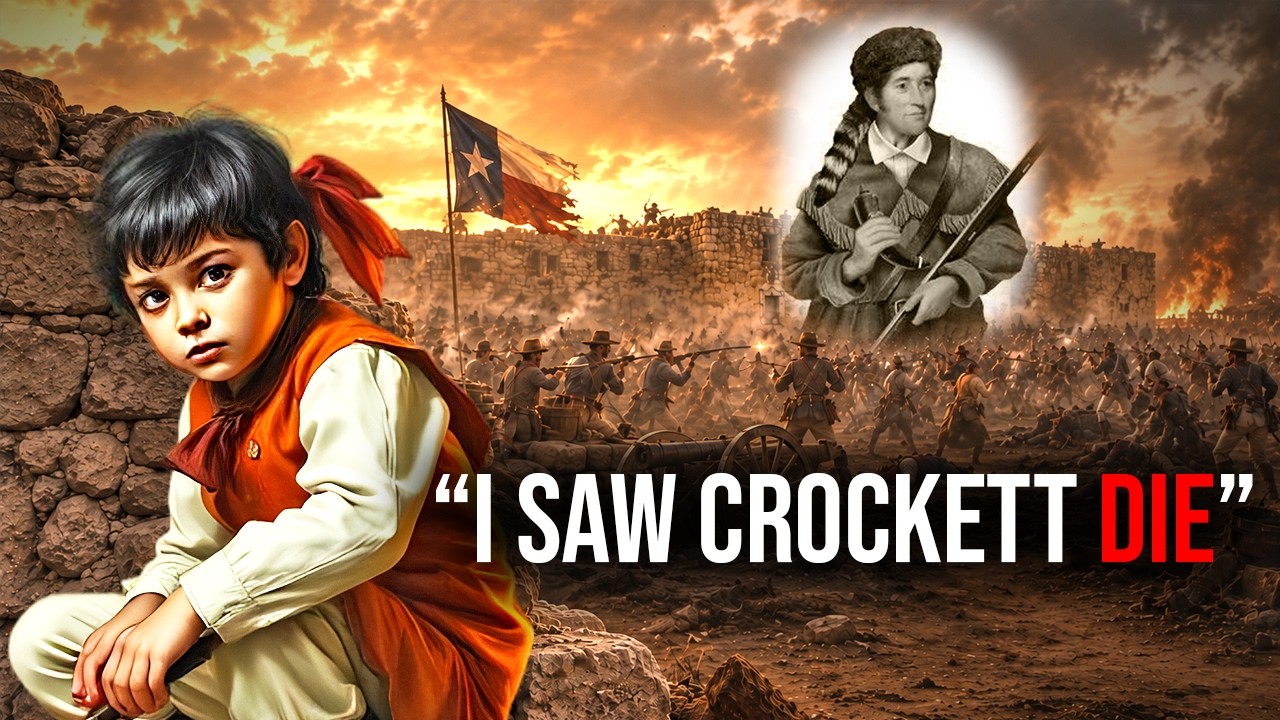
His name was Enrique Esparza, and decades later, as an old man in San Antonio, he would tell a journalist what he had seen that morning. The winter of 1836 had brought three very different men to the same crumbling mission. David Crockett, the fifty-year-old former congressman from Tennessee, had lost his seat after crossing Andrew Jackson on the Indian Removal Act. Broke and humiliated, he had ridden into Texas as a private citizen, telling his constituents he would go to Texas rather than accept defeat.
William Barrett Travis, a twenty-six-year-old lawyer from Alabama who had failed at law, marriage, and money, had come to Texas looking for a second chance and found himself in command of a garrison with too few men and too many walls to defend. Marching toward them was Antonio López de Santa Anna, the self-styled Napoleon of the West, at the head of an army of six thousand men dragged north from central Mexico. The Alamo was not built as a fortress. It was an old Spanish mission with walls eight to twelve feet high enclosing roughly three acres.
There were weak spots: a low stretch along the north side and a wooden palisade of logs and packed earth connecting the chapel to the long barracks. Inside were 185 to 189 defenders, including Tejanos who had called this land home for generations. Among them was Gregorio Esparza, a Mexican citizen by birth who had brought his wife and children inside the walls when Santa Anna’s army appeared. His wife begged him to leave.
He told her he had come to fight for his country and would not abandon his comrades. His own brother, Francisco, served in the Mexican army on the other side of the walls. Santa Anna arrived on February 23 and raised a blood-red flag from the tower of San Fernando Church, signaling no quarter. Travis answered with a cannon shot and wrote his famous letter to the people of Texas, closing with the words victory or death.
Help never came. On March 1, thirty-two volunteers from Gonzales slipped through the Mexican lines, the only reinforcements the garrison would ever receive. The Mexican artillery pounded the compound for thirteen days, but the stone walls held. The bombardment was psychologically devastating, and inside the walls, food ran low and sleep came in fragments.
Santa Anna’s officers urged patience. They argued that the garrison’s supplies were nearly exhausted and that a slow siege would bring the same result with far fewer casualties. Santa Anna listened, then ordered a frontal assault for the hours before dawn on March 6. He wanted a spectacle.
Between 1,400 and 1,800 Mexican soldiers were organized into four assault columns, with reserves and cavalry waiting behind them. One of the columns was led by General Martín Perfecto de Cos, who had been driven out of San Antonio in humiliation months earlier. For him, the assault was personal revenge. The attack came just before six.
A bugle call cut through the pre-dawn air, followed by drums and the sound of men surging forward in the half dark. The defenders fired cannons loaded with grape and canister into the advancing ranks, and the Mexican columns staggered under the first volleys. A column aimed at the weak north wall broke and pulled back, but the officers rallied their men and drove them forward again. The defenders’ rifles could hit a target at two hundred yards, while the Mexican smoothbore muskets were accurate only to about seventy-five.
Between the walls and the Mexican lines lay a killing ground, and every soldier who crossed it knew the only way to survive was to reach the wall and climb. The Mexicans breached the north wall first. A few soldiers pressed themselves against its base, where the cannons above could not depress low enough to reach them, then began to climb. Once they gained the top, they turned the defenders’ own cannons on the compound.
The Texian line collapsed, and men who had been firing outward suddenly took fire from behind. The other columns surged forward, climbing ladders under devastating fire. One Mexican officer later wrote that the assault was most bloody and that his men had to climb over the bodies of their comrades to enter. Inside the chapel, Enrique lay on the floor as bullets struck the walls and a Mexican soldier thrust his bayonet through a hole in the door.
He would later remember the noise as terrific, and he watched his father fall by the cannon in the chapel yard. The battle broke into close-quarters fighting through the long barracks, room by room, door by door. Travis died on the north wall, shot in the head. James Bowie, bedridden with illness, was found in his room by soldiers and killed where he lay.
The smoke inside the compound grew so thick that men fired at muzzle flashes rather than targets. By roughly half past six, organized resistance had ended. The killing continued for another hour as Mexican soldiers swept room by room, bayoneting the wounded. No quarter had been promised, and none was given.
Then came the moment that would define the controversy at the heart of Alamo legend. According to the account of José Enrique de la Peña, a Mexican lieutenant colonel who witnessed the aftermath, a small group of defenders were captured alive and brought before Santa Anna. Among them, de la Peña wrote, was David Crockett, whom he described as a man of great stature with a fine open countenance and hair inclined to red. De la Peña records that an officer protested the execution order, asking what Santa Anna was doing, insisting that the men were prisoners.
Santa Anna answered with a gesture of indignation and ordered them executed on the spot. The prisoners were fallen upon with swords and bayonets. The de la Peña manuscript was composed in the years after the battle, lost, found again, and not published in full until the 1950s. When it appeared, it triggered outrage.
The idea that Crockett had not died swinging his rifle in a blaze of frontier glory but had surrendered and been executed was, for many Americans, unthinkable. Scholars have since examined the manuscript and concluded that the core is authentic, but the argument has never fully ended. The survivors of the battle numbered only women and children, along with a few slaves and noncombatants. Their names would largely be forgotten for a century.
Among them was Susanna Dickinson, whose husband had died in the chapel. Santa Anna spared her life and sent her east with a warning to carry to Sam Houston: no quarter would ever be given. The bodies of the defenders were stacked with wood and brush and burned. The pyres smoldered for days, and the smell of burning flesh hung over San Antonio.
Every defender was burned except one. Francisco Esparza, the brother in the Mexican uniform, received special permission to take his brother Gregorio’s body and bury it properly. In a battle defined by total destruction, it was the only act of individual mercy. The warning Susanna carried did exactly what Santa Anna intended and the opposite.
It terrified the settlers, but it also enraged them. Within weeks, Remember the Alamo became the battle cry of Sam Houston’s army. On April 21, forty-six days after the fall of the Alamo, Houston’s men attacked Santa Anna at San Jacinto. The battle lasted eighteen minutes, the Texians killed more than six hundred Mexican soldiers and captured Santa Anna himself.
The Alamo had been a total military defeat, but it became a martyr story so powerful that it outlasted the truth. The myth of the heroic last stand took hold almost immediately. Crockett, already a folk hero, became something larger than the man. The version of his death that Americans embraced was the one they needed to believe.
The Tejano defenders who had stood with Travis were systematically written out of the story for more than a century. Enrique Esparza lived to old age, working as a farmer and laborer in San Antonio. Interviewed by journalists who wanted to hear about the famous battle, he told them what he remembered: the noise, the smoke, his father by the cannon, the bodies in the courtyard. He never became famous, and his name does not appear on most Alamo monuments next to Crockett, Travis, and Bowie.
He was a witness, and witnesses, unlike heroes, do not sell coonskin caps. Today the Alamo sits surrounded by the modern city that grew over the battlefield. What remains is the chapel and the stories, some true, some not.
The truest may be the one told by the boy who lay on a stone floor while the world exploded around him and walked out into the light of a morning that had taken everything.