On the afternoon of July 3, 1863, Lieutenant General James Longstreet stood on Seminary Ridge and watched his worst fears take shape before him. More than twelve thousand Confederate soldiers stepped out into the open fields between the two armies at Gettysburg, advancing toward the Union line a mile away on Cemetery Ridge. Longstreet had argued against this attack. He had pleaded with his commander, General Robert E.
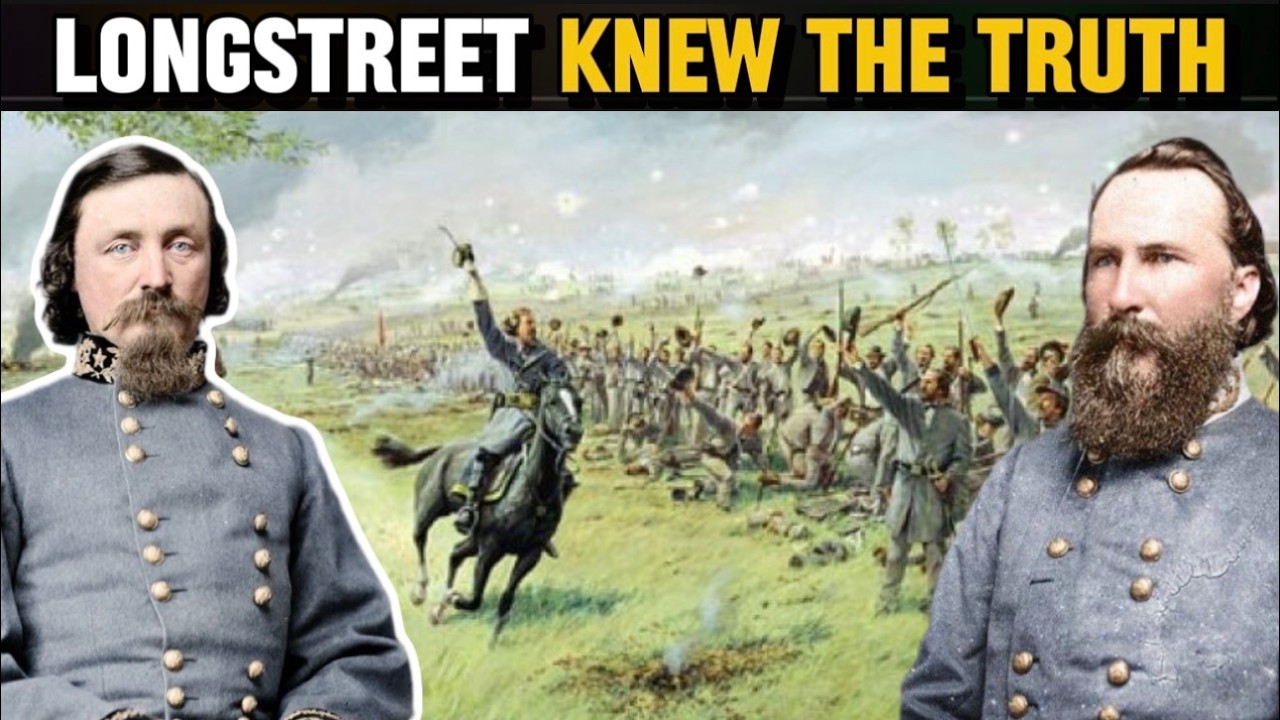
Lee, to abandon it. He had told Lee that no fifteen thousand men ever arranged for battle could take that position. And when the order came anyway, he gave it with a nod he could not put into words, so choked with emotion that he could not speak. Longstreet was not a man given to hesitation.
Born in 1821 in South Carolina and raised on a Georgia plantation, he had graduated from West Point in 1842 and fought with distinction in the Mexican-American War, where he was wounded at Chapultepec and earned brevets for bravery. When the Civil War erupted in 1861, he resigned his United States Army commission and joined the Confederacy, rising quickly through the ranks. By 1862 he had become Lee’s most trusted lieutenant, the old warhorse of the Army of Northern Virginia. He had hammered Union forces at the Seven Days Battles, delivered a crushing counterattack at Second Manassas, held the line at Antietam, and turned Marye’s Heights into a killing ground at Fredericksburg.
Lee relied on him, consulted him, and valued his judgment. But Longstreet had a strategic philosophy that set him apart from his commanding general. He favored what he later described as offensive strategy but defensive tactics. He believed the Confederacy should force the enemy to attack on ground of its own choosing, then wear the attacking army down.
Lee, by contrast, had an aggressive instinct that had served him well in Virginia. That difference in outlook would collide with terrible consequences in Pennsylvania. The campaign began after the Confederate victory at Chancellorsville in May 1863. Lee, despite the loss of Stonewall Jackson, proposed carrying the war into the North.
The goals were simple: shift the fighting out of battered Virginia, draw supplies from Pennsylvania’s rich farmlands, and perhaps threaten Washington or Philadelphia enough to force a political settlement. Longstreet disagreed. He wanted troops sent to reinforce the Western Theater, where Braxton Bragg was struggling in Tennessee and Vicksburg was under siege. Lee overruled him and insisted the main effort remain in the East.
Longstreet agreed to the invasion, but with a condition. He later claimed Lee promised the campaign would be fought using defensive tactics, that the army would force the enemy to attack in a good position rather than launch a full offensive. Lee later denied making any such promise, but the tension between them was already in the air. The Army of Northern Virginia marched north in June, crossing into Pennsylvania with Longstreet’s corps guarding the wagons far behind.
The Confederate army moved blind, with Jeb Stuart’s cavalry off on a raid and no reliable information about Union movements. Longstreet had hired a spy named Harrison who brought word of the enemy’s approach, but the picture remained incomplete. On July 1, Confederate brigades under A. P.
Hill bumped into Union cavalry west of Gettysburg, and what began as a skirmish grew into a full battle. Union General John Reynolds rushed reinforcements forward and was killed in the early fighting. By afternoon, Richard Ewell’s corps arrived and drove the Federals through the town to the high ground south of it, Cemetery Hill and Culp’s Hill. Lee ordered Ewell to take the hills if practicable, but Ewell hesitated, and the Union army settled in.
The new Union commander, George Meade, who had replaced Joe Hooker only days earlier, formed a fishhook-shaped line along Cemetery Ridge, anchored at both ends by hills. Longstreet’s corps arrived late. He was not on the field the first night, but when he reached Lee, he urged a different course. He proposed moving the army around the Union left flank, positioning itself between Meade and Washington and forcing the Federals to attack.
Lee refused. If the enemy is there tomorrow, he said, we must attack him. Longstreet pushed back: if the enemy is there, he argued, it will be because he is anxious that we should attack him, which is a good reason not to do so. Lee would not be moved.
The next day, July 2, Longstreet’s divisions under McLaws and Hood came up after a grueling march. Lee’s plan called for echelon attacks: Longstreet against the Union left, Ewell against the right. Delays plagued the execution. Longstreet had to countermarch to avoid detection and did not attack until late afternoon.
He again suggested swinging around the Round Tops to the south, but Lee pointed at the map and ordered an attack up the Emmitsburg Road. Longstreet confided to Hood that Lee was a little nervous that morning and pressing for an attack while Pickett’s division had not yet arrived. He did not like going into battle with one boot off. The assault that afternoon was ferocious.
Hood’s men charged into the Devil’s Den and the Wheatfield, fighting hand to hand. McLaws struck the Peach Orchard, where Union General Dan Sickles had advanced his corps into a vulnerable salient. The fighting was brutal, with bayonets, clubbed muskets, and hurled rocks. Hood was wounded early with a shattered arm, and Longstreet rode among the troops steadying the lines under fire.
The Confederates pushed the Union back, but they could not take Little Round Top, where Colonel Joshua Chamberlain’s 20th Maine held the flank with a desperate bayonet charge. On the Union right, Ewell’s attacks on Culp’s Hill and Cemetery Hill gained ground but faded at dusk. Longstreet later called it the best three hours of fighting ever done by any troops on any battlefield, but it was not enough. The Union line held, and the casualties were enormous.
That night, Longstreet proposed withdrawing Hood and McLaws and swinging around the Union flank to force Meade to attack. Lee declined, his attention fixed on the center of Cemetery Ridge. The enemy is there, he said, and I am going to strike him. Dawn on July 3 brought worse news.
Union counterattacks had driven Ewell’s men off part of Culp’s Hill. Lee adjusted his plan and concentrated everything on the center. Longstreet would command the assault, using Pickett’s fresh Virginia division along with brigades from Hill’s corps under Pettigrew and Trimble, roughly twelve thousand five hundred men in all. Colonel E.
P. Alexander’s artillery would soften the Union line with a massive bombardment. Longstreet was appalled. The terrain was open ground, swept by Union artillery for nearly a mile with no cover.
The Union position was entrenched and held by massed infantry and guns. He rode with Lee that morning and made his case directly. He told Lee he had been a soldier all his life, had seen fighting in every scale from squads to armies, and knew what soldiers could do. His opinion was that no fifteen thousand men arranged for battle could take that position.
He also warned of the danger to the flanks. Hood and McLaws were holding a mile of line on the right against twenty thousand men, and if they withdrew to support the assault, the enemy would follow and crush the attacking column from the side. He suggested the attack would need at least thirty thousand men to have any chance. Lee waved the objections aside.
He was confident, perhaps overconfident, from his past victories, and he believed in his men. They will go through anywhere, he insisted. Longstreet was deeply depressed. He later told his staff he had never been so depressed as on that day, feeling he was sending his men to slaughter.
In a letter to his uncle weeks afterward, he explained that Lee had chosen the plan, that he considered it his duty to express his views to the commanding general, and that when the decision went against him, it was his duty to adopt Lee’s views and execute his orders as faithfully as if they were his own. He still tried to lessen the damage. Around noon he sent a note to Alexander, saying that if the artillery fire did not have the effect of driving off the enemy or greatly demoralizing them, he would prefer that Alexander not advise Pickett to make the charge. Alexander, young and eager, replied that the barrage would do the work.
Shortly after one o’clock in the afternoon, the cannonade began. Between 150 and 170 Confederate guns thundered for nearly two hours, the largest bombardment of the war so far. Smoke blanketed the field, but the Union batteries replied in force. Alexander’s ammunition ran low, and he urged Pickett forward.
Longstreet rode to the position. When Pickett asked if he should advance, Longstreet could not bring himself to speak. He nodded silently. At three o’clock, the charge began.
Thirteen thousand men in gray stepped out across the fields, flags waving, the rebel yell rising from their throats. Union artillery tore through their ranks with shell and canister, cutting men down in heaps, but the survivors closed ranks and kept advancing. Fences slowed them, then the Emmitsburg Road, where crossfire intensified from both sides. Pettigrew’s left flank crumpled under fire from the Union line.
Pickett’s Virginians angled toward a copse of trees near a stone wall bend known as the angle. Lewis Armistead led the final rush, his hat raised on his sword, and they crossed the wall in a hand-to-hand frenzy. For a moment, they had breached the Union line at what would be called the high-water mark of the Confederacy. But Union reinforcements poured in from Hancock’s corps.
Bayonets clashed, muskets were swung like clubs, and the fighting lasted barely thirty minutes. Armistead fell mortally wounded with his hand on a Union cannon. The survivors staggered back across the field, leaving it carpeted with dead and wounded. Pickett’s division lost two-thirds of its men, and all of its brigade commanders were down.
Total Confederate casualties that day exceeded six thousand. Lee met the retreating survivors and told them it was his fault, that he had lost the fight. Longstreet watched from the ridge, his warnings confirmed but his heart broken by the cost. The army began its retreat on July 4 in rain and mud.
Meade pursued cautiously and missed the chance to destroy Lee’s army. Gettysburg had produced roughly 51,000 casualties, 23,000 Union and 28,000 Confederate, the bloodiest battle of the war. Lee’s invasion of the North was shattered, and on that same day Vicksburg fell, splitting the Confederacy along the Mississippi. In the aftermath, the blame fell heavily on Longstreet.
Lee accepted responsibility in his official report, but in the postwar years the architects of the Lost Cause narrative, including Jubal Early and Fitzhugh Lee, made Longstreet the scapegoat. They accused him of sulking, of delaying the attack on July 2, and of disobeying orders for a sunrise attack that had never existed. His real offenses were political: he became a Republican, supported Reconstruction, and criticized Lee in his memoirs. He defended himself all his life, insisting he had offered his objections to Pickett’s battle and had been overruled.
Modern historians have largely sided with him. His cautions were sound, and the cost of Lee’s confidence was enormous. Longstreet lived until 1904, serving as a diplomat and railroad commissioner, but he was always shadowed by Gettysburg. He is remembered as a brilliant tactician who understood the price of folly and argued against it until the end.
The fields where the charge took place are preserved now as a national park, a quiet monument to the fallen and to the roads not taken.