By 1944, the war had turned decisively against Germany, and the Wehrmacht was bleeding out. Veteran soldiers were dead on the Eastern Front, captured in North Africa, or pinned down in Normandy, and there were no fresh men to replace them. So the Nazi regime reached into the classrooms and the Hitler Youth camps, and put rifles into the hands of boys. Some were seventeen.
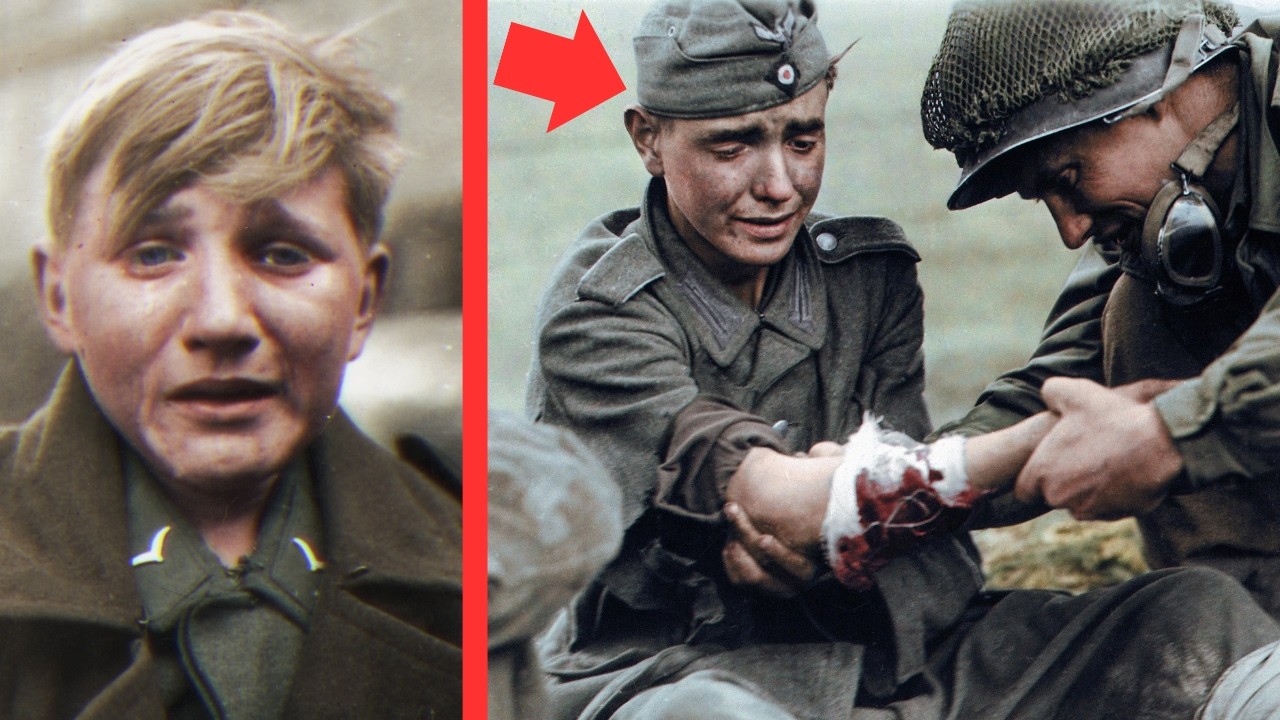
Some were fifteen. Some were younger still. They were sent to fight a losing war as though they were grown soldiers, and on the battlefields of 1944 and 1945, thousands of them died. The Hitler Youth had been preparing German boys for this for years.
Established long before the war, it had evolved from a youth organization into a military preparatory machine, subjecting boys to ideological indoctrination, physical training, and weapons instruction. In 1943, the Waffen-SS formed the 12th SS Panzer Division Hitlerjugend, drawing directly from these ranks. Many of its soldiers had been born in 1926 and were only seventeen or eighteen when they went into combat. Their youth did not shield them from the merciless realities of the battlefield.
By 1945, as the Allies pushed into Germany itself, the situation became even more desperate. The regime created the Volkssturm, a mass people’s militia intended to defend the homeland. Boys in their mid-teens were thrown into combat alongside elderly men, some of them decades older. Propaganda celebrated these young warriors, holding them up as heroes who fought Soviet tanks with handheld anti-tank weapons.
But the war no longer had any real prospect of victory, and the boys being sent to the front were effectively being sacrificed. Being young did not make them safe. A fifteen-year-old carrying a rifle, a machine gun, or a Panzerfaust was just as capable of killing an Allied soldier as an adult was. In close-quarters fighting, in urban streets, in forests, and during chaotic retreats, soldiers had only seconds to decide whether the person in front of them was a threat.
In those conditions, German teenage soldiers were killed in combat just like any other enemy soldier. That was not in itself unlawful. They were combatants, and they were legitimate targets. But the darker reality was that some of these boys were killed even after they had surrendered.
Documented cases of Allied troops shooting German prisoners occurred across the final campaigns, and there were certainly many more that were never recorded. The reasons were varied. Fury after the deaths of comrades and friends. Fear that a prisoner might still be armed.
The breakdown of discipline in fast-moving battles. A desire for revenge. And sometimes, a special hatred for particular German formations. The Waffen-SS was especially feared and loathed, because SS units were closely associated with Nazi ideology and with atrocities.
An SS soldier, no matter how young, was in a highly dangerous position if captured in the immediate aftermath of brutal fighting. The 12th SS Panzer Division Hitlerjugend was one of the formations that gained a particularly grim reputation. During the Normandy campaign in June 1944, members of the division murdered Canadian prisoners of war, including a group killed near the Ardenne Abbey. When Allied soldiers learned of these killings, the bitterness between the two sides intensified.
There is evidence that unlawful killings of German prisoners by Allied troops also occurred during the Normandy campaign, some of them direct responses to the actions of the Hitlerjugend. In that atmosphere, young German soldiers from SS units could easily become targets of reprisal, even though killing prisoners was technically illegal. For enraged enemy troops, the SS insignia mattered more than the age of the boy wearing it. One weapon in particular made teenage fighters especially dangerous and especially vulnerable.
The Panzerfaust was a cheap, single-shot anti-tank weapon that German propaganda celebrated as a wonder weapon. A boy armed with one could destroy a tank from relatively close range, and by 1945, as the Allies advanced into German cities, they knew it. A seemingly harmless teenager might have a hidden pistol, a grenade, or a Panzerfaust ready to fire. When Allied soldiers entered towns and encountered boys who kept fighting, they often opened fire immediately.
In the chaos of urban combat, there was no realistic way to determine a young fighter’s age before deciding whether to pull the trigger. It was kill or be killed. The Eastern Front was even more brutal. By 1945, the Red Army was entering Germany after nearly four years of a war of extraordinary destruction on Soviet soil.
German forces had carried out mass executions, starvation policies, reprisals against partisans, and the destruction of settlements, resulting in the deaths of millions of Soviet civilians and prisoners of war. The hatred and desire for revenge among Soviet soldiers were immense. German soldiers, including the youngest ones, could face extremely harsh treatment. Some were killed in combat.
Others died after capture. Enormous numbers of German prisoners were eventually held in Soviet captivity for many years afterward. But a prisoner’s youth was not the reason they were targeted. Many of these boys were perceived as fanatical Nazis.
The regime had deliberately shaped them into ideological fighters, and propaganda had made heroes out of boys who resisted to the end. During the final battles of 1945, including the Battle of Berlin, Hitler Youth members were held up as models for others to emulate, fighting tanks with Panzerfausts even as organized resistance collapsed. Some continued fighting even after regular military formations in their areas had given up. Allied soldiers, therefore, could not assume a person was harmless simply because he looked fifteen or sixteen.
By law, however, a German teenager who genuinely surrendered should have been protected. The rules of war prohibited the deliberate killing of a prisoner who had surrendered. Millions of German soldiers, including many very young ones, surrendered to the Western Allies and survived captivity. They were searched, disarmed, and marched to prisoner of war camps.
For them, surrender meant survival. The most disturbing aspect of the final years of the war was not simply that boys were killed in combat or sometimes executed after capture. It was that the Nazi state was pouring ever younger Germans into a war it could no longer realistically win. Boys who should have been in classrooms were handed rifles and Panzerfausts instead of pens, and ordered to face experienced American, British, Canadian, and Soviet soldiers supported by tanks, aircraft, and artillery.
They were being sent to throw their futures into a fire. Many surrendered and lived. Many others died fighting. And some, after surrendering, were unlawfully shot on the spot.
In the end, German teenage soldiers were not killed simply because they were teenagers. They were killed because they were combatants, and in the ferocious conditions of 1944 and 1945, any armed enemy was a target. Some of them were also victims of unlawful reprisals and prisoner killings.
Their tragedy was that the regime that sent them into battle had abandoned any concern for their survival long before the final shots were fired.