In January 1929, the man who had become the most famous lawman of the American West lay dying in a Los Angeles apartment. Wyatt Earp was eighty years old. For decades, he had worked quietly to make sure that when this moment came, the world would remember the legend he had carefully constructed, not the complicated truth. That legend began in Monmouth, Illinois, where Earp was born in 1848 to Nicholas and Virginia Earp, a family perpetually chasing better land and quick wealth across the Midwest.
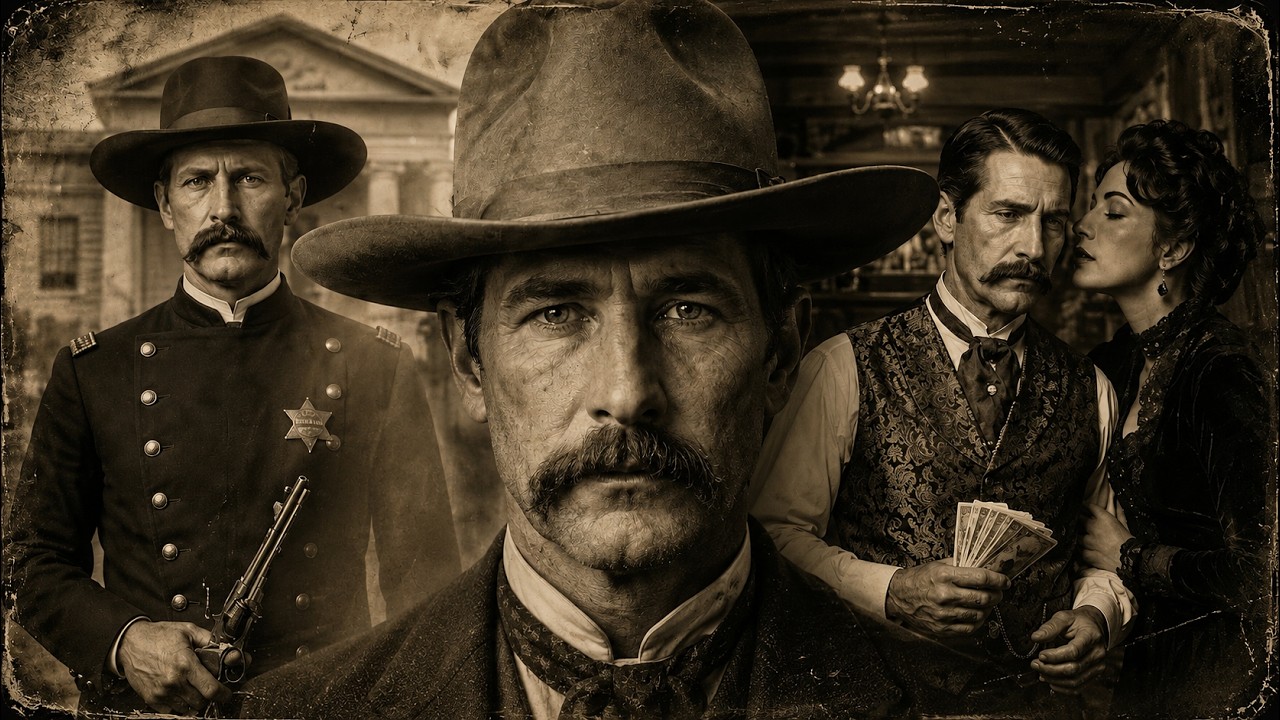
The constant movement meant Wyatt never knew a stable childhood, and the early death of his sister Martha on the family farm in Iowa showed him how fragile frontier life could be. His father, a bootmaker, farmer, and sometime law officer, taught his sons one unbreakable rule: family came before everything, and brothers defended one another against all outsiders. When the Civil War broke out, Wyatt was only thirteen. His brothers enlisted and fought, while he stayed behind to work the family’s cornfields.
In 1864, the family joined a wagon train of forty families heading to California. The two-thousand-mile journey across deserts and mountains transformed the teenager into a tough, resourceful young man, but Wyatt wanted no part of farming. At seventeen, he drove freight wagons across the brutal desert routes between San Bernardino, Los Angeles, and Prescott, learning to handle mule teams, rough teamsters, and long nights around campfires where he first studied the mechanics of gambling. By 1868, railroad construction had pulled him into the wild work camps of Wyoming and Utah, where he loaded freight, refereed boxing matches, and learned to move through violent crowds without losing his composure.
Nothing in those years suggested he would ever wear a badge. He was simply a hard frontier laborer looking for his place. In late 1869, Wyatt returned to his family in Lamar, Missouri, where his father had become town constable. Wyatt studied law under him, won election as constable himself at just twenty-one, and fell in love with Urilla Sutherland, the daughter of a local hotel owner.
They married in January 1870, and for a brief moment, Wyatt appeared to have found the settled, respectable life he claimed to want. He bought land, built a home, and handled his duties well. Then, late that year, Urilla contracted typhoid fever and died within days. Some historians believe she may have been carrying their child, though records do not confirm it.
Her death destroyed everything. The grief drove the young constable to abandon his duties, sell his home at a loss, and fall into conflict with the town and his late wife’s family. In early 1871, a civil lawsuit was filed against him over school funds he had handled as constable, and rather than resolve the matter, Earp left town and headed into Indian Territory. There, his life took its darkest turn.
On March 28, 1871, a federal grand jury in Van Buren, Arkansas, indicted Wyatt Earp for horse theft, along with two other men. He was arrested, jailed, and released on bail, but as his trial approached in May, Earp made a desperate choice. He failed to appear in court, forfeited his bond, and vanished into the West. Warrants were issued, the case was never tried, and Earp became, for the first time, a fugitive from federal justice.
He resurfaced in Peoria, Illinois, a bustling river town where a man could disappear into the vice districts. For over a year, Earp worked in the brothels along the riverfront as a bouncer, gambler, and enforcer. Local newspapers recorded his arrests in three separate brothel raids during 1872, once specifically listing him as a resident of a floating brothel on a riverboat. He learned how brothel owners paid off police and how law enforcement and organized crime worked together for profit.
That cynical education stayed with him for the rest of his life. Years later, Earp would erase this period entirely, claiming he had spent those years hunting buffalo on the Kansas plains. Modern historians found no evidence of that. The newspaper records placed him in Peoria, and the story of the buffalo hunter was an invention.
By late 1873, Earp needed to escape those records. He moved to Wichita, Kansas, where his brother James ran a saloon and brothel, and in April 1875 he was appointed a city policeman. He proved effective, using his tall, commanding presence and a long-barreled Colt to club unruly cowboys over the head rather than shoot them. But he never abandoned the gambling and the close ties to brothel owners that had sustained him in Peoria.
In April 1876, he beat a political rival in the street over insults to the Earp family, and the city council voted not to rehire him. He moved on to Dodge City, the wildest cattle town in the West, where he was hired as assistant marshal under a bonus system that paid for every arrest and confiscated gun. There he met and formed an unbreakable bond with Doc Holliday, a brilliant, dying former dentist from Georgia with a lethal temper and no fear of death. In 1877, Holliday saved Earp’s life when a group of drunken cowboys surrounded him in a saloon, drawing his pistol against the leader’s head and forcing the men to back down.
From then on, the quiet lawman and the volatile gambler were inseparable. In December 1879, Earp, his brothers Virgil and James, and their wives arrived in Tombstone, Arizona Territory, a silver boomtown growing at a staggering pace. Wyatt had not come to enforce the law; he had come to get rich. When the richest mining claims proved already owned, he bought into the Oriental Saloon and took charge of its gambling tables.
Virgil became deputy U. S. marshal, and the family built a powerful presence in Cochise County, quickly colliding with a faction of ranchers, rustlers, and gunmen known as the Cowboys. The feud was about money and political control, not simple good and evil.
It turned personal through Sheriff Johnny Behan, who allied with the Cowboys, and through a beautiful actress named Josephine Marcus, who left Behan for Wyatt. By October 1881, the tension had reached its breaking point. Ike Clanton, a Cowboy leader with a secret, dangerous deal with Wyatt regarding a stagecoach robbery reward, had grown paranoid and was publicly threatening to kill the Earps. On the afternoon of October 26, 1881, Virgil, Wyatt, Morgan, and Doc Holliday walked down Fremont Street to disarm five Cowboys who had gathered in a vacant lot near the O.
K. Corral. The confrontation lasted roughly thirty seconds. When the thick clouds of black powder smoke cleared, three Cowboys lay dead.
Billy Clanton had died against a building, Frank McLaury with a bullet in his brain, and Tom McLaury from a blast of buckshot. Virgil was shot through the calf, Morgan through both shoulder blades, and Holliday grazed across the hip. Wyatt stood untouched. The town split along political lines.
Ike Clanton filed murder charges, but after a lengthy hearing, Judge Spicer ruled the Earps had acted within their legal duty, and all charges were dismissed. The court victory did not bring peace. On December 28, 1881, Virgil was ambushed from an unfinished building, his left arm shattered by buckshot and permanently crippled. On March 18, 1882, Morgan was shot through a glass door while playing billiards and died within minutes, only thirty-one years old.
Wyatt knew who had done it, and he knew the courts would never act. Wyatt made a terrifying decision. He had a badge, as a deputy U. S.
marshal, but he no longer intended to use it for arrests. He raised a private posse of deadly, loyal men, including Doc Holliday, and rode out on what became known as the Vendetta Ride. On March 20, he shot and killed Frank Stilwell in a Tucson railyard, abandoning the pretense of law entirely. Two days later, the posse killed Florentino Cruz, a lookout in Morgan’s murder.
At Iron Springs, when his men were caught in an ambush, Wyatt dismounted under heavy fire, walked toward Curly Bill Brocius, and killed the Cowboy leader with a double-barreled shotgun blast to the chest. Over three weeks, at least four prominent Cowboys were dead, and the organization’s power across Arizona was shattered. But Earp was now a wanted fugitive, charged with murder, hunted by the very legal system he had once served. Business partners erased his name from their ledgers.
Former friends refused to help. He had won his revenge but lost his home, his fortune, and his political ambitions in Arizona. Earp fled to Colorado, where the governor refused Arizona’s extradition request, effectively exiling him from the territory forever. Doc Holliday, his health destroyed by tuberculosis, moved on alone and died in November 1887.
Wyatt abandoned his common-law wife, Mattie Blailock, who later died of an overdose, and committed fully to Josephine Marcus. For the rest of his life, Earp drifted through boomtowns, following silver strikes in Idaho, a real estate boom in San Diego, and then a boxing scandal in San Francisco, where his disputed referee decision in an 1896 heavyweight fight brought his past arrests and trials back into the newspapers. In 1897, he and Josephine joined the Klondike gold rush, and in Nome, Alaska, Wyatt finally made his fortune running the Dexter Saloon, the largest and most luxurious establishment in town. He left Alaska in 1901 with over eighty thousand dollars in gold and cash.
He settled in Los Angeles, where the frontier was disappearing beneath pavement and electric lights, and where Hollywood was turning the Wild West into myth. Earp visited film sets, befriended silent-film stars, and gave advice to a young extra named Marion Morrison, who later became John Wayne. He came to understand that if he did not tell his own story, others would tell it brutally. In his late seventies, Earp collaborated with author Stuart Lake on an official biography, sitting on his porch and carefully choosing which chapters of his life to reveal.
He omitted the horse theft indictment, the years in Peoria, the deal with Ike Clanton, and the vengeance killings. He presented himself as a patient officer who had only drawn his gun when forced. Josephine guarded his reputation aggressively, interrupting interviews whenever questions turned toward Mattie or his gambling debts. Earp died peacefully on January 13, 1929.
Two years later, Stuart Lake published Wyatt Earp, Frontier Marshal. The book became a massive sensation, and where Wyatt’s story had gaps, Lake filled them with inventions, including the famous Buntline Special revolver that Earp never actually carried. Hollywood bought the film rights, and for six decades, clean, heroic actors in white hats played a simple lawman taming lawless towns. The darker chapters never appeared on screen.
Modern historians eventually dug through forgotten courthouse records, police blotters, and nineteenth-century newspapers, uncovering the federal indictment, the Peoria brothel arrests, the ambushes, and the executions. They found neither a spotless saint nor a ruthless outlaw. They found a hard, pragmatic survivor who wore many masks across eighty years, operating in the gray space between law and crime, defined by fierce family loyalty, financial ambition, and a violent frontier that rewarded men who made their own rules.