On the morning of April 2, 1855, a small group of men drove a herd of horses along a dusty road north of Brownsville, Texas. The sun had just risen over the mesquite trees. The animals churned up a thick brown haze around the riders as they pushed westward toward California. One of those men was forty-seven years old.
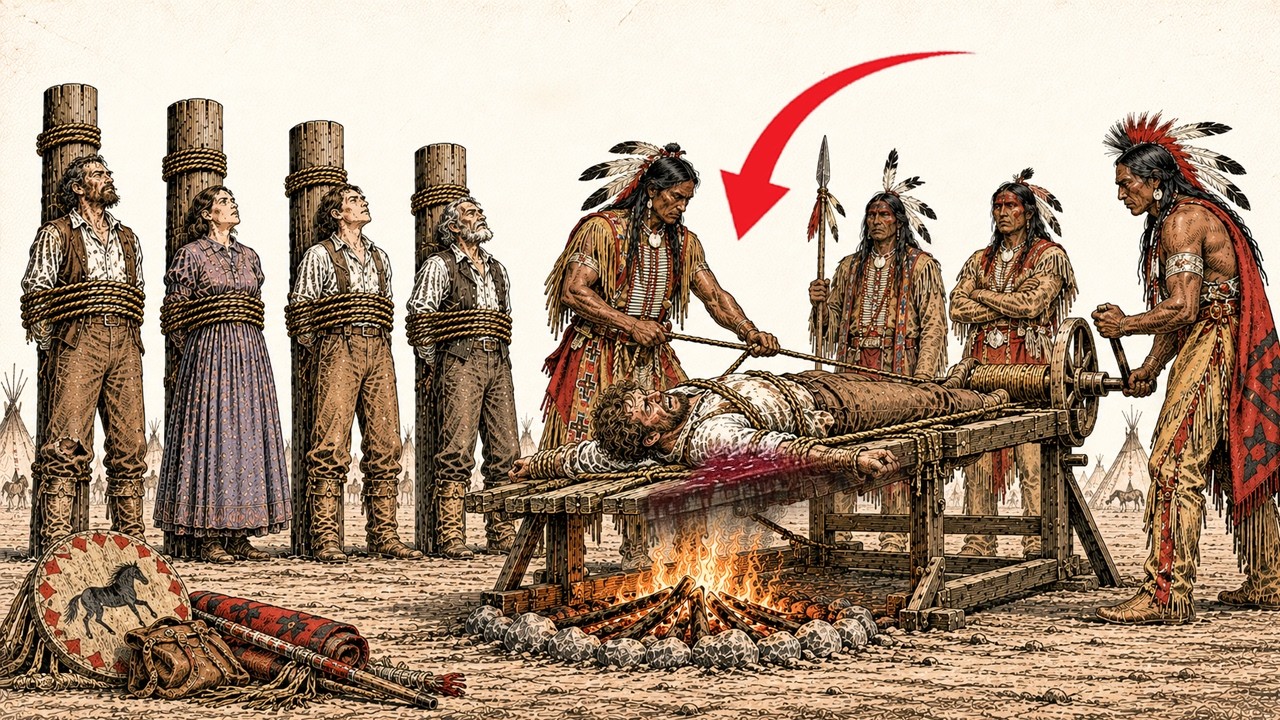
His name was Nelson Lee. Within roughly two minutes, every man riding with him would be dead, except three. Lee himself would spend the next three years sold like livestock among the Comanche warriors of the southern plains. The men who attacked the horse train that morning were not faceless raiders.
They were Comanche horsemen from the last full generation of Comanche power, a world that was collapsing under the pressure of Anglo-American settlers, Mexican ranchers, disease, and the disappearance of the buffalo. For them, attacking a small group of white men driving horses across their land was not a crime. It was defense. It was economics.
It was survival. Some of the warriors were likely teenagers. Some had families waiting in camps a hundred miles north. History would not record their names, but they were there, watching the road.
The attack came from the brush. The horses panicked and scattered. The men who fell in the first moments never got up. Those who tried to fight were killed for trying.
Those who tried to flee were chased down and killed for running. It was fast, brutal, and completely one-sided. By the end of the first few minutes, most of the group lay dead in the dirt. Only four remained alive.
Nelson Lee was one of them. The reason he survived was not courage. It was not luck. It was something in his pocket worth less than a dollar.
In the chaos after the fight, Lee reached into his clothes and pulled out a pocket watch. He held it out in front of him. He wound it, opened it, made it tick, made it chime. The men who had just killed his companions stopped.
The watch fascinated them. It made him worth keeping. Not quite a prisoner, not a slave in the way the word had been used before, but property, valuable in a strange way because he owned something that made an odd sound. A life bought and sold because of a piece of brass and glass with a spring inside that a watchmaker could have replaced in an afternoon.
Lee was taken north with the raiders. The survivors who had been spared were pushed across the country at the pace of mounted warriors for days on end. Lee was not fed like the men who captured him. He did not sleep like them.
He was watched constantly because the watch, the thing that saved him, was now the thing that bound him to whichever man currently owned him. At the end of that journey, he was given, traded, or sold, the accounts vary, to a warrior whose name was translated as Big Wolf. His first of three lives inside the Comanche world was about to begin. Lee’s role in the camp was low and exhausting.
The watch was a ceremonial object, brought out for display, wound in front of visitors, its ticking shown to men who came from other camps specifically to hear it. Lee was reduced to being the keeper of the watch. His identity faded in the eyes of the men around him until he became just the sound that object made. He understood that if the watch stopped working, he stopped working with it.
Every day he wound it with hands that grew weaker in a camp where he was already the least important thing there. During his captivity, Lee passed from Big Wolf to a warrior called Spotted Leopard, and later to a third owner known as Rolling Thunder. The transitions happened through trade, gift, or the shifting politics of the Comanche world. The text that survives is not precise, and it is the only witness.
What matters is the pattern. Lee was no longer a man. He was something attached to something else, and both could change owners. By the time he was sold for the last time, Lee had spent nearly three years in Comanche country.
He was fifty years old. His body was failing. The frontier toughness that had carried him to that country was dissolving under malnutrition, exposure, and a life that offered no rest. The camp moved with the seasons, and Lee moved with it.
He learned fragments of the language, enough to understand sometimes what was being said about him, never enough to argue. He watched other captives arrive and disappear, killed, ransomed, adopted, or gone in ways he never learned. There was a particular kind of endurance captivity demanded. A battle lasts minutes.
Captivity lasts years. It was not about the ability to fight. It was about the ability not to lose your identity when everything around you told you daily that your identity no longer existed. Lee lay awake in the camp of Rolling Thunder and made his decision.
He chose the desert over the hut. He chose the almost certain death he could walk toward on his own over the certain death waiting for him if he stayed. This was not a battle scene. This was a man in the dark deciding to stand up.
He went at night. He went alone. He took almost nothing. A man in his condition, in that country, in that season, struck out toward the horizon.
The attempt should not have succeeded, and somehow it did. He walked days without water. The body pushed to its edge kept moving with nothing but a refusal to stop. He finally reached the settled edges of the American Southwest.
The account brings him to El Paso in a state of severe suffering and extreme hunger. He emerged from the desert into the outskirts of the settled world. What remained of the boots he had left camp in was gone by the time he reached the settlements. His feet were cracked and bleeding, wrapped in whatever cloth he could tear from his clothes.
He ate carefully, because a starving man cannot eat freely without killing himself. He rested. He began telling his story in fragments to those around him. Word spread.
A man had come out of Comancheria. A man had survived three years. Lee sailed from the Gulf and reached New York City on November 10, 1858. New York in that autumn was a city already leaning toward a war it would not survive intact.
Lincoln was two years from the presidency. Fort Sumter was two and a half years away. The city was full of publishers who understood better than anyone what sold. A man walked into that city saying he had been held by the Comanche for three years.
Within days, he was sitting across from editors at Baker & Taylor, and they were asking him to tell them everything from the beginning. He sat in a room in New York at fifty-one years old, only weeks removed from the Comanche world. At least one editor, maybe two, sat before him with pen and paper, and Lee began to talk. He spoke day after day, across multiple sessions, long enough to form a book.
At every session, someone else wrote down what he said. At every session, someone else decided what to keep and what to cut. The man being interviewed was a trauma survivor whose memory had carried three years of captivity and whose body had only recently recovered enough for fluent speech. And that watch, the watch that saved his life on the road, the watch that made him worth keeping, the watch that became a character in his captivity, was now the center of the book being written around him.
In the narrative that emerged, the watch was not just an object. It was the reason for everything. It was what turned a killing into a captivity. The book, Three Years Among the Comanches, was published in 1859, a year after Lee arrived in New York.
It sold. It sold well. It fed a market of American readers who desperately wanted to know what the Comanche world looked like from the inside and who were not interested in the accuracy of what they read. The book gave them Big Wolf.
It gave them Spotted Leopard. It gave them Rolling Thunder. It gave them torture, captivity, and a miraculous escape. It gave them everything they had come to expect from the genre.
And in the opening pages, in a note most readers ignored, the editors had revealed the truth about what they had made. The man whose name was on the cover of one of the most famous Comanche captivity narratives in American history could not write fluently. Every word in that book passed through someone else’s hand before it reached the page. The editorial acknowledgment in the front of the 1859 edition read that the narrative was recorded as taken from the lips of Nelson Lee, day by day, not accurately in his own words, as he is not an educated but an intelligent man, though his narrative is given substantially as he related it.
Not accurately in his own words. Substantially as he related it. This was not a memoir. It was a book about a man, written by other men, based on what the man was able to say aloud in a room across multiple sessions, then shaped by editors to fit what the market wanted.
The publishers of 1859 were not hiding this. They placed it in the first pages. But almost no one read the first pages. They read the torture.
They read the escape. For more than a century and a half, scholars have argued over how much of Nelson Lee’s account represents his real experience during his three years among the Comanche and how much is editorial drama. Some readings treat the book as substantially honest but refined. Others treat it as closer to a fabrication dressed in the clothes of a memoir.
The honest answer is that the records cannot settle the matter. The only man who could has been dead for more than 140 years. There is not one Nelson Lee story. There are two.
There is what happened on the plains, which we can only see in part. And there is what happened in that office in New York, which is why we can only see the plains in part. The uncomfortable truth about Nelson Lee’s captivity is that the record we have of it was never fully his to tell. His tongue spoke it.
Other men wrote it down. The public bought it. What we call his history is what survived that process.