In July 2022, a grave marker was placed in the ground beside the first fairway of a golf course in New Jersey. The land belonged to her former husband. The public narrative is familiar: the Olympic skier who married Donald Trump and got everything. The documented story is stranger.
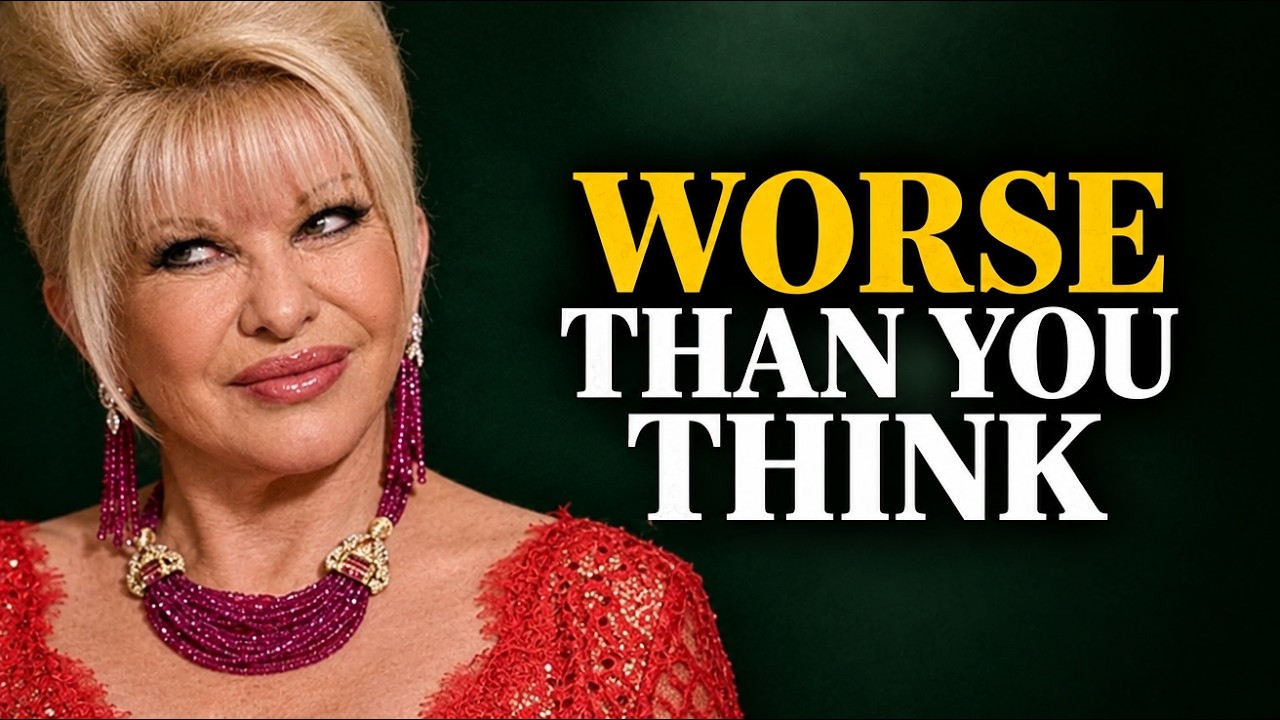
She reached the West on an Austrian passport obtained through a marriage that barely lasted two years to a man she reportedly never lived with as a couple. She managed two Trump properties for one dollar a year plus a clothing allowance. Her divorce agreement restricted what she could say about him. So she wrote novels instead.
Ivana Trump died on July 14, 2022, at her home on East 64th Street in Manhattan, the house she had lived in for decades and decorated herself. Her funeral was held at St. Vincent Ferrer Church, a few doors from her home. Then her body was taken to Bedminster, New Jersey, to a private golf club owned by the man she had divorced in 1991 on grounds of cruel and inhuman treatment.
The plot is small: one stone, flat grass, a view of manicured grounds. Her three children chose it, and Trump later described it as a place she loved. But within days of the burial, property tax specialists and journalists noted New Jersey laws that exempt cemetery lands from property tax, income tax, and inheritance tax. That is commentary, not proof.
No one produced a document showing the burial was a tax maneuver, and the club’s cemetery plans had been submitted to the state years before her death. What can be said is this: a woman who spent twenty years learning that nothing in that family was purely emotional ended up buried in an asset. That was the shape of her entire life with him. By the early 1990s, Ivana Trump was one of the most photographed women in America and legally restricted in what she could say about her marriage.
The 1987 marriage agreement, upheld by the court in 1991, contained secret clauses. Press reports at the time described a provision barring her from discussing the marriage or Trump’s business affairs without his consent. She was the most famous wife in the country, yet she could not tell her own story. The question beneath everything is simple.
Who owned Ivana’s biography? She supplied the charm, the accent, the discipline, the fourteen-hour days in Atlantic City. He supplied the name, the apartments, the titles, the press contacts, and ultimately the papers that decided which version of their lives could be told publicly. To understand why she kept signing, you have to go back before the marble and gold fixtures, to a smaller place where she first learned that a name on a document could be a way to travel.
Zlín in Moravia. In her childhood it was called Gottwaldov, after the country’s first Communist president. Her father, Miloš Zelníček, was an electrical engineer. Her mother, Marie, worked as a telephone operator.
This was not the aristocratic Central Europe that New York society columns later imagined. It was an industrial city behind the Iron Curtain, and the family’s asset was not money. It was skiing. Competitive skiing was one of the few legal mechanisms that could carry a young person across closed borders.
Athletes traveled. For decades, profile after profile described her as a member of the Czechoslovak Olympic ski team, sometimes as an alternate for the 1972 Sapporo Games. The claim appears in promotional material tied to Trump businesses and in press coverage his office encouraged. It was never confirmed by Czechoslovak team records.
Czech journalists who searched federation and Olympic committee archives could not find her name on any Olympic roster. Harry Hurt III, who wrote the most document-based book about their marriage, considered it an exaggeration. Several biographers reached the same conclusion: she was a genuinely good competitive skier at club and regional level, but she was not an Olympian. The embellishment came most strongly in American texts written by people promoting the Trump story.
The myth was not entirely her own. It was manufactured in collaboration with a media operation that needed his wife to be more than a pretty Czech girl who skied. But she was also someone who had learned, before she ever met him, how useful a borrowed identity could be. In 1971, at twenty-two, she married Alfred Winklmayr, an Austrian ski instructor, in Vienna.
Many biographers, and Winklmayr’s own later account to journalists, describe it as a marriage of convenience arranged so she could obtain Austrian citizenship and passport. That paper was the entire point. With it, she could leave Czechoslovakia and return without being branded a fugitive, which mattered enormously because her parents were still in Zlín. Winklmayr later said they never lived together as a couple.
The marriage was dissolved in the mid-1970s. During those same years, she was in a relationship with Jiří Syrovátka, a Czech skiing figure moving in the same circles. That was the relationship that was real in the ordinary sense. Winklmayr was the relationship that was real in the legal sense.
Before New York, there was a young woman holding two surnames and two sets of documents: one for feeling and one for function. In 2016, Czech media reported materials in the archives of the Prague security services, the ABS, which holds records of the StB, the Communist secret police. The documents indicate the StB took an interest in her after she married an American, and that agents contacted her father in Zlín, a routine practice for a regime monitoring relatives abroad. Luke Harding discussed this material in his 2017 book.
The existence of the file is documented. The interpretation of it is disputed. There is no evidence she informed on anyone, and no evidence she knew what the StB had gathered. What the file shows is that even after she left, her private life retained official value to someone.
She arrived in Montreal around 1972, where she worked as a model and did promotional work tied to the 1976 Montreal Olympics. She spoke four languages. She was fiercely organized. In 1976, a trip to New York with a group of models for Olympic publicity brought her to Maxim’s on East 61st Street.
A busy night, a long wait for a table. The story, told by both of them in nearly matching versions, is that a young developer at another table noticed the group, arranged their table, paid the bill, then had his car follow theirs to the hotel. She was not impressed enough to make it dramatic, but interested enough to take his calls. He flew to Montreal.
She later said his persistence was part of the appeal. He acted like a man who had already made his decision. Look at what each of them held in 1976, because that is the deal beneath the romance. He was in his thirties, working through his father’s company in Brooklyn and Queens, trying to break into Manhattan.
The Commodore Hotel deal that became the Grand Hyatt had not yet closed. He had ambition and his father’s credit lines, but no social standing in the city he wanted. What he lacked was exactly what she carried: European polish, a foreign accent that New York read as old lineage, athletic beauty, and a biography vague enough to improve. She had a short modeling career, an Austrian passport, a dissolving sham marriage, and parents behind closed borders.
What she lacked was stability: a wealthy American husband who would solve the immigration problem, the ending-career problem, and the Zlín problem in one stroke. Both were selling a version of themselves. They recognized each other’s style immediately. That is not cynicism; it is compatibility.
Before the wedding, Roy Cohn, Trump’s lawyer, the man who had been an advisor to Joseph McCarthy, drafted a prenuptial agreement. Ivana objected. There were revisions. She hired her own attorney.
The version signed in 1977 gave her far less than the public might assume, and it was the first of four. She said she cried over it. She also said she understood it. Both could be true.
In December 1976 they were engaged, and in April 1977 they married at St. Patrick’s Cathedral on Fifth Avenue, not a Czech parish church. The ceremony was conducted by the Reverend Norman Vincent Peale, the positive-thinking preacher the Trump family had followed for years. Mayor Abraham Beame was among the guests.
That guest list is the marriage in miniature: romance, a sermon about faith in your own success, and the man who could sign the tax abatement. New York wedding announcements described the bride as a former member of the Czechoslovak ski team. Within a few years, press releases and profiles had elevated her to Olympic participation. No one from the family issued a correction.
The exaggeration cost nothing and bought a great deal, arriving exactly when Trump needed Manhattan to take him seriously. She also became, almost immediately, an employee. The Commodore Hotel at 42nd and Lexington was a derelict thousand-room building beside Grand Central Station, and its redevelopment as the Grand Hyatt was the deal that made Trump’s career. Ivana was put in charge of the interiors, not as a courtesy.
She managed it completely: fabrics, lobby finishes, brass, the famous reflective surfaces, arguing with contractors in heavily accented English on a site where almost no one expected a former model to know change orders. The hotel opened in 1980 and was a commercial success. Hyatt officials and construction workers quoted in later reports generally agreed on one thing: she was relentless, she was on site, and she was not decorative. What she did not earn was equity.
Her title was vice president of interior design for the Trump Organization. Her compensation, as she later described it and as reports at the time reflected, was almost nothing: one dollar a year, in the formula she herself used, plus money for clothes. There is a version of this that sounds charming: husband and wife building something together. And there is another version: one spouse holds the stock, the leases, the banking relationships, the institutional signature, while the other holds only a business card.
She did an executive’s job. She was paid as a wife. By 1981 they had moved on to Trump Tower, and when the building opened in 1983, the family took a triplex apartment near its top. She designed it herself.
Agape, bronze, Austrian crystal chandeliers, a painted ceiling. Journalists were constantly walking through it. It became one of the most photographed private residences in America, and every image served a double purpose, because the building’s primary goal was selling the apartments below it. She lived in his building, in an apartment that functioned as a showroom for the project, in a company where she was technically registered for one dollar.
Her home was a marketing tool. She had three children during that period: Donald Jr. in 1977, Ivanka in 1981, and Eric in 1984. Her accounts over the decades were consistent about how they raised the children.
She was present and demanding. There was full staff, and the children’s schedules revolved around the construction calendar. Czech was spoken at home with her, and the children picked some of it up. She taught them to ski, which she considered non-negotiable.
She also returned to work quickly after each birth, something she recalled often and with visible pride. Every few years, the documents became stricter. There were amendments to the marriage agreement in 1979, 1984, and 1987. Each replaced the one before it.
Reports during the divorce described the 1987 version as the operative document. There was roughly $25 million at stake in her claim, and a settlement structure, as described by Trump’s side, that offered her about a tenth of that plus housing. The details changed between versions; the direction never did. The man whose wealth was growing kept narrowing his exposure, and the woman doing the work kept signing.
Why did she sign? Her own explanation, given in interviews over the years, was that she was a wife and mother and would not quarrel with her husband over a document while they were building their lives. That may be partly true. What was also true: her parents were still in Communist Czechoslovakia.
Her legal status in the United States depended on her marriage until she obtained citizenship in 1988, eleven years after the wedding. She held a foreign passport obtained through a sham marriage, a career entirely dependent on her husband’s company, and no independent income. The question is not why she signed. The question is what the alternative looked like from her position.
In 1985, Trump bought Mar-a-Lago, Marjorie Merriweather Post’s 120-room estate in Palm Beach, for between five and ten million dollars depending on how the furnishings were counted. Ivana took over the restoration: gold leaf, ballroom repair, gardens, staff. She was described negotiating with the old guard of Palm Beach, who were not happy about any of it. The property became the family’s winter residence, and she ran it the way she ran everything: with lists.
Grand Hyatt, Trump Tower, Mar-a-Lago. Three properties, three restorations, her taste stamped on all of them. None of them belonged to her. Then Atlantic City.
In 1988, Trump appointed her president of Trump Castle, the marina casino. This was not interior design. This was a licensed gambling operation with thousands of employees, requiring approval from New Jersey gaming regulators. She received approval, took the job, and the job was in Atlantic City, 130 miles from Trump Tower.
Publicly, this was presented as the perfect modern marriage. Magazine after magazine promoted them as the couple who had everything: his buildings, her casino, the children, the private plane. She told interviewers she woke at six, arrived in Atlantic City at eight, and returned for dinner. The prevailing story was partnership.
In reality, the arrangement meant she spent her working life in another state: helicopter rides from Manhattan, long days, weeknights at the shore. People who worked with her describe her as constantly present, walking the floor, firing anyone who did not meet her standards, obsessed with numbers. The casino performed respectably under her management. She was good at it.
While she was there, he was in New York. The record supports a simpler and in some ways colder point. The moment Ivana became most publicly useful to the enterprise was the same moment she stopped being physically present in the marriage. Her promotion and her absence were a single event.
Then she was transferred again. In 1988, Trump bought the Plaza Hotel on Central Park South for roughly $400 million, which many considered madness, and he admitted it was about ego. He made Ivana president. Her salary for running one of the most famous hotels in the world, in the famous phrasing from his own book, was “one dollar a year and all the dresses she could buy.
” He wrote that line himself and considered it a compliment. She took the Plaza seriously: new uniforms, staff retraining, restaurants, the Palm Court. The hotel was a prestige property bleeding money because of the debt he had loaded onto it. No degree of management could fix a $400 million bill.
But the job brought her back to Manhattan, five minutes from the Tower, which theoretically looked like a reunion. It was not. By the time she settled into the Plaza, people around them were noticing a change, and so was she. Numerous accounts from that period, including her own later interviews, describe a marriage reduced to a schedule.
He began making comments about her appearance. Multiple biographies report that he pushed her toward cosmetic surgery and then criticized the results. He complained about her accent after a decade of promoting it. This is the reversal no one expected in 1977.
The exoticism that was her entire market value, the thing that made her interesting to a Queens developer trying to break into Manhattan society, had become by 1989 something he complained about. It was not she who changed. His needs changed. Here Marie Brenner must be introduced, because she matters for two reasons.
Brenner was a journalist who had previously written about Trump for TV Guide in 1988, a piece he hated. She was working on something much larger for Vanity Fair in 1989 and 1990, reporting the inside of the marriage with access to people on both sides. Ivana spoke to her, and so did Trump at length, which he later regretted. The article appeared in September 1990 under the title “After the Gold Rush,” and it remains the most important contemporary document about this relationship, not because it was kind but because it was reported in real time by someone sitting with both of them while everything collapsed.
Brenner also noticed something almost no one wrote then: Ivana was not a passive victim in a gilded cage, but a woman who knew precisely what she was owed and what she could get. Both things were true. She was badly treated, and she was keeping count. Before the article ran, there was a weekend in Colorado that put everything under a spotlight.
Aspen, December 1989, Christmas holiday. Multiple accounts, including witnesses on the mountain that day and Ivana’s own version repeated over the years, describe a confrontation at a restaurant at the base of the ski area between Ivana and a young woman named Marla Maples, who had been having an affair with Trump. Accounts differ on the exact words. They do not differ that it happened publicly, in a resort town full of people from New York and Palm Beach, in front of her children’s ski instructors and much of her social circle.
That is the important detail: not the affair, but the audience. She could have handled an affair. She had known or suspected it for some time, according to reports. What she could not handle was a scene witnessed in a town where everyone she knew skied.
Once the confrontation was on people’s tongues, the marriage ceased to be a private matter and became a public story. And the story was the one asset in that family she had never controlled. Within weeks the tabloids led with it. In February 1990, the New York Post and Daily News fought a war over the story.
The Post’s coverage was hostile to Ivana, and its sources were not obscure: Trump was speaking to reporters directly by phone, constantly, as he had been for fifteen years. The Daily News took the other side. The most lasting artifact of that war is the Post’s February 1990 front page, featuring a photo of Marla Maples and a headline quoting her calling Trump “the best sex I’ve ever had. ” The quote was never confirmed.
Maples denied saying it. Journalists who covered the story have suggested various origins over the years, including the possibility that it came from Trump’s side. What is documented is its effect: it ran and was reprinted forever, reducing a forty-one-year-old woman running the Plaza to the loser in a comparison she never agreed to enter. She responded by hiring a lawyer with a passion for exactly this kind of fight.
In divorce proceedings begun in 1990, Ivana’s team filed on grounds of cruel and inhuman treatment, the standard ground in New York at the time, since no-fault divorce was not yet available, meaning that to get a divorce she had to formally prove misconduct. That legal detail had enormous consequences: New York’s fault requirement turned every high-profile divorce into a theater of mutual accusation, and it meant everything Ivana said in sworn deposition became a document. Documents have a way of surviving. Her primary legal strategy was to challenge the 1987 prenuptial agreement.
If it stood, she got what it provided. If it was invalidated, she could claim a share of a fortune Trump publicly estimated in the billions. Her lawyers argued the agreement was signed under pressure, that she did not fully understand what she was giving up, and that Trump had misrepresented his financial position. Reports at the time described her demands at around $25 million plus the Greenwich house and use of Mar-a-Lago, against an agreement providing far less.
She held an unusual pressure card, and it was not emotional. It was financial. The spring of 1990 was the worst financial moment of Trump’s life to that point. The Taj Mahal in Atlantic City opened in April with crushing debt.
The Plaza, which she was running, was losing money. By June he was negotiating a rescue package with a consortium of banks, and reports of the period describe bankers imposing personal spending limits, hundreds of thousands per month, generous by any standard but humiliating for a man calling himself a billionaire. He was months away from the first of what would be multiple casino bankruptcies. The divorce came at the exact moment his finances could least afford exposure.
She was suing him for a share of an empire he had every reason not to show to a judge. Her lawyers knew it. His lawyers knew it. Contemporary coverage treated that timing as the essence of the negotiation.
It was the closest she came to a clean win. It did not hold. In 1991, Justice Phyllis Gangel-Jacob of the New York Supreme Court ruled on the prenuptial agreement and upheld it. Ivana had been represented by independent counsel when she signed it.
She had negotiated changes. She had signed four successive versions over a decade. The court would not accept that a woman running a casino and a hotel did not understand a contract. The duress argument failed.
With that, the entire structure of her life collapsed into arithmetic. The settlement, finalized in the divorce granted in 1991 and the judgment in 1992, gave her roughly $14 million in cash, the Greenwich estate in Connecticut, an apartment in Trump Plaza on Third Avenue, child support, and several weeks of Mar-a-Lago use each year. By any ordinary standard, that is a vast sum. Against a claim to a fortune he publicly described in the billions, it is a fraction.
The agreement also included a specific provision. Contemporary reports described confidentiality clauses barring her from discussing the marriage, Trump personally, or his business affairs without his written consent, with the financial terms at risk if she violated them. The full text was never published. What is documented is her behavior afterward, consistent with a woman operating under strict constraints.
For years, when asked directly about the marriage’s collapse, she deflected, changed the subject, or said she was not allowed to discuss it. She said versions of exactly that in interviews. So the public story of Ivana Trump as the first wife who took him for everything is precisely inverted. The agreements held.
She got the amount in the document. What she lost, beyond the money she did not receive, was the right to describe her own life. She kept the name. That decision is easy to overlook, and it is the hinge on which her entire second act turns.
She could have gone back to Zelníčková. She could have gone back to Winklmayr, a name she still technically had some legal history with. Instead, she kept Ivana Trump, and within two years she had turned that name into a licensing business. The settlement stripped her of the right to recount the marriage’s details.
It did not strip her of the brand that marriage had built. He was so good at turning his name into a product that he made his ex-wife’s name a product too, and no clause in the four agreements could take that back. The vehicle was initially the novel. In 1992 she signed with Simon & Schuster.
The novel, For Love Alone, appeared in 1993. It follows a young Czechoslovak woman named Katrinka Graham, a competitive skier who escapes to the West, marries a wealthy American, builds a glamorous life in New York and Europe, and endures a humiliating husband. The publisher’s marketing made little effort to pretend the story was entirely fictional. Reviewers treated it as a roman à clef and said so.
It sold. That was one of the cleverest moves in the history of celebrity divorce: a confidentiality clause bars you from making factual statements about someone, but it does not bar you from writing a novel. She told the story of the marriage in a legally unassailable form and was paid for it twice. She followed it in 1995 with Free to Love, a second novel in the same vein, and also with The Best Is Yet to Come, a nonfiction advice book about surviving divorce, remarkable to read with the confidentiality clause in mind.
It offers advice on recovery, presentation, money, and men, and is deliberately vague about the specific marriage that gave her the authority to write it. The experience is on every page. The evidence has been erased. Then came the licensing.
House of Ivana was founded in the early 1990s. Clothing on home shopping networks and later QVC, jewelry, fragrance: Ivana Golden Lady, Ivana’s Desire, a skin care line. She appeared on television and sold directly to the women who were the demographic that had followed the divorce on the cover of the Post, and they bought in volume for years. She wrote an advice column that ended up in the Globe, answering readers’ letters about men.
The woman who had been paid one dollar a year to run the Plaza was now the sole owner of an income stream carrying her name. No one could amend that agreement. There was no agreement. In 1996 she did the thing that fixed her public image in a brief on-screen appearance of about fifteen seconds.
In the film The First Wives Club, a comedy about abandoned wives who revenge themselves on their husbands, Ivana appears as herself at a party and delivers her line: “Ladies, you have to be strong and independent, and remember, don’t get mad, get everything. ” It became her cultural epitaph. Compared to the recorded reality, it is the most ironic sentence anyone in this story said out loud. She did not get everything.
She got about $14 million against a claim for many times that, after a court upheld a contract she had tried to invalidate under terms that restricted her speech. She stood in front of the camera and sold the fantasy of the triumphant first wife to millions of women, which was itself a performance, and a profitable one, because it was the only role the agreement permitted her to play. Then in 1993, while the ink on the judgment was barely dry, a book appeared that put her sworn words into print and forced her to argue against herself in public. The book was Lost Tycoon: The Many Lives of Donald J.
Trump by Harry Hurt III, published by W. W. Norton in 1993. Hurt spent years on it and obtained material from the divorce file, including deposition testimony.
In one passage, Hurt described an incident in the Trump Tower apartment and quoted Ivana’s own sworn description from the divorce proceedings. In that testimony, she used the word rape. This passage requires precision, because it is constantly simplified and distorted by people with agendas. What is documented?
Hurt’s book quotes Ivana’s language in her deposition during the contested divorce. What is also documented, printed in the book’s own preface, is a signed statement by Ivana herself. In it, she acknowledged using the word during the divorce, said she felt violated at the time, then stated she did not want her words interpreted literally or criminally, and that she did not mean rape in the legal sense. That statement exists because Trump’s lawyers threatened the book before publication.
Reports at the time described legal pressure on Norton and on Hurt. Hurt said publicly in later years that the publisher’s lawyers required Ivana’s statement to be included, and that the confidentiality terms of her settlement were part of why she issued it. Lay the two documents side by side. In 1990, under oath, in proceedings where New York law required her to allege cruel and inhuman treatment to obtain a divorce, she described an incident in a specific way.
In 1993, bound by an agreement governing what she could say about him and with her money depending on it, she signed a statement asking the public not to take her sworn words at face value. The record cannot settle what happened in that apartment. What the record proves is a structural fact: by 1993, Ivana Trump was in a legal position where the safest thing she could do about her own testimony was to publicly soften it. She never returned to the matter in any substantive way.
When the passage resurfaced in 2015 and 2016 during the presidential campaign, she issued a terse statement calling the story baseless and describing Trump as a good man. She elaborated neither then nor later. That is the gag order visible in daylight: the most famous first wife in America, asked about the most serious thing in her own testimony, with a book contract, a television platform, and dozens of world journalists at her door, had only one safe move available, and it was the brief denial. The agreement that silenced her also bound her to him permanently.
As long as she remained attached to him, she would never become irrelevant. She accepted that with open eyes. That brings us back to the patch of grass in Bedminster. The club sits on roughly 500 acres in Somerset County, New Jersey, land Trump bought in 2002 from the family of automaker John DeLorean.
There had been plans for a cemetery on the property for years: applications to the state, proposals for a mausoleum, then a cemetery, the scope shifting repeatedly, the paperwork oscillating between approval and denial. Trump spoke openly about wanting to be buried there. When Ivana was buried there in July 2022, the questions resurfaced immediately. Writers noted the tax exemptions.
Some framed it as a tax maneuver. No one produced a document proving that was the motive. The cemetery approvals predated her death by years, and her children chose the site. Reports indicated she loved the property and the golf course.
That may be the whole explanation. But look at the marker again. Her first name, the Trump surname, the dates. A flat marker on tended grass beside the first fairway, on a parcel whose legal classification carries a tax advantage, inside a business owned by the man from whom a New York court freed her in 1991 after she swore to cruel and inhuman treatment.
She spent most of her adult life in properties he owned: Trump Tower, Mar-a-Lago, the Third Avenue apartment from the settlement in a building bearing his name. The only house she bought outright and furnished to be hers alone, not a showpiece for others, was on East 64th Street, and in it she died. Then she was moved one final time to his land. The intuitive reading is that she ended up back on his property, making the burial a final defeat.
The records do not support that conclusion. She is the only one there. Trump has said he intends to be buried on that property. For now, the grave on that course is hers alone, bearing a name she made more famous in women’s retail than he ever did.
On a property strangers will visit as long as the business operates. No foundation, no library, no papers: a marker on a golf course that cannot be removed, amended, or subjected to a confidentiality clause. She spent twenty-six years unable to describe the nature of her marriage. The headstone does not need to say anything.
It only has to remain in place. So what was the relationship, finally? It was not merely a romance, and it was not merely a business deal. In 1976, two people with limited credentials and enormous ambition recognized the same opportunistic spirit in each other.
For nearly a decade, that partnership succeeded better than any similar arrangement in American business: three buildings, a casino, a hotel, three children, and a shared public image that helped sell real estate. The affection in that period, by the remaining accounts, appears to have been real. It became institutional around 1984, when the agreements began to accumulate and her workload grew while her ownership stake stayed at zero. It became theater in 1988, when the job that made her most publicly useful was moved 130 miles away.
It became a legal matter in 1990. And from 1991 on, it became something barely nameable: a dissolved marriage that continued to operate as a joint venture with shared children, property access, mutual exploitation of the press, and a contract governing speech. They were divorced for thirty-one years and never actually separated. The part to return to is the dollar.
One dollar a year and all the dresses she could buy, for running the Plaza. He wrote that himself, proudly, and no one at the time read it for what it was: a statement that her labor was worth nothing because the compensation was the marriage itself. The moment the marriage ended, the compensation ended, and the court confirmed the papers had anticipated exactly that. She received no equity.
She received the name, invested it commercially for thirty years, passed it to three children who turned it into their own careers, and carried it to the grave on his golf course. She was not a lucky victim, and she was not the triumphant ex-wife of the movies. She was something less flattering and far more interesting: a professional at converting other people’s documents, names, and properties into her own standing. A skill developed at twenty-two in Vienna because the government left her no legal alternative, then used for the rest of her life because it worked.
“Don’t get mad, get everything. ” She said it on camera in 1996, and the country repeated it back to her until she died. She never got everything. She got $14 million, a house in Greenwich, a few weeks a year at Mar-a-Lago, and a clause requiring her silence.
Then she spent the next twenty-six years taking the one thing the lawyers forgot to list. And when she was finished, nothing remained to reclaim but the name carved into the stone.