At dawn on September 1, 1939, German armored columns crossed the Polish border from the north, west, and south simultaneously. In London and Paris, the governments that had guaranteed Polish sovereignty prepared ultimatums that would become declarations of war within two days. In Warsaw, streets filled with civilians staring at the sky. Across the country, men reported to mobilization points, and women began packing what could be carried.
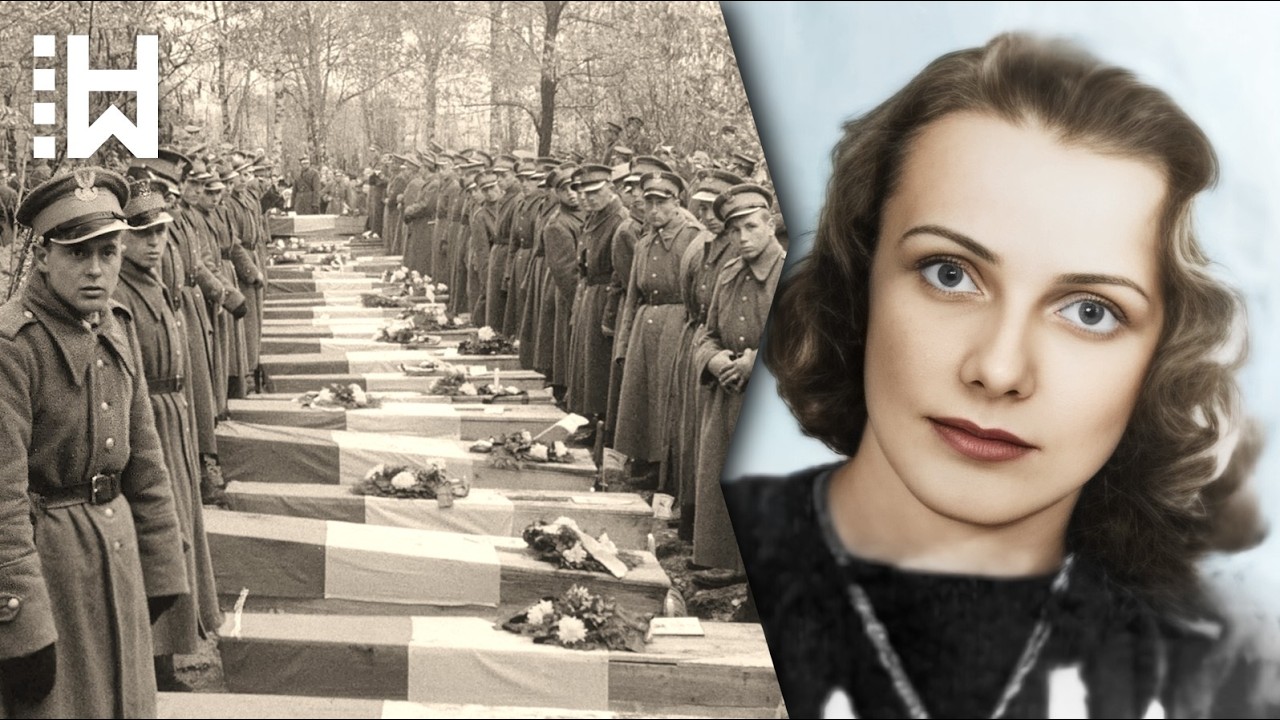
In the town of Siedlce, east of Warsaw, a sixteen-year-old girl heard the news along with the rest of her nation. She was the daughter of a military judge. Within two years, she would join the Polish resistance and be decorated for bravery by General Stefan Rowecki, commander of the Home Army, the largest underground organization in occupied Poland. Within three years, she would hand him over to the Nazi secret police, the Gestapo.
Her name was Blanka Kaczorowska. She was born on October 13, 1922, in Brześć Litewski, now Brest in Belarus, then part of the Polish Republic. Her father, Jan Kaczorowski, came from a noble family of the Hrusiatyn settlement in Podolia. He had studied at St.
Petersburg Technical University, volunteered in the Russian army during the First World War, and after the war joined the newly independent Polish state, rising through the military legal system until qualifying in 1931 as an investigating judge. Between 1934 and 1938, he presided over the local military court in Siedlce. The family was respected, patriotic, and well connected within Poland’s prewar state institutions. Blanka grew up in this environment.
She attended a school of the Military Family Association in Warsaw, then the Queen Jadwiga Secondary School of Natural Sciences in Siedlce. She was a member of the Polish Scouting Association, which instilled in her early values of patriotism and organizational discipline. When the war broke out, she had not yet completed her final school examinations. The German occupation that followed the invasion divided Poland into several administrative zones.
Siedlce fell within the General Government, the German colonial administration established over central and southern occupied Poland. Underground resistance organizations formed quickly, drawing on the structures of prewar civil society and the army. By early 1940, Kaczorowska was in contact with the resistance and joined the structures of the Union of Armed Struggle, the predecessor of the Home Army, known as the Armia Krajowa. She worked in the kitchen of a German airfield, then as a cleaner in a German military hospital, jobs that gave her access to intelligence of value.
During this period, she attracted the attention of a German Luftwaffe officer named Johannes Barrand, and her resistance superiors encouraged her to exploit this connection as a source of information. In November 1941, the Gestapo arrested her in Siedlce. Materials that incriminated her were confiscated, including private letters from Barrand. She was released after a few days, explaining to the resistance that she had convinced the Germans the materials had been found by accident while cleaning.
Within the underground, this explanation was accepted, and she was awarded the Cross of Valour, ironically by order of General Rowecki, the man she would later betray to the Gestapo. At the ceremony for the award, she met for the first time Ludwik Kalkstein, the man who would bring about her downfall. Kalkstein was an intelligence officer in the Home Army, leading a network called Group H operating under the Army’s command. He received his own decoration at the same ceremony as Kaczorowska.
In early 1941 and 1942, she joined his group. Kalkstein became her superior in the underground, and their relationship quickly grew close. In late March or early April 1942, the Gestapo arrested him and held him at their headquarters on Szucha Avenue in Warsaw. He broke under interrogation and agreed to cooperate.
After his release in August 1942, he changed his appearance and sought out Kaczorowska, whom he found a month later. He told her plainly that he had been released on condition that he work for the Germans, and she raised no objection. On November 14, 1942, they married in a church in Radość, a suburb of eastern Warsaw. The marriage was kept secret from the resistance.
Kaczorowska continued to work in resistance organizations under her maiden name and kept a separate address from her husband so that their connection would not be discovered. In secret meetings, she told Kalkstein everything: the names of the people she worked with, the tasks assigned to her, and the identities of her organizational contacts. This information passed through Kalkstein to the Gestapo, where she was registered as agent V-98. Kalkstein carried the number V-97.
The third member of that network, Kalkstein’s brother-in-law Eugeniusz Świerczewski, worked under the number V-100. The consequences for the Polish resistance were severe. Kaczorowska later admitted in her postwar testimony that she knew the information she passed to her husband reached the Gestapo. In the summer of 1943, her capacity to cause damage increased when she was assigned to the headquarters of the Home Army.
She exploited this position to obtain information for the Gestapo. In December 1943, information she provided directly led to the arrest of at least fourteen resistance members, five of whom were later executed. Among the dead was Jadwiga Karaśewska, head of the propaganda and morale section of the Studies Bureau, and Kaczorowska’s direct superior. But the most serious act of betrayal had occurred months earlier.
On June 30, 1943, General Stefan Rowecki, the commander of the Home Army, was arrested at his safe house in Warsaw and later executed. After an investigation lasting several months, Home Army counterintelligence concluded that three agents bore collective responsibility: Kalkstein, Kaczorowska, and Świerczewski. According to some sources, the secret military court sentenced all three to death in absentia. The sentence was carried out on Świerczewski, identified as the man who had pinpointed Rowecki’s location in the street and informed the Germans, in June 1944.
An assassination unit went looking for Kalkstein and Kaczorowska at their apartment on Śniadeckich Street in Warsaw, but failed to find them. Kaczorowska, pregnant at the time, had taken refuge in a hospital under German protection. She gave birth to a son, and in April 1944, Kalkstein moved her to the town of Piastów outside Warsaw. The marriage did not last, and the couple separated shortly after the birth of their son.
The death sentence was never carried out, and Kaczorowska survived the following months under German protection. In January 1945, with Soviet forces approaching and the structures of German occupation collapsing, Kaczorowska and Kalkstein headed for the newly liberated city of Łódź. In February 1945, Kaczorowska left Łódź for her last prewar place of residence, Siedlce, to obtain official documents. At the local municipal office, she received the necessary document under her maiden name.
At the same time, she did not conceal the fact of her marriage. Her father, Jan Kaczorowski, the prewar military judge, had by then been recruited by the new communist authorities and appointed a judge on the Supreme Military Court in Lublin. This position, held by a senior judicial figure in the new state apparatus, gave Blanka a measure of protection that she exploited fully in the turbulent early postwar years in Poland. She settled in Łódź and obtained her high school completion certificate in July 1945, finishing her interrupted education in an intensive course.
On October 31, 1945, she enrolled in the Art History department at the University of Łódź. On her application, she stated that she was married but did not give her husband’s family name. At the university, she was not a standout student, caused no problems, and graduated with a clear evaluation of good conduct. She also entered into a relationship with Roman Vogel, also known as Roman Rawicz, a military judge who served in the same section of the Supreme Military Court as her father and co-authored a commentary on the postwar military penal code.
She moved in with him and presented him as her husband, though they were never officially married. During the late 1940s, Kaczorowska lived a quiet life in Łódź, then later in Warsaw, where she completed her university studies. In 1949, she found work at the State Institute for the Study of Folk Art in Warsaw. On the surface, she had reinvented herself completely.
But it did not last. The political climate in Poland was changing. The Stalinist tightening of communist control in the early 1950s brought intense scrutiny of wartime records and renewed interest in former Gestapo collaborators. The protective network around Kaczorowska began to erode.
Her father was discharged from military service in April 1948, and her partner Vogel came under increasing political pressure. In late December 1952, she was arrested. Her apartment was searched, and a formal investigation was opened against her. She gave a lengthy testimony describing her wartime activities in detail, trying to minimize her personal responsibility.
She claimed she had trusted Kalkstein, denied direct collaboration with the Gestapo, and insisted she had only spoken to her husband about her work. On June 12, 1953, she was tried before the Warsaw Regional Court. The charge was collaboration with the Nazi occupation under the decree of August 31, 1944, on the punishment of Hitlerite fascist criminals. The court convicted her and sentenced her to life imprisonment and permanent loss of civil rights.
On appeal, the Supreme Court reduced the sentence to fifteen years with ten years’ loss of civil rights. A subsequent judicial pardon reduced this to twelve years. She served her sentence in the women’s prison at Fordon, near Bydgoszcz in northern Poland, and was released on parole in July 1958, after five and a half years in custody. In prison, she became an informer for the communist security apparatus, reporting on her fellow inmates.
After her release, she continued this role, working as a secret agent under the code name Katarzyna. In 1968, she legally left Poland for Paris, where she first worked on small projects in art history, then as a caregiver and hotel receptionist. Her former husband Ludwik Kalkstein was arrested after the war and sentenced to prison for his collaboration with the communists during the war. After his release, he left Poland and eventually moved to France, where their son was living.
Under a false identity, he spent the rest of his life in Western Europe and died in 1994. In 1983, Kaczorowska was admitted to a Polish charitable care home in La Haye-en-Val in the Loire Valley, which since 1957 had cared for veterans of the Polish armed forces in the West and political refugees. She was identified there by chance when a Polish woman working in the administration came across her French residence card, which described her as a victim of political persecution in communist Poland. Her wartime past soon came to light.
She lost her job, and after reaching retirement age, Kaczorowska was moved to a French care home in Boganzy in north-central France, where she spent the rest of her life. Blanka Kaczorowska died on August 25, 2002, at the age of seventy-nine, in a hospital run by the Camillian Fathers in Bry-sur-Marne, a suburb east of Paris. She was buried in the local municipal cemetery.