In June 1509, England’s future passed to a seventeen-year-old boy who had never been alone with a woman. The old king, Henry VII, had died in April, and his son now sat on the throne as Henry VIII. The new king’s first major decision was his marriage. Within weeks of his father’s burial, he announced that he would wed Catherine of Aragon, the Spanish princess who had been living in England for nearly a decade, waiting in a state of uncertain widowhood while diplomats argued over her future.
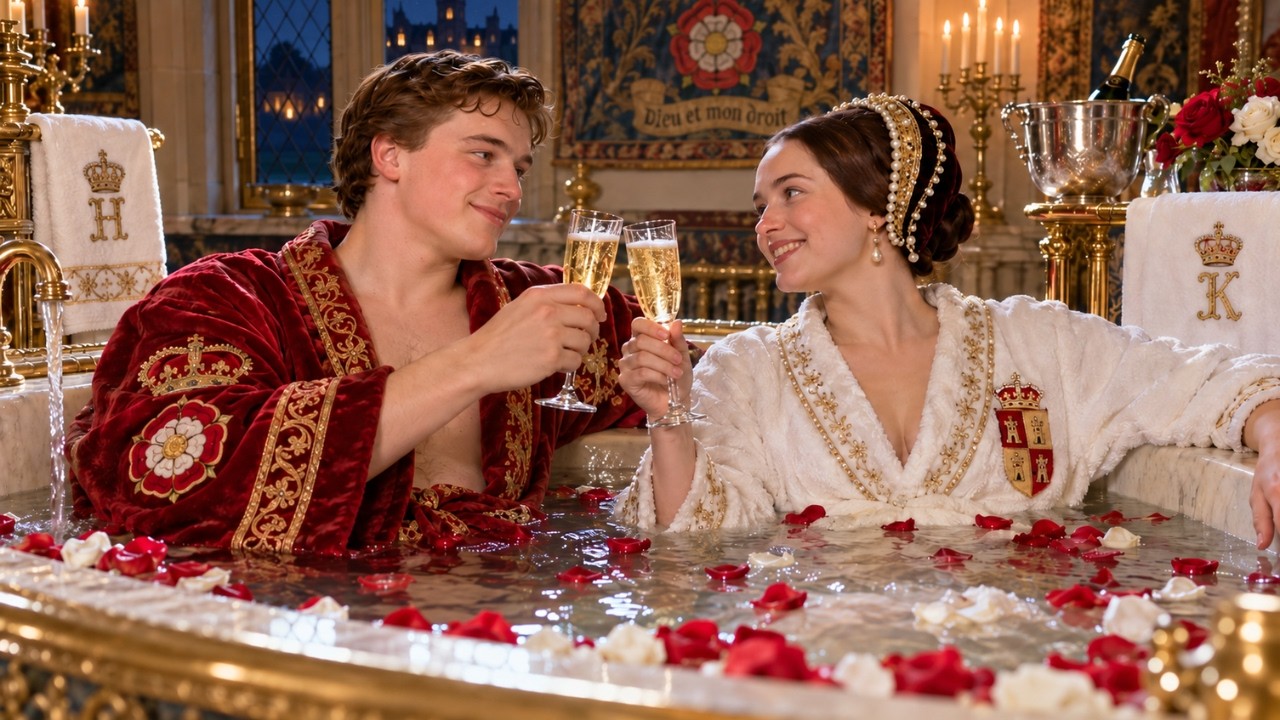
Catherine was twenty-three, six years older than Henry, and she had been in England since 1501. She had arrived as the bride of Henry’s older brother, Arthur, Prince of Wales, but the marriage had lasted only five months before Arthur died of what was likely sweating sickness. What followed for Catherine were eight years of limbo. She was a widow in a foreign land, used as a bargaining chip in the ongoing negotiations between her father, King Ferdinand of Aragon, and the English king.
At times she was left without adequate funds for food or clothing, and she wrote desperate letters to her father that went unanswered. She endured it all with a patience that would come to define her. There was a legal obstacle to the marriage. Catherine maintained that her marriage to Arthur had never been consummated, that Arthur had been too ill, and that she came to Henry as a virgin.
If that was true, a papal dispensation could clear the path. Henry chose to believe her, and the wedding proceeded with remarkable haste. The couple was married on June 11, 1509, in a deliberately quiet ceremony at the Church of the Observant Friars at Greenwich. Catherine wore white, unusual for a widow, with her famous auburn hair loose around her shoulders, as was traditional for a bride.
Henry was by all accounts a spectacular sight, tall, broad-shouldered, athletic, with reddish-gold hair and a face contemporaries described as beautiful. He spoke several languages, composed music, danced brilliantly, and radiated charm. The wedding night took place within the ritual of the bedding, a centuries-old practice throughout the courts of Europe. The bride and groom were escorted to the bridal chamber by their guests, accompanied by music, torchlight, laughter, and ribald jokes.
The ladies of the court helped Catherine into the great carved oak bed, hung with embroidered curtains and piled with feather mattresses. The gentlemen did the same for Henry. A priest blessed the bed, sprinkled it with holy water, and prayed that the union would be fruitful. Then the curtains were drawn, the candles dimmed, and the guests retreated, leaving Henry and Catherine alone together for the first time in their lives.
The bedchamber at Greenwich faced the Thames, and on a warm June evening the air coming off the water would have been soft. The room was hung with tapestries for insulation, the sheets were fine linen, and the candlelight gave the space a human warmth. The atmosphere was celebratory rather than merely ceremonial. This was a court that had reason to be happy.
The cautious, sometimes parsimonious reign of Henry VII was over, and the young king seemed full of promise. Privacy barely existed for royalty in Tudor England. The king’s body was state property, and his movements were watched from morning to night. The consummation of a royal marriage was not an intimate moment between two people.
It was a political event, witnessed and confirmed by the court. A marriage that had not been consummated could be annulled, a fact that would become tragically relevant later in Henry’s life. That night, however, no one was thinking about such possibilities. The whole purpose of the union was to produce a male heir, and the weight of that dynastic expectation filled the room as surely as the candlelight.
Henry was the last male Tudor, and the burden of the succession rested entirely on him. What happened behind the curtains is not directly recorded. What survives is indirect evidence. Shortly after the wedding, Henry wrote to Catherine describing her as his queen and well-beloved, expressing his contentment in warm terms.
In the weeks and months that followed, he showed no sign of dissatisfaction. He was openly affectionate, danced with her, brought her gifts, and wrote poetry about her. By all observable measures, the night had gone well. The early years of the marriage were marked by genuine partnership.
Catherine had been educated for queenship by her mother, Isabella of Castile, and she settled into the role with impressive competence. She organized her household, managed her ladies, and handled diplomatic correspondence with a fluency that Henry could not match. She made him laugh, quiet and ironic where his humor was boisterous, and she was not intimidated by his brilliance. He called her wise and sought her counsel.
Before the trauma of the succession crisis destroyed everything, Henry VIII genuinely respected his queen. Catherine became pregnant quickly. The first pregnancy ended in tragedy when the child, a daughter, was stillborn or died shortly after birth in January 1510. Henry comforted his wife rather than blaming her, and within months she was pregnant again.
In February 1511, she delivered a healthy son, named Henry after his father and baptized with enormous celebration. The king celebrated with a jousting tournament he entered himself. He was twenty years old, and he had a son, a queen he loved, and a kingdom that seemed to be flourishing. Fifty-two days later, the infant prince died.
The cause is not entirely clear, and the grief was immense. The pattern repeated itself for years. Catherine was pregnant at least six times between 1509 and 1518, and most of those pregnancies ended in miscarriage, stillbirth, or the death of an infant within days. Only one child survived, the future Mary I, born in February 1516.
The medical understanding of the time offered no real explanation for the losses. Catherine endured them with a faith that can only be called heroic, grieving as any mother grieves while believing her suffering had meaning. The failure to produce a male heir eventually became the wedge that destroyed the marriage, but that destruction took nearly two decades. For most of the 1510s, the marriage remained functional and in many ways affectionate.
Henry’s attention wandered to other women, including Elizabeth Blount, who gave him a healthy illegitimate son in 1519, but mistresses were understood as evidence of male nature rather than a failed marriage. Catherine did not allow her husband’s infidelities to alter her public demeanor or her dedication to her role as queen. Looking back from the terrible end of the marriage, the story’s trajectory is already present in the wedding night of 1509. The gap in ages, the differences in temperament, the weight of dynastic expectation, and the religious devotion that would eventually put the couple on opposite sides of the most consequential theological dispute in English history were all in that bridal chamber at Greenwich.
The saddest part is not the annulment, the long legal and theological arguments, Catherine’s humiliation when her marriage was declared invalid, her separation from her daughter, or her lonely death at Kimbolton Castle in January 1536. The saddest part is what was lost between the beginning and the end. Henry at seventeen was not the monster of popular imagination. Catherine at twenty-three was not the passive victim of later narratives.
They were people shaped by their world, doing what their world required, and for a time finding in each other something that felt like love. On a warm June night in 1509, two young people were alone together for the first time, and by every measure available, they made the most of the moment they were given. What came after is everything else.