The 1979 film *Escape from Alcatraz* was the fifth and final collaboration between Clint Eastwood and director Don Siegel, a partnership that had produced the *Dirty Harry* series. Shot inside the actual abandoned prison on Alcatraz Island in San Francisco Bay, the picture is still regarded as one of the finest prison films ever made. But behind the scenes, the production was marked by deception, danger, and a friendship quietly falling apart. The screenplay came from Richard Tuggle, a laid-off magazine writer who had never sold anything to Hollywood.
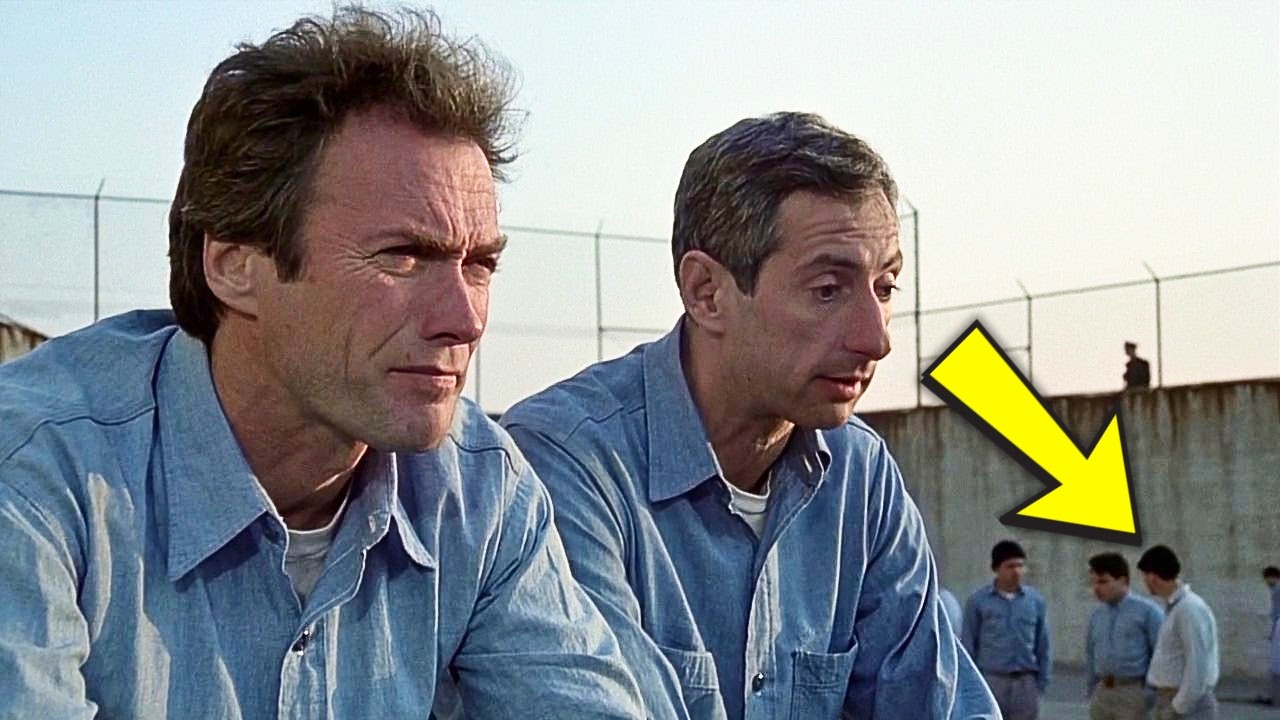
Earlier readers had rejected the script over its dialogue and lack of a love interest. Desperate for a chance, Tuggle cold-called Siegel’s agent and falsely claimed he had met the director at a party. That small lie got the script read, and Siegel bought it outright, launching Tuggle’s career on the strength of a fabricated introduction. To shoot in the actual prison, the crew ran roughly 15 miles of electrical cable from San Francisco out to the island, which had been closed and decaying since the early 1960s.
The production refused to build a replica on a sound stage, wanting the genuine rot and cold of the location in every frame. Cast and crew endured the same bone-deep damp that inmates had once faced, and that misery is visible in the finished footage. The cast included Patrick McGoohan as the prison warden, a role that carried a dark irony: McGoohan was famous for playing a man desperate to escape an inescapable village in the cult series *The Prisoner*. He had reportedly turned down the role of James Bond years earlier.
His cold, restrained performance in *Escape from Alcatraz* was singled out by critics as one of the film’s strongest elements. Cinematographer Bruce Surtees, nicknamed the Prince of Darkness, gave the film its black, rain-slicked look through low-key lighting that kept much of the frame in shadow. He had previously worked on Eastwood’s *Dirty Harry* films and was a recent Oscar nominee for *Lenny*. His oppressive visual style deepened the sense of dread that holds the movie together.
Siegel had been chasing this story for over a decade. In 1966, he read J. Campbell Bruce’s account of the 1962 escape and wrote a treatment he called *The Rock*, but no studio would touch it. When Tuggle’s script finally reached him, it answered an obsession he had carried through most of his career.
He wanted the project badly enough that he would later make a decision that cost him his friendship with Eastwood. Much of what tourists see on Alcatraz today was actually built by the film crew. The production reportedly spent around half a million dollars restoring the decaying prison, dressing cells to look as they had during its working life. After filming, most of that restoration stayed in place, and the National Park Service left it standing.
Visitors walking through the cells today are largely touring a 1978 movie set. The warden character in the film never existed. Warden Dollison was a composite invented by Tuggle and Siegel because the real wardens from the prison’s working years were still alive, and portraying them as cold antagonists would have invited defamation lawsuits. The fictional character allowed the writers to make him as harsh as the drama required.
Ironically, the real warden from that period, Olin Blackwell, was remembered as one of the most relaxed administrators the prison ever had. Composer Jerry Fielding, who had scored *The Wild Bunch*, created a score that broke from convention. He manipulated orchestral recordings until they lost almost all human warmth, producing an electro-acoustic texture that sounded like industrial machinery. It matched the building itself and deepened the film’s sense of cold machinery closing in.
Fielding said he wanted the sound of steel on steel. He died in early 1980, shortly after the film’s release. The screenplay drew directly from newly released FBI files on the 1962 escape. The spoons sharpened into digging tools, the drill improvised from a vacuum cleaner motor, the papier-mâché dummy heads left in bunks to fool guards, and the loosened ventilation grills all came from the documented record.
Tuggle layered invented characters and symbolism over those verified facts, and the seams between authenticity and invention almost never show. The production was required to protect graffiti left by Native American activists who had occupied Alcatraz from 1969 to 1971. Under its agreement with the National Park Service, the crew could only use temporary peelable paint. The occupation messages, including lettering on the island’s water tower, survived the shoot and remain visible today.
Danny Glover makes his first proper screen appearance in a small role as a young inmate handing out library books, years before *Lethal Weapon* made him a star. His few lines were dubbed over by another performer, leaving his face in the film but his voice on the cutting room floor. Fred Ward and Larry Hanken also appear early in their careers alongside him. The film marked the end of the Eastwood-Siegel partnership.
Eastwood wanted the project for his own production company, Malpaso, and assumed Siegel would bring the material to him as he always had. Instead, Siegel went around him, bought the rights himself, and set the picture up at Paramount. Eastwood felt betrayed, and the wound never healed before Siegel’s death in 1991. When Eastwood directed *Unforforgiven* and won the Academy Award the following year, he dedicated the film to Siegel and Sergio Leone.
For the climactic escape sequence, Eastwood and his co-stars made the climb down the prison wall and plunged into the bay themselves, with no stunt doubles. The water around Alcatraz is fast and cold, and Siegel later wrote in his memoir that on two occasions he believed the current had taken the actors under for good. They surfaced both times, but the director’s fear shows how thin the line was between an authentic shot and a genuine tragedy. Much of the filming had to happen at night because Alcatraz was still a working tourist attraction during the day, with boats landing roughly every half hour.
The production could not interrupt that schedule, so the crew worked largely after sundown in the unheated prison, around a timetable nobody could touch. Fred Ward and Jack Thibeau were cast as the Anglin brothers in large part because they were physically tough enough to survive the demanding climb and icy swim. Ward, in his first major film, had been a boxer, a lumberjack in Alaska, and served in the Air Force. The production needed bodies that could take punishment more than it needed polished resumes.
The film’s opening features Eastwood’s only fully unclothed scene in his entire career. Morris is marched through prison intake with no defenses, a deliberate stripping away of the actor’s usual untouchability. Quentin Tarantino, a vocal admirer of the film, has praised the cold stark beauty of that opening. Paramount expected little from the slow, dialogue-light prison drama with no love story.
Made on a budget of roughly $8 million, it grossed around $43 million in North America alone, becoming a sleeper hit and breathing new life into the prison escape genre. The success confirmed that the Eastwood-Siegel pairing was nearly a sure thing at the box office. The film’s most sympathetic failure, a nervous young inmate named Charlie Butts who loses his nerve and is left behind, is a fictional softening of a real man. The character is based on Alcatraz inmate Allen West, who by most accounts was an aggressive career criminal and repeat escape artist.
West may have helped originate the 1962 plan itself, and he was left behind only because he could not work his own ventilation grill loose in time. He later cooperated extensively with investigators, which is why so much of the escape’s inside story is known. Siegel gave himself an uncredited cameo as the prison doctor who examines Morris during intake. Eastwood’s longtime producing partner, Fritz Manes, also appears among the inmates, one of several Eastwood movies he wandered into as a background face.
The film’s most shocking moment, an older inmate called Doc turning a hatchet on his own hand after his painting privileges are taken away, was drawn directly from documented Alcatraz history. In 1937, a prisoner named Rufus Percival reportedly seized a hatchet during an outdoor work detail and deliberately maimed his own hand. The era’s brutal regime, including long stretches of enforced silence, produced such acts of desperate self-harm. In May 2025, the film triggered an unexpected political development.
A PBS affiliate in South Florida aired *Escape from Alcatraz* over a weekend, and by Sunday evening the sitting president posted online that he wanted the long-shuttered prison reopened as a working federal penitentiary. Reporting tied the announcement directly to the film’s airings. The proposal drew widespread doubts about its cost and feasibility. The president reportedly acknowledged the strangeness of the connection, telling reporters that he was supposed to be a movie maker.
The chrysanthemum that appears throughout the film was invented entirely by Tuggle, who built the symbol after learning that flowers once grew somewhere on Alcatraz. The final shot of a pale bloom on Angel Island suggests, without confirming, that the escaping men may have made it to shore. That hope is pure fiction layered over the documented mechanics of the escape. Whether Morris and the Anglin brothers ever reached dry land has never been settled.
One of the film’s great losses was a Christmas scene cut before filming. In it, Morris drops a single gumball that rolls beyond the reach of his outstretched hand, a small image of powerlessness that captured the entire theme of imprisonment. The scene survives only as a written description. The film closes the way the real escape did, with three men gone into the dark and no one able to say whether the bay took them or whether they finally caught their breath on dry land.
It stands as the last collaboration between Eastwood and Siegel, a film about breaking free made by two men whose own partnership was coming apart as they made it.