In early 1944, the Japanese stronghold of Truk Lagoon erupted in flames as waves of American carrier aircraft turned what had once been the Imperial Navy’s most feared anchorage into a burning scrapyard. For two years, Allied planners had regarded Truk as untouchable. Inside its vast reef ring, battleships, cruisers, submarines, and hundreds of support vessels sheltered beneath thick natural defenses, refueling, repairing, and regrouping beyond any direct threat. Strategists called it the Gibraltar of the Pacific, a fortress built not by walls but by geography, ringed with airfields, radar stations, and anti-aircraft batteries.
The Japanese believed any head-on assault would be suicidal, and for a long time, they were right. American intelligence, however, was improving faster than Tokyo imagined. Code breakers intercepted messages, reconnaissance flights collected images of ship movements and fuel reserves, and analysts reached an alarming conclusion: if Truk remained intact, Japan could replace its losses faster than the American island-hopping campaign could outpace them. By early 1944, American carrier doctrine had also matured.
Pilots had learned to dismantle enemy defenses methodically, radar-guided intercepts blunted Japanese air counterattacks, and American logistics now overwhelmed everything in their path. When commanders received intelligence that large warships inside Truk would soon reposition, they saw an opportunity too valuable to ignore. As the lagoon burned, a small formation of Japanese warships slipped toward the open Pacific. Their commanders knew that anchored ships were death traps; fuel tanks, magazines, and tight compartments meant a single accurate bomb could gut a cruiser in seconds.
Under pre-dawn darkness, the light cruiser Katori, accompanied by destroyers and an auxiliary transport, made a desperate run north, hoping to outrun American attention. The destroyers could push past thirty knots, and the damaged Katori still limped along at more than twenty. Darkness and distance were their only shields. But American reconnaissance patrols from the light carrier Cowpens spotted the fleeing column.
From altitude, the smoke trails and wakes stood out clearly against the deep blue ocean, and the position was relayed directly to Admiral Raymond Spruance. He had two choices: send aircraft until their fuel gave out, or commit the surface vessels that had not yet fired a shot that day. Spruance chose the second option. He assembled a pursuit group built around two of the most powerful battleships afloat, USS Iowa and USS New Jersey, joined by heavy cruisers Minneapolis and New Orleans and a screen of destroyers.
Unlike the Japanese ships, this American group could sustain more than thirty knots without straining its machinery. The chase was on. Hours later, radar operators aboard Iowa detected faint returns at the far edge of their scopes, contacts too far away for any lookout to see. The plotting team marked courses on transparent boards, feeding everything into the battleship’s mechanical brain.
Aboard the Japanese vessels, the tension tightened. Their commanders knew they were being hunted. Lookouts stared into the haze until their eyes burned, and intercepted radio fragments confirmed that American packs were gathering. By early afternoon, the American task group had shortened the distance dramatically.
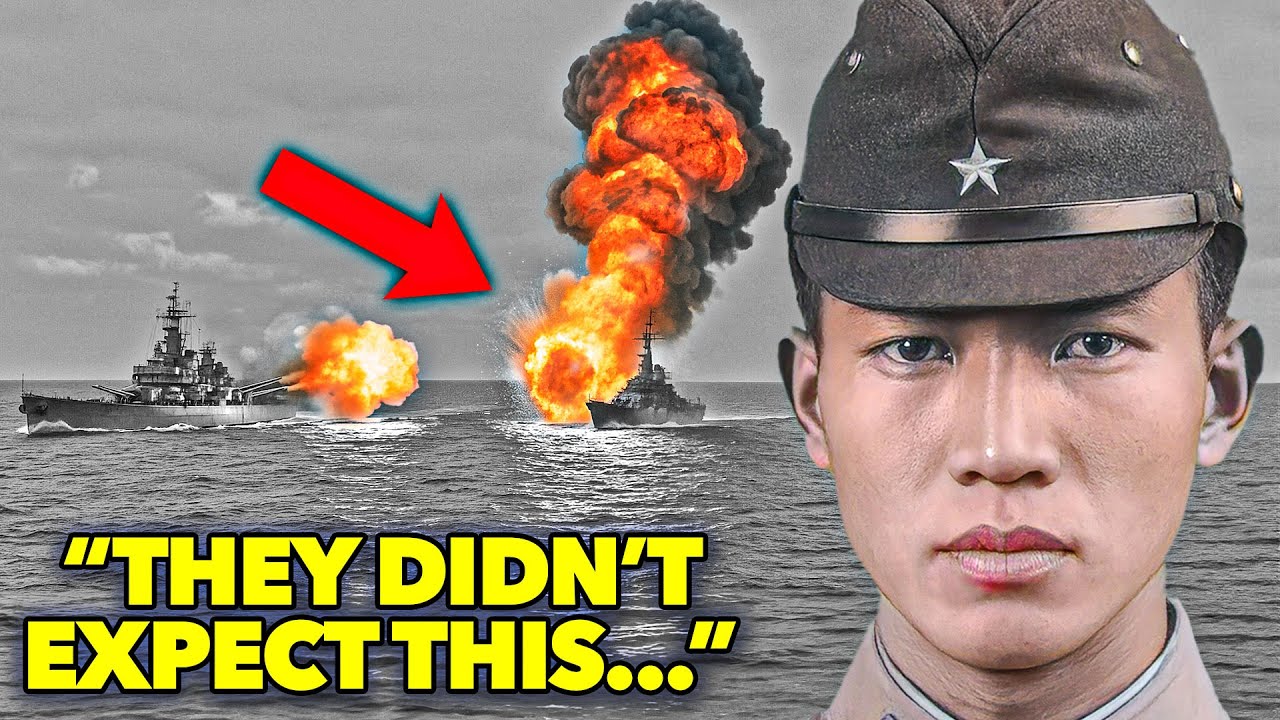
Aboard Iowa, turret crews braced behind armored bulkheads as the firing order came down the steel ladders. Six silk powder charges were loaded for each sixteen-inch rifle, handled with absolute care, because a single spark could obliterate an entire turret. In the fire control director, operators watched the Mark 8 radar display as the fleeing Katori crept across a coordinate grid. The distance was 32,000 yards, far beyond human vision.
To the naked eye, the enemy did not exist. But the mechanical brain below decks knew exactly where she was. The order came to commence firing. Iowa’s opening salvo roared from the center turret, each projectile heavier than a small automobile engine.
The ship lurched sideways under the shockwave, blast shields humming and paint blistering from the heat. For nearly a full minute, the ocean was silent. Then a geyser of seawater erupted beside Katori. A near miss.
Radar measured the splash instantly and fed corrections to the rangekeeper, an analog computer of gears, cams, and spinning discs that calculated not only where the enemy was but where she would be when the shells came down. It compensated for the ship’s turn, wind, drift, humidity, and even barrel fatigue. American engineers joked that it calculated everything except prayer. A second salvo thundered, and the shells walked closer, bracketing the cruiser with towering sprays.
Japanese gunners swung their barrels desperately, but their optical sights could not lock onto anything but haze. Their rangefinders could not solve angles hidden by the curve of the earth. Aboard Katori, officers shouted orders over the roar of ruptured steam lines, and crewmen sprinted across decks slick with fuel. They fired back out of defiance more than hope, their five-inch shells arcing harmlessly toward a shape they could not confirm.
Then came the third salvo. One shell slammed into Katori’s midship superstructure and detonated with concussive violence, shredding compartments and igniting fires fed by ruptured fuel lines. Communications vanished, and the bridge flickered with emergency lights. The Japanese crew now understood the horror of the situation: the enemy did not need to see them.
Seeing the cruiser in distress, the destroyer Maikaze closed into the line of fire like a loyal guard dog. Her captain knew he could not win, but he could try to slow death’s arrival. He throttled to full speed and laid thick smoke across the ocean surface, a desperate curtain meant to break the American firing solution. American radar saw straight through it.
As Maikaze darted across Iowa’s bow, the heavy cruisers New Orleans and Minneapolis opened up, their eight-inch shells stitching a line of fire across the destroyer’s superstructure. Maikaze refused to break off. With her torpedo tubes aligned, she launched a fan of Long Lance torpedoes into the Pacific swell, weapons that could gut a battleship. For a moment, every heartbeat aboard the American ships paused.
But aircraft overhead circled like hawks, spotting the torpedo wakes and relaying corrections by radio. New Jersey angled slightly to starboard, and the weapons passed harmlessly into foam. Then the tide turned. A perfectly timed broadside tore through Maikaze’s hull, punching a burning crater through decks stacked with ammunition.
Her magazines ignited with a sound like the earth splitting open. The destroyer buckled, cracked, and snapped in half. Sailors who leapt overboard found themselves surrounded by floating flames. Back aboard Katori, the end was near.
Shell hits punched open her engine spaces, power died, pumps stalled, and the fires raged unchecked. The cruiser rolled, listing hard to port as compartments flooded beyond control. The American guns showed no mercy, because this was war without witness. When the order to abandon ship finally echoed through dying corridors, many Japanese sailors refused.
Years of indoctrination had taught them that death was honorable and surrender shameful. Some clutched rifles even in the water. When American destroyers approached to rescue survivors, they were met with blades and fists, and the horrified rescuers withdrew. The sea claimed every last man.
Only one major Japanese warship still had a chance to escape: the destroyer Nowaki. Smaller, lighter, and far faster than any battleship, she poured everything into her engines, sprinting north past thirty-five knots toward rain squalls looming on the horizon. But Iowa and New Jersey refused to let her go quietly. Their massive rifles elevated to their highest angles, hurling shells on trajectories that looked impossible to the human eye.
Minutes later, towers of ocean erupted around the fleeing destroyer. Even without direct hits, fragments blasted across her superstructure, wounding men and tearing away antennas. Gunners aboard Nowaki fired back blindly. American radar plotted each splash and adjusted aim with mechanical precision.
Then came the moment historians still discuss. A salvo landed so close that it straddled Nowaki at more than 35,000 yards, over twenty miles away, the longest-range straddle ever achieved by a battleship in combat. The ocean itself seemed to shudder, as though the horizon had reached out and swatted at a fleeing insect. Then clouds and rainfall swallowed the destroyer whole, and the radar returns faded into noise.
Speed saved her where armor could not. She vanished into the storm, battered and terrified. On the American decks, nobody cheered. They simply logged the range, confirmed the echoes, and turned south.
The deeper meaning of the engagement settled like ash across the Pacific. For decades, Japanese naval strategy revolved around a single vision: a decisive fleet clash at manageable distance, where skilled gunners and devastating torpedoes would shatter an enemy battle line. It was a doctrine rooted in heritage and the assumption that both sides would fight within the limits of human sight. The shots fired that day proved that assumption dead.
Radar-driven accuracy had chained mathematics to gunpowder, allowing American battleships to land blows long before Japanese optics could even acquire a silhouette. In Tokyo, reports were met with disbelief. Engineers realized Japan lacked both the equipment and the industrial capacity to replicate such systems quickly, and fuel shortages, limited factories, and mounting convoy losses strangled every hope. For the first time, senior planners whispered the unthinkable: fighting spirit could not close range, courage could not bend ballistic arcs, and years of training meant nothing if the enemy killed you before you ever saw him.
In just ninety minutes, American technology had sunk a doctrine. And when doctrine dies, entire empires follow. The crew of USS Iowa and USS New Jersey had demonstrated the longest-range, most accurate surface gun engagement in naval history, proving their mighty rifles still had a place in modern war. But the world was already changing faster than they realized.
Carrier aircraft had crushed Truk before the battleships even arrived. Submarines choked Japan’s lifelines, and radar now guided entire fleets. Ironically, this stunning display would be the last time Iowa and New Jersey ever fired at enemy ships during World War II. Their immense rifles became symbols more than tools, thundering mostly at beaches and fortifications.
Japan’s greatest battleships would never trade broadsides with their American counterparts; instead, they met their end under swarms of carrier-launched bombs and torpedoes, weapons born of the new age. For ninety minutes near Truk Lagoon, the battleship stood at the top of naval warfare’s throne one last time, and the record set that day will never be broken, because no navy will ever build weapons like these again.