When work crews broke ground near Towton Hall in 1996, they uncovered a burial pit containing 37 skeletons packed shoulder to shoulder. The bodies belonged to men who died at the Battle of Towton on Palm Sunday, March 29, 1461, a clash fought in a snowstorm that blew directly into the faces of the Lancastrian line. The bones told a story that did not match the poems. Clean cuts from sword blades were almost entirely absent.
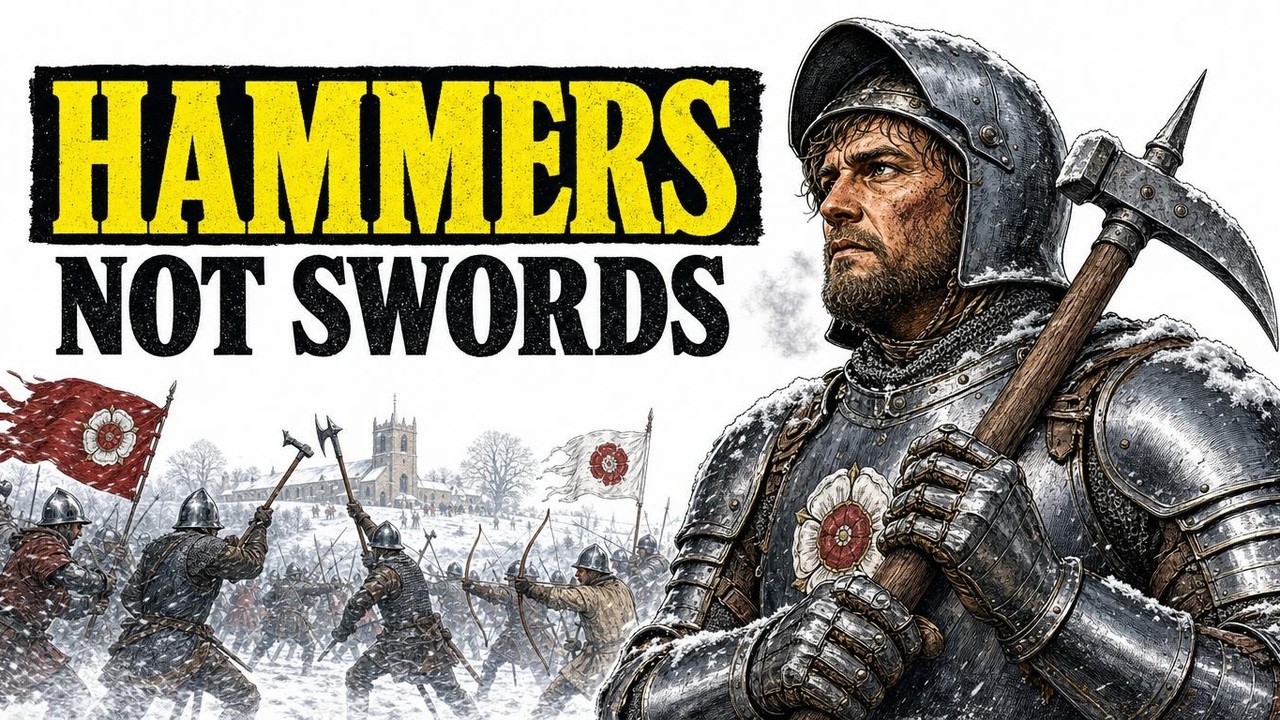
Instead, forensic analysis revealed the marks of crushing force: skulls caved in by heavy blows, a kneecap pulverized by a deliberate strike, and fine puncture wounds in the neck and behind the eye. These small punctures were not battle wounds. They were placed with precision after the men were already down, made by a narrow spike driven up under the jaw or through the eye socket. The pattern suggests a method, not chaos.
Towton was the culmination of a decades-old dynastic quarrel. King Henry VI suffered a mental collapse so complete that when his son was born in 1453, he could not recognize the child. Around the hollow throne, the houses of York and Lancaster circled one another, and the conflict took its later name, the Wars of the Roses, from their badges. The rift had already turned bloody.
At the first Battle of St. Albans in 1455, the Duke of Somerset was killed outside an inn. At Wakefield in December 1460, the Duke of York himself fell, and his head, crowned in paper, was fixed above the city gates. His son Edward inherited that severed head as a debt to be repaid.
Edward, barely 19, declared himself king in London in March 1461 and rode north to make the claim true. The men in the pit at Towton were the price of a crown. Chroniclers recorded numbers no medieval field had seen before. A herald’s count that reached Edward afterward claimed some 28,000 dead, a figure copied into a letter George Neville sent to the papal legate Coppini within days.
The Croyland chronicler wrote that blood ran in the melting snow and bodies choked the local stream so that men crossed it on the backs of the fallen. The wind mattered that day. Yorkist archers firing downwind outranged the Lancastrians shooting into the gale. The enemy arrows fell short, and the Yorkists walked forward, gathered the spent shafts from the snow, and sent them back.
The wounds on the skeletons show what that decision looked like up close. One skull, cataloged as Towton 25, carried a healed blade wound from an older battle. On the day he died, the same man received wounds to the skull numbering in double figures: cuts, punches from a squared point, a great caving blow from a hammer, and a slice that took a piece off the back of his head as he turned. The healed scar and the fresh ruin sat on the same bone.
He was likely a professional soldier in his late 30s. The men in the pit ranged in age from their teens to their 50s. Their spines and shoulders carried the marks of years of drawing the great war bow. Several had healed injuries from earlier fights.
These were not frightened farmers. Many were seasoned men, and it did not save them. The pulverized knee in the assemblage was not a random injury. Fracture lines radiated from a single point of impact.
A man with a destroyed knee could not rise, swing, or grapple. At Towton, the order had gone out before the armies met: no quarter. Kill the commons. Spare no lord.
The heralds called it the day of the great slaughter. A man on the ground with his knee destroyed was not a prize to be bargained for. He was salvage waiting to be sorted. The smallest wounds were placed with intent.
Slender perforations pierced the cervical vertebrae and the thin orbital plate behind the eye. Someone crouched over fallen men, lifted their heads, and drove a stiff narrow spike up under the jaw or through the eye. This was not how men die in a charge. This was killing done kneeling after the fighting moved on.
After the battle, the field was left to scavengers who stripped bodies of armor, clothing, rings, and coin. Then came the burial crews. A Cistercian monk, perhaps drawn from a nearby abbey, was sent to see the dead into the earth. His task was not grief but logistics: calculating how much quicklime to buy, how many laborers to hire, how deep the pits must be cut.
The cost of a battle was measured in shillings, cartloads of lime, and hours of digging. Some bodies were laid with a strange care despite the haste, arms folded as if a hand that had killed still remembered the burial rites. Years later, a chapel was raised on the ground and money granted so masses could be said for the dead. The weapon that matched the punctures in the bones was a rondel dagger.
It had no cutting edge. It was a thick, rigid, tapering spike with a cylindrical grip capped by flat steel discs. It was not made to slash. It was made to punch through gaps in armor.
The French called its cousin the misericorde, the mercy blade, because it delivered the final stroke to a man beyond saving. At Towton, there was no mercy in it. It was the instrument of the no quarter order, the tool that turned a routed army into a body count. The same style of blade had done famous work before, when the Duke of Orléans was cut down in the streets of Paris in November 1407 by hired men working for John the Fearless of Burgundy.
That murder lit the long feud between Burgundian and Armagnac and helped open France to English invasion. Among the Lancastrian dead at Towton were the Earl of Northumberland and Lord Dacre. Lord Dacre was said to have lifted his helmet to take a drink and been struck in the throat by an arrow. Titles did not slow the blows.
The armor that was built to make a man invincible was the same armor he was wearing when they killed him. The fortress and the coffin were the same object. A full harness of 15th-century plate was a machine built to defeat the sword. Every surface was convex.
The breastplate swelled outward, the helmet domed, the shoulders rounded. A sword blade could not find a flat surface to bite and slid off into empty air. The plate was deliberately hardened, made tougher than the blade that struck it. Taking a long sword to a good breastplate was like taking a carving knife to an anvil.
Surviving harnesses in collections at Leeds, London, Vienna, and Graz tell the truth. They are not raked with slash marks. They are pocked with deep, round, ugly dents hammered by something blunt and heavy. At the temple of many helmets is a clear hollow with a torn hole at its center.
This is the print of a poleaxe’s hammer face or the beaked fluke of a war hammer. A helmet was a struck bell, and the skull inside was the clapper. Even a blow that left the steel whole flooded the brain with force and dropped an armored man where he stood. The battle at Towton lasted from mid-morning until the light failed and beyond, roughly ten hours.
Men stood on windrows of their own dead to keep fighting. The sound was not the ring of edge on edge the poems loved. It was a duller noise, the flat heavy knock of iron on iron, like a whole village of blacksmiths at work in the falling snow. A suit of plate weighed about 60 pounds, less than a modern soldier hauls into battle.
Trained men could run, vault, and even turn cartwheels in their harness. Killing one was never a matter of outrunning a slow giant. It was the patient, deliberate dismantling of a costly piece of hardware with the operator still inside. The evidence points to a two-step method.
Step one: put him down. That was the work of the mace, the war hammer, the poleaxe, weapons of shock built to stun rather than pierce. Step two: once he is down and cannot rise, find the way in. That was the work of the rondel dagger.
A harness was not a seamless skin. It had openings for seeing, breathing, and bending. The rondel was shaped to hunt them. The slit in the visor led straight to the brain.
The armpit, guarded only by mail and a small floating plate, allowed a blade to reach the lung or heart. The nape of the neck, where helmet and gorget left a thin gap, offered a path to the spinal cord. The very armor that made a knight untouchable while he stood had drawn in its own gaps a precise map for his killing. Standing, a knight was lord of the field.
Fallen, he was a turtle rolled onto its shell. Sixty pounds of steel pinned him in place. The joints that bent one way would not fold the other. A single foot on the breastplate could hold him there while someone fitted the key to the lock.
The cold fact the myths need clearing on: a full harness could cost as much as a small farm or a village’s yearly income. A fortune worn on the body. The method was not rage. It was not chance.
The same blows landed in the same places, battle after battle, grave after grave, as if every killer had studied the same page. And somewhere, someone had written that page. The manuscript is called a Fechtbuch, a fight book. The copy that matters was drawn up in the early years of the 15th century by a man named Fiore dei Liberi, a master of arms from Cividale in the Friuli in northeastern Italy.
He was a fighting man who sold his craft. He trained knights and men at arms for the wars of northern Italy, named his noble pupils in the prologue, and boasted he was challenged five times by rival masters to fight with sharp swords and no armor, and came away unhurt each time. His book, Fior di Battaglia, prepared around 1409 for the Marquis of Ferrara, is not a hymn to chivalry. It is a plain, illustrated method for ending a human life.
Four versions survived, one now in the Getty in Los Angeles, another in the Morgan Library in New York. Much of the book is given over to wrestling, which Fiore calls abrazare. Page after page shows men in full plate with their swords dropped, locked chest to chest, trying to put each other in the mud. One sequence shows a master catching the enemy’s leg and driving him over backward.
Another shows a man slipping inside the guard, seizing the helmet, and wrenching the head down until the body follows it to the earth. Once the enemy is on the ground, Fiore turns to the dagger. The dagger he draws is the rondel. A man in armor kneels on the chest of a downed opponent, pinning the sword arm with his own knee, and sets the point of the dagger to the eye slit of the fallen man’s helmet.
The words that go with the pictures carry no heat. Fiore counts the places on an armored body where a dagger kills and where it only wounds. The armpit, the palm of the gauntlet, the groin, the bend of the knee, the throat above the gorget, the eye. He writes of the thrust that enters the face or the visor and names it, flatly, a mortal blow.
The question the whole system turns on is why a master would spend his life teaching how to disable a man without killing him. The answer was money. The center of knightly war was the ransom. A living knight was an asset to seize.
A man in fine armor was a walking treasury. In 1356 at Poitiers, the Black Prince’s outnumbered English force took King John II of France alive on the field. Chronicler Jean Froissart describes English knights crowding so thickly around the fallen king, each shouting that the prisoner was his, until a Gascon squire named Denys de Morbeke shouldered through the press and claimed him in French. That single capture carried a ransom of 3 million gold crowns, roughly twice the yearly income of the English crown and enough to run the English war for two years.
Gathering it broke the back of France. Debased coin, crushing taxes, and defeat drove the countryside into the peasant revolt called the Jacquerie in 1358. The ransom could not be paid in full. John returned to captivity in London and died there in 1364.
One man taken alive was priced at a kingdom. This shaped the weapons. A sword might kill a valuable prisoner by accident. A war hammer could drop a man senseless without breaching the plate, leaving the asset stunned and whole.
A knight who knew the trade would yield only to a captor of standing. Prisoners were sold on, and a single duke might change owners three times before the money was raised. At Towton, the ransom rule was suspended. Edward’s no quarter order tore up the account book for a single day.
The economy that usually kept men alive was switched off, and the killing was allowed to run unpriced from mid-morning until dark and on into the pursuit down the road to Tadcaster. The same cold arithmetic appeared at Agincourt in 1415. In the middle of the battle, Henry V ordered the French prisoners already taken to be killed. The men-at-arms holding them balked because obeying meant destroying their own winnings with their own hands.
The king had to detail 200 archers to carry out what the gentlemen refused to do. It was not conscience that made them hesitate. It was arithmetic. Every wound on the skeleton from the pit reads as a page from Fiore.
The pulverized knee and caved temple are the work of the poleaxe and war hammer. The throws and locks of the wrestling chapters explain how he came to be on the ground. The fine punctures in the neck and eye socket answer mark for mark to the drawings in the dagger chapter. He was judged not worth taking alive.
He was a failed investment. Fiore’s manual is a step-by-step confession set down decades before the man in the pit drew his last breath, describing the exact manner of his killing. The image of the shining knight fighting for honor was built by chroniclers on noble wages, by poets hunting patrons, and by the families who had beggared themselves paying ransoms and needed to believe the money had bought something nobler than a life. The bones do not flatter anyone.
The dented steel keeps no one’s secret. The killer’s own handbook says plainly what the paintings were paid to forget. The field at Towton is quiet now. Sheep graze the slope down to the little beck, and in spring the ground still gives up buckles, arrowheads, and the odd worn coin.
A stone cross stands at the roadside, weathered nearly smooth. The men in the pit lay unnamed for five centuries until a work crew’s spade broke into them in 1996. What survived was never the armor and never the honor the poets promised them.
What survived was the record in bone, in indented plate, and in a master’s careful ink of exactly how a man came to be worth more alive than dead, and what was done cheaply and without ceremony to those who were worth neither.