In late May 1942, the strongest navy on Earth was on the move. The Japanese carrier fleet—the same force that had devastated Pearl Harbor six months earlier—had vanished into the Pacific, and Washington could not determine its destination. American analysts argued over competing theories involving Australia, Hawaii, and other targets. But in a sweltering basement at Pearl Harbor, a veteran commander wearing a red smoking jacket and house slippers told his superior he knew the answer.
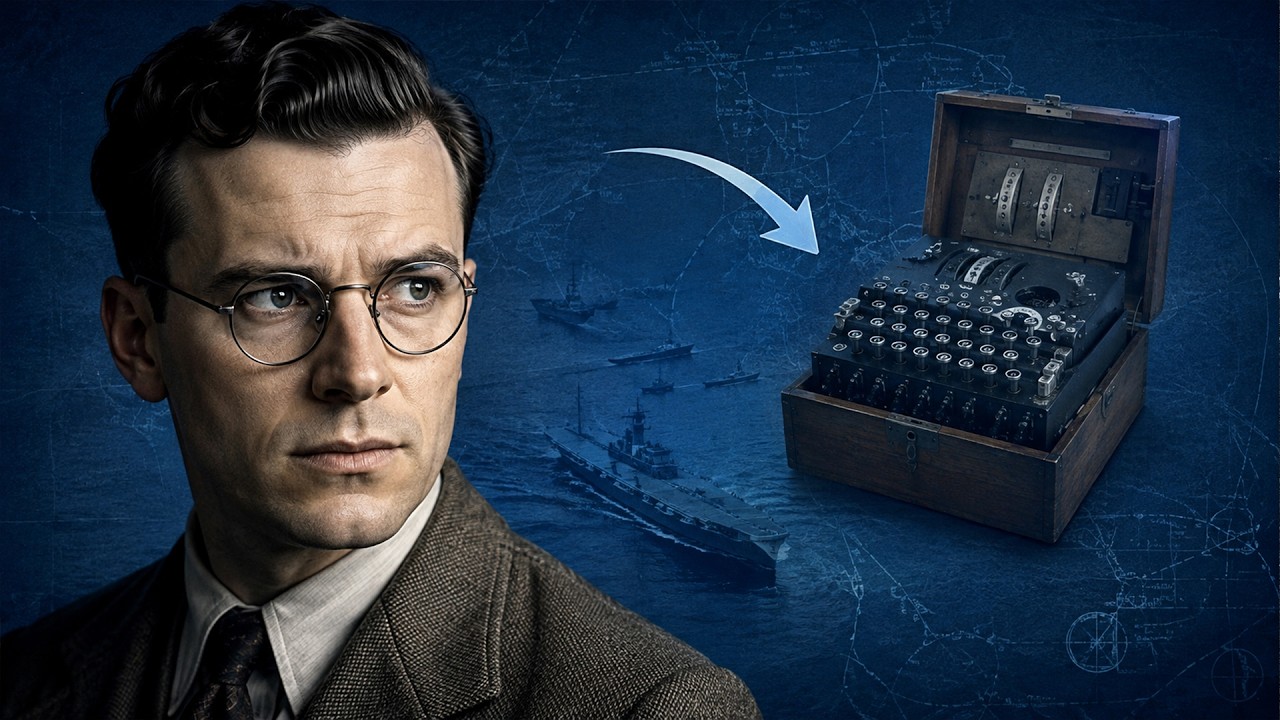
The Japanese would strike a small coral atoll called Midway. The attack would come on June 4, from the northwest. Almost no one believed him. He was right about everything.
And when the battle ended—a battle that would turn the entire Pacific War—the Navy rewarded him by stripping away his work and ending his career. This is the story of Joseph Rochefort. Joseph John Rochefort was born in May 1900 in Dayton, Ohio, and grew up in Los Angeles. When the United States entered World War I, he joined the Navy as an ordinary seaman, a teenager in uniform.
He stayed in service. After being commissioned as an officer, he studied engineering, and then the Navy discovered something unusual about him. He had a gift for languages. The service sent him to Tokyo for three years to master Japanese, and he returned fluent.
More remarkably, he returned fascinated. He became absorbed in the country itself—its history, customs, and the way its people thought. He was one of the rare American officers who understood the enemy across the ocean as human beings, not just targets. Then the Navy did what it does with a man skilled at something.
It locked him in a room and gave him a job. By early 1941, Rochefort was running a combat intelligence unit at Pearl Harbor. The men called the basement “Hypo,” the phonetic code for the letter H, as in Hawaii. It was a windowless vault beneath the Fourteenth Naval District headquarters, hot as an engine room and filled with the noise of fans and calculating machines.
Rochefort practically lived there. He worked twenty hours a day, wore a red smoking jacket and slippers because he rarely went home, and smoked constantly. Around him sat a small group of codebreakers, mathematicians, and Japanese-language experts—the type of people who see patterns in chaos and cannot let them go. Their target was the Japanese Navy’s operational code, JN-25, a vast system of codebooks.
Breaking it was not the quick breakthrough of Hollywood films. It was months of staring at columns of five-digit groups, guessing, testing, failing, and starting over. Often the team could recover only a small fraction of each message, just enough to piece meaning together from fragments, like following a conversation heard partially through a wall. It was slow, painstaking, creative work.
After December 7, 1941, it became the most important work in the Pacific. Rochefort’s basement had one mission above all others: find the Japanese fleet. In the spring of 1942, the basement began proving its worth. Codebreaking and traffic analysis warned of Japan’s advance toward Port Moresby in New Guinea, a warning that set the stage for the Battle of the Coral Sea, the first naval battle fought entirely by aircraft.
That was only a prelude. Rochefort was already seeing something bigger in the message traffic. A cluster of call signs kept gathering around a target identified by just two letters: “AF. ” Where was AF?
Rochefort believed it was Midway, a tiny atoll at the far end of the Hawaiian chain. Analysts in Washington were not convinced. So he set a trap. With the approval of Admiral Chester Nimitz, the garrison at Midway was told to send an uncoded message in plain language—a complaint about equipment, the kind of thing an island might send without a second thought.
The message said the island’s freshwater distillation plant had broken down and fresh water was running short. The message spread through the cables like gossip. The Japanese swallowed the bait completely. Two days later, the Hypo team decrypted a Japanese message stating that target “AF” was short on water.
The two letters finally had a name. AF was Midway. One of the most important questions of the Pacific War had been answered by a complaint about plumbing. Now Rochefort decided to risk everything.
Working from message traffic patterns, fuel consumption, troop movements, and months of hard-won intuition, he built a prediction that still amazes historians today. The Japanese would attack Midway. They would attack on June 4. They would come from the northwest.
A diversionary raid would strike the Aleutian Islands first. The attacking force would carry most of Japan’s first-line carriers. In Washington, senior codebreakers objected strongly, arguing that both the date and the target were wrong. For weeks, the argument continued at the highest levels.
But Nimitz had learned to trust the man in the smoking jacket. He asked how confident Rochefort really was. The answer, in essence, was simple: confident enough to bet the fleet. So Nimitz did exactly that.
The admiral sent his three remaining Pacific carriers into hiding northeast of Midway, a spot the sailors called “Point Luck. ” One of them, the Yorktown, had been badly damaged at the Coral Sea. The yard estimated it needed 72 hours for repairs. It was given 72 hours, and it sailed.
On June 4, 1942, exactly as the basement had predicted, Japanese aircraft hit Midway from the northwest. The trap closed. American dive bombers caught the enemy carriers in the middle of rearming, with fuel lines open and bombs and ammunition stacked in the open. In five minutes of chaos, the course of the twentieth century changed.
Three Japanese carriers burned that morning. A fourth was hit that evening. The Imperial Japanese Navy, the fleet that had never lost an open battle, lost four irreplaceable carriers in a single day. Midway was such a complete and improbable victory that some Americans initially refused to believe it.
One of them had found the fleet. In the aftermath of the victory, medals, promotions, and parades were expected. Here is what actually happened. Days after the battle, Nimitz personally recommended Rochefort for the Distinguished Service Medal.
A senior admiral in Washington rejected the recommendation. Then, in October 1942, four months after the battle, Rochefort was transferred. Not to a bigger role. Not to intelligence at all.
He was sent to the San Francisco Bay Area to take charge of a massive floating dry dock being built for the fleet. Think about that. The officer who found the Japanese fleet and made the most important ambush in naval history possible was put in charge of a docking facility at a shipyard. A dead-end pier job.
The massive codebreaking operation in Washington had its own ideas about how to run wartime intelligence and never fully trusted the small independent unit in Hawaii. After Midway, the politics hardened. Credit went elsewhere. Rochefort never worked in intelligence again.
He never served at sea again. He was never promoted to admiral. Rochefort left active service in 1953, after a career that, in the eyes of the establishment, peaked at a dry dock. He settled in California and became a rare thing: the man who made the most important naval battle of the century possible remained utterly silent about it.
He avoided interviews. He rarely attended reunions or ceremonies. Some who knew him said the treatment left him bitter. Others said he preserved his dignity through silence.
Historians eventually came looking. Major postwar studies of Midway relied heavily on what Rochefort finally shared in private conversations. But real public recognition never came during his lifetime. Joseph Rochefort died on July 20, 1976, at the age of 76.
The Navy he served for 35 years did not yet fully understand what it had wasted. It took nearly another decade. In 1985, after a campaign led by historians and members of Congress, the Navy finally awarded Joseph Rochefort the Distinguished Service Medal—the same honor he had been denied twice while alive—presenting it to his family in his memory. In 2000, he was inducted into the Military Intelligence Hall of Fame.
In 2019, when Hollywood produced a major film about Midway, Rochefort, not a pilot or an admiral, stood at the emotional center of the story: the obsessive in the basement, wrapped in a smoking jacket, who found the fleet. Today, historians agree on the essential point. The Battle of Midway was won before the first plane took off. It was won in a basement by a handful of codebreakers, and by one admiral willing to risk everything on their word.
Rochefort’s story is not only about genius. It is about institutions, how they treat the people who save them, and how slowly they admit error when they have made one. Every intelligence officer since has been told to be patient, to keep silent, and to trust the chain of command. They all know the name Rochefort.
He is the patron saint of the man who is right and has to wait a lifetime for the world to catch up.