In 1930, Army Chief of Staff Douglas MacArthur, then 50 and recently divorced, met a 34-year-old Filipina actress named Isabel Rosario Cooper in Manila. Known professionally by the nickname Dimples, Cooper was pursuing a career in local entertainment when MacArthur took an interest in her. When MacArthur returned to Washington, D. C.
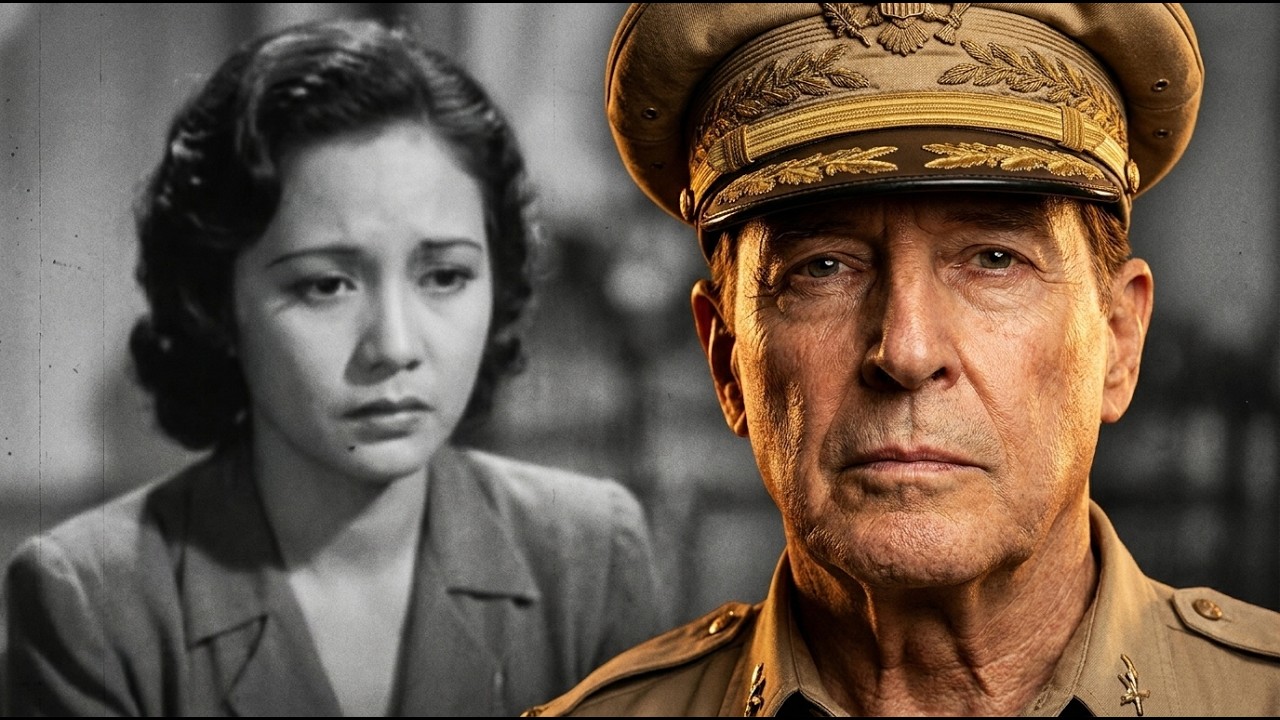
to assume his role as the most senior uniformed officer in the U. S. military, he arranged for Cooper to travel with him. He did not present her as a public companion.
Instead, he installed her in a suite at the Chastleton Hotel, a residential Washington hotel known for discretion, where he paid her expenses and visited her in private. For four years, Cooper lived concealed in that suite. She was not introduced to his colleagues, did not appear at official functions, and remained entirely absent from the social record of his public life. During that time, MacArthur wrote her intimate letters, the kind of unguarded correspondence a powerful man composes when he is confident the arrangement will stay private.
The arrangement collapsed in 1934 when a journalist named Drew Pearson obtained information about the relationship. Pearson’s knowledge became leverage in a defamation case MacArthur had filed against him, and the details of the hotel suite and the actress threatened to become a courtroom exhibit. MacArthur responded by sending his aide, Major T. J.
Davis, to make the problem disappear. Davis presented Cooper with a bank draft for $15,000, a sum roughly equivalent to $300,000 today, attached to strict conditions: leave Washington, do not contact the general, do not speak to journalists, and remove herself from his life permanently. She took the money, left the capital, and returned most of the letters Davis was instructed to collect. The Army’s intelligence assessment was that Los Angeles, roughly 3,000 miles away, would absorb her into an industry that generated enough scandals to drown out any single woman’s private history.
The calculation was comfortable. Every part of it was wrong. Cooper relocated to California and pursued the acting career she had long hoped for, working under the professional name Chubing, a Filipino term of endearment. She attended auditions, made industry contacts, and appeared in film roles, but the career never arrived as she had imagined.
The $15,000 cushion was consumed faster than theory suggested, and she lived in grinding poverty, documented by the accounts of people who knew her during those years. What made the poverty especially cruel was its company. During the years Cooper was struggling to get her name into a film credit, MacArthur became one of the most celebrated military figures of the 20th century. When Japan invaded the Philippines in 1941, the country where he had found her, he became the central figure of the Pacific War.
His face appeared on the covers of major magazines; his voice filled radio broadcasts. From a studio apartment in Los Angeles, Cooper watched him liberate the homeland he had taken her from. She kept the letters. Through the four years of hotel isolation, through the humiliation of the payoff, through the poverty and the decades of watching the man who had discarded her rise to global prominence, she kept his correspondence in a shoebox under her bed.
The letters survived every apartment, every relocation, every year the gap between her life and his grew wider. She was the one thing she had that the money hadn’t bought back. In 1960, at age 54, Cooper made a final private decision in a small room in Los Angeles, concluding her own story on her own terms, 26 years after she had been paid to disappear. The historical record notes the context the clinical documents do not: the general whose letters she had kept through all of it was still alive, still celebrated, still the unassailable icon the official record described.
MacArthur died in April 1964 at Walter Reed Army Medical Center at age 84, receiving a state funeral and interment at the MacArthur Memorial in Norfolk, Virginia, in a building constructed to house his papers and perpetuate his legacy. He died believing the archive had been dissolved by a bank draft 30 years earlier. He was wrong. After Cooper’s death, the letters surfaced among her effects and eventually reached biographers and historians examining the period.
The correspondence documented the relationship with a specificity the $15,000 payment had been intended to make unavailable permanently. The payment had bought 30 years of silence. It had not bought the archive. The biographies that incorporated the Cooper correspondence produced a complicated portrait of the general, not a destroyed one.
His operational record in World War II and his administration of occupied Japan were significant enough that no private correspondence would reduce him to a footnote. But the letters revealed that his public construction of himself as a figure of Roman virtue had required the active management and occasional financial suppression of the reality behind the construction. The specific cost of that management had been borne entirely by one person. Cooper had arrived in Washington at 34 with a career and a future that four years in the Chastleton Hotel effectively consumed.
She had been paid to disappear, and she largely succeeded, in the sense that the public record of her life during MacArthur’s most celebrated years contains almost nothing. She kept his letters when keeping them served no practical purpose the circumstances of her life could access. The monument still stands at Norfolk. The correspondence is in the historical record.
Both are true simultaneously, and the gap between them is the precise measurement of what $15,000 actually purchased: not silence, but 30 years of it, and then the truth at the standard rate that suppressed truths tend to charge for their eventual appearance.