On the morning of February 12, 1943, twelve blue-gray fighters lined up on the coral runway of Henderson Field on Guadalcanal. They had a shape no one had seen before in combat on that front. The wings did not extend straight from the fuselage; they bent downward, then outward, then upward in a deep inverted curve that gave the aircraft a menacing, crouched appearance even at rest. These were Vought F4U Corsairs, among the fastest fighters the United States had yet sent to the Pacific.
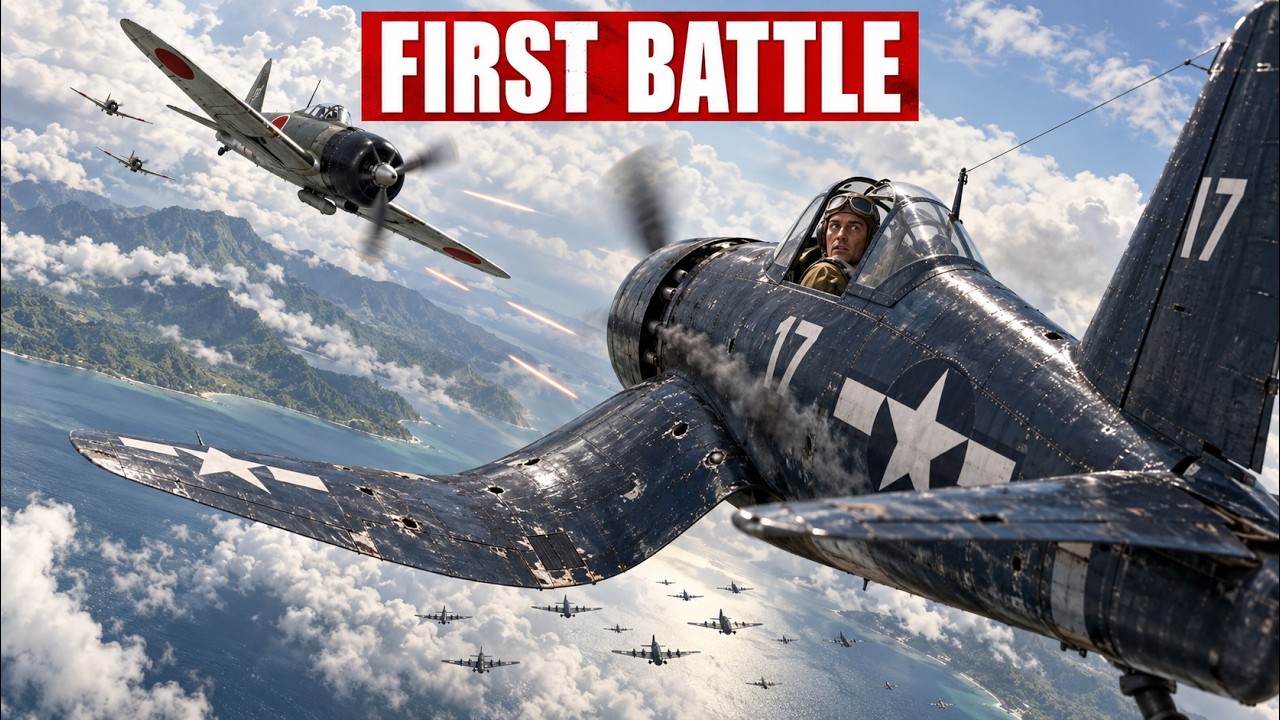
The squadron flying them was Marine Fighting Squadron 124, formed only months earlier at Camp Kearny near San Diego and declared operational at the end of December. Their pilots averaged roughly 25 hours of flight time on the Corsair. This was an extremely short amount of time to master a demanding machine, and they were expected to learn the aircraft while fighting seasoned enemies. The Corsair had been designed to change the equation of the air war.
Its Pratt & Whitney R-2800 Double Wasp engine produced about 2,000 horsepower, nearly double the power of the Japanese Zero’s engine. It could exceed 400 miles per hour in level flight, carried six . 50-caliber machine guns in its wings, and was built to absorb damage and keep flying. Its Hamilton Standard propeller measured more than 13 feet across, and the distinctive bent wing existed for a practical reason: it provided enough clearance for the propeller blades without unduly lengthening the landing gear.
But the very qualities that made the Corsair powerful also made it difficult and initially dangerous for its own pilots. The long nose housing that massive engine blocked the pilot’s forward view, a serious problem during landing, when forward visibility matters most. The stiff landing gear tended to bounce on contact. At low speeds, one wing could stall before the other and drop sharply, the kind of sudden loss of control that killed pilots near the ground.
Carrier trials went so poorly that the U. S. Navy deemed the aircraft unsuitable for carrier operations and sent it instead to Marine squadrons flying from island runways. The pilots who flew it in those early days gave it a grim nickname: the “Bone Crusher.
”
The first mission was not a battle. On the morning of February 12, the twelve Corsairs escorted a PBY Catalina flying boat on a rescue mission to Sandfly Bay at Vila Lavella, roughly 230 miles away, to retrieve two downed pilots. No Japanese aircraft appeared. The mission was quiet, almost gentle, and the pilots returned without firing a shot.
Two days later, everything changed. On February 14, 1943, Marine Fighting Squadron 124 fought its first real battle. The Corsairs joined P-38 Lightnings and P-40 Warhawks escorting a formation of B-24 Liberator bombers raiding the Japanese airfield at Kahili on the southern tip of Bougainville, deep in enemy-held territory. Japanese fighters rose to meet the raid and dealt with it harshly.
When the fighting ended, the Americans had lost four P-38s, two P-40s, two Corsairs, and two of the Liberator bombers they had been sent to protect. In return, they had downed no more than four Japanese aircraft. American pilots grimly remembered the engagement as the “Saint Valentine’s Day Massacre. ”
It was the combat debut of the fighter that would later dominate the skies of the Pacific.
It was not a victory; it was a costly defeat. The bombers had gotten through and hit their target, but the price paid by the escort was severe, and the new Corsairs had not turned the battle as their performance figures had promised. The fighter that could outrun and out climb the Zero returned from its first battle with empty ranks. The lesson of that defeat shaped everything that followed.
The problem on February 14 was not the aircraft itself. The Corsair in that mission was the same aircraft that would later terrify the Pacific. Its engine was just as powerful, its guns just as heavy, its dive just as fast. What was missing was on the American side of the cockpit: inexperienced pilots with only a few hours on the type, thrown against veteran enemies, fighting in ways that wasted the advantages the Corsair had been designed to exploit.
The instinct they had to abandon was turning. When an enemy is behind you, the oldest instinct in air combat is to turn your aircraft into the tightest circle possible, trying to get on his tail before he gets on yours. Against the Zero, that instinct was close to suicide. The Zero was designed with maneuverability as its first priority above all else.
It was light, had large wings, and at low speeds it could turn tighter than any aircraft the Americans flew. A Corsair pilot who tried to match a Zero in a turning fight at low speed was playing the game the Japanese fighter had been built to win. That is what happened to the men who had not yet realized this, and that is why they died. But the Zero’s strengths came at a heavy price, and there lay the answer.
To stay light, the Zero carried no armor to protect its pilot and no self-sealing liners in its fuel tanks. When Corsair fire hit it, it quickly burned or broke apart. Its controls became heavy and stiff at high speeds, so it could not follow a heavier aircraft in a fast dive without risking structural failure. The Corsair was a machine of a completely different kind.
It was heavier but had nearly double the engine power. It was faster, far better armed, and designed to absorb damage. It could outrun a Zero at speeds the Japanese fighter could not safely match, and its powerful engine allowed it to regain altitude and attack again. From this contrast emerged a completely different method of fighting, the turning point that made everything else possible.
The rule the Marines adopted was never to fight a Zero on its own terms. Maintain high speed and keep the altitude advantage. Attack in a diving pass from above, fire one quick burst, and use your speed to climb back out of reach before the enemy could respond. If a Zero tried to lure you into a slow turning fight, you refused, dived away, and set up for the next attack on your own terms.
Speed and altitude were treated as assets to be spent carefully and then recovered, never wasted in circular maneuvers. This was accompanied by strict air discipline. American fighter pilots learned to fly in pairs protecting each other using a tactic devised earlier in the war by a naval officer named Commander John Thach. When a Zero pursued one aircraft, the two fighters turned toward each other so that the wingman’s guns swept the space the attacker had to cross.
A lone Zero could not easily solve this problem. When properly flown, a pair of Corsairs had no unprotected blind spot for the enemy to exploit. Results appeared quickly once these tactics took hold. On April 1, 1943, in a battle over the Russell Islands, Kenneth Walsh scored his first three Japanese kills.
On May 13, 1943, he shot down two more, becoming the first pilot to achieve ace status flying the Corsair. He was not alone. During the spring and summer, the rest of the Marine fighter squadrons in the Solomons converted to Corsairs. They learned the same lessons and applied the same discipline.
The aircraft that had failed over Kahili in February was by early summer doing exactly what its designers had promised, because the men flying it had finally stopped fighting the wrong way. They needed every bit of that advantage because the fighting was widening. In mid-1943, the Allied advance moved through the Solomons chain to New Georgia and toward the airfield at Munda. Each step forward pulled the two air forces into larger and more frequent battles.
Corsair squadrons escorted bombers to defended targets, swept the skies ahead of advancing troops, and confronted Japanese formations partly made up of experienced pilots. What the new tactics could and could not do was written clearly in the two missions for which Kenneth Walsh earned the Medal of Honor. By late summer, he had been promoted to first lieutenant. On August 15, 1943, over Vila Lavella, he attacked a Japanese formation that outnumbered his division by nearly six to one.
His aircraft was hit repeatedly, but its armor and rugged frame held, and he shot down two dive bombers and one fighter before returning safely. Two weeks later, on August 30, 1943, his engine failed while he was en route to a bomber escort mission. He landed his crippled aircraft at Munda, got into another Corsair, and took off again to rejoin his formation over Kahili, where he faced a large force of Japanese fighters. He attacked anyway and shot down four before his aircraft was hit hard enough to force him down.
He ditched in the sea and was rescued. Walsh was credited with 21 victories during his combat career, but his record was not one of invincibility. He was shot down or forced down more than once and lost several Corsairs while performing his duties. The Corsair had tilted the balance strongly in favor of the American pilot, but it did not make him safe.
Men still died in those skies, and those who survived often did so because their aircraft absorbed damage that would have destroyed any lighter plane. As summer turned to autumn, a squadron formed that would become symbolic of the entire Corsair story. Marine Fighting Squadron 214, known as the Black Sheep, was formed in the central Solomons in September 1943 under Major Gregory Boyington, a man whose pilots called him “Pappy. ” Boyington had already flown with the American Volunteer Group, the Flying Tigers, in China and understood the Zero and the tactics needed to defeat it.
Under his command, the Black Sheep conducted sweeps and escorts toward Rabaul. Over the squadron’s tours, they were credited with shooting down or destroying roughly 200 Japanese aircraft. This was proof that the advantage now lay with the Corsair as a system, not with any single gifted pilot. Behind the individual battles, a larger and more decisive change was taking place on the Japanese side of the front line.
During the autumn of 1943, the Allied advance toward Bougainville threatened Rabaul directly. Japanese command chose to defend the base with its best remaining pilots. In early November 1943, Admiral Mineichi Koga, commander of the Combined Fleet, ordered reinforcements known as Operation Ro, stripping most of the aircraft and highly trained crews from his carriers to send them to Rabaul. These were the elite of Japanese naval aviation, the product of years of prewar training.
They were thrown into a battle that was already turning against them, and there they were consumed. The situation became so hopeless that the Japanese themselves called it the “Bismarck Sea sinkhole. ” The veteran pilots who entered the battle did not come out in numbers that matched those who went in. This was the difference that decided the air war, and it was a matter of arithmetic as much as tactics.
When the United States lost pilots, its massive training program produced replacements and sent them to the Pacific with hundreds of flight hours before they saw combat. Every returning veteran passed on hard lessons to the men who followed. Japan, when it lost pilots, could not replace them at the same rate or with the same quality. The men sent to the front arrived with far less training than those they replaced.
The Corsair’s margin of superiority meant that even the average American pilot could now defeat a more experienced enemy. And as enemy experience faded over Rabaul, that margin widened further. Even the aircraft’s last stubborn weaknesses were being solved in those same months. The flaw that had kept the Corsair off carrier decks, the long nose blocking the view of the deck on approach, was overcome not by rebuilding the aircraft but by changing how it was landed.
The British Fleet Air Arm devised a curved approach that kept the deck and landing signal officer in view around the side of the nose until the last moment. This was combined with landing gear improvements and specialized training suited to the aircraft’s characteristics. It worked. In 1944, Corsairs were finally cleared for carrier operations.
By late 1943 and the first days of 1944, the air battles over Rabaul had become a continuous drain on Japanese strength implemented by the combined Allied effort. Carrier aircraft struck the base and its harbor in November. The Army’s Fifth Air Force bombed it from the air, and Navy and Marine Corsairs, Hellcats, and Army P-38 Lightnings conducted sweeps and escorts. The Corsair was the Marines’ primary fighter in that effort, but it was one instrument in a larger orchestra.
The overall effect was the destruction of the veteran Japanese air force in the region. The cost still fell on both sides. On January 3, 1944, while leading a sweep over Rabaul, Gregory Boyington himself was shot down and captured, spending the rest of the war as a prisoner. His squadron continued fighting and scoring victories without him.
By early 1944, the pattern was unmistakable. The Japanese fighter force that had once made these skies so dangerous was being crushed and shattered faster than it could be rebuilt. Its irreplaceable veterans had died over a base the Allies had already decided to bypass rather than storm. The question was no longer whether the Corsair and the men who flew it could win the air battle over Rabaul.
The answer was already visible every day. The question was how long Japanese command would keep sending pilots into a battle it could no longer win, and what would happen on the day it finally stopped. That day came in mid-February 1944. After the elite of the naval air force had been thrown into combat over Rabaul and largely destroyed, and after American carrier aircraft had struck the great fleet anchorage at Truk to the north on February 17 and 18, Japanese command made the decision to abandon the air defense of Rabaul entirely.
On February 19, 1944, the surviving aircraft, numbering between roughly 70 and 120, took off from Rabaul and flew north to Truk. The mechanics and ground crews who were supposed to follow tried to leave by ship two days later, but Allied bombers sank their transport before it could get clear. The men who had kept the aircraft flying died or were trapped on the island. Organized Japanese air resistance over Rabaul simply ended.
This was the answer to the question the entire campaign had posed. The strongest Japanese base in the South Pacific, the fortress that had anchored the entire Japanese position, was never taken by direct assault. It was bypassed and left behind. Instead of paying the enormous cost of a ground attack on Rabaul and its garrison of roughly 100,000 troops, the Allies chose to isolate it and let it wither.
The airfields that had launched a year of raids were now under attack themselves, and they had nothing left to send in response. For the rest of the war, the men at Rabaul were prisoners of their island, isolated and bypassed, waiting for the end of a conflict that had moved beyond them. The promises made in this story were eventually kept, honestly and with a warning. Among the Japanese naval pilots who survived, the American Corsair was considered the most terrifying fighter they faced in the Pacific, the aircraft that stripped from them the conditions of combat they had relied on since the beginning of the war.
That respect was real, and it was earned in the air over the Solomon Islands. But the shock those pilots felt was not only the shock of a superior machine; it was the shock of seeing an entire style of fighting stop working, and losing the veteran comrades who had made the Zero dangerous faster than replacements could be trained. The Corsair broke their advantage. The Solomon Islands campaign was in essence a campaign to dismantle that air force mile by mile, and the principle behind it all was simple and merciless.
Japan’s collapse in pilot training and industry guaranteed they could never rebuild it. This distinction is the real lesson of the Corsair, more useful than the myth surrounding it. Air superiority in the Pacific was never achieved by a single aircraft. It was the product of an integrated system.
It required a machine with its power, speed, and damage tolerance. It required tactics the Marines had to learn the hard way after the defeat over Kahili: the discipline of not fighting a Zero on its own terms. It required an intensive training program to feed new pilots to the front faster than combat consumed them, and an industry that produced aircraft faster than they were lost. The Corsair was the spearhead of that system, the tool everyone could see.
But the whole machine behind the scenes is what decided the air war, and the Corsair alone would not have been enough. The aircraft continued in service. It served through the final year of the war and later flew over Korea. It remained in production longer than any other American piston-engine fighter of its generation.
But its decisive work was completed by the spring of 1944 over the Solomons and Rabaul, where it helped dismantle the finest naval air force Japan ever sent to war. That is why that period of the war is remembered the way it is. In a little over a year, the balance of power in the skies over the Pacific had reversed. A fighter rejected by its own navy, initially flown by men who did not yet know how to use it, became the aircraft that ended Japanese air supremacy in the South Pacific.
Not because a single aircraft was invincible, but because a nation capable of building the aircraft, teaching the tactics, and training the pilots finally brought all three elements together at the same time and in the same place. Whoever controls the air controls what happens over the water and on the ground below. If you lose the air, ships cannot sail and troops cannot move. By the time Marine Fighting Squadron 124 arrived at Guadalcanal, the long battle for the island itself was over.
The Japanese had evacuated their surviving troops days earlier in the first week of February. The fighting was now moving north, up the chain toward the central Solomons and eventually toward Rabaul itself. That was the direction the new squadron was flying, and the enemy waiting in that direction was still dangerous and experienced. The Corsair pilots who had to overturn those conditions succeeded because they abandoned the tactics that had made the Zero deadly and adopted new ones built around speed and altitude.
They learned to refuse turning battles, to attack from above, and to use the Corsair’s power to escape and re-engage. The combination of a better aircraft, better tactics, better training, and superior production ultimately wore down the Japanese air forces. The veterans who had made the Zero dangerous died in the skies over Rabaul, and the system behind the Corsair ensured they could not be replaced.
The fortress of Rabaul, never taken by assault, was simply bypassed and left to rot, its 100,000 men stranded for the rest of the war, waiting for a conflict that had already moved past them.