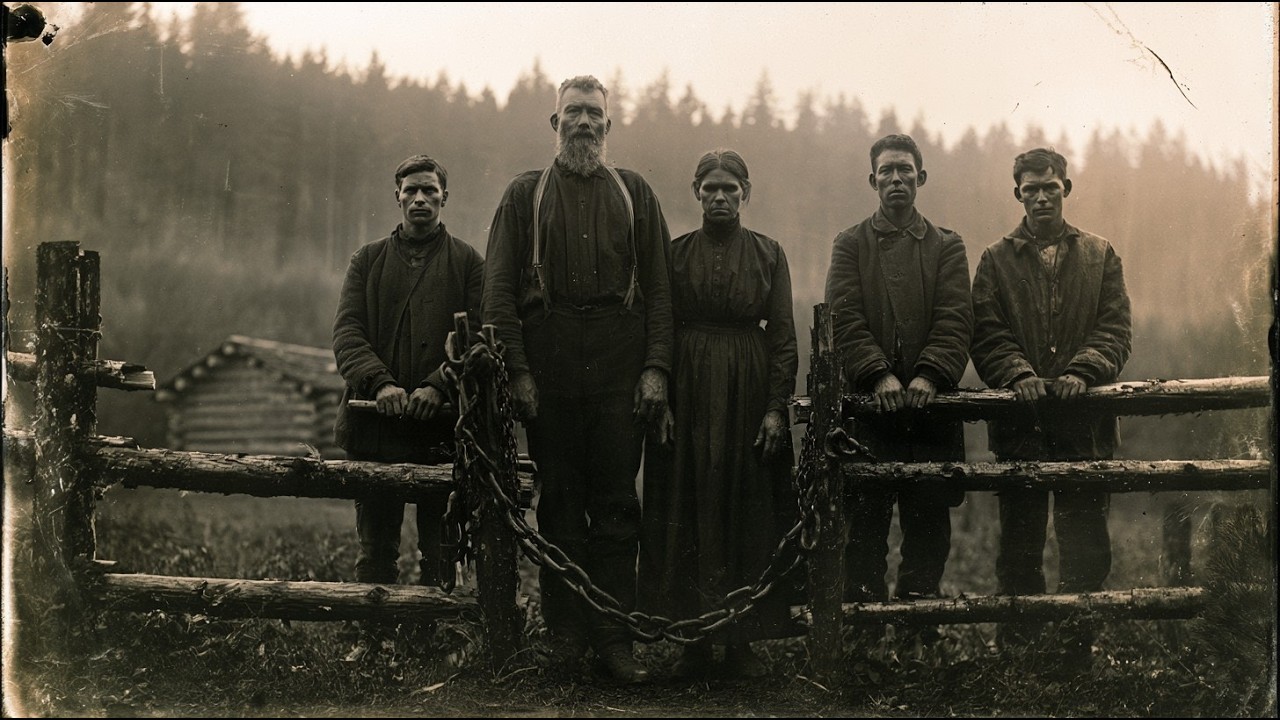
For nearly seventy years, the Halloran family lived in a valley on the western slope of the Cascade Range, and in all that time, they never once gave a straight answer to any man wearing a uniform. Their valley was called Ashfall Woods, named for the fire of 1868 that blanketed the basin in grey for an entire season, and because nothing ever grew naturally there again. The story of what happened in that valley, and what happened to the people who went in looking for answers, was pieced together by a county clerk named Sylvanus Marshbanks, who spent forty years reading records no one else thought to question. In 1893, Marshbanks sat behind a small desk in the records office of Halstead County.
He was forty-one years old, precise, and given to correcting other people’s errors. He worked behind that same desk until he was seventy-nine. Then, in 1955, one year before the office was moved to the new courthouse and half the old files were sent to the incinerator, he did something no one had asked him to do. He read every case in the county records relating to the land west of Winet Ridge.
Every deed, every sheriff’s report, every missing person notice, every marginal note. He arranged them on his kitchen table in the order they occurred. When he finished, he had a stack of papers the size of a bible, and on the top page he wrote a single word in light pencil. He wrote “Ashfall.
” Beneath it he wrote “Halloran. ” Beneath that he wrote a number that existed in no official record: 23. The first name in his stack was a timber surveyor named Alcott Rine. In the summer of 1893, Rine was thirty-six years old, a broad-shouldered man who could cover fifteen miles in a day’s work.
He was contracted by a Portland lumber company to examine the spruce standing on the north side of Winet Creek. He walked in alone, carrying a compass, a survey rod, bedding, hard bread for a week, and a Colt revolver he had carried since his army days. He told the storekeeper at Elwood’s Corners he would return by the same road in nine days. Elwood watched him climb the trail toward the valley around ten on a Tuesday morning.
The sun was bright. There was no wind. Elwood said the last thing he noticed was that Rine did not turn and wave, which was unusual for him. Rine was a friendly man who always waved.
Nine days passed, then ten. On the twelfth day, Elwood sent his hired hand out on a mule to look for him. The man cut four miles up the trail until he reached a place where the trees began to lean strangely over the path, then he turned around and came back. He did not want to say why.
Elwood went to the county seat and reported the matter to Sheriff Roswell Kirkpatrick, a serious and fair man who assembled a party of six and went up. At the four-mile mark, the temperature dropped enough that two men had to put their coats back on. Kirkpatrick noted in his private journal that the mercury in his field thermometer fell from seventy-two to fifty-three within roughly a hundred feet of trail, and it did not rise for the rest of the day. There were no birds after the four-mile mark.
Not faint bird song. No birds at all. One of his deputies, a former scout named Cyrus Vanock, dismounted without being asked, placed his hand flat on the ground, and after a moment stood up and said, in a voice the sheriff described as embarrassed, that the ground was warm. It was cold everywhere else.
The trail itself was warm to the touch. They found the compass first. It was lying flat on a mossy stump about three miles into the valley, and its needle did not point to magnetic north. It pointed back down the trail they had come from.
Another hundred yards on, they found the survey rod leaning against a fir, as if a man had set it there for a moment while he went to check something. No bedding. No rations. No boots.
No coat. They found Rine on the fourth day. He was sitting in a small clearing about a mile below the Halloran fence line, his back against a tree trunk, his hands folded in his lap the way a man sits when he is waiting for someone. He wore no boots, no coat, no shirt.
His eyes were open. His mouth was closed. There was not a mark on him. No wound, no bruise, no bite, nothing to explain what had stopped him.
Kirkpatrick wrote a brief report. He wrote that Rine had apparently sat down to rest and died of exposure or heart failure, and he underlined the word “apparently. ”
He walked the last mile to the Halloran gate. The man who came to the gate was Absalom Halloran, sixty-four years old, thin as a clothes hanger, with a beard down to the second button of his shirt.
Kirkpatrick asked whether the family had seen a large man pass through the valley in the past two weeks. Absalom Halloran said no. Kirkpatrick asked whether any of the Halloran sons had gone up to the north slope in the past two weeks. Absalom Halloran said no.
Kirkpatrick asked if he could look around the property. Absalom Halloran said, with what the sheriff described as perfect courtesy, that the Hallorans did not receive visitors, and he stood at the gate with his hand on the chain until the sheriff and his men turned and left. None of the men looked at the woman standing in the doorway. Kirkpatrick recorded that too.
He wrote: “We did not look at the woman, and I do not know why. ”
Fifteen years passed in Ashfall Woods without a single name being added to the county records. Not because nothing happened, but because nothing was reported. A hunter named Ossie Fenwick crawled out of the valley on a January morning in 1898 on his hands and knees and could not speak his own name for three weeks.
When he recovered his speech, he moved to Idaho. Before he left, he told a reporter three things the editor refused to print. First, that he had lost a compass, a knife, and a small canvas purse with two dollars in it while going up, and found all three on his way down, laid neatly on a flat rock a quarter mile from where he lost them. Second, that on his last night in the valley he heard a woman singing at a distance in a language he did not know, and that the singing did not stop even when he covered his head.
Third, that he had not gone into the valley to hunt. He had gone in on a bet, to spend one night on the Halloran side of Cold Water Fork and return with a strip of bark from the black spruce nearest the cabin as proof. The second named case came in the summer of 1908, and it was a larger matter because it involved four men, a mule, and a contract with the United States government. The men were surveyors.
The Cascade Range was being mapped for a proposed forest reserve, and the expedition from Salem was under the command of a man named Ozias Trowbridge, a forty-nine-year-old former Union Army topographer who had a reputation for going into difficult country and coming back with precise field notes. His three men were younger: a chainman named Harlow Feder, a surveyor named Ansell Browe, and a cook and packer named Isadore Gunswint. They left Elwood’s Corners on July 3 with orders to establish a preliminary route from Winet Ridge down through the west basin and return within four weeks. They lasted eleven days.
Trowbridge, unlike Rine, wrote every night. His field notebook was later found in a box in a barn in Salem by a nephew sorting through his uncle’s effects in the 1920s. The first six days were exactly what a surveyor’s notebook should be. Bearings, distances, elevations, drainage sketches, timber notes, nothing at all unusual.
Then, on the seventh day, at the bottom of the page, in handwriting that appeared to be the same precise hand but slightly larger, there is a single sentence: “The woman on the bank across the creek stood in the same place from noon until dusk, did not move once, and we did not go to her. ” The eighth day returned to normal for the first three entries. Then there is a drawing, not of a route, but of a face with a long jaw, dark eyes, and hair down to the collarbone. Beneath it, Trowbridge wrote that Gunswint had woken the night before to find her inside the tent looking at the coffee tin.
A marginal note in different ink, added later, says: “I have decided not to draw her again. Drawing her seems to bring her closer. ” The ninth day is one line: “We will move camp two miles east tomorrow. ” The tenth day is one line: “Feder refuses to take point.
” Then a second entry at the bottom of the page, in less steady hand: “We did not move camp. When I ask Feder why we did not, he says we did. Gunswint is not with us today. Feder says Gunswint left yesterday.
I do not remember yesterday. ” The eleventh day is the final entry: “Browe is gone. Bedding folded. Boots by the fire.
Ganswint is packing. We leave at first light. If I do not come out of this basin by the 25th, please tell my wife I loved her and that I did not leave of my own accord. ” There is no twelfth day.
The mule came out alone on July 20. It walked into Elwood’s Corners with an empty saddle, trailing its halter rope, and stood in front of the store waiting to be watered. Elwood said the mule was calm. He said that was the part that bothered him.
A mule that had been through any kind of ordeal is not calm. This mule was calm. Sheriff Kirkpatrick, the same Kirkpatrick from 1893, older now, went up again with twelve men and a warrant. The warrant allowed him to enter Halloran land on suspicion that the party had passed through, and to make inquiry.
It did not authorize a search. This time a different Halloran met him at the gate. Absalom was dead. The man at the gate was one of the sons, Caster Halloran, forty-two, taller than his father, with the same beard and the same hands.
Caster said no surveyors had passed through family land. He said yes, he knew the government had sent a party, and no, the family had not seen them. Then he said, and Kirkpatrick recorded it word for word because it stayed with him for the rest of his life, that the woods do not always return a man by the way he went in, that this was not the family’s doing, and that the sheriff was welcome to search along the creek if it would set his mind at ease. Kirkpatrick and four men went up along the creek.
They found a boot print, size ten and a half, with the heel worn on the outside, in soft mud beside a pool of water. Ansell Browe had worn size ten and a half and walked heavily on the outer edges of his heels. There was no print leaving the other side of the pool. Kirkpatrick turned back, thanked Caster Halloran, and left.
In his private journal he wrote one sentence: “I looked at the woman in the doorway this time, and I wish I had not. ”
Trowbridge, Feder, Browe, and Gunswint were never found. The federal government sent another expedition the following spring, larger and armed. It completed its mission without incident and came out, but it plotted its route on the south side of the Winet high ground.
It never entered the west basin. On the map published in 1914, a section of roughly eleven thousand acres in the west basin was left blank, with only the word “Ashfall” printed in small letters, and no contour lines at all. Thirteen years later, in the summer of 1921, the person who entered Ashfall Woods was a woman named Ilona Vandegrave. She was thirty-two, unmarried, a photographer.
She had trained in New York and spent five years photographing what she called the disappearing rural world. In a hotel bar in Salem she heard about a family in the Cascades who lived in a valley that no map showed and that received no visitors. That was all she needed. She hired a wagon and a driver, loaded her camera, her plates, her tripod, and a box of magnesium flash powder.
She arrived at Elwood’s Corners on a Thursday and asked the way to the Halloran place. The Elwood at the store by then was the first Elwood’s son, a bigger man, less friendly, and not more helpful. He asked her to sit down. He poured her coffee.
He told her, in short sentences, about Rine and about the Trowbridge party. He told her he did not know of a woman who had gone up into that valley and come back out on her own two feet. He asked her to think about turning her wagon around and going back to Salem. She thanked him.
She drank the coffee. She paid for the coffee. She and her driver went up the road, and Elwood did something he had not done in twenty years of running that store. He closed early and drove to the county seat and told the sheriff where she had gone.
Ilona Vandegrave was gone for six days. The driver, a twenty-six-year-old man named Pharaoh Kellet, came out of the valley on the third day on foot, with no wagon, no horses, and no hat. He sat down on the porch at Elwood’s and did not get up again. When Elwood asked where the lady was, he said, “She’s at the house.
” When asked which house, he said, “The long house. ” When asked where the horses were, he said, “The horses wouldn’t go past the second gate. ” When asked why he had come back without her, he said, “She told me to. She told me to come back and tell Mr.
Elwood she was fine and would be staying. ” Kellet refused food. He refused a bed. He sat on the porch through the night and into the next morning.
When the sun came up, he stood and began walking south along the wagon road, and Elwood never saw him again. A body matching his description was found in a ditch outside Eugene four weeks later. The cause of death was recorded as exhaustion. The second source was a package that arrived at the magazine’s offices in New York on August 22, 1921.
It was addressed in Ilona Vandegrave’s handwriting and postmarked from a coastal town she had never visited, as far as anyone could establish. Inside were twenty-three glass plates and a note in her hand: “Please develop these and keep them for me. I will come for them. Do not open the box until I do.
” She never came for them. Two years later, the magazine developed them. Nineteen were usable. Marshbanks obtained a set of prints in 1951 when the magazine’s archive was cleared out.
The first plate is the road going up. The second is the gate. The third is the long, low cabin from about a hundred yards in dull afternoon light. Plates four through nine are exterior shots of the outbuildings.
Plate ten is a photograph of a tree stump in a clearing behind the cabin with something sitting on it that Marshbanks said he could not identify and did not want to. He described the object only as roughly the size and shape of a folded coat, dark, casting a shadow that seemed to him illogical for the time of day the image was taken. He also noted that the trees behind the stump, which in plates three and four were ordinary Douglas fir, appear in plate ten to be a kind of hardwood he could not name, which cannot happen because trees do not change species between exposures. Plates eleven through fourteen are interior shots of the cabin.
Plate fifteen is a picture of Caster Halloran sitting on a chair by a window, looking directly into the camera. Plate sixteen is a photograph of a woman Marshbanks identified from later documents as Delphi Halloran, Caster’s younger sister. Plate seventeen is a photograph of a room he did not believe was in the cabin based on the earlier interior shots. It has no window.
There is a wooden chair in the middle of it and nothing else. Plate eighteen is the same room. The chair has been moved. Plate nineteen is the same room, the chair moved again, and then Marshbanks stopped describing.
Sheriff Vandenburgh went up in October after the story reached him. Caster Halloran met him at the gate and said a woman with a camera had visited briefly in July, taken some pictures of the outside of the property, been offered coffee and declined, and gone back down the road with her driver. Vandenburgh recorded that. He underlined it.
He made no follow-up. He resigned in 1923 and moved to California, and according to his daughter, he refused for the rest of his life to speak about that trip. The man who went up in 1938 was a government game warden named Percival Kroper. He was twenty-nine, tall, narrow-shouldered, wore round glasses, and had graduated from the state college in Corvallis with a degree in wildlife conservation.
By the end of summer he had made himself a small enemy of every logger and hunter in the district by writing citations for things no one had ever been cited for. Someone in a bar at Elwood’s told him about Ashfall Woods. Kroper’s official interest was elk. There were quiet reports from hunters who had come out of the west basin pale-faced and never returned to it that the elk numbers in the Winet watershed had collapsed.
Not declined. Collapsed. A whole herd that was there in 1932 was gone by 1937. No carcasses.
No sign of wolves. Nothing. Kroper wrote to Salem for permission to survey the west basin, and Salem, which had by then forgotten why the west basin was empty on its maps, approved. He went up in September alone, because he was that kind of man.
He left an itinerary with the county office and left on a Wednesday morning at seven. He was seen by two loggers at the entrance to the trail. He waved. He was in good spirits.
He came down on Saturday, not Friday, around four in the afternoon, alone. He had lost his rifle, his sidearm, and his hat. His notebook was in his coat pocket, and there was dried blood on the outside of the coat. A doctor later said it was not his blood.
He walked into Elwood’s Corners and asked, in a normal voice, for a glass of water. He drank it. He sat down on the porch, the same porch, and Elwood, who was on the porch when he arrived and did not leave it for the rest of the day, watched him do it. Elwood said Kroper did not look around, did not ask whether anyone was expecting him, and climbed the porch steps like a man who had done it a hundred times.
Elwood said the strangest thing was Kroper’s shadow. It was long because the sun was low, but it was not, as Elwood said, quite the shape of the man casting it. Elwood watched the shadow for a full minute before he could convince himself otherwise. He said, in the statement he gave two days later, that he was ready to swear on the Bible that the shadow was not Kroper’s, and that he would also swear it stayed with Kroper for the rest of the afternoon, and that when the sheriff arrived at dusk, the shadow was gone and Kroper cast his natural shadow again.
Kroper wrote in his notebook for about twenty minutes in small, even handwriting. A doctor who later examined the notebook for signs of shock or drugs said it was steadier than the doctor’s own handwriting on a normal day. The notebook still exists in the county archive. The first two pages are dates and coordinates, the kind of thing a warden writes to make himself feel like a warden.
The third page is a list of names, which Halstead later matched one by one against the county record. Alcott Rine. Ozias Trowbridge. Harlow Feder.
Ansell Browe. Isadore Gunswint. Ilona Vandegrave. Pharaoh Kellet.
All the names from the Ashfall file, in order, and one additional name at the bottom in slightly larger letters: his own. The fourth page contains nothing but a single sentence, underlined three times: “Do not send the next one alone. ” He observed that this was the final, defining statement of his life, and then he closed the notebook. The sheriff at the time was Emory Halstead, forty-eight, sober, and the grand-nephew of the man for whom the county was named.
Halstead came that evening with six deputies and one doctor. Kroper was still on the porch. When Halstead asked what had happened, Kroper said, in the same ordinary tone, that he had spent four days on Halloran property. That he had been shown things during those four days for which he did not have vocabulary.
That on the fourth night he had woken up and walked out alone and had not been prevented from leaving. That his professional opinion as a game warden of the state of Oregon was that the family should be arrested that night because there would not be another chance. Halstead asked him for a specific charge. Kroper said, and this is recorded: “I cannot provide a specific charge.
I can describe to you the shape of the thing. If you go up now in the dark with six armed men, you will find the shape. If you go up in the morning, you will find nothing at all. That is my professional opinion.
” Halstead said they would go up at dawn. Kroper said quietly that it was a mistake. He said it once and did not repeat it. At dawn, Halstead’s party went up.
They found the gate open. This was, as far as anyone knew, the first time in seventy years that the Halloran gate had been opened. They crossed through on horseback. They approached the long, low cabin.
The door was open. The chairs were in their places. The stove was cold but had been used within the past two days. The dishes were stacked and clean.
The beds were made. The coats hung on their hooks. The boots were by the door. There was no one in the house.
There was no one anywhere. The smokehouse was empty. The spring house was empty. The barn held two horses, calm, that had been fed and watered that morning.
The wood shed was full. Halstead’s record of that morning is dry and systematic, but one entry stands out. He wrote that at around ten in the morning, standing alone on the porch of the cabin, he heard from somewhere he could not locate a woman humming, not singing, humming a tune he did not recognize. He wrote that he called out loudly.
He wrote that the humming stopped. He wrote that he waited a full minute and called out again, identifying himself, and there was no answer. He wrote that when he went back inside the cabin, one of the coats hanging on the hooks by the door had been moved to the next hook. He was certain of it.
He did not tell his deputies. He did not put it in the county report. He put it in his private journal. Beside it he wrote: “I am 48 years old and I do not want to hear that sound again in my life.
”
They searched the property for two days. They found no recent grave. They found no sign of a struggle. In a sealed room at the back of the cabin, whose door they had to break down, they found a room with no windows and a wooden chair.
On the chair seat was a folded piece of paper. Halstead opened it. On it, in handwriting no one could later identify, was a single line: “We have gone up. ” That was the end of the Halloran family in the county records.
Percival Kroper gave his full statement in Halstead’s office two days later. He would not allow anyone else in the room. Halstead wrote it in his own hand, filed it, and closed the file. When he retired in 1949, he gave the key to Marshbanks and told him, according to Marshbanks’s account, only this.
Read it if you want. I never did. If it needs to go anywhere after me, you decide. Marshbanks read it once, at his kitchen table at night, alone.
He never read it again. He did not place it in the files when he assembled the case. He put it in a separate envelope, sealed it, and wrote on the front: “Kroper statement. Do not open.
” The envelope was still sealed when it was found among his papers after his death. Sylvanus Marshbanks died in the fall of 1961 at the age of eighty-five. His sister found the file on his kitchen table under an oilcloth with a note on top. The note read: “These are the Ashfall materials.
If you don’t know what to do with them, give them to the county historical society and tell them not to be released until the death of every Halloran in the county record is confirmed, which it has not been. Because Verity Halloran, Caster’s niece, born 1894, present on the property in the 1921 photographs, last appearing in records in 1938, I do not consider her confirmed deceased. ” The sister gave the file to the historical society, a small organization run by three retired teachers, which put it in a box, and the box went into a cabinet in the basement of the old library. It stayed there for thirty years.
In 1991, a graduate student from the state university writing a thesis on the missing in the Pacific Northwest between the wars retrieved it. He read it. He wrote his thesis. It included a chapter on the Halloran cases.
The thesis was rejected by his committee, not for the quality of the research, but because the material was not suitable for academic work. Verity Halloran, if she was alive when Marshbanks wrote his note, would have been sixty-seven. If she is alive now, she would be older than anyone known to be living in the state. That is not likely.
But there is no death record. No marriage record. No census entry after 1930. Marshbanks tried to find her in the last years of his life.
He wrote to death registrars, to the diocese, to the Grange, to every post office within a hundred miles of Winet Ridge, asking in plain language whether they had handled mail addressed to Verity Halloran, and if so, when. Every answer said the same thing: no. Except for one thing. A woman walked into a general store in Bend, Oregon, in the summer of 1952, paid for a sack of flour and a tin of coffee with silver dollars, told the clerk, when he asked, that her name was Halloran and she was from the Cascades, and left.
The clerk mentioned it to a friend, who mentioned it to a cousin, who mentioned it to Marshbanks in a letter in 1953. Marshbanks placed the letter in the file and wrote in the margin: “Unconfirmed. Not disproven. This is the last one.
”
Ashfall is now under the Forest Service. It has been since 1962. The section is labeled “Ashfall” on the current map in small letters. It is not open to the public.
There is no trail into it. There is a locked gate on the road that once led to Elwood’s Corners. Elwood’s Corners itself was removed in 1971, and now there is only a concrete slab and a wellhead. No one has filed a claim from that basin since Kroper, but no one goes in either.
When the four cases are laid out in a row, Rine in 1893, Trowbridge in 1908, Vandegrave in 1921, Kroper in 1938, the intervals are fifteen years, then thirteen, then seventeen. There is no pattern to the intervals. But the ages of the people who went in — Rine at thirty-six, Trowbridge at forty-nine, Vandegrave at thirty-two, Kroper at twenty-nine — are slowly declining, irregularly but declining. And of the one who came out and could speak about it, there was one, then none, then none, then one.
The two who came out did not live long ordinary lives afterward. Kellet walked south until his heart stopped. Kroper gave one statement and never spoke of it again. Whatever was in Ashfall Woods was not finished.
It was waiting for the next one.